


Stamp duty on share transfers in Singapore: rates and deadlines
Yes, stamp duty is payable on most share transfers in Singapore. The rate is a flat 0.2% of the higher of the purchase price or the actual value of the shares, rounded down to the nearest dollar, with a minimum duty of $1, according to the Inland Revenue Authority of Singapore (IRAS). Timing matters as much as the rate.
- Documents executed in Singapore must be stamped within a fortnight of signing. Documents signed overseas but brought into Singapore must be stamped within about a month of receipt.
- Where Additional Conveyance Duties (ACD) might apply, duty can fall on the sale and purchase agreement (SPA) rather than the transfer instrument, and the earlier document usually sets the clock running.
Miss these deadlines and you face penalties on top of the duty owed.
Key Takeaways
| Point | Details |
|---|---|
| Standard rate applies broadly | Duty is 0.2% of the higher of price or value, rounded down, with a $1 minimum. |
| Deadlines are strict | Stamp within 14 days for Singapore executed documents, 30 days for documents brought in. |
| NAV must be current | Use accounts dated within 24 months, otherwise the valuation basis is invalid. |
| ACD changes the sequence | Property holding entities may require duty on the SPA before the transfer instrument. |
| Bizsquare supports the process | Corporate secretarial and valuation checks help directors stamp transfers correctly and on time. |
What documents attract stamp duty share transfer Singapore rules
Not every paper you sign during a deal is dutiable, but most of the important ones are. IRAS treats several instruments as chargeable, and each carries its own timing quirk.
- Share transfer instruments. This is the core document that shifts legal ownership from seller to buyer, and it is almost always dutiable.
- Sale and purchase agreements (SPA). Where the deal involves a property holding entity and ACD may apply, duty can attach to the SPA itself, sometimes before the transfer instrument is even signed.
- Declarations of trust. If shares are held on trust or beneficial interest changes hands without a formal transfer, this document can trigger duty too, making trust consultation & lifetime advisory a valuable resource in such cases.
- Mortgages over shares. Less common, but still within scope if shares are used as security.
- Electronic documents. IRAS treats an electronic instrument as executed once it is digitally signed, so the 14 day or 30 day clock starts from that moment, not from when a paper copy might later be printed.
The Companies Registrar (ACRA) will not process certain lodgements smoothly if the underlying transfer instrument has not been stamped first, so directors should treat stamping as a precondition to filing, not an afterthought. The Stamp Duties Act sets out the statutory basis for all of this, and it is worth a skim if your transaction involves anything beyond a straightforward transfer.
Pro Tip: If your deal has any property angle, ask your corporate secretary to flag ACD exposure before signing anything. Stamping the wrong document first can create real timing headaches.
How to calculate share duty using NAV or market price
IRAS uses different valuation methods depending on whether the company is listed or private.

For listed companies, the value used is the average of the last transacted price on the Singapore Exchange on the date of the document, or the purchase price, whichever is higher. Scripless transfers of SGX listed shares settled through the exchange’s own systems are not subject to stamp duty at all, a point confirmed in PwC’s summary of Singapore’s other taxes.
For private companies, there is no market price to refer to, so IRAS falls back on net asset value (NAV). The rule is precise: NAV must come from the latest statement of accounts, and that statement must be dated within 24 months of the transfer date. If your company’s most recent accounts are older than that, you cannot use them and will need a fresh set prepared before you can calculate duty properly.
Key figures at a glance: the duty rate is 0.2%, the minimum charge is $1, and NAV accounts cannot be older than 24 months from the transfer date.
A few allocation rules complicate matters further:
- Where a company has issued preference shares alongside ordinary shares, NAV must be allocated fairly across share classes according to their respective rights, not simply divided by total share count.
- Where new shares are being allotted rather than transferred between existing holders, the allotment price set by the company can sometimes serve as the value basis instead of NAV, particularly for newly incorporated entities with no trading history.
- Duty is always calculated on the higher of the agreed price or the computed value, so underpricing a transfer to save on duty does not work.
Getting this valuation step wrong is the single most common reason IRAS queries a stamping submission, so treat it as the foundation of the entire exercise.
Worked examples: calculating duty step by step
Numbers make this easier to follow than rules alone. Consider a private company transferring shares between two shareholders.
- The company’s latest accounts, dated eight months ago, show net assets of $2,000,000 across 1,000,000 issued shares. NAV per share works out to $2.00.
- A transfer of 50,000 shares is valued at $100,000 (50,000 x $2.00).
- Duty payable is 0.2% of $100,000, which comes to $200, rounded down to the nearest dollar.
IRAS’s minimum duty rule ensures that even a nominal transfer still attracts a $1 charge.
Reliefs, remissions and the Additional Conveyance Duties question
Not every share transfer pays the full 0.2% without any relief available. The Stamp Duties Act provides remissions for qualifying acquisitions of ordinary shares in certain corporate restructuring scenarios, often subject to statutory caps and conditions around group relationships.
- Where a transaction involves ACD, the SPA duty may be remitted in some cases even though duty on the actual transfer instrument still falls due separately.
- Section 75 of the Act allows a refund claim where duty has already been paid but is later found to have been overpaid or was never properly chargeable.
- A practical warning sign that ACD might apply is when the target company, or its subsidiaries, hold significant Singapore residential property, sometimes called a property holding entity (PHE), a point Grant Thornton’s tax notes flag as an area advisers frequently miss.
- If ACD is a possibility, stamp the earlier document promptly rather than waiting to see how the deal structure finalises, since delay can compound penalties on both instruments.
A step-by-step checklist for stamping your share transfer
Directors and company secretaries benefit from a simple sequence rather than trying to remember every rule at once.
- Confirm which valuation basis applies, listed market price, NAV, or allotment price, before anyone signs anything.
- Request updated financial accounts if the latest set is older than 24 months, since stale NAV figures cannot be used.
- Complete the share transfer instrument and arrange all required signatures, noting the execution date carefully.
- E-stamp the document through IRAS before lodging anything with ACRA, since ACRA lodgements can stall without proof of stamping.
- Pay the duty calculated, keep the payment receipt, and download the stamp certificate once issued.
- File the stamp certificate alongside your ACRA lodgement papers and retain copies in your statutory records.
Pro Tip: Build stamping into your standard share transfer template as a fixed step, not an optional extra. Companies that treat it as routine rarely miss deadlines.
Directors preparing accounts for NAV purposes may find it useful to review Bizsquare’s guide to preparing tax filings for Singapore companies, since accurate bookkeeping underpins every NAV calculation that follows.
Paying duty, late penalties and retrieving your stamp certificate
IRAS handles nearly all of this online now, so the process is more straightforward than it was a decade ago, but the penalties for missing it remain firm.
- Duty is paid through IRAS e-stamping, accessible via the MyTax portal, where you upload the document and pay online.
- Late stamping attracts a penalty, and the longer the delay, the steeper it becomes, though IRAS does allow requests for penalty mitigation in genuine cases of oversight.
- If underpayment is discovered later, contact IRAS directly to arrange a top up payment rather than waiting for a query to arrive first.
- Stamp certificates can be retrieved through the same portal at any time, which is useful if a bank or auditor later asks for proof.
- Keep records, receipts, and certificates for at least five years, since IRAS can raise queries well after a transaction closes.
How Bizsquare Accounting supports directors through share transfers
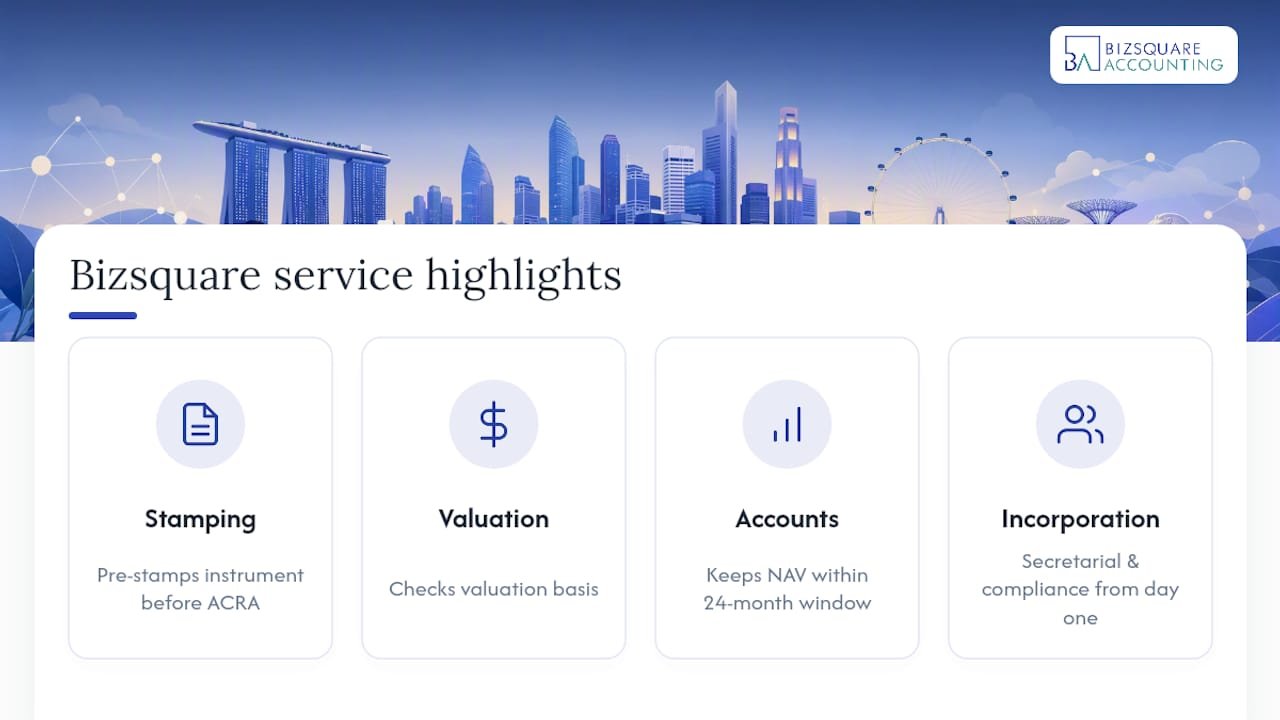
Calculating NAV correctly, tracking deadlines, and coordinating with ACRA filings takes real attention to detail. Bizsquare Accounting supports directors through each stage.
- Corporate secretarial support to prepare and lodge transfer instruments correctly.
- Valuation checks against your latest accounts to confirm NAV figures are current and defensible.
- Guidance on e-stamping and payment timing to avoid late penalties.
- Advisory input where ACD exposure or multi class share structures make the calculation complex.
Complex NAV allocations or property holding entity concerns are exactly the moments to bring in a professional before signing anything, and Bizsquare’s corporate secretarial services page has more detail on how that support works.
A director’s note on the mistakes that cost the most
The two costliest mistakes are using outdated accounts for NAV and missing the 14 day stamping deadline after signing. Both are avoidable with basic discipline.
Keep your financial statements current, build stamping into your closing checklist, and treat share transfers as a compliance event with a clock attached, not paperwork you can circle back to later. Directors who skip these steps rarely save time, they just move the problem downstream.
Get help stamping your next share transfer correctly
Bizsquare is the practical alternative to piecing this together yourself across IRAS portals, ACRA filings, and stale accounts. Rather than juggling NAV calculations and stamping deadlines alone, you get a corporate secretarial team that handles the paperwork, checks your valuation basis, and confirms your transfer instrument is properly stamped before it ever reaches ACRA.

This matters most for private companies with property exposure or multi class share structures, where a single valuation error can trigger an IRAS query months later. Bizsquare also supports the accounting side, keeping your statement of accounts current so NAV figures never fall outside the 24 month window. If you also need help getting your company set up properly from the start, our company incorporation services cover secretarial and compliance needs from day one.
Ready to get your next share transfer stamped correctly the first time? Request a compliance check or quotation from Bizsquare and let the team walk you through the calculation, the stamping, and the filing.
Sources
For readers who want to check the rules directly, IRAS publishes the core guidance on buying or acquiring shares and on the basics of stamp duty for shares, including timing and valuation examples.
- Buying or Acquiring Shares – Singapore (IRAS)
- Stamp Duties Act (SSO / Attorney-General’s Chambers)
- Singapore – Corporate – Other taxes (PwC)
FAQ
1.) Do you pay stamp duty when transferring shares?
Yes, most share transfers in Singapore attract stamp duty at 0.2% of the higher of the purchase price or the share value, unless a specific exemption or remission applies.
2.) How do you transfer shares from one person to another in Singapore?
Complete a share transfer instrument, have it signed by both parties, stamp it through IRAS e-stamping, then lodge the update with ACRA.
3.) How do you calculate share transfer stamp value for a private company?
Use the net asset value from the company’s latest accounts, provided those accounts are dated within 24 months of the transfer date.
4.) What happens if I miss the stamping deadline?
IRAS applies a penalty for late stamping, and the amount increases the longer the delay continues, though mitigation may be requested in genuine cases.
5.) Is stamp duty payable on shares listed on the Singapore Exchange?
Scripless transfers settled through SGX’s own systems are not subject to stamp duty, though off-market transfers of listed shares can still attract duty.
6.) What is Additional Conveyance Duty and how does it affect share transfers?
ACD applies when a transferred company holds significant Singapore residential property, and it can shift the stamping obligation onto the SPA rather than the transfer instrument.
7.) Can I get a refund if I overpaid stamp duty?
Yes, section 75 of the Stamp Duties Act allows a refund claim where duty was paid but later found to be incorrect or not chargeable.
8.) What accounts should I use to calculate NAV for stamp duty?
Use the company’s most recent statement of accounts, provided it is dated within 24 months of the share transfer date.
9.) Where can I pay stamp duty in Singapore?
Stamp duty is paid through IRAS e-stamping services, accessible via the MyTax portal, where the document is uploaded and duty settled online.
10.) Does Bizsquare help with share transfer compliance?
Yes, Bizsquare Accounting offers corporate secretarial support, valuation checks, and e-stamping assistance for directors managing share transfers.
11.) How long should I keep stamp duty records?
Retain payment receipts, stamp certificates, and valuation working papers for at least five years in case IRAS raises a query.


1 Comment
Directors: Singapore Share Transfer Checklist for ACRA's 14 Day Rule
September 13, 2026, at 5:40 pm[…] Stamp duty on share transfers in Singapore: rates and deadlines […]