

Directors: Singapore Share Transfer Checklist for ACRA’s 14 Day Rule
A share transfer in a Singapore private company only becomes effective once the company registers the transferee and ACRA updates the electronic register of members. Notify ACRA promptly after the transfer, using the correct instrument of transfer and board approval, and check whether IRAS stamp duty applies before you file anything.
Overview:
Share transfers only become effective once the company registers the new owner with ACRA, not upon signing or stamping the documents.
A transfer typically requires prior board approval, compliance with constitutional restrictions, and proper documentation, including the instrument of transfer and original share certificate.
Stamp duty is often applicable and must be paid before the transfer is registered, with IRAS calculating duty based on the higher of the consideration or net asset value.
The transfer should be filed within 14 days via BizFile, with errors like mismatched figures or delayed submission risking additional legal costs or penalties.
Directors should carefully review constitutional transfer clauses early and securely maintain all relevant documents to prevent disputes or refusals during registration.
Table of Contents
- What is the share transfer process in Singapore?
- What legal checks come before a share transfer?
- Which documents do you need for a share transfer?
- How do you file a share transfer with ACRA on BizFile?
- What tax rules apply to a Singapore share transfer?
- What mistakes cause share transfer problems, and how do directors avoid them?
- What can you do if a share transfer is disputed or refused?
- Bizsquare’s share transfer checklist for directors
- What Singapore directors get wrong about share transfers
- How Bizsquare keeps your share transfer compliant
- Sources
- FAQ
What is the share transfer process in Singapore?
Transferring shares in Singapore private companies follows a fixed sequence. Skipping a step, or doing them out of order, tends to cause the most common filing errors.
- Check the company constitution and any shareholders’ agreement. Look for pre-emption rights, transfer restrictions, or clauses requiring board consent before shares change hands.
- Obtain board approval. Most private companies need a board resolution approving the transfer, and directors should record this formally in the minutes.
- Prepare the instrument of transfer. This document, sometimes paired with a sale and purchase agreement, records the consideration and identifies both parties.
- Arrange stamping if the document is dutiable. IRAS requires certain share transfer documents to be e-stamped before they take full legal effect.
- Deliver the signed documents to the company. The company secretary or directors then pass a resolution to register the new shareholder.
- File the transfer with ACRA via BizFile. This step updates the electronic register of members and formally records the new ownership.
A few practical notes make this smoother:
- The transferor usually initiates the paperwork, but either party can request registration under the Companies Act.
- The company secretary typically handles the BizFile filing, since directors rarely have direct system access.
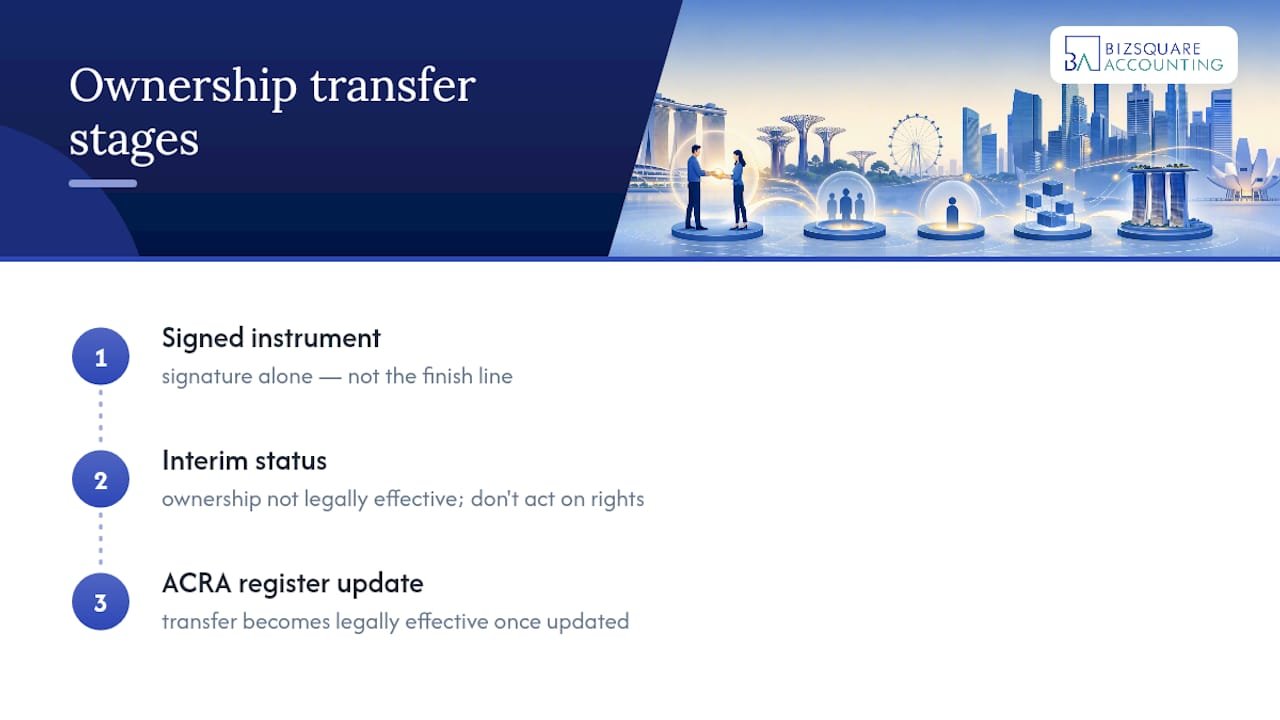
- Timing matters. The transfer only becomes legally effective when ACRA updates the register, not when the instrument is signed or stamped.
Older shareholders unfamiliar with online filing should ask their corporate secretary to walk through each screen before submitting anything. A rushed filing is harder to fix than a slow one.
What legal checks come before a share transfer?
Every private company’s constitution sets its own rules on share transfers, and these usually override generic assumptions about free transferability.
Common restrictions include a right of first refusal, requiring the seller to offer shares to existing shareholders before an outside buyer. Some constitutions also require unanimous board or shareholder consent for transfers above a certain percentage.
Before signing anything, work through these checks:
- Read the constitution’s transfer article carefully, including any pre-emption or approval clauses.
- If a right of first refusal exists, issue formal notice to other shareholders and wait out the response period stated in the constitution.
- Confirm there are no outstanding share options, unpaid calls, or nominee arrangements that complicate the transferee’s legal title.
- Check whether the shares are fully paid, since partly paid shares carry ongoing obligations that transfer with ownership.
Pro Tip: Ask your corporate secretary to pull the constitution’s transfer clause and summarise it in plain English before you start negotiating price. It saves weeks of back and forth later.
Which documents do you need for a share transfer?
A share transfer in Singapore needs a specific paper trail, and missing one document is a frequent cause of rejected or delayed filings.
- Instrument of transfer, signed by both transferor and transferee, stating the number of shares and consideration.
- Original share certificate, which the company cancels and reissues to the new holder.
- Sale and purchase agreement or proof of consideration, particularly where the price is not a simple cash figure.
- Identification documents for the transferee, needed for the company’s own know your customer checks.
- Stamp certificate from IRAS, confirming duty has been paid where the document is dutiable.
IRAS also provides Form E4A as supporting evidence for certain share transfer stampings, which some companies keep on file alongside the transfer instrument.
Stamp duty snapshot: IRAS treats share transfer instruments and sale agreements as dutiable documents in many cases, and expects e-stamping to be completed shortly after execution, not left until the ACRA filing deadline arrives. Stamping late does not usually block the transfer outright, but it can attract penalties, so treat it as a step to complete early rather than an afterthought.
How do you file a share transfer with ACRA on BizFile?
ACRA’s BizFile portal is where the transfer actually becomes legally binding, through its “Update shares information” eService.
- Log into BizFile using Singpass, either as a director or through your appointed corporate secretary.
- Select the transfer of shares transaction and enter the transferor and transferee details exactly as they appear on identification documents.
- Input the share class, number of shares, and consideration amount, matching the instrument of transfer precisely.
- Submit within 14 days of the transfer, since ACRA requires notification within this window.
- Confirm the electronic register of members updates, which is the moment the transfer becomes effective, not the filing date itself.
The most frequent mistakes involve mismatched paid-up capital figures, duplicate share certificate numbers, or entering the wrong effective date. ACRA’s own filing guidance flags that some errors cannot be fixed with a simple notice of error and instead require a costly Order of Court. Double check every figure against the instrument of transfer before you submit.
What tax rules apply to a Singapore share transfer?
IRAS treats many share transfer instruments as dutiable documents, meaning stamp duty applies before the transfer is complete in practice.
- Confirm whether your instrument of transfer or sale agreement falls under IRAS’s dutiable document rules for shares.
- Decide upfront who pays the duty. Convention places this on the buyer, but the sale agreement can allocate it differently.
- Keep the e-stamp certificate with your company records, since ACRA or auditors may ask for it during future checks.
Stamp duty snapshot: IRAS calculates duty based on the higher of consideration paid or net asset value of the shares, so a transfer priced well below net asset value does not avoid the charge.
Transfers involving complex consideration, deferred payments, or valuation disputes usually warrant a proper tax advisory conversation before signing, particularly where capital gains or related-party pricing questions arise.
What mistakes cause share transfer problems, and how do directors avoid them?
Most share transfer disputes trace back to a handful of avoidable errors, and directors carry real responsibility for catching them early.
- Filing without board approval. A transfer registered without a proper board resolution can be challenged later by other shareholders.
- Missing the pre-emption process. Skipping a required right of first refusal notice can void the transfer or trigger litigation.
- Backdating documents. ACRA does not allow the transfer date to predate the electronic register update, and attempting this creates compliance risk.
- Poor record keeping. Losing the original share certificate or resolution minutes makes later corrections far harder.
Directors should always document board consent in writing, act with reasonable care when reviewing constitutional restrictions, and keep a clean file of every signed document.
Pro Tip: Store a digital copy of every share transfer instrument, resolution, and stamp certificate in one folder. When ACRA or IRAS asks questions years later, you will need it fast.
What can you do if a share transfer is disputed or refused?
When a company or director refuses to register a transfer, the Companies Act gives shareholders a formal path to push back.
- Serve a written notice under section 128 of the Companies Act 1967, requiring the company to produce the register or explain its refusal, since this provision governs registration disputes.
- If the company still refuses, apply to the court for an order compelling registration or rectifying the register.
- Once resolved, the company must update the electronic register promptly and file the corrected transfer with ACRA.
Court applications are formal, slower than a standard filing, and typically involve legal costs that far exceed what a proper pre-transfer check would have cost.
Bizsquare’s share transfer checklist for directors
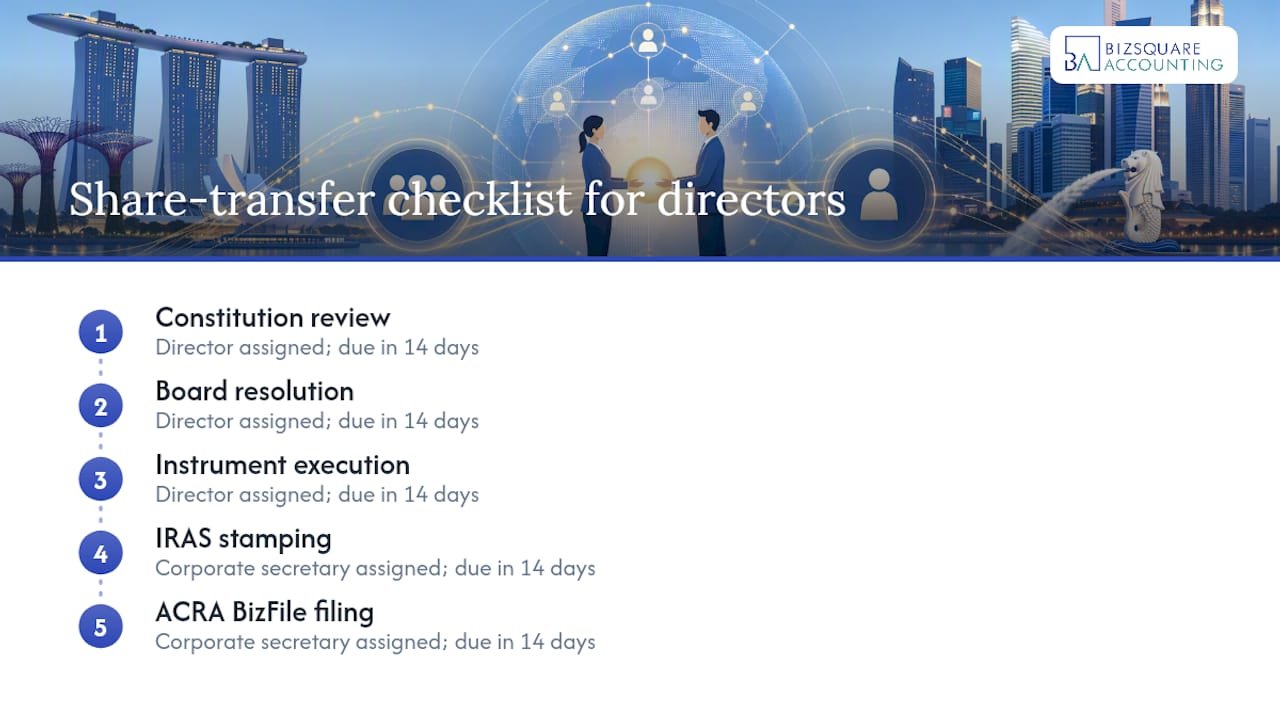
Directors should work through a simple one-page checklist covering constitution review, board resolution, instrument execution, IRAS stamping, and the ACRA BizFile filing, each assigned to a named person with a completion date.
Most companies split these tasks between the director approving the transfer and the corporate secretary handling the paperwork and filing. Setting a two-week internal deadline, matching ACRA’s own 14-day rule, keeps everyone accountable and avoids last-minute scrambling before the statutory cutoff arrives.
What Singapore directors get wrong about share transfers
The biggest misconception among Singapore directors is treating a signed instrument of transfer as the finish line. It is not. The transfer only becomes legally effective once ACRA updates the electronic register, and plenty of well-meaning shareholders have acted on ownership rights weeks before that update occurred.
Conventional advice tends to focus heavily on the paperwork itself, the instrument, the certificate, the stamp. What gets underweighted is the constitutional review at the very start. A right of first refusal clause buried in a decade-old shareholders’ agreement can unwind an entire transaction after money has already changed hands.
If there is one priority worth stressing above the rest, it is this: read the constitution before you negotiate price, not after you sign. Everything else, the BizFile filing, the stamping, the board resolution, follows naturally once that first check is done properly. Rushing straight to documentation is where most avoidable disputes begin.
How Bizsquare keeps your share transfer compliant
Getting a share transfer wrong costs far more than getting it right the first time, particularly once court orders enter the picture. A corporate secretary can check the constitution, prepare the instrument of transfer, and file it correctly on BizFile within the 14 day window.

Bizsquare’s corporate secretary services cover the full share transfer cycle, from board resolution drafting through to the ACRA filing itself. Where stamp duty applies, Bizsquare’s tax advisory team can confirm your IRAS obligations and help arrange e-stamping before deadlines slip. For companies weighing up a bigger ownership restructuring, Bizsquare’s outsourced CFO and corporate advisory service can also model the financial impact before you sign anything.
Reach out to Bizsquare’s company incorporation and secretarial team early in your transfer process. A short review call before you draft the instrument of transfer usually costs far less than fixing a rejected ACRA filing after the fact.
Sources
- Overview of share transactions | Accounting and Corporate Regulatory Authority
- Learning the basics for shares | IRAS
FAQ
1.) Can I transfer shares to another person in Singapore?
Yes, private company shareholders can transfer shares to another individual or entity, subject to any restrictions in the company’s constitution and board approval requirements.
2.) What are the rules for transfer of shares?
The transfer must follow the constitution’s rules on consent or pre-emption, be documented through a signed instrument of transfer, and be notified to ACRA within 14 days.
3.) What documents do you need for a share transfer?
You need the instrument of transfer, the original share certificate, proof of consideration such as a sale agreement or proof of consideration, and identification documents for the new shareholder.
4.) Can I transfer my shares to another person?
Yes, provided the company’s constitution permits it and any pre-emption rights held by existing shareholders have been properly waived or exhausted first.
5.) When does a share transfer legally take effect in Singapore?
A transfer takes legal effect only when the company registers the transferee and ACRA updates the electronic register of members, not on the signing date.
6.) Do I need to pay stamp duty on a share transfer?
Many share transfer instruments are dutiable under IRAS rules, and duty is usually calculated on the higher of consideration or net asset value.
7.) How long do I have to notify ACRA of a share transfer?
Companies must notify ACRA within 14 days of the transfer taking place, using the BizFile “Update shares information” eService.
8.) Who normally pays stamp duty on a share transfer?
Convention places the cost on the buyer, though the sale agreement between transferor and transferee can allocate the duty differently by mutual agreement.
9.) What happens if a company refuses to register a share transfer?
The transferor can serve a notice under section 128 of the Companies Act, and if refused, apply to the court for an order compelling registration.
10.) Can directors be held liable for share transfer filing errors?
Directors carry responsibility for proper board approval and accurate filings, and serious errors can require a costly Order of Court to correct.
11.) Does a share transfer affect existing shareholders’ voting rights?
Yes, transferring shares moves the associated voting rights and dividend entitlements to the new shareholder once the register is updated.
12.) Is the process different for public companies?
Public companies often face additional securities and disclosure obligations, while private companies rely primarily on their constitution and the Companies Act framework.
13.) What if the share certificate is lost before a transfer?
The company can issue a replacement certificate after appropriate verification, though this can add delay to the overall transfer timeline.
14.) Can Bizsquare help with the ACRA filing itself?
Yes, Bizsquare’s corporate secretarial team can prepare the instrument of transfer and complete the BizFile filing on your behalf.
15.) What is an instrument of transfer?
It is the legal document recording the sale or gift of shares, including the parties, share class, quantity, and consideration paid.