



Avoid S$25,000 Fines: Update Nominee Directors Register in Singapore
Unless your company qualifies for an exemption, you must keep a private Register of Nominee Directors and file its particulars with ACRA’s Central ROND. This applies to local companies and foreign companies registered in Singapore. Once you update your private register, you have two business days to reflect that change with ACRA, and missing this window can expose your company to penalties.
Overview:
Companies must keep an up-to-date private register of nominee directors at their registered office or in Singapore for foreign entities, and file updates within two business days of changes.
Accurate entries require detailed personal and company information, with no fields left blank, and must match the information submitted to ACRA’s Central ROND.
Filings are made through BizFile, allowing up to 50 nominators per transaction, with a recommended internal process to prevent missed deadlines.
Failure to comply can result in penalties up to S$25,000, especially if updates are late, incomplete, or the private register is stored outside Singapore.
Professional secretarial services can help maintain timely filings and proper register management, reducing compliance risk and administrative burden.
What is the register of nominee directors in Singapore?
The register of nominee directors, known as the ROND, records anyone appointed to a board who acts on the instructions of another person or entity, called the nominator. Singapore law requires most companies to keep this private register and, unless exempt, submit its details to ACRA’s Central ROND.
The rule has existed since 31 March 2017 under the Companies (Registers of Controllers, Nominee Directors, Nominee Shareholders, and Members of Foreign Companies) Regulations 2017. ACRA refreshed its guidance on 16 June 2025, tightening expectations for both local companies and foreign companies operating here. If your company incorporated after that date, your initial filing obligation begins from the date of incorporation. If your company existed before the change, you should have already completed your first filing, and any gaps need urgent attention.
Limited liability partnerships generally fall outside this specific ROND regime, since it targets companies with directors in the traditional sense. Certain entities, such as those where no nominee arrangement exists at all, can declare an exempt status to ACRA rather than filing a nil return repeatedly. You declare this exemption through the same BizFile channel used for filing, so there is no separate paper process to worry about.
What details must appear in the register of nominee directors?
Both your private register and the Central ROND filing require precise, matching particulars. Sloppy or incomplete entries are one of the most common triggers for compliance queries from ACRA, so treat this as a checklist rather than a rough guide.
For each individual nominee director, you need to record:
- Full name as it appears on their identification document
- Identification type and number (NRIC, FIN, or passport for foreign nationals)
- Residential address and nationality
- Contact details, including a reachable phone number or email
- The date they became a nominee director and, later, the date they ceased to hold that role
For each nominator, whether an individual or a corporate entity, you record:
- Full name or registered company name
- Unique Entity Number (UEN) or overseas registration number for corporate nominators
- Registered office address and jurisdiction of incorporation
- Name of the foreign registrar, where applicable, plus its identification number
- A working contact point for verification purposes
If your company genuinely has no nominee directors, you still need to make a declaration confirming this on BizFile, according to ACRA’s guidance on setting up and maintaining the ROND. Never leave a field blank when a “not applicable” declaration is what the system expects.
How do you maintain the private register correctly?
Your private ROND sits at a specific physical or digital location, and Singapore law is fairly strict about where that is. For local companies, the register stays at the registered office address. For foreign companies, it must be kept in Singapore, either at the local registered office or at the office of the corporate service provider handling your filings.
You can keep the register in hard copy or electronic form, and most corporate secretaries now prefer digital records because they are easier to update, back up, and hand over during staff changes. Whichever format you choose, treat it with the same rigour as your statutory registers of members and officers.
Here is the practical sequence to follow every time something changes:
- Update the private ROND first, the moment a nominee is appointed or ceases their role.
- Verify every particular against the nominee’s identification and the nominator’s registration documents.
- File the corresponding update with ACRA’s Central ROND within two business days of updating your private copy.
- Retain a dated internal record showing who made the update and when.
This two-step workflow, private register first and then Central ROND, creates a clean audit trail that regulators and auditors can follow, a point ACRA itself emphasises in its filing guidance.
Pro Tip: Assign one named person, whether that is your company secretary or a director, as the sole owner of ROND updates. Shared responsibility without a clear owner is how the two-business-day deadline gets missed.
How do you file nominee director details on BizFile?
Filing with ACRA runs entirely through BizFile, the government’s online eService portal, and the process is more straightforward than many directors expect once you know the sequence.
- Log in to BizFile using your Singpass or CorpPass credentials and navigate to the “Update Registers of Nominee Directors and Nominee Shareholders” eService.
- Select whether you are declaring an exempt status or proceeding with an actual nominator filing.
- Add each nominator’s particulars manually, or use the “Retrieve Information” function if the nominator holds a local UEN, which pulls registered details automatically and reduces typing errors.
- Check the transaction limit. BizFile’s instructions allow up to 50 nominators per single transaction, so larger companies with more nominee arrangements need to split filings into batches.
- Review every entry on screen before confirming submission, since amendments after filing require a fresh transaction.
- Save or print the acknowledgement page as your internal audit record.
Keep this confirmation alongside your private register entry for that nominee. It closes the loop between your internal records and what ACRA holds publicly.
What happens if you miss the ROND filing deadline?
Non-compliance carries real financial exposure. Penalties for failing to maintain or file the register can reach up to S$25,000, and repeated breaches invite closer scrutiny of your company’s overall filing history.
The most frequent mistakes company secretaries report are:
- Filing late because nobody tracked the two-business-day window
- Submitting incomplete nominator particulars, especially missing UENs for corporate nominators
- Confusing the private register update with the Central ROND filing, treating them as one step instead of two
- Foreign companies failing to store their private register physically in Singapore
Exempt companies must actively declare that status on BizFile rather than assuming silence is sufficient. If your structure changes and a nominee arrangement begins, that exemption declaration needs updating too.
What checklist keeps your nominee register filings on track?
Before filing anything, gather the nominee’s identification document, the nominator’s registration certificate or UEN, and confirmation of appointment dates. Your company secretary should sign off internally before submission, and evidence should sit in the same folder as your other statutory registers.
Typical timelines look like this: at incorporation, file within your initial deadline; when a new nominee is appointed later, update within two business days; when a nominee ceases, file the cessation just as promptly.
- Assign the company secretary or engaged CSP as the primary filer
- Keep a simple spreadsheet template logging appointment and cessation dates
- Cross-check every filing against your private register before submission
Pro Tip: Review your ROND alongside your annual return preparation. It catches gaps before they become overdue filings.
Why accurate nominee registers matter beyond compliance
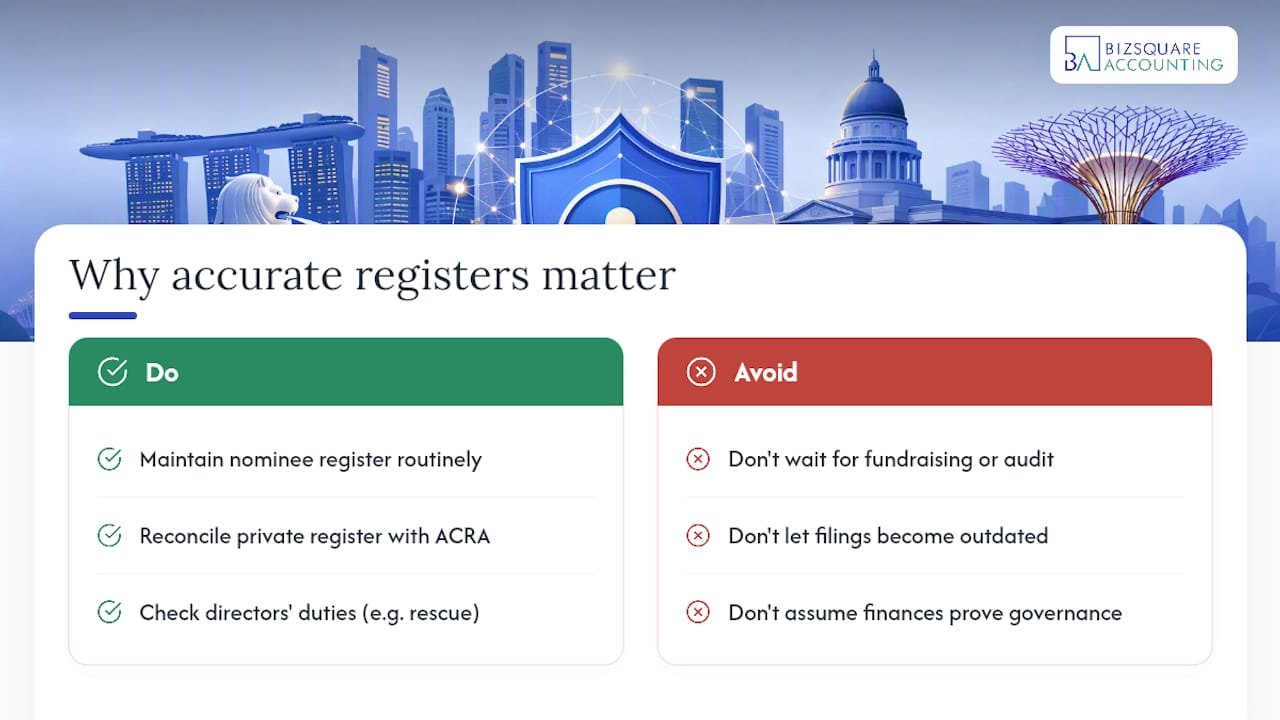
Getting the register of nominee directors right is not just a box-ticking exercise; understanding the broader context of directors’ duties, such as those outlined in the business rescue process, is also important for good governance. ACRA’s public records feed directly into how banks, investors, and business partners assess your company during due diligence, and a messy or outdated nominee filing raises questions before anyone even reads your financials.
Companies often treat ROND filing as an afterthought until a financing round or an audit forces a scramble to reconcile private registers against what ACRA holds. Companies treat ROND filing as an afterthought until a financing round or an audit forces a scramble to reconcile private registers against what ACRA holds. That mismatch is avoidable with disciplined, routine maintenance rather than reactive fixes. Good governance on paper protects your company’s standing in ways a balance sheet alone cannot.
Let Bizsquare handle your nominee register filings
Professional corporate secretarial services are an alternative to managing these filings yourself, tracking deadlines carefully. Where DIY filing means tracking two-business-day windows across every appointment and cessation, our corporate secretarial team builds that tracking into your existing compliance calendar, so nothing slips through.

Services can cover statutory register maintenance, registered office provision, and direct ACRA filings, including nominee director declarations and updates. If you are incorporating a new company, we can set up your ROND correctly from day one through our company incorporation service. If you already operate in Singapore and want ongoing peace of mind, our corporate secretary services take the filing burden off your desk entirely. Reach out to corporate secretarial service providers for a consultation to review your current register status and flag any gaps before ACRA does.
Where to check official ROND rules yourself
For the primary rules, consult ACRA’s guidance and PDF documents, the BizFile filing instructions, and the Companies Regulations 2017 on Singapore Statutes Online.
Sources
- Setting up & maintaining ROND & RONS | Accounting and Corporate Regulatory Authority
- Companies (Registers of Controllers, Nominee Directors, Nominee Shareholders, and Members of Foreign Companies) Regulations 2017
- Instruction – Update Registers of Nominee Directors and Nominee Shareholders | BizFile
FAQ
1.) What is the register of nominee directors in Singapore?
It is a private record every company must keep listing directors who act on another party’s instructions, with particulars filed to ACRA’s Central ROND unless the company is exempt.
2.) Who needs to file with ACRA’s Central ROND?
Local companies and foreign companies registered in Singapore must file, unless they qualify for an exemption and declare that status on BizFile.
3.) How long do you have to update the Central ROND after a change?
You must file the update within two business days of changing your private register, according to ACRA’s guidance.
4.) Where must the private ROND be stored?
Local companies keep it at their registered office, while foreign companies must store it in Singapore, either at the registered office or the CSP’s office.
5.) Can the private register be kept electronically?
Yes, the private ROND can be kept in hard copy or electronic form, provided it stays accessible and accurate.
6.) What penalties apply for failing to maintain the register?
Non-compliance can attract penalties of up to S$25,000, making timely and accurate filing a genuine financial priority.
7.) How many nominators can you file in one BizFile transaction?
BizFile allows up to 50 nominators per transaction, so larger batches need to be split across multiple submissions.
8.) Is a nominee director different from a regular director?
Yes, a nominee director acts on instructions from a nominator, while a regular director exercises independent judgement over company affairs.
9.) What if my company has no nominee directors at all?
You must still make a formal declaration of this on BizFile rather than leaving the filing blank or assuming no action is needed.
10.) Do exemptions need to be renewed or reconfirmed?
You should update your exemption declaration whenever your company’s nominee arrangements change, since ACRA expects an active, current status.
11.) Can Bizsquare help with existing overdue ROND filings?
Yes, Bizsquare’s corporate secretarial team can review your current register status and help bring overdue filings into compliance through our corporate secretary services.
12.) What documents should I gather before filing?
Collect the nominee’s identification document, the nominator’s registration certificate or UEN, and clear appointment or cessation dates before starting your BizFile submission.


1 Comment
Get a Compliant Nominee Director in Singapore in 1–2 Weeks
October 05, 2026, at 1:14 pm[…] are not used to compliance deadlines measured in days rather than months. Bizsquare’s guide on updating the nominee directors register covers the fines that follow a missed deadline, which can run into thousands of dollars per […]