


Corporate Secretary in Singapore: Complete Guide to Roles, Duties & Legal Requirements 2026
Most business owners don’t realize that appointing a corporate secretary in Singapore is a legal requirement, not a choice. Under Section 171 of the Companies Act, every company must appoint a corporate secretary within six months of incorporation.
This isn’t about hiring someone to answer phones or schedule meetings. A corporate secretary is a statutory officer responsible for ensuring your company complies with Singapore’s Companies Act and ACRA regulations. Think of them as the guardian of your company’s legal compliance and corporate governance framework.
Get this wrong, and you’re facing penalties that start at S$300 and escalate quickly. More importantly, you risk compliance gaps that can derail fundraising, complicate transactions, and damage your business reputation. I’ve seen companies lose investor deals because their corporate records were a mess, something that could have been prevented with proper corporate secretary services.
This guide covers everything you need to know about corporate secretary services in Singapore:
- What corporate secretaries actually do (beyond filing paperwork)
- Specific legal requirements under Singapore law
- Government regulations you must follow in 2026
- When to outsource vs hire in-house
- How to choose the right provider
If you’re a startup founder, SME owner, or foreign entrepreneur, understanding these obligations isn’t optional, it’s fundamental to operating legally in Singapore.

What Is a Corporate Secretary in Singapore? (And What It’s Not)
The term “corporate secretary” confuses people because it sounds like an administrative role. In reality, it’s a strategic position that sits at the intersection of corporate governance, regulatory compliance, and business operations. Let me explain what this role actually entails and why it matters more than you might think.
Legal Definition Under the Companies Act
A corporate secretary in Singapore is defined as a key officer of the company under Section 171 of the Companies Act (Cap. 50). This person or firm ensures your business complies with three critical areas: the Companies Act and its regulations, ACRA filing requirements, and your company’s own constitution. They’re also responsible for implementing board decisions according to corporate governance standards.
The role carries legal weight. Corporate secretaries have statutory duties that, if violated, can result in personal penalties and fines. They’re not just support staff, they’re compliance officers with real legal responsibility for keeping your company on the right side of Singapore law.
When ACRA needs to communicate with your company about compliance matters, they often go through the corporate secretary. When investors conduct due diligence, they examine the work your corporate secretary has done. When disputes arise about corporate actions or shareholding, the records your corporate secretary maintains become critical evidence.
This is fundamentally different from an administrative assistant who handles schedules and correspondence. The corporate secretary role requires deep knowledge of company law, regulatory requirements, and corporate governance principles.
What Corporate Secretaries Are NOT
Let me clear up the most common misconceptions, because understanding what this role isn’t will help you appreciate what it actually is:
| What People Think | What It Actually Is |
|---|---|
| Administrative assistant who handles scheduling | Statutory officer responsible for legal compliance |
| Optional support role | Mandatory appointment required by law |
| Someone who works once a year | Ongoing compliance officer needed year-round |
| Any employee can do it | Must meet specific eligibility requirements |
| Pure paperwork processor | Strategic advisor on governance matters |
The scheduling confusion comes from the traditional Western use of “secretary” to mean administrative assistant. In Singapore’s legal context, “corporate secretary” is a technical term referring to a compliance officer with specific statutory duties. It’s closer to a compliance manager or governance officer than what most people picture when they hear “secretary.”
Another dangerous misconception: thinking this is optional. Every single company incorporated in Singapore must have a corporate secretary. There are no exemptions based on size, revenue, or activity level. A one-person startup with S$1 paid-up capital has the same requirement as a multinational subsidiary with hundreds of employees.
The “once a year” myth is particularly costly. While annual return filing is a major task, corporate secretaries handle ongoing obligations throughout the year—director changes, share issuances, address updates, constitutional amendments. Each of these triggers specific filing requirements with tight deadlines. Companies operating on the “once a year” assumption regularly miss these deadlines and accumulate penalties.
Read also: 7 Essential Responsibilities of Corporate Secretary Services
Key Distinctions
Understanding these distinctions will help you set appropriate expectations and get maximum value from corporate secretary services in Singapore.
Administrative Tasks vs Governance Responsibilities
There’s a clear line between general administrative support and the corporate secretary’s governance role:
Administrative tasks include:
- Organizing board meeting logistics (venue, materials, attendance)
- Maintaining filing systems and document organization
- Distributing meeting materials to participants
- General office coordination
Governance responsibilities include:
- Ensuring board resolutions comply with the Companies Act
- Advising directors on their legal duties and obligations
- Filing statutory documents with ACRA within prescribed deadlines
- Maintaining accurate statutory registers that serve as legal records
- Interpreting regulatory changes and explaining implications for the board
- Documenting corporate actions properly to create valid legal records
The governance work requires legal knowledge, regulatory expertise, and understanding of corporate law principles. It’s specialized professional work, not general administrative support. This is why qualified corporate secretaries command professional fees, they’re providing expert services, not clerical assistance.
Individual Appointments vs Professional Firms
You can appoint either an individual person or a corporate secretarial firm. Each approach has distinct characteristics:
| Individual Corporate Secretary | Professional Corporate Secretarial Firm |
|---|---|
| Single person handling all responsibilities | Team-based approach with multiple specialists |
| Knowledge limited to their personal expertise and experience | Institutional knowledge accumulated across hundreds of clients |
| No backup when unavailable due to sick leave, vacation, or resignation | Continuous service regardless of individual availability |
| Lower annual cost but higher risk exposure if they make mistakes | Higher annual cost but comprehensive risk management |
| Personal relationship but potential knowledge gaps | Professional indemnity insurance coverage protecting your company |
| — | Quality control systems and multi-level review processes |
Most startups and SMEs in Singapore choose professional firms because the risk-adjusted cost is actually lower. Yes, the annual fee is higher than an individual’s salary might be, but you get insurance protection, institutional backup, and quality assurance that individuals can’t match.
The Bridge Between Directors and Regulators
This is where the corporate secretary’s strategic value becomes clear. They don’t just process paperwork, they translate between two different worlds.
Corporate secretaries perform three critical functions that protect your business:
1. Interpretation and Translation
When ACRA updates regulations or the Companies Act is amended, corporate secretaries translate what this means for your specific business structure. Regulatory language is technical and dense. Your corporate secretary interprets these requirements and explains: “Here’s what changed, here’s how it affects you, here’s what you need to do.”
For example, when Singapore enhanced beneficial ownership disclosure requirements, professional corporate secretaries immediately reviewed how this affected their clients. They identified which companies needed to update their registers, explained the new timelines, and implemented the changes. Directors didn’t need to parse through regulatory notices—their corporate secretaries handled the interpretation.
2. Compliance Monitoring and Prevention
Corporate secretaries track deadlines and obligations to prevent breaches before they occur. They maintain compliance calendars showing when filings are due, when directors’ terms expire, when AGMs must be held (if applicable). This proactive monitoring prevents the “I didn’t know it was due” scenario that leads to penalties.
Professional firms use automated systems that calculate deadlines based on your company’s specific dates and trigger reminders at 30, 14, and 7 days before due dates. This systematic approach catches things that human memory alone would miss.
3. Risk Flagging and Advisory
Experienced corporate secretaries identify potential compliance issues before directors make decisions that could create problems. This proactive advisory role saves companies from expensive mistakes.
Real example: A board proposes issuing shares to a new investor at a specific price. The corporate secretary reviews the company’s constitution and notices that existing shareholders have pre-emption rights, they must be offered the shares first at the same terms. The board wasn’t aware of this provision. By flagging it before the issuance, the corporate secretary prevented an invalid share issuance that would have created shareholder disputes and required expensive remediation.
This bridge function, connecting directors’ business decisions with regulatory requirements, is where corporate secretaries create real value beyond just filing forms.
When ACRA sends notices or requests for information, your corporate secretary handles the response and ensures proper documentation. When directors plan corporate actions, the corporate secretary advises on procedural requirements and compliance obligations. When investors or auditors request corporate records, the corporate secretary produces accurate, complete documentation.
This isn’t reactive paperwork, it’s proactive risk management that keeps your company compliant and protects directors from personal liability.
Why Companies in Singapore Should Have a Corporate Secretary
Let me be direct, you don’t have a choice. But understanding why this requirement exists, beyond just “because the law says so”, will help you see how proper corporate secretarial support actually protects and benefits your business.
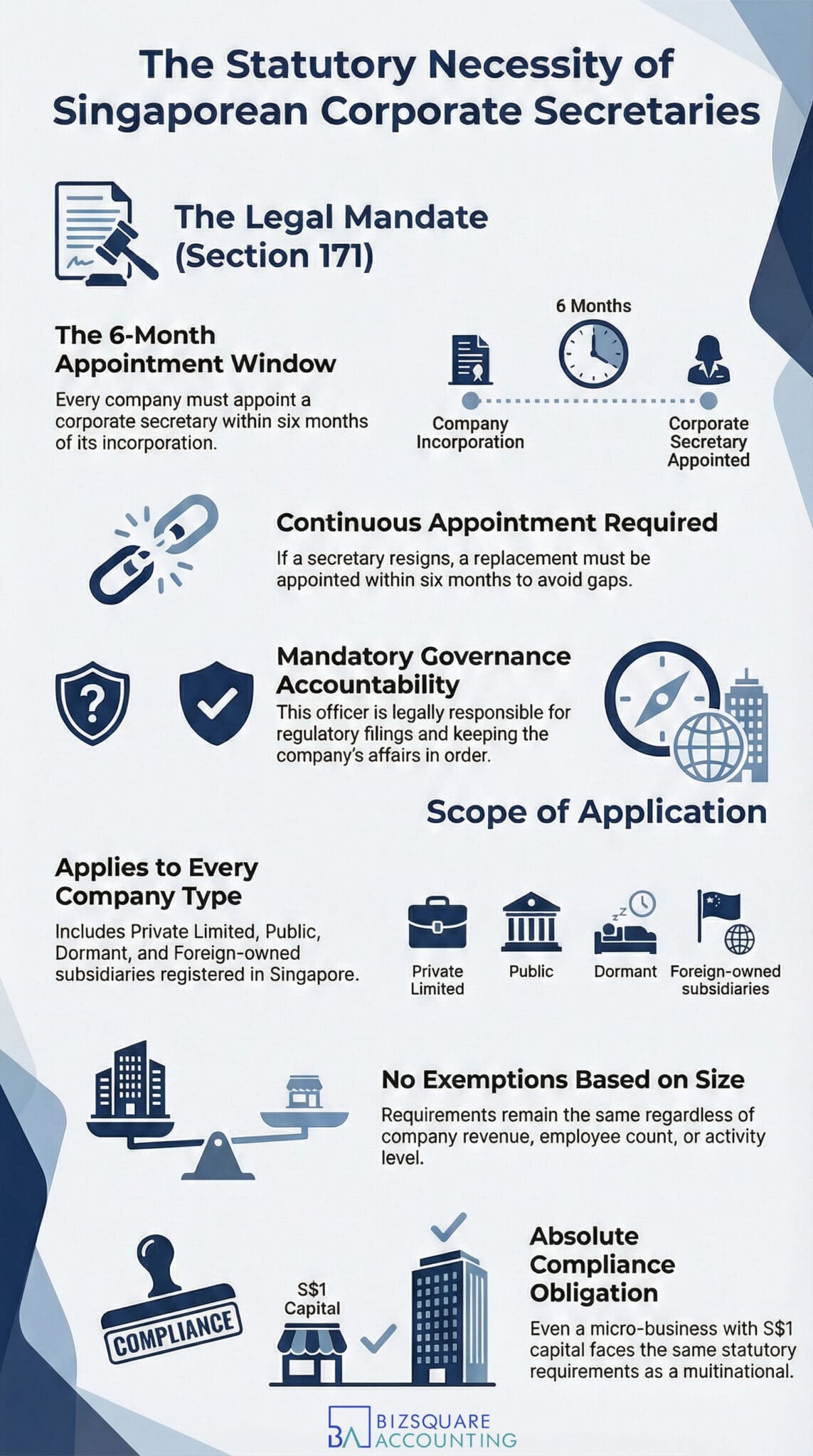
Legal Mandate: Section 171 of the Companies Act
The legal requirement is absolute and unambiguous. Section 171 of the Companies Act states clearly: every company incorporated in Singapore must appoint a corporate secretary within six months of incorporation. This isn’t a suggestion or best practice, it’s a statutory obligation that carries penalties for non-compliance.
The requirement reflects Singapore’s approach to corporate governance: companies must have designated officers responsible for regulatory compliance and proper record-keeping. This ensures there’s always someone accountable for maintaining statutory registers, filing required documents, and keeping the company’s legal affairs in order.
Statutory Requirement:
Every company must appoint a corporate secretary within 6 months of incorporation. The appointment must be continuous, you cannot operate without one at any point after that initial six-month window. If your corporate secretary resigns, you have another six months to appoint a replacement, but there must never be a gap longer than six months.
This applies to absolutely every company type:
- All private limited companies (the most common structure)
- All public companies (whether listed or unlisted)
- Exempted private companies (still need one despite other exemptions)
- Dormant companies (even if not actively trading)
- Foreign companies registered in Singapore (subsidiaries incorporated here)
No Exceptions: There are no exemptions based on company size, revenue, employee count, or activity level. A micro-business with one director and S$1 paid-up capital faces the same requirement as a multinational subsidiary with complex operations.
Legal Framework and Penalties
Singapore’s regulatory framework doesn’t just require compliance, it enforces it with specific penalties designed to ensure companies take their obligations seriously.
| Violation | Penalty | Legal Reference |
|---|---|---|
| Failure to appoint within 6 months | Up to S$5,000 fine | Section 171(1A) Companies Act |
| Operating without a corporate secretary | Daily penalties for continuing breach | Section 171(1B) Companies Act |
| Sole director acting as corporate secretary | S$5,000 fine | Section 171(1C) Companies Act |
| Appointing non-resident as secretary | S$5,000 fine | Section 171(1D) Companies Act |
These penalties apply to both the company and “every officer in default” which typically means the directors personally. This dual liability ensures directors can’t simply ignore the requirement and let the company absorb fines. Directors face personal financial consequences for compliance failures.
The “continuing breach” provision is particularly significant. If you operate without a corporate secretary for months, you’re not just facing one S$5,000 fine, you’re accumulating daily penalties that can add up to substantial amounts. ACRA takes these requirements seriously and has the authority to strike off companies that remain chronically non-compliant.

Beyond Legal Compliance: Strategic Benefits
While the legal mandate gets companies to appoint corporate secretaries, the real value comes from understanding how this role actually protects and benefits your business strategically.
1. Protection for Directors
Directors in Singapore face significant personal liability for compliance failures. The Companies Act holds directors personally accountable when companies breach regulatory requirements. A competent corporate secretary creates a protective buffer by ensuring compliance happens correctly and on time.
Here’s how corporate secretary services protect directors:
- Ensures filings happen on time: Prevents automatic penalties for late submissions
- Documents board decisions properly: Creates legal record showing directors acted with proper information and consideration
- Maintains accurate statutory records: Establishes clear evidence of company structure, ownership, and corporate actions
- Flags potential breaches before they occur: Allows directors to correct course before violations happen
- Creates documented compliance trail: Demonstrates good faith efforts if questions arise later
This documented compliance trail becomes crucial protection if directors face scrutiny from regulators, shareholders, or creditors. Proper board minutes showing what information directors considered and why they made particular decisions can shield directors from liability claims.
I’ve seen cases where directors faced shareholder lawsuits over business decisions. The companies with thorough board minutes showing the directors’ reasoning and due diligence were in far stronger positions than companies with sparse or non-existent documentation. The corporate secretary’s documentation work literally protected directors from personal liability.
2. Investor and Bank Confidence
Professional investors and banks always examine corporate governance as part of their risk assessment. They’re not just evaluating your business model and finances—they’re evaluating how well you manage your corporate affairs.
Due diligence reviews always examine these elements:
- Completeness and accuracy of statutory registers
- Quality and consistency of filed documents with ACRA
- Thoroughness of board minutes and resolutions
- Timeliness of regulatory filings (any late filing penalties?)
- Proper authorization of past corporate actions
Poor corporate secretarial records send a negative signal. When investors find missing board minutes, inaccurate registers, or late filing penalties, they question management competence. If you can’t manage basic compliance, how can they trust you to manage their capital?
Clean, professional corporate records demonstrate competence and reduce perceived risk. Investors who see well-maintained statutory registers, thorough board minutes, and zero compliance issues gain confidence that you run a tight ship. This can influence investment decisions, affect valuations, and impact the terms you’re offered.
Banks similarly view corporate governance quality as a risk indicator. When applying for credit facilities or loans, banks request certified copies of registers and board resolutions authorizing banking relationships. Clean documentation facilitates faster approvals and potentially better terms.
3. Operational Efficiency
Directors and founders should focus their time and mental energy on strategy, product development, customer acquisition, and business growth—not wrestling with regulatory compliance details.
Without proper corporate secretarial support, directors waste time on tasks that don’t drive business value:
- Calculating ACRA filing deadlines based on financial year-end dates
- Preparing board resolutions in legally compliant language
- Tracking beneficial ownership changes and register updates
- Reading through Companies Act amendments trying to understand implications
- Figuring out whether specific corporate actions require shareholder approval
This is false economy. A founder spending hours trying to draft a proper board resolution for share issuance isn’t creating customer value or driving revenue. That time costs far more in opportunity cost than professional corporate secretary fees would.
Delegating corporate secretarial work to qualified specialists frees up management time for revenue-generating activities. Your time is better spent talking to customers, improving your product, and growing your business, not trying to interpret Section 161 of the Companies Act.
4. Risk Mitigation
Proper corporate secretarial support prevents problems that cost far more than the service fees:
- Late filing penalties: Starting at S$300 but escalating for repeat violations or chronic non-compliance. Professional corporate secretaries track deadlines systematically and ensure filings happen on time.
- Invalid corporate actions due to procedural errors: If you issue shares without following required procedures (like obtaining necessary shareholder approvals), the issuance may be void. This creates shareholder disputes, requires expensive legal work to remediate, and can derail transactions. Corporate secretaries ensure procedures are followed correctly the first time.
- Disputes over share ownership: Inaccurate statutory registers create ambiguity about who owns what percentage of the company. This leads to shareholder conflicts that can paralyze the business. Properly maintained registers establish clear, legally recognized records of ownership.
- Transaction delays due to incomplete documentation: During fundraising or M&A, incomplete corporate records cause delays while you scramble to recreate missing documents. Time-sensitive deals can fall apart during these delays. Corporate secretaries maintain complete documentation that makes due diligence smooth and fast.
- ACRA enforcement actions: Chronic non-compliance can trigger enhanced monitoring, audits, or even strike-off proceedings. Companies struck off by ACRA face complex and expensive restoration procedures. Corporate secretaries keep you in good standing with regulators.
The cost of fixing these problems always exceeds the cost of prevention. I’ve watched companies spend S$15,000-30,000 in legal fees cleaning up years of incomplete corporate records before a fundraising round. That’s 5-10 years’ worth of professional corporate secretary fees spent in a few months fixing preventable problems.
5. Scalability for Growth
As companies grow, compliance complexity increases exponentially. What works for a two-person startup doesn’t scale to a 50-person company with investors, employee share options, and multiple entities.
Growth brings increased compliance demands:
- More frequent board meetings requiring proper documentation
- Share issuances and transfers as you raise funds and grant ESOPs
- Director changes as you build out the board
- Constitutional amendments to accommodate new governance structures
- Group structures requiring coordinated compliance across entities
A competent corporate secretary scales with your business needs. Professional firms can adjust service levels as your requirements grow, providing basic compliance for early-stage companies and comprehensive support for scale-ups.
This scalability prevents the scramble of trying to hire specialized staff during rapid growth phases. Your corporate secretary grows their support as your company grows, maintaining continuity and institutional knowledge throughout your journey.
What Happens Without Proper Corporate Secretarial Support
Let me share some real patterns I’ve observed when companies try to cut corners or handle corporate secretarial work with unqualified people:
Fundraising delays and complications:
Investor due diligence reveals missing or incomplete board minutes documenting past decisions. Statutory registers don’t match actual shareholding because transfers weren’t recorded properly. Resolution language doesn’t properly authorize share issuances, creating questions about whether they’re legally valid.
The company wastes 2-4 weeks during a time-sensitive funding round fixing records and recreating documentation. Sometimes investors reduce their valuation or walk away entirely when they see governance sloppiness.
M&A transaction problems:
A potential acquirer’s lawyers review corporate records and find gaps, inconsistencies, and missing documentation. The purchase price gets reduced to account for remediation costs and risk. The deal timeline extends while lawyers work through issues, sometimes causing the transaction to fall apart.
Legal fees spike as both sides spend time resolving corporate governance problems that should never have existed. What could have been a clean transaction becomes expensive and contentious.
Banking difficulties:
Banks request certified copies of registers and board resolutions for facility approvals. The company can’t produce accurate, current documents. Credit decisions get delayed while records are corrected.
Banks view governance problems as management risk and may require personal guarantees from directors or offer less favorable terms than they would to well-governed companies.
ACRA enforcement:
Companies face automatic late filing penalties when they miss deadlines. ACRA places them on enhanced monitoring lists for chronic non-compliance. In serious cases, ACRA initiates strike-off proceedings, forcing expensive restoration procedures.
Directors face personal fines and potential disqualification from serving on boards. The reputational damage affects future business opportunities.
The cost of fixing these problems always exceeds the cost of doing it right from the start. Professional corporate secretary services in Singapore typically cost S$2,000-5,000 annually for SMEs. Compare that to S$15,000-30,000 in remediation fees, or lost deals worth hundreds of thousands or millions.
Key Roles and Responsibilities of Corporate Secretaries in 2026
Corporate secretaries handle a surprisingly broad range of responsibilities that go well beyond the “filing annual returns” that most people imagine. Understanding these roles helps you appreciate why qualified professionals are worth their fees and why trying to cut corners creates risk.

Statutory Registers and Records Management
Every company in Singapore must maintain specific registers documenting ownership, governance, and corporate structure. These aren’t optional or administrative nice-to-haves, they’re legal records that ACRA can demand to inspect and that serve as official evidence in disputes or transactions.
Corporate secretaries are responsible for creating, maintaining, and updating these mandatory registers under the Companies Act. The registers must be accurate, current, and available for inspection when required by law.
Mandatory Registers Required by Law:
| Register | Required Information | Update Frequency |
|---|---|---|
| Register of Members | Shareholder names, addresses, share numbers, share classes, dates of becoming/ceasing membership | Within 14 days of any change |
| Register of Directors | Director names, addresses, nationalities, identification numbers, appointment dates | Within 14 days of any change |
| Register of Secretaries | Secretary name/firm details, address, appointment date | Within 14 days of any change |
| Register of Controllers | Beneficial owners, controllers, significant shareholders (>5%) | Within 2 days of knowledge of change |
| Register of Charges | Details of mortgages, charges over company assets | Within 30 days of charge creation |
| Register of Nominee Directors | Directors appointed as nominees, nominators | Within 14 days of any change |
Each register has specific information requirements and update deadlines. The tight timeframes (often just 14 days) mean corporate secretaries must track changes systematically and update registers promptly.
The Register of Members, for instance, must show every shareholder’s complete details: full legal name, residential or business address, number of shares held, class of shares, date they became a member, and date they ceased to be a member if applicable. When shares are transferred, the corporate secretary updates this register to reflect the new ownership, ensures the transfer is properly documented, and verifies the transaction was authorized according to the company’s constitution.
Miss something here, and you create ambiguity about who actually owns shares in your company. During fundraising or disputes, these registers serve as the official legal record. Inaccuracies can derail transactions or create shareholder conflicts that take months and significant legal fees to resolve.
Digital Record-Keeping Requirements (2026):
Singapore law now permits electronic registers, but this doesn’t mean you can just keep information in random Excel files. The Electronic Transactions Act and Companies Act specify requirements for electronic records:
- Registers may be kept electronically under Section 395 of the Companies Act
- Must be accessible and producible in legible form when required by ACRA or authorized parties
- Backup systems required to prevent data loss or corruption
- Electronic signatures are acceptable for resolutions under the Electronic Transactions Act
- Records must be secured against unauthorized access or tampering
Professional corporate secretaries use specialized compliance software that maintains registers in formats that satisfy legal requirements while providing easy access and robust security.
Inspection Rights and Production:
Certain registers must be available for inspection by members and, in some cases, the public. The register of members and register of controllers can be inspected by shareholders. ACRA can demand production of any register at any time for inspection or investigation.
Failure to produce registers when legally required: fine up to S$5,000 and potential prosecution of directors. This isn’t theoretical, ACRA exercises these inspection rights regularly, and companies unable to produce accurate registers face immediate compliance issues.
ACRA Filing Obligations and Deadlines
The Accounting and Corporate Regulatory Authority (ACRA) is Singapore’s business and company registration authority. Corporate secretaries manage all interactions with ACRA, including regular annual filings and event-triggered submissions when specific corporate actions occur.
The filing requirements are extensive, specific, and carry tight deadlines. Missing deadlines triggers automatic penalties, and chronic non-compliance can result in the company being struck off the register.
Annual Filing Requirements:
Every year, companies must file their annual return with ACRA. This comprehensive document includes information about the company’s structure, financial position, directors, shareholders, and more.
| Filing | Deadline | Penalty for Late Filing |
|---|---|---|
| Annual Return | Within 7 months of financial year end (AGM exemption) or 1 month after AGM | S$300 late filing fee; company may be struck off |
| Financial Statements | Within 7 months of financial year end (with Annual Return) | Same as Annual Return |
| AGM Minutes (if held) | Within 1 month of AGM | Prosecutable offence |
Most private companies in Singapore now benefit from the AGM exemption, meaning they don’t need to hold Annual General Meetings unless shareholders require one. This simplifies compliance, but the annual return still must be filed within 7 months of the financial year end.
The S$300 late filing penalty applies automatically the day after your deadline passes. No warning, no grace period, ACRA’s systems assess the penalty immediately. If you remain non-compliant for extended periods, ACRA can issue notices warning of strike-off, and eventually dissolve the company if filings aren’t brought current.
Professional corporate secretaries track these deadlines based on each client’s specific financial year end, send advance reminders, and ensure filings happen with time to spare.
Read also: Guide to Income and Corporate Tax Filing in Singapore (2026)
Event-Based Filings (Must File Within Specified Time):
Beyond annual requirements, specific corporate events trigger immediate filing obligations. These can occur at any time during the year, and each has its own deadline for notification to ACRA.
| Event | Filing Deadline | Form Required |
|---|---|---|
| Appointment of director | 14 days | Form 45 |
| Resignation of director | 14 days | Form 45 |
| Change of director particulars | 14 days | Form 45 |
| Appointment/change of secretary | 14 days | Form 49 |
| Change in registered office address | 14 days | Form 6 |
| Allotment of shares | 1 month | Form 14 |
| Change in share capital | 14 days | Form 8 |
| Alteration of constitution | 14 days | Form 28 |
| Creation of charge | 30 days | Form 62 |
| Change in controllers/beneficial owners | 2 days (to update register), then annual return | Recorded in Register of Controllers |
These deadlines are strict. If you appoint a new director on January 15th, the Form 45 must be filed by January 29th, just 14 days later. Companies that don’t track these obligations miss deadlines and accumulate penalties.
Corporate secretary in Singapore maintain systems to ensure events are captured and filings submitted within required timeframes. When a board appoints a new director, the corporate secretary immediately schedules the Form 45 filing, prepares the necessary documentation, obtains the director’s consent, and submits to ACRA, all within the 14-day window.
2026 Regulatory Updates:
ACRA has significantly enhanced its monitoring and enforcement capabilities using digital systems and automation. The regulatory environment has evolved:
- Automated deadline tracking systems: ACRA’s systems know every company’s deadlines and flag late filings instantly
- Immediate penalty assessment: Penalties are assessed automatically without human review or discretion
- Risk-based compliance reviews: ACRA uses data analytics to identify companies with poor compliance patterns for enhanced scrutiny
- Increased enforcement actions: More aggressive pursuit of chronic non-compliers, including faster strike-off proceedings
The days of “flying under the radar” are over. ACRA’s automated systems catch everything, regardless of company size. Small companies face the same monitoring and enforcement as large ones.
Board Resolutions and Minutes Preparation
Every company must maintain proper records of board meetings and decisions. This isn’t just good practice, it’s a legal requirement under Sections 188 and 189 of the Companies Act. A corporate secretary in Singapore is responsible for creating and maintaining these critical governance documents.
Legal Requirements:
The Companies Act mandates that every company must maintain minutes of:
- Board meetings (Section 188): Meetings where directors gather to make decisions
- Directors’ resolutions in writing (Section 184A): Written resolutions signed by all directors instead of holding meetings
- General meetings (Section 189): Meetings of shareholders, including AGMs if held
These minutes serve multiple purposes: legal record of decisions made, evidence of directors’ due diligence and reasoning, protection for directors if decisions are later questioned, and documentation required for audits and due diligence.
What Proper Minutes Must Include:
Corporate secretaries prepare minutes that contain all legally required elements:
✓ Date, time, and location of meeting
✓ Names of directors present and those absent
✓ Declaration of quorum (confirming enough directors present for valid meeting)
✓ Matters discussed and specific decisions made
✓ Dissenting votes recorded if any director voted against a resolution
✓ Director declarations of interest in any transactions being considered
✓ Signatures of chairperson and/or directors as required
The quality and completeness of minutes matter. Sparse minutes that just say “Board approved share issuance” provide little protection if that decision is later challenged. Detailed minutes showing what information the board reviewed, what concerns were raised, and what reasoning supported the decision demonstrate proper care and diligence.
Common Types of Board Resolutions:
Corporate secretaries prepare different types of resolutions for different corporate actions:
| Resolution Type | When Required | Filing Needed? |
|---|---|---|
| Appointment of directors | Filling board vacancies | Yes – Form 45 within 14 days |
| Director resignation | Director departing | Yes – Form 45 within 14 days |
| Share allotment | Issuing new shares | Yes – Form 14 within 1 month |
| Dividend declaration | Distributing profits | No – internal record |
| Approval of financial statements | Annual accounts approval | No – but submitted with Annual Return |
| Related party transactions | Transactions with directors/connected persons | No – but must be documented |
| Constitution amendments | Changing company constitution | Yes – Form 28 within 14 days |
| Opening bank accounts | New banking facilities | No – but bank requires certified copy |
Each resolution type has specific language requirements and procedural considerations. Corporate secretaries ensure resolutions are drafted properly, comply with the company’s constitution, and satisfy legal requirements for authorization.
Written Resolutions vs Meeting Resolutions:
Singapore law allows companies to use written resolutions as an alternative to physical board meetings. This is particularly practical for small companies where directors may not need to meet in person for routine decisions.
Companies can use written resolutions instead of meetings if:
- All directors entitled to vote sign the resolution
- The resolution clearly states it’s a written resolution under Section 184A
- The resolution is filed with the company’s meeting minutes for record-keeping
This streamlines governance for routine matters like approving standard contracts, authorizing business registrations, or opening bank accounts. Directors can review and sign resolutions electronically without scheduling a physical meeting.
Corporate secretaries prepare written resolutions with proper legal language, circulate them to all directors for signature, track responses, and file the executed resolutions in the minute book once complete.
Corporate Secretary’s Role:
The corporate secretary responsibilities in this area go beyond just taking notes:
- Draft resolutions in legally compliant language: Using precise wording that clearly authorizes intended actions
- Ensure resolutions align with company constitution: Verifying that proposed actions don’t violate constitutional restrictions
- Verify proper authorization and quorum requirements: Confirming the right people are approving decisions
- Document decisions accurately: Creating clear records that withstand scrutiny
- File necessary forms with ACRA when required: Submitting required notifications within deadlines
- Maintain organized minute books: Keeping all governance documents accessible for inspection or audit
Professional corporate secretary in Singapore use template libraries with pre-approved language for common resolutions, adapted to each client’s specific circumstances. This ensures consistency, accuracy, and compliance while maintaining efficiency.
Advisory on Governance and Compliance
Beyond executing administrative tasks, experienced corporate secretaries serve as governance advisors to the board. This advisory function often creates more value than the filing work, because it prevents expensive mistakes before they happen.

Director Duties Under Companies Act:
Directors in Singapore have specific statutory duties defined in the Companies Act. Corporate secretaries help directors understand and fulfill these obligations:
- Duty of care and diligence (Section 157): Directors must exercise reasonable diligence in discharging their duties. This means making informed decisions, staying aware of the company’s business, and actively participating in governance.
- Duty to act in good faith (Section 157): Directors must act in the company’s best interests, not their personal interests. Decisions should benefit the company, not individual directors.
- Duty to avoid conflicts of interest (Section 156): Directors must declare any personal interest in transactions the company enters. For example, if a director owns property the company wants to purchase, they must disclose this interest.
- Duty not to misuse position (Section 157): Directors cannot use their position for personal gain or advantage. Insider trading, diverting business opportunities, or benefiting at the company’s expense violate this duty.
- Duty not to misuse information (Section 157): Directors cannot misuse confidential company information for personal benefit or to harm the company.
Corporate secretaries advise directors on these duties in practical situations, helping them navigate potential conflicts and ensure they’re meeting their legal obligations.
Practical Advisory Examples:
Let me illustrate how corporate secretaries provide valuable advisory input with real scenarios:
Share Issuance Advisory:
Directors propose issuing shares to a new investor to raise capital. Without proper advice, they might simply draft a quick resolution and proceed. An experienced corporate secretary advises on the complete requirements:
- Board resolution required authorizing the issuance
- Constitution check: Does it allow this share class? Are there restrictions on who can hold shares?
- Pre-emption rights: Must existing shareholders be offered shares first before outside investors?
- Pricing considerations: Is the price fair and justified by valuation?
- Form 14 filing required within 1 month of issuance
- Register of members must be updated to reflect new shareholding
- Share certificates prepared and issued to the investor
By ensuring all these steps are completed correctly, the corporate secretary helps the company execute a legally valid share issuance that won’t create problems during future fundraising or exits.
Related Party Transaction Guidance:
A director wants the company to purchase property they personally own. This is a related party transaction requiring special handling:
- Director must declare their interest under Section 156 before the board considers the transaction
- Interested director may not vote on the resolution approving the purchase
- Transaction must be on arm’s length terms (fair market value)
- Documentation needed to evidence fair value (appraisals, comparable sales)
- May require shareholder approval depending on the company’s constitution and transaction size
The corporate secretary flags all these requirements, helps the board navigate the procedural requirements, and ensures proper documentation. Without this guidance, the company might enter an improperly authorized transaction that could be challenged later.
Constitutional Amendment Process:
The company wants to change its authorized share capital or add a new class of shares. The corporate secretary advises on the complete process:
- Special resolution required (75% shareholder vote, not just simple majority)
- Notice period: At least 21 days’ notice for the general meeting where shareholders will vote
- Form 28 filing within 14 days after the resolution is passed
- Updated constitution must be filed with ACRA along with Form 28
Many directors don’t realize that constitutional amendments require special resolutions and shareholder approval, they can’t just be done by board decision. The corporate secretary’s advisory prevents the company from attempting invalid amendments that would need to be redone.
Managing Corporate Actions
Corporate actions, changes to company structure, ownership, or governance, require careful execution following specific legal procedures. Corporate secretaries coordinate these actions from planning through completion, ensuring all requirements are met.
Common Corporate Actions Requiring Secretarial Support:
1. Share Allotment and Transfers
Issuing new shares (allotment) and transferring existing shares between parties both require proper documentation and procedures:
Process for issuing new shares:
- Board resolution authorizing allotment (specifying number, class, price, recipients)
- Verify constitution permits this allotment and check for any restrictions
- Prepare share certificates evidencing the newly issued shares
- Update register of members with new shareholders and shareholding
- File Form 14 with ACRA within 1 month of allotment
- Notify controllers if shareholding thresholds crossed (5% or more)
Process for share transfers:
- Transfer instrument executed by transferor and transferee
- Board approves transfer if constitution requires such approval
- Update register of members to reflect new ownership
- Issue new share certificates to transferee
- No ACRA filing required for straightforward transfers (unless it’s a buyback)
Corporate secretaries coordinate all these steps, prepare documentation, track deadlines, and ensure nothing is missed. Errors in share allotments can create disputes about ownership that take months to resolve.
2. Share Capital Changes
Companies sometimes need to change their share capital structure. Different types of capital changes have different requirements:
| Change Type | Requirements | ACRA Form |
|---|---|---|
| Increase in authorized capital | Special resolution; file within 14 days | Form 8 |
| Reduction of capital | Court approval; creditor notification | Form 8 |
| Share consolidation | Special resolution | Form 8 |
| Share subdivision | Special resolution | Form 8 |
| Share buyback | Solvency declaration; specific procedures | Form 14A |
Each of these requires shareholder approval (typically special resolution with 75% vote) and ACRA filing within specified deadlines. Share buybacks have particularly complex requirements including solvency declarations and restrictions on when shares can be repurchased.
Corporate secretaries manage the entire process: drafting resolutions, convening shareholder meetings, preparing required declarations, filing forms, and updating registers.
3. Director and Shareholder Changes
When directors join or leave the board, specific procedures must be followed:
Director appointments require:
- Board resolution or shareholder resolution appointing the new director
- Director consent to act (written confirmation they accept the position)
- Declaration of non-disqualification (confirming they’re not bankrupt, not underage, etc.)
- Verification of eligibility (ordinarily resident in Singapore if a local director)
- Form 45 filing within 14 days of appointment
Director resignations require:
- Written resignation letter from the departing director
- Board acknowledgment of the resignation
- Update to register of directors
- Form 45 filing within 14 days of the effective resignation date
Corporate secretaries handle the paperwork, ensure proper documentation, track the 14-day filing deadline, and update all relevant registers.
4. Constitutional Amendments
The company’s constitution sets the rules for how it operates. Amendments require specific procedures:
Process:
- Draft proposed amendments clearly showing changes
- Special resolution at general meeting (75% shareholder approval required)
- File Form 28 within 14 days after the resolution is passed
- Submit updated constitution to ACRA showing all amendments
- Update company’s internal records with amended constitution
Constitutional amendments often occur when companies need to create new share classes, change voting rights, alter director powers, or modify procedures for future amendments.
5. Company Name Changes
Changing a company’s registered name involves regulatory approval and widespread updates:
Requirements:
- Special resolution approving the new name
- ACRA name availability check (ensuring name isn’t already taken or restricted)
- File Form 19 with S$50 fee
- Update all company documents, registers, and records
- Notify banks, vendors, clients, and other business relationships
Corporate secretaries coordinate name changes, handle ACRA submissions, and help companies update their documentation and business relationships.
Digitalization and BizFile+ Integration
Singapore’s corporate compliance has moved almost entirely to digital platforms. ACRA’s BizFile+ system handles all electronic filing, and corporate secretaries must navigate this digital environment efficiently.
BizFile+ Platform (2026):
ACRA’s electronic filing platform has specific requirements and features that corporate secretaries must master:
- CorpPass login required for all company filings (Singapore’s corporate digital identity system)
- Digital signatures for authorized persons submitting filings
- Electronic document submission in PDF format with specific formatting requirements
- Online payment for filing fees via internet banking or credit card
Corporate secretaries maintain CorpPass access for clients, ensure they’re authorized to file on the company’s behalf, and manage the technical aspects of electronic submission.
Corporate Secretary Responsibilities in Digital Filing:
✓ Maintain updated CorpPass authorization for filing access
✓ Ensure documents meet digital submission requirements (correct format, readable, complete)
✓ Track submission confirmations and reference numbers for all filings
✓ Download filed documents for company records (ACRA doesn’t mail physical copies)
✓ Monitor ACRA portal for notices, requests, and communications
Professional firms have integrated their internal systems with ACRA’s platform, allowing streamlined filing directly from their compliance software into BizFile+.
Automated Compliance Monitoring:
Professional corporate secretarial firms use sophisticated systems that go well beyond what individual appointees can manage:
- Calculate and track all filing deadlines automatically based on each client’s specific dates
- Send reminders 30/14/7 days before deadlines via email to both the corporate secretary team and the client
- Flag overdue items immediately if deadlines are approaching or missed
- Generate compliance reports showing filing status for all obligations
- Integrate with ACRA for real-time status updates on submitted filings
These systems prevent human error, the “I forgot about that deadline” problem that leads to penalties. Automation ensures nothing slips through the cracks even when dealing with hundreds of clients.
Read also: Complete Guide to Filing Corporate Tax in Singapore
Why Accuracy Matters More in 2026
The digital filing environment has fundamentally changed the stakes for accuracy:
- Submissions are instant, there’s no manual review before filing happens. Once you click submit, it’s filed immediately with ACRA. You can’t catch errors in a manual review process because there isn’t one.
- Errors are published immediately on the public record. If you file incorrect information, it’s visible to anyone searching the company’s ACRA profile right away.
- Corrections require amendment filings and additional fees. You can’t just quietly fix mistakes, you need to file formal amendments, which take time and money.
- ACRA’s automated systems flag inconsistencies faster. Data analytics compare your filing against previous submissions and other government databases, identifying discrepancies that trigger review.
- Penalties trigger automatically without human intervention. Late filings generate penalty assessments instantly, there’s no person to appeal to for understanding.
This is why professional corporate secretaries implement multi-level checking procedures before anything gets submitted. One person prepares the filing, another reviews it, and a senior professional approves it before submission. This catches errors that solo practitioners or unqualified staff would miss.
Legal Obligations: What Singapore Companies Must Know
Understanding your legal obligations isn’t optional, it’s fundamental to operating a company in Singapore. The Companies Act creates specific requirements that every director must know, and penalties for non-compliance are real and enforced.
Statutory Appointment Requirements
The law is crystal clear about corporate secretary appointments. There’s no ambiguity, no room for interpretation, and no exemptions based on company size or circumstances.
Section 171(1) Companies Act states:
“Every company shall have a secretary and, in the case of a company with more than one director, shall have a secretary who is not the sole director of the company.”
This single sentence creates several specific obligations. Every company must have a corporate secretary at all times (after the initial 6-month grace period). If the company has more than one director, the corporate secretary cannot be one of those directors. For companies with a sole director, that director cannot simultaneously serve as corporate secretary, they must appoint someone else.
Timeline Requirements:
The law provides a brief window for new companies to get organized, but after that, continuous compliance is mandatory:
| Company Type | Appointment Deadline |
|---|---|
| Newly incorporated company | Within 6 months of incorporation |
| Existing company (secretary vacancy) | Within 6 months of vacancy occurring |
If your corporate secretary resigns, you don’t get to operate indefinitely without one. The six-month clock starts the day the vacancy occurs, and you must fill the position within that window.
Penalties for Non-Appointment:
The Companies Act doesn’t just create obligations, it enforces them with specific penalties designed to ensure compliance:
- Company and every officer in default: Fine up to S$5,000
- Continuing offence: Daily penalties for each day the breach continues
- ACRA enforcement: May initiate strike-off proceedings for chronic non-compliance
The “every officer in default” language means directors personally face fines, not just the company. This dual liability ensures directors can’t simply ignore the requirement and let the company absorb penalties.
The “continuing offence” provision is particularly significant. If you operate without a corporate secretary for three months, you’re not just facing one S$5,000 fine. You’re potentially facing daily penalties that accumulate over those 90+ days, creating substantial financial liability.
ACRA takes these requirements seriously. Companies that remain non-compliant despite notices may face administrative strike-off, dissolving the company and potentially creating personal liability for directors for debts incurred before dissolution.
Eligibility and Qualification Requirements
Not just anyone can serve as a corporate secretary in Singapore. The law specifies eligibility criteria designed to ensure corporate secretaries have appropriate connection to Singapore and competence to perform the role.
Mandatory Requirements (Section 171):
✓ Ordinarily resident in Singapore: This is more than just having an address here. “Ordinarily resident” means the person physically lives in Singapore as their primary home. They must have genuine residential connection to Singapore, not be temporary visitors or tourists. Employment Pass or S Pass holders who genuinely reside in Singapore can qualify. People who maintain their primary residence overseas and just visit Singapore occasionally do not qualify.
✓ Natural person or qualified corporate entity: The corporate secretary can be either an individual person or a company (corporate secretarial firm) licensed to provide these services. Firms must be registered with ACRA and have proper business licenses.
✓ Not the sole director: If the company has only one director, that director cannot also serve as the corporate secretary. This requirement ensures separation of duties and independent oversight.
✓ Not under disqualification: The person cannot be an undischarged bankrupt or someone disqualified from serving as a director. Disqualification typically results from serious compliance breaches, criminal convictions related to business conduct, or court orders.
These eligibility requirements are verified by ACRA when appointments are filed. Filings that don’t satisfy these criteria are rejected, and companies must correct the issue before the appointment can be processed.
Professional Qualifications (Not Legally Required But Recommended):
While Singapore law doesn’t mandate specific professional qualifications for corporate secretaries, practical competence matters. Look for:
- ICSA qualification: Institute of Chartered Secretaries and Administrators certification demonstrates specialized corporate governance knowledge
- Relevant degree: Law, accounting, or business administration education provides helpful foundation
- Substantial experience with Singapore Companies Act and corporate governance
- Professional membership: Belonging to bodies like SCSA (Singapore Chartered Secretaries Association) or ICSA Singapore indicates commitment to professional standards
Corporate secretarial work requires technical legal knowledge and regulatory expertise. While anyone meeting the basic eligibility criteria can legally be appointed, competent performance requires actual knowledge and experience.
Public Companies – Additional Requirements:
For public companies and subsidiaries of public companies, Singapore imposes higher standards:
Section 171(1E) requirements:
- Secretary must be a “qualified person” with prescribed knowledge and experience
- Typically requires professional certification (ICSA or equivalent) or relevant degree
- Higher standards reflect greater regulatory obligations and governance complexity
Most public companies and larger organizations engage professional corporate secretarial firms rather than individual appointees, ensuring they have appropriate expertise and resources.
Restrictions: Sole Director Cannot Be Secretary
This restriction trips up many solo founders who want to minimize costs by serving in all roles themselves. The law explicitly prohibits it.
Section 171(1C) Companies Act:
A company with only one director cannot appoint that director as the company secretary. The positions must be held by different people or entities.
Why This Rule Exists:
The restriction serves important governance purposes:
- Ensures separation of duties between decision-making (directors) and compliance oversight (corporate secretary)
- Prevents concentration of all statutory powers in a single person
- Requires independent verification of compliance by someone other than the sole decision-maker
- Creates checks and balances even in smallest companies
The corporate secretary role includes advising directors on their duties and ensuring compliance with company law. If the director and corporate secretary are the same person, there’s no independent oversight or advisory function.
Compliance Solutions for Sole Directors:
If you’re the only director of your company, you must choose one of these options:
- Option 1: Appoint another individual as corporate secretary (must be ordinarily resident in Singapore and meet eligibility requirements)
- Option 2: Engage a professional corporate secretarial firm (they qualify as ordinarily resident entities)
- Option 3: Appoint a second director (then one director could serve as secretary, though this is still not recommended for governance reasons)
Most solo founders choose Option 2, engaging a professional firm. This provides expertise and compliance support without the commitment of hiring an employee or bringing on a co-director.
Common Violation:
Solo founders often try to list themselves as both director and corporate secretary during incorporation. ACRA’s system automatically rejects these filings for single-director companies. You must have a different person or entity serving as corporate secretary before ACRA will process your incorporation.
Director Liability and Responsibility
Here’s what many directors don’t fully appreciate: you remain personally liable for compliance failures even when you’ve outsourced corporate secretarial functions to professionals. Delegation of tasks doesn’t eliminate director responsibility.
Key Legal Principle:
Directors cannot delegate their statutory duties, only the execution of tasks. You can hire someone to perform corporate secretarial work, but you remain accountable for ensuring it’s done properly.
Section 199 Companies Act – Officer Liability:
“Where an offence under this Act is committed by a company, every officer of the company who is in default shall be guilty of that offence.”
This provision creates joint liability. When the company violates the Companies Act, directors personally face prosecution and penalties if they’re “in default.”
What “Officer in Default” Means:
A director is considered “in default” if they:
- Authorized or permitted the contravention to occur
- Failed to take reasonable steps to prevent the contravention
- Knew or ought to have known about the breach based on their position
You can’t claim ignorance if you should have known about compliance obligations based on your role. Directors are expected to maintain oversight and ensure compliance happens.
Personal Consequences for Directors:
Directors face real personal penalties for compliance failures:
| Violation Category | Potential Penalties for Directors |
|---|---|
| Late filing of returns | Personal fine S$300+ |
| Failure to maintain registers | Fine up to S$5,000 |
| False/misleading information | Fine up to S$250,000 and/or imprisonment up to 2 years |
| Operating without secretary | Fine up to S$5,000 |
| Persistent breaches | Disqualification from being a director (up to 5 years) |
These aren’t theoretical. ACRA regularly prosecutes directors for compliance failures, and courts impose fines and disqualification orders on directors who demonstrate pattern of non-compliance.
Due Diligence Obligations:
Directors must exercise due diligence when appointing and supervising corporate secretaries:
Directors must:
- Verify the corporate secretary has appropriate qualifications and competence
- Ensure the corporate secretary has access to necessary information to perform their duties
- Review compliance reports and status updates regularly
- Respond promptly to the corporate secretary’s requests for approvals or information
- Maintain active oversight even when functions are delegated to professionals
- Take corrective action when compliance issues are identified
Simply hiring a corporate secretary and never checking on their work doesn’t satisfy director obligations. You need active engagement and oversight.
Defense Against Liability:
If prosecuted for compliance violations, directors can defend themselves by demonstrating they:
- Took all reasonable steps to ensure compliance was maintained
- Relied on competent professionals in good faith and with reasonable grounds
- Had systems in place to monitor compliance status
- Acted promptly when issues were identified or brought to their attention
This defense only works if you actually implemented proper oversight. You need documented evidence of your supervision, regular compliance reviews, and responsive action when problems arose.
The “I hired someone to handle it” defense fails if you never checked their work, ignored their warnings, or failed to provide information they needed.
Penalties and Consequences
Singapore enforces corporate compliance through a combination of automatic penalties, progressive enforcement, and potential criminal prosecution for serious violations. Understanding the penalty framework helps you appreciate why proper corporate secretarial support matters.
ACRA’s Enforcement Approach (2026):
ACRA has modernized its enforcement systems using technology and data analytics:
- Automated penalty assessment: Systems calculate and impose penalties immediately when deadlines pass
- Immediate enforcement for late filings without manual review or discretion
- Escalating penalties for repeat offenders to create progressive deterrence
- Risk-based compliance reviews: Analytics identify companies with poor compliance patterns for enhanced scrutiny
- Public disclosure of enforcement actions to create reputational consequences
This automated approach means there’s no person to appeal to for understanding or leniency. The system is rules-based and applies uniformly regardless of company size, excuses, or circumstances.
Common Violations and Specific Penalties:
| Violation | Penalty Amount | Legal Basis |
|---|---|---|
| Late filing of Annual Return | S$300 late filing fee | Companies (Filing Fees) Rules |
| Failure to file after notice | Company may be struck off | Section 344 Companies Act |
| Failure to maintain registers | Fine up to S$5,000 | Section 395 Companies Act |
| Late filing of change in particulars | Fine up to S$5,000 | Section 173 Companies Act |
| Filing false/misleading information | Fine up to S$250,000 and/or 2 years imprisonment | Section 401 Companies Act |
| Operating without corporate secretary | Fine up to S$5,000 | Section 171 Companies Act |
| Secretary not ordinarily resident | Fine up to S$5,000 | Section 171 Companies Act |
The S$300 late filing fee for annual returns is the most common penalty, affecting thousands of companies annually. This fee applies automatically the day after your deadline, no warning, no grace period, no discretion.
Escalation for Repeat Violations:
ACRA tracks compliance history and escalates enforcement for repeat offenders:
- First offence: Standard penalty (e.g., S$300 for late annual return)
- Second offence: Higher fine (typically double the standard penalty)
- Third and subsequent offences: Maximum penalties plus potential director disqualification
This graduated approach means companies with poor compliance records face increasingly serious consequences. A company that consistently files late will eventually face enhanced penalties and potential prosecution.
Strike-Off Proceedings:
Companies that fail to file annual returns for consecutive years face administrative strike-off:
The process:
- ACRA issues first notice (company name published in Government Gazette) warning of potential strike-off
- Company has 60 days to file outstanding returns and bring compliance current
- If still non-compliant, ACRA issues final strike-off notice
- Company is struck off the register and dissolved as a legal entity
- Directors remain personally liable for company debts incurred before strike-off
Being struck off creates serious problems. The company ceases to exist as a legal entity, but debts don’t disappear. Creditors can pursue directors personally for unpaid obligations. Restoring a struck-off company requires court application and substantial legal fees (typically S$3,000-8,000 plus court costs).
Reputational Damage:
Beyond direct financial penalties, compliance failures create reputational consequences:
- Enforcement actions visible in company’s ACRA profile that anyone can search
- Investors review compliance history during due diligence and may decline to invest or reduce valuations
- Banks check regulatory standing for credit decisions and may deny facilities or require higher rates
- Late filing status appears in credit reports affecting creditworthiness
- Business partners may require clean compliance records as condition of contracting
These indirect costs often exceed direct penalties. A S$300 late filing fee is annoying, but losing a S$500,000 investment deal because investors saw poor compliance is devastating.
Criminal Prosecution:
Serious violations can result in criminal charges:
- Criminal charges against directors personally for violations like filing false information
- Court proceedings and legal defense costs that can run into tens of thousands of dollars
- Potential imprisonment for fraud, persistent breaches, or egregious violations (up to 2 years)
- Disqualification from serving as director for up to 5 years, ending business careers
While criminal prosecution is reserved for serious cases, it’s not theoretical. Singapore courts regularly hear cases against directors for compliance violations, and convictions result in fines, imprisonment, and disqualification orders.
2026 Regulatory Changes and Updates
Singapore’s corporate regulatory environment evolves continuously. Staying current with these changes is one of the key values professional corporate secretaries provide, they monitor regulatory developments and advise clients on implications.

Enhanced Beneficial Ownership Transparency:
One of the most significant regulatory areas in recent years has been beneficial ownership disclosure requirements designed to combat money laundering and increase corporate transparency.
Register of Registrable Controllers (Sections 386AI-386BL Companies Act):
Since 2017, all companies must maintain a Register of Controllers showing ultimate beneficial owners. 2026 has brought enhanced requirements and stricter enforcement:
- Reporting threshold: Any individual owning more than 5% of shares or voting rights must be identified
- Controller definition expanded: Includes indirect control through other entities, not just direct shareholding
- Update deadline: Register must be updated within 2 days of knowledge of any change
- Verification requirements: Companies must take reasonable steps to identify who controls them
- Penalties for non-compliance: Fine up to S$5,000 for failure to maintain accurate register
Information Required for Each Controller:
The register must show comprehensive details for each person who controls the company:
- Full legal name as it appears on identification documents
- Complete residential address (not business address)
- Nationality and country of residence
- Date of birth for age verification
- Identification number (NRIC for Singapore citizens/PRs, passport number for foreigners)
- Date the person became a controller
- Nature and extent of control (shareholding percentage, voting rights, other control mechanisms)
This information must be accurate and current. Companies that don’t know who their controllers are must take reasonable steps to find out, including sending notices to shareholders requesting information.
2026 Update – ACRA Access and Integration:
ACRA now has enhanced access to controller information through multiple channels:
- Annual return filings now include controller data that ACRA captures and compares
- On-demand production of registers when ACRA requests during investigations
- Cross-checking against other government databases (immigration, tax, business registration)
- Penalties for inaccurate or incomplete information enforced more strictly
Professional corporate secretaries help companies map their ownership structures, identify controllers accurately, and maintain compliant registers with current information.
Nominee Director Disclosure:
If any director serves as a nominee for another party, this must be disclosed:
- Disclosure required in Register of Nominee Directors
- Identity of nominator must be recorded
- Failure to disclose: Fine up to S$5,000
This prevents hidden control arrangements where directors appear to be independent but actually serve at the direction of undisclosed parties.
Foreign Company Requirements:
Foreign companies registered to do business in Singapore face additional obligations:
For Foreign Companies with Singapore Branch or Representative Offices:
Must appoint and maintain:
- Authorized Representative (increased to at least 2 in recent changes): Local residents who can accept service of legal documents
- Agent: Usually the same persons as authorized representatives
- Corporate Secretary: Separate person or firm (cannot be the same as authorized representative for subsidiaries)
Additional ongoing obligations:
- File parent company’s audited financial statements with ACRA annually
- Maintain local register of charges if branch has secured debts in Singapore
- File changes in foreign company’s constitution or directors
- Annual declaration of solvency in some circumstances
These requirements ensure there are always local persons who can be contacted and served with legal notices, even though the parent company is overseas.
Anti-Money Laundering (AML) Compliance:
Corporate secretaries increasingly play a role in AML compliance:
- Customer Due Diligence (CDD) for company formation to verify identity of beneficial owners
- Ongoing monitoring of beneficial ownership changes to detect suspicious patterns
- Reporting suspicious transactions if the corporate secretary is an authorized filing agent
- Maintaining documentation for minimum 5 years to satisfy regulatory requirements
Professional firms have implemented KYC (Know Your Customer) procedures as part of their onboarding process to comply with AML requirements.
Digital Signatures and Electronic Documents:
Singapore has progressively enabled electronic execution of corporate documents to facilitate business efficiency:
Electronic Transactions Act Integration:
- Electronic signatures are valid for most company documents and resolutions
- Digital execution of resolutions and contracts is legally permitted
- Requirements exist for secure electronic signature certificates
- Original physical signatures still required for certain documents:
- Share certificates (unless constitution specifically allows electronic)
- Certain statutory declarations
- Court-related documents and affidavits
This digital enablement streamlines governance for companies with directors in multiple locations, allowing resolutions to be circulated and executed electronically rather than requiring physical signatures.
ACRA’s Digital Services Expansion:
ACRA continues to enhance its digital service offerings:
New services in 2026:
- Real-time company information updates reflected immediately in public searches
- Automated compliance alerts pushed to registered email addresses
- Electronic service of ACRA notices and official communications
- Digital certificate issuance for company documents (certified copies available online)
- API access for corporate secretarial software to integrate directly with ACRA systems
These services improve efficiency but also increase expectations for real-time compliance. When changes can be filed instantly, regulators expect prompt filing rather than batch processing.
Increased Enforcement and Monitoring:
ACRA’s enforcement capabilities have grown substantially through technology:
Data Analytics and Automated Monitoring:
ACRA uses sophisticated systems to:
- Flag late filings immediately without human review
- Identify patterns of non-compliance across related entities or industries
- Cross-reference information across multiple company filings to detect inconsistencies
- Detect discrepancies in reported data automatically
- Prioritize enforcement based on risk scores calculated from compliance history
Companies can no longer assume “they won’t notice” or “we’re too small to matter.” The systems notice everything and flag issues automatically.
Proactive Compliance Outreach:
ACRA now sends proactive communications designed to improve compliance:
- Pre-deadline reminders for annual returns sent to registered email addresses
- Alerts when directors approach disqualification thresholds due to late filings
- Notifications of regulatory changes affecting specific industries
- Educational materials on compliance obligations and common mistakes
These communications eliminate the “we didn’t know” excuse. When ACRA sends multiple automated reminders about approaching deadlines, companies can’t credibly claim ignorance.
Regulatory Guidance Updates:
ACRA regularly publishes updated guidance:
- Practice directions clarifying interpretation of regulations
- Guidance notes on specific compliance topics and common questions
- FAQs addressing issues that frequently arise
- Industry-specific advisories for sectors with particular requirements
Corporate secretary in Singapore must monitor these updates continuously and advise clients when guidance affects their obligations or practices.
The regulatory environment in 2026 is more transparent, more automated, and more strictly enforced than ever before. This makes professional corporate secretarial support increasingly valuable, firms invest in systems and knowledge management to stay current, while individual companies would struggle to track all these developments on their own.


1 Comment
7 Benefits of Outsourcing Your Company Secretary in Singapore
February 12, 2026, at 4:31 am[…] companies outsource company secretarial Singapore services, they gain access to professionals who track regulatory updates, deadlines, and filing requirements […]