


How to Set Up Company in Indonesia: 2026 Guide
Overview
Setting up a business in Indonesia requires obtaining an NIB through the OSS system and securing necessary licenses based on risk level. The chosen legal structure, such as PT PMA or representative office, significantly influences ownership, licensing, and operational scope. Strategic location verification, KBLI code selection, and careful planning are crucial for efficient market entry and long-term compliance.
To set up a company in Indonesia, you must obtain a Business Identification Number (NIB) through the Online Single Submission (OSS) system, complete legal formation steps, and secure the appropriate licenses before operating. The NIB functions as your company’s legal identifier, import license, and access key for government systems. Without it, no business activity is legally permitted. This guide walks through every stage of the process, from choosing the right business structure to navigating Indonesia’s risk-based licensing framework, with updated 2026 insights for foreign investors and entrepreneurs.
How to set up a company in Indonesia: choosing the right structure
The business structure you select determines your licensing requirements, ownership rights, and operational scope from day one. Choosing the correct entity upfront impacts compliance costs and operational flexibility significantly. Indonesia offers several legal structures for foreign investors, and each one carries distinct rules.

PT PMA: the primary vehicle for foreign investment
A PT PMA (Penanaman Modal Asing) is a foreign investment limited liability company. It is the standard structure for foreign entrepreneurs who want to conduct commercial activities and generate revenue in Indonesia. A PT PMA requires at least two shareholders, one director, and a commissioner. The company must also obtain an NIB and notify authorities of its business activities before operations begin.
The capital requirement is substantial. Minimum investment capital for PT PMA is IDR 10 billion, with at least IDR 2.5 billion in paid-up capital required. This figure excludes land and buildings and covers investments projected over one to three years. For many early-stage investors, this threshold is the single biggest planning consideration.
Representative offices: limited scope, lower commitment
Representative offices give foreign companies a legal presence in Indonesia without full commercial rights. There are three main types:
- KPPA (Kantor Perwakilan Perusahaan Asing): A general representative office for marketing and liaison activities. It cannot generate revenue.
- KP3A (Kantor Perwakilan Perusahaan Perdagangan Asing): Covers foreign trading companies. Also restricted from direct sales.
- BUJKA (Badan Usaha Jasa Konstruksi Asing): The only representative office type that can participate in revenue-generating work, specifically through construction joint operations.
Representative offices cannot conduct revenue-generating activities beyond their defined scope. Many foreign companies mistakenly treat these entities as full commercial vehicles, which leads to compliance violations and costly restructuring later.
Local PT and joint ventures
A Local PT (Perseroan Terbatas) is a fully Indonesian-owned limited liability company. Foreign investors cannot hold shares directly in a local PT, but they can enter joint ventures with Indonesian partners who hold the shares. This approach works well for sectors where foreign ownership is restricted under Indonesia’s Positive Investment List.
Pro Tip: Review the Positive Investment List (Daftar Prioritas Investasi) before selecting your structure. Some sectors allow 100% foreign ownership in a PT PMA, while others cap it at 49% or 67%. Selecting the wrong structure can require a full legal restructure later.
| Structure | Foreign Ownership | Revenue Rights | Min. Capital |
|---|---|---|---|
| PT PMA | Up to 100% (sector-dependent) | Full commercial rights | IDR 10 billion |
| KPPA / KP3A | N/A (representative only) | None | None specified |
| BUJKA | N/A (representative only) | Construction JO only | None specified |
| Local PT (JV) | Indirect via Indonesian partner | Full commercial rights | IDR 50 million |
What are the legal steps to register a business in Indonesia?
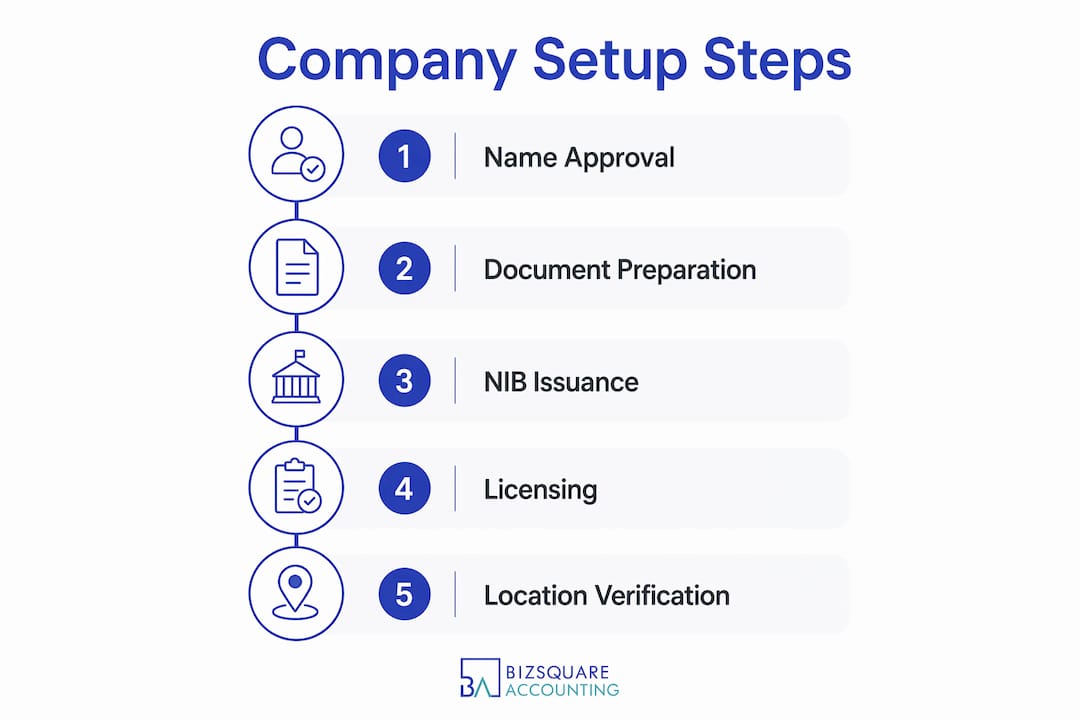
The legal steps to incorporate in Indonesia follow a defined sequence. Skipping or misordering any step causes delays at the OSS stage. Here is the full process:
- Company name approval. Submit your proposed company name to the Ministry of Law and Human Rights (Kemenkumham) for availability check and reservation. The name must be unique, in Indonesian language, and not resemble an existing registered entity.
- Notarization of the Deed of Establishment. A licensed Indonesian notary drafts and notarizes the Deed of Establishment, which includes the Articles of Association. This document defines the company’s purpose, share structure, and governance rules. The notary then submits it to Kemenkumham for legal entity status.
- Obtain NPWP (Tax Identification Number). The NPWP is Indonesia’s corporate tax ID. NPWP registration is required before completing OSS registration. The tax office registers the company at its declared business address, so the address must be confirmed before this step.
- Register through OSS and obtain NIB. Log in to the OSS portal (oss.go.id) using the company’s legal entity data. Complete the business activity declaration using the correct KBLI codes (Indonesian Standard Business Classification). The system then issues the NIB automatically upon successful submission.
- Obtain additional licenses based on risk level. After receiving the NIB, the OSS system prompts for additional permits based on your business activity’s risk classification. Low-risk businesses receive only the NIB. Medium and high-risk businesses must complete further approvals, which are detailed in the next section.
| Step | Document / Output | Issuing Authority |
|---|---|---|
| Name approval | Name reservation certificate | Kemenkumham |
| Deed of Establishment | Legal entity status | Notary + Kemenkumham |
| Tax registration | NPWP | Tax Office (DJP) |
| OSS registration | NIB | OSS system (BKPM) |
| Risk-based licenses | Standard certificate or full license | Relevant technical ministry |
Pro Tip: Prepare all shareholder and director identity documents, including passports and Indonesian tax IDs where applicable, before approaching a notary. Missing documents are the most common cause of delays at the notarization stage.
The entire process, from name approval to NIB issuance, typically takes two to four weeks for a straightforward PT PMA. Complex business activities or high-risk classifications extend this timeline considerably.
How does the OSS risk-based licensing system work?
Indonesia’s OSS system classifies every business activity by risk level. This classification determines what licenses you need beyond the NIB. The OSS system issues the NIB as the primary legal identifier for all registered businesses. Think of it as the foundation on which every other license rests.
Risk categories and their licensing implications
The OSS licensing system classifies businesses as low, medium, or high risk. Each category carries different compliance requirements:
- Low risk: NIB is sufficient. No additional permits are required to begin operations.
- Medium-low risk: NIB plus a Standard Certificate (Sertifikat Standar) that is self-declared by the company.
- Medium-high risk: NIB plus a Standard Certificate that must be verified and approved by the relevant technical ministry.
- High risk: NIB plus a full Business License (Izin Usaha) issued after inspection and approval by the relevant authority.
This tiered approach means that a retail trading company and a pharmaceutical manufacturer face very different compliance paths, even though both register through the same OSS portal.
Location verification: RDTR and KKPR
One of the most overlooked steps in the OSS process is location verification. Location verification against RDTR zoning plans is critical for license issuance and can block your application entirely if the address is in a non-compliant zone. RDTR stands for Rencana Detail Tata Ruang, which is the detailed spatial planning map for each region.
Here is how it works in practice:
- If your business location falls within an area that has an integrated RDTR plan, the OSS system automatically issues a KKPR (Kesesuaian Kegiatan Pemanfaatan Ruang) confirmation. This is the spatial use conformity document.
- If your location is not covered by an integrated RDTR, you must apply for KKPR approval separately through the OSS system before your license proceeds.
Key insight: RDTR verifications are not merely administrative. An incorrect or unsupported location can trigger license rejection or significant business delays, requiring alternate zoning approvals that add weeks or months to your timeline. Always verify your intended office address against the local RDTR map before signing a lease.
Common pitfalls at this stage include using a virtual office address that does not match the zoning requirements, selecting a residential address for a commercial activity, and failing to confirm whether the local government has uploaded its RDTR data to the national OSS system.
What practical strategies help entrepreneurs enter the Indonesian market?
Starting a business in Indonesia requires more than completing the registration forms. Strategic decisions made before incorporation affect your compliance burden and speed to market.
Selecting the correct KBLI codes
KBLI codes define your permitted business activities. Each code corresponds to a specific industry classification, and the OSS system uses these codes to determine your risk level and required licenses. Selecting a KBLI code that does not align with your actual activities creates compliance gaps. More critically, some KBLI codes are restricted for foreign ownership, so selecting the wrong one can invalidate your PT PMA application entirely.
Cross-reference your intended activities against the Positive Investment List before finalizing your KBLI selections. You can register multiple KBLI codes under one PT PMA, which gives operational flexibility as your business grows.
Understanding capital injection vs. total investment
Many entrepreneurs confuse paid-up capital with total investment. For a PT PMA, the IDR 10 billion minimum refers to total investment, which includes projected operational expenditure over one to three years. The paid-up capital of IDR 2.5 billion is the amount that must be deposited into the company’s bank account and reflected in the Deed of Establishment. These are two separate figures with separate legal implications.
Physical office address requirements
A physical office address is not optional. Tax office visits the business address before approving VAT registration, and Indonesian regulations require a real, verifiable office location. Virtual offices are frequently rejected during tax and licensing verification. This requirement also connects directly to the RDTR zoning check described earlier.
Pro Tip: Serviced offices in commercial zones like Jakarta’s CBD or Surabaya’s business districts are generally RDTR-compliant and accepted by the tax office. Confirm compliance with the building management before signing any agreement.
Phased market entry through partnerships
Many foreign companies enter via local PT partnerships with import and trading licenses before incorporating their own PT PMA. This approach offers faster compliance and revenue capabilities without the full IDR 10 billion capital commitment upfront. A local partner with an established PT can handle initial trading, distribution, or import activities while the foreign investor prepares the PT PMA structure in parallel.
This phased approach also gives investors time to validate the market before committing full capital. It is a practical and legally sound strategy for sectors where the regulatory environment is still being assessed.
Key takeaways
Setting up a company in Indonesia requires selecting the correct legal entity, completing a five-step registration process through OSS, and obtaining risk-appropriate licenses before conducting any commercial activity.
| Point | Details |
|---|---|
| NIB is the legal foundation | Every business in Indonesia must obtain an NIB through the OSS system before operating. |
| PT PMA requires IDR 10 billion | Minimum total investment for a foreign-owned company is IDR 10 billion, with IDR 2.5 billion paid-up. |
| Risk level determines licenses | Low-risk businesses need only the NIB; medium and high-risk activities require additional permits or full licenses. |
| RDTR verification affects approval | Office location must comply with local zoning plans or license issuance will be blocked or delayed. |
| Phased entry reduces early risk | Partnering with a local PT before full PT PMA incorporation allows faster market entry with lower capital exposure. |
How Bizsquare can simplify your Indonesia company registration
Setting up a company in a foreign jurisdiction involves layers of legal, tax, and administrative requirements that are easy to mismanage without local expertise. Bizsquare provides professional support across every stage of the process, from entity selection and notarization to OSS registration and tax compliance.

Bizsquare’s consultants have direct experience with Indonesia’s OSS system, KBLI code selection, and RDTR location verification. The team also provides physical office address solutions that meet tax office requirements, along with bookkeeping and corporate secretarial services to keep your company compliant after incorporation. For entrepreneurs ready to move forward, Bizsquare’s Indonesia business registration service covers the full registration process from start to finish. Reach out to Bizsquare today to get your incorporation started correctly.
FAQ
1.) What is the NIB and why is it required?
The NIB (Nomor Induk Berusaha) is Indonesia’s Business Identification Number, issued through the OSS system. It serves as the company’s legal identifier, import license, and access key to government systems, and no business can operate legally without it.
2.) How long does it take to set up a company in Indonesia?
A straightforward PT PMA typically takes two to four weeks from name approval to NIB issuance. High-risk business activities or locations requiring separate KKPR approval can extend the timeline to two or three months.
3.) Can a foreigner own 100% of a company in Indonesia?
Foreign investors can own up to 100% of a PT PMA in sectors that are fully open under Indonesia’s Positive Investment List. Restricted sectors cap foreign ownership at lower percentages, requiring a local partner to hold the remaining shares.
4.) What is the minimum capital to set up a PT PMA?
The minimum total investment for a PT PMA is IDR 10 billion, with a minimum paid-up capital of IDR 2.5 billion. These figures exclude land and buildings and cover projected investment over one to three years.
5.) Is a virtual office acceptable for company registration in Indonesia?
Virtual offices are generally not accepted for tax registration and VAT approval in Indonesia. The tax office conducts physical visits to the registered business address, so a real, commercially zoned office is required.
6.) What is the difference between a PT PMA and a representative office?
A PT PMA is a full commercial entity that can generate revenue, hire staff, and operate independently. A representative office such as KPPA or KP3A can only conduct marketing and liaison activities, and it cannot generate direct revenue.
7.) What are KBLI codes and why do they matter?
KBLI codes are Indonesia’s Standard Business Classification codes. They define your permitted business activities and determine your risk level and licensing requirements under the OSS system. Selecting incorrect codes can restrict your operations or invalidate your application.
8.) What happens if my office address fails the RDTR verification?
If your address is not covered by an integrated RDTR plan, you must apply for a separate KKPR approval through OSS before your license proceeds. Non-compliant addresses can result in license rejection or significant delays.
9.) Can I start operating immediately after receiving the NIB?
Low-risk businesses can begin operations immediately after receiving the NIB. Medium and high-risk businesses must obtain additional standard certificates or full licenses before commencing commercial activity.
10.) What is the difference between total investment and paid-up capital for a PT PMA?
Total investment of IDR 10 billion refers to the projected capital expenditure over one to three years. Paid-up capital of IDR 2.5 billion is the amount deposited into the company’s bank account and declared in the Deed of Establishment. Both figures are legally required and separately verified.
11.) Is it possible to enter the Indonesian market without setting up a PT PMA immediately?
Yes. Many foreign investors partner with a local PT that holds import and trading licenses before incorporating their own PT PMA. This phased approach allows faster market entry and revenue generation without the full capital commitment of a PT PMA from the start.