
How to Reduce Business Costs in Singapore: 2026 Guide
Overview
Effective cost reduction in Singapore businesses requires consolidating vendors, automating financial processes, and applying zero-based budgeting to eliminate unnecessary expenses. Building a cost-conscious culture and leveraging technology like AI spend management and cloud tools sustain savings and enhance oversight. Continuous auditing, strategic outsourcing, and aligning expense controls with revenue priorities ensure long-term financial resilience.
Cost reduction is defined as the process of identifying and eliminating unnecessary expenditures while preserving the activities that generate revenue and sustain growth. For Singapore business owners and financial managers, knowing how to reduce business costs is not optional. It is a core management discipline that directly determines profitability and long-term survival. 52% of CFOs now prioritize cost reduction as a strategic objective, which signals that expense management has moved from a back-office concern to a boardroom priority. This guide covers the most effective cost-saving strategies available in 2026, from zero-based budgeting and vendor consolidation to automation and culture change, with specific guidance relevant to Singapore’s operating environment.
What are the highest-impact cost-saving strategies for businesses?
The most effective ways to reduce business costs target the largest expense categories first. For most Singapore SMEs, those categories are labor, vendor contracts, technology subscriptions, and office overhead. Addressing these four areas with discipline produces measurable results faster than broad, unfocused cuts.
Here are the top strategies, ranked by impact and ease of implementation:
- Vendor consolidation. Spreading purchases across many suppliers weakens negotiating power. Consolidating to fewer, preferred vendors allows businesses to negotiate volume discounts, extended payment terms, and priority service. A manufacturing SME in Singapore that consolidates from 12 suppliers to 4 can often negotiate 10 to 15 percent lower unit costs on repeat orders.
- Accounting and administrative automation. Automating financial processes like billing, payroll, and expense reporting reduces errors, cuts labor hours, and improves spending visibility. Tools like QuickBooks, Xero, and Zoho Books handle these tasks at a fraction of the cost of manual processing.
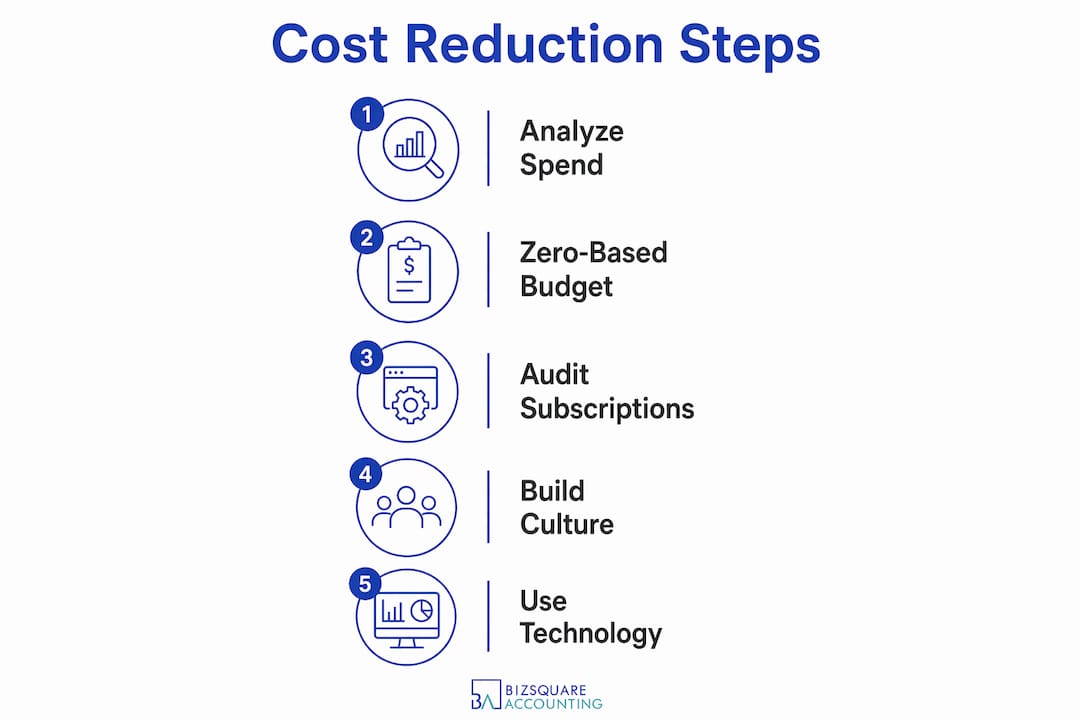
- Zero-based budgeting (ZBB). ZBB requires every expense to be justified from scratch each budget period, rather than rolling forward last year’s figures. This method eliminates budget creep, the gradual accumulation of costs that no longer serve a business purpose.
- VoIP and cloud migration. Replacing traditional phone systems with VoIP providers like RingCentral or Zoom Phone, and migrating infrastructure to cloud platforms like AWS or Microsoft Azure, cuts telecom and IT hardware costs significantly. Singapore businesses that shift to cloud-based tools also reduce the need for on-site IT staff.
- Flexible and remote work arrangements. Remote or hybrid work models reduce fixed office real estate and utilities costs. For Singapore businesses paying premium CBD rents, even a partial reduction in office space can produce substantial annual savings.
Pro Tip: Before cutting any vendor contract, run a 90-day spend analysis to identify which suppliers account for 80 percent of your total procurement spend. Focus negotiation efforts there first, not on low-value contracts.
How to apply zero-based budgeting for effective cost control
Zero-based budgeting is a budgeting method where every expense category starts at zero at the beginning of each period. Every cost must be justified with a clear business rationale before it receives funding. This contrasts sharply with traditional budgeting, which typically adds a percentage increase to the prior year’s budget without questioning whether each line item still serves a purpose.

The practical problem with traditional budgeting is budget creep. Costs accumulate year over year because no one challenges them. A department that spent SGD 50,000 on software in 2023 will often receive SGD 52,000 in 2024 simply because the prior year’s figure becomes the baseline. ZBB breaks this cycle by forcing accountability at every level.
Prerequisites for ZBB adoption:
- Cost transparency. Every department must have clear visibility into its own spending. Without granular data, ZBB becomes guesswork.
- Data granularity. Finance teams need expense data broken down by category, vendor, and frequency, not just department totals.
- Management buy-in. ZBB requires department heads to justify their budgets. Leadership must enforce this process consistently.
- Defined review cycles. Most businesses run ZBB annually, but quarterly reviews of high-risk categories like SaaS subscriptions produce better results.
Step-by-step ZBB process:
- List every expense category from scratch, with no reference to prior year figures.
- Assign a business owner to each category who is responsible for justification.
- Evaluate each expense against a clear criterion: does it directly support revenue, compliance, or operational continuity?
- Rank approved expenses by priority and allocate budget accordingly.
- Flag any expense that cannot be justified as a candidate for elimination or renegotiation.
One of the most valuable outcomes of ZBB is the identification of “zombie” costs. These are expenses that continue to be paid but deliver no active value. Companies lose $18 million annually due to unused or redundant software subscriptions. This figure illustrates how quickly unmonitored SaaS licenses accumulate into a material financial drain.
| ZBB Stage | Action Required | Common Outcome |
|---|---|---|
| Baseline reset | Set all budgets to zero | Removes inherited assumptions |
| Expense justification | Each cost must have a business case | Eliminates zombie costs |
| Priority ranking | Rank by revenue or compliance impact | Focuses spend on what matters |
| Quarterly audit | Review SaaS and vendor costs | Catches new redundancies early |
Pro Tip: Use a tool like Spendesk or Payhawk to track SaaS subscriptions in real time. Quarterly audits catch duplicate licenses and unused tools before they compound into significant annual losses.
How can businesses build a cost-conscious culture to sustain savings?
A cost-conscious culture is the organizational condition where every employee, from senior management to front-line staff, treats company resources with the same care they would apply to their own money. Without this culture, even the best cost-saving strategies erode within months as old spending habits return.
Building company-wide cost awareness improves both employee engagement and spending control. The key is to make cost responsibility a shared value, not a top-down mandate. When employees understand how their spending decisions affect the company’s profitability, they make better choices without constant supervision.
Practical tactics to build this culture include the following:
- Assign budget ownership to department heads. When a department head is personally accountable for their team’s spending, they scrutinize costs more carefully. This shifts cost control from the finance team to the operational level.
- Train staff to identify wasteful spending. Run quarterly workshops where teams review their own expense reports and identify patterns. Many employees have never been shown what their department actually spends.
- Create a cost-saving suggestion program. Invite employees to submit ideas for reducing expenses. Reward accepted suggestions with recognition or a small financial incentive. This taps into ground-level knowledge that management rarely has direct access to.
- Share financial performance data transparently. When employees see how cost reductions translate into company health, they connect their behavior to business outcomes. Monthly or quarterly financial summaries shared at team meetings achieve this effectively.
- Address rogue spending proactively. Unauthorized purchases, personal expenses on company cards, and unapproved vendor contracts are symptoms of weak culture. Implement pre-approval workflows and spending limits to prevent these before they occur.
The role of tax advisory in Singapore also intersects with culture. When finance teams understand the tax implications of spending decisions, they make more informed choices about timing, categorization, and vendor selection.
What technology solutions can optimize spending and reduce overhead costs?
Technology is the most scalable lever for reducing overhead costs. The right tools automate repetitive tasks, provide real-time visibility into spending, and prevent unauthorized expenses before they are processed. For Singapore SMEs, the return on investment from accounting and expense management software is typically realized within the first two quarters of adoption.
Accounting automation is the starting point. Platforms like QuickBooks, Xero, and Sage automate invoice processing, bank reconciliation, payroll calculations, and financial reporting. These tasks, when done manually, consume significant staff hours and introduce errors that compound into costly corrections. Automating them frees finance staff to focus on analysis rather than data entry. For guidance on maximizing these tools, the bookkeeping accuracy tips published by Bizsquare provide a practical starting framework for Singapore SMEs.
AI-driven spend management takes automation further. Tools like Payhawk and Spendesk use artificial intelligence to flag anomalous transactions, enforce spending policies in real time, and generate instant reports on budget utilization. This approach shifts cost control from reactive to preventive. Rather than discovering overspend at month-end, finance managers receive alerts the moment a transaction breaches a policy threshold.
Cloud-based collaboration tools reduce infrastructure costs directly. Microsoft 365, Google Workspace, and Slack replace the need for on-premise servers, physical meeting rooms, and expensive enterprise software licenses. For Singapore businesses managing remote or hybrid teams, these platforms also reduce the need for travel and physical office space.
Smart subscription management addresses one of the most overlooked cost categories. Quarterly subscription audits are more effective than annual reviews for eliminating duplicate or unnecessary SaaS costs. A business with 30 employees can easily accumulate 40 to 60 active software subscriptions, many of which overlap in function or are no longer actively used.
| Tool Category | Example Tools | Primary Cost Benefit |
|---|---|---|
| Accounting automation | QuickBooks, Xero, Sage | Reduces manual labor and error correction costs |
| Spend management | Payhawk, Spendesk | Prevents unauthorized and duplicate spending |
| Cloud infrastructure | AWS, Microsoft Azure | Eliminates on-premise hardware and IT maintenance |
| Communication | Zoom Phone, RingCentral | Replaces costly traditional telecom contracts |
| Subscription tracking | Spendesk, Payhawk | Identifies and eliminates zombie SaaS licenses |
For businesses investing in digital marketing, managing ad spend efficiently is equally important. Platforms that provide real-time visibility into marketing spend performance help prevent budget waste on underperforming campaigns.
Pro Tip: Before purchasing any new software, audit your existing subscriptions first. Most Singapore SMEs discover they already own tools that cover the functionality they are about to pay for again.
Key takeaways
Reducing business costs requires a combination of structured budgeting, technology adoption, and company-wide accountability, not isolated cuts to individual line items.
| Point | Details |
|---|---|
| Prioritize high-impact categories | Target labor, vendor contracts, SaaS subscriptions, and office overhead first for the fastest results. |
| Apply zero-based budgeting | Justify every expense from zero each period to eliminate budget creep and zombie costs. |
| Automate financial processes | Tools like QuickBooks and Xero reduce manual labor costs and improve spending visibility. |
| Build a cost-conscious culture | Assign budget ownership to department heads and train staff to identify wasteful spending. |
| Audit subscriptions quarterly | Companies lose significant sums annually to unused SaaS licenses; quarterly reviews prevent this. |
Cost reduction requires strategy, not just cuts
The most common mistake Singapore business owners make is treating cost reduction as a one-time exercise. A round of cuts is made, savings are recorded for one quarter, and then costs quietly creep back to their previous levels within a year. This pattern repeats because the underlying systems and behaviors that generated the costs were never addressed.
The distinction between successful and failed cost-cutting is what costs are targeted. Revenue-supporting expenses must be preserved, even under financial pressure. Cutting marketing spend, customer service capacity, or product development to hit a short-term savings target is a trade-off that typically costs more in lost revenue than it saves in reduced overhead.
The businesses that sustain cost reductions over time share three characteristics. They set SMART financial goals, meaning targets that are specific, measurable, achievable, realistic, and time-bound. They use technology to monitor spending continuously rather than reviewing it monthly or quarterly. And they treat cost management as a cultural value, not a finance department function.
For Singapore SMEs specifically, the accounting services landscape offers significant opportunities to reduce overhead through outsourcing. Outsourcing bookkeeping, tax filing, and corporate secretarial work to a specialist firm costs less than maintaining equivalent in-house capacity, and it provides access to expertise that most SMEs cannot afford to hire full-time.
The practical recommendation is to start with a full cost audit, categorize every expense by its direct contribution to revenue or compliance, and then apply ZBB to the categories where costs are highest and justification is weakest. Technology and culture change follow from that foundation.
How Bizsquare can help you reduce operational costs
Managing costs effectively requires accurate financial data, disciplined processes, and expert guidance. Bizsquare provides Singapore businesses with the accounting, bookkeeping, and advisory services that make this possible.
Bizsquare’s accounting and bookkeeping services give business owners real-time visibility into their expenses, accurate financial records for decision-making, and compliant tax filings that minimize liabilities. For businesses at the growth stage, Bizsquare’s Outsourced CFO service provides senior financial expertise without the cost of a full-time hire. Contact Bizsquare today to receive a personalized cost reduction assessment tailored to your business structure and industry. For businesses starting fresh, explore company incorporation in Singapore with a structure designed for cost efficiency from day one.
FAQ
1.) What is the most effective way to reduce business costs?
The most effective approach combines vendor consolidation, accounting automation, and zero-based budgeting. These three strategies address the largest cost categories for most Singapore SMEs simultaneously.
2.) What is zero-based budgeting and how does it help?
Zero-based budgeting requires every expense to be justified from scratch each period, rather than rolling forward prior year figures. It eliminates budget creep and identifies unused costs that traditional budgeting misses.
3.) How can small businesses in Singapore cut expenses without harming operations?
Small businesses should protect revenue-generating and customer-facing expenses while trimming overhead categories like unused software, excess office space, and redundant vendor contracts. Indiscriminate cuts to marketing or service capacity typically reduce revenue more than they save in costs.
4.) How often should businesses audit their software subscriptions?
Quarterly audits are more effective than annual reviews. Companies lose significant sums annually to unused SaaS licenses, and quarterly reviews catch new redundancies before they accumulate into material losses.
5.) What role does company culture play in reducing business costs?
A cost-conscious culture ensures that savings are sustained beyond the initial reduction exercise. When employees at all levels are trained to identify wasteful spending and are accountable for departmental budgets, cost discipline becomes self-reinforcing rather than dependent on top-down enforcement.
6.) Can outsourcing accounting functions reduce overhead costs in Singapore?
Yes. Outsourcing bookkeeping, tax filing, and corporate secretarial work to a firm like Bizsquare typically costs less than maintaining equivalent in-house staff. It also provides access to specialized expertise that reduces compliance risk and tax liability.
7.) What are “zombie” costs and how do businesses identify them?
Zombie costs are recurring expenses, most commonly unused SaaS subscriptions or lapsed vendor contracts, that continue to be paid without delivering active value. A quarterly expense audit cross-referenced against actual usage data identifies them reliably.
8.) How does automation help lower expenses for Singapore businesses?
Automating billing, payroll, and expense reporting with tools like QuickBooks or Xero reduces manual labor hours, eliminates processing errors, and provides real-time spending visibility. Each of these outcomes translates directly into lower operational costs.
9.) What are SMART financial goals and why do they matter for cost reduction?
SMART goals are specific, measurable, achievable, realistic, and time-bound targets. Applying this framework to cost reduction ensures that savings targets are trackable and that progress can be evaluated objectively rather than estimated.
10.) Should businesses cut marketing expenses to reduce costs?
Marketing expenses that directly support revenue generation should be preserved. Cutting them to meet a short-term savings target typically results in revenue losses that exceed the savings achieved. Overhead and administrative costs are the more appropriate targets for reduction.
11.) How can a financial manager in Singapore start reducing costs today?
The most practical starting point is a full expense audit categorized by revenue contribution. From there, apply zero-based budgeting to the highest-cost categories, automate repetitive financial processes, and engage a qualified accounting firm for expert guidance on tax efficiency and compliance.