


How to Appoint a Company Secretary in Singapore
Overview
Under Singapore law, every company must appoint a resident company secretary within six months of incorporation to ensure compliance. Failing to do so risks penalties and statutory disruptions, making early outsourcing to professionals a smart choice. The secretary’s role involves ongoing statutory duties, requiring expertise and timely filings to safeguard company legal standing.
Knowing how to appoint a company secretary is not optional for Singapore business owners. It is a legal obligation under Section 171 of the Companies Act, and it carries a firm deadline. Every company must complete this appointment within six months of incorporation, or directors risk penalties. Yet many business owners treat this role as an afterthought, not realizing how much it affects day-to-day compliance. This guide covers the legal requirements, eligibility rules, the exact appointment steps, and best practices for choosing the right person or firm to protect your company.
Table of Contents
- Key takeaways
- How to appoint a company secretary: legal requirements
- Step-by-step company secretary appointment process
- Responsibilities of a company secretary
- How to choose the right company secretary
- My perspective on appointing company secretaries
- Let Bizsquare Accounting handle your company secretary needs
- FAQ
Key takeaways
| Point | Details |
|---|---|
| Six-month legal deadline | Singapore law requires every company to appoint a company secretary within six months of incorporation. |
| Residency is mandatory | The appointed secretary must be ordinarily resident in Singapore, such as a citizen, PR, or eligible pass holder. |
| Sole directors are excluded | A sole director cannot also serve as company secretary under Section 171(1E) of the Companies Act. |
| ACRA filing is required | The appointment must be filed promptly via BizFile+ using valid CorpPass credentials to remain compliant. |
| Outsourcing is a smart option | Many businesses benefit from engaging a professional secretarial firm to reduce compliance risk and administrative load. |
How to appoint a company secretary: legal requirements
Before taking any steps, it helps to understand the statutory foundation behind this requirement. Section 171 of the Companies Act mandates that every Singapore-incorporated company appoint a company secretary within six months. This is not a suggestion. It is a binding legal obligation with real consequences for non-compliance.
Who qualifies as a company secretary
The appointee must be a natural person, not a corporate entity. More importantly, the individual must be ordinarily resident in Singapore, meaning they hold Singapore citizenship, permanent residency, or an eligible work pass. This residency requirement exists to ensure the secretary remains accessible for regulatory queries and time-sensitive submissions.
Here is a quick summary of eligibility criteria:
- Singapore citizen or permanent resident: Fully eligible to act as company secretary.
- Employment Pass or Dependent Pass holder: Generally eligible, subject to pass conditions.
- Foreign national without Singapore residency: Not eligible to serve in this role.
- Sole director of the company: Prohibited by law from also serving as company secretary.
That last point surprises many founders. Section 171(1E) specifically prevents a sole director from doubling up as company secretary. This rule exists to avoid conflicts of interest and to strengthen statutory oversight. If your company has only one director, you must appoint a separate individual or engage an external firm.
Qualifications for private vs. public companies
For private limited companies, there are no prescribed professional qualifications. The law simply requires the secretary to be a resident individual who is capable of performing the role. However, appointing someone with experience in Singapore corporate law is strongly advisable.

For public companies, the bar is significantly higher. The appointed secretary must have at least three years of prior experience or hold recognized qualifications under Singapore law, such as membership in the Institute of Chartered Secretaries and Administrators (ICSA) or equivalent.
Consequences of non-compliance
Failing to appoint a secretary within the six-month window creates real legal exposure. Directors can face fines of up to S$1,000 for leaving the position vacant beyond the deadline. Beyond the monetary penalty, an unfilled secretary role can disrupt annual return filings, AGM documentation, and other statutory obligations that flow through this function.
Pro Tip: Do not wait until month five to start the search. The residency verification, written consent, and ACRA filing all take time. Starting early prevents last-minute scrambles that lead to missed deadlines.
Step-by-step company secretary appointment process
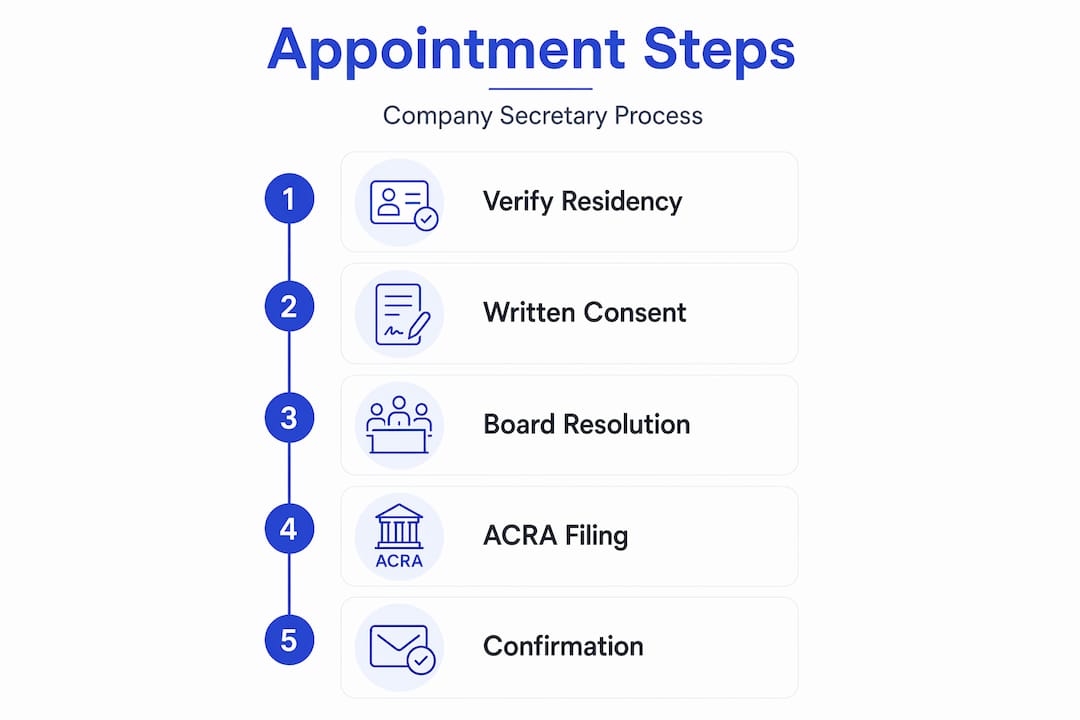
Once eligibility is confirmed, the actual company secretary appointment process follows a defined sequence. Each step builds on the previous one, so skipping ahead can cause filing errors or incomplete records.
The appointment steps in order
- Decide on internal or external appointment. Consider whether to appoint an employee or director as secretary, or engage a professional secretarial firm. For most small and medium-sized companies, outsourcing to a specialist firm offers better coverage, reduces administrative burden, and lowers compliance risk compared to relying on an untrained internal staff member.
- Hold a board meeting to pass a resolution. The appointment must be formally approved by the board of directors. This meeting does not need to be elaborate. A written resolution signed by all directors is sufficient for private companies. The key point is that the appointment requires board approval and documented minutes.
- Obtain the written consent of the appointee. The individual or firm accepting the role must provide written consent. For individuals, this is captured in Form 45B, which confirms the appointee understands and accepts the responsibilities of the position. Corporate secretarial firms typically handle this step internally.
- Verify CorpPass and SingPass permissions. Before filing anything with ACRA, confirm that the correct digital access rights are in place. Missing CorpPass or SingPass permissions are among the most common causes of filing delays, even when all other paperwork is correct. This check saves significant time.
- File the appointment on BizFile+ via ACRA. Log into the ACRA BizFile+ portal using valid CorpPass credentials. Select the relevant filing transaction for updating the company secretary. Enter the appointee’s personal details, including NRIC or FIN number, and submit the filing. Filing must be done promptly to reflect accurate records in the ACRA register.
- Update statutory registers and internal records. After ACRA confirms the filing, update the company’s Register of Officers. Record the secretary’s full name, address, appointment date, and identification number. This register must be kept at the registered office address and made available for inspection.
- Set up a compliance calendar. A company secretary’s role does not end at appointment. Once in place, the secretary should maintain a calendar of upcoming deadlines, including the annual return filing date, AGM requirements, and any changes to directors or shareholders that need to be reported.
Pro Tip: If your company is newly incorporated, appoint your company secretary at the same time as completing incorporation. Bizsquare Accounting offers bundled company incorporation packages that include secretarial setup, so both obligations are fulfilled in one step.
Responsibilities of a company secretary
Appointing a secretary is just the beginning. Understanding what the role actually covers helps business owners set the right expectations and avoid governance gaps. The company secretary’s ongoing duties are broad and directly tied to the company’s statutory standing.
Key responsibilities include the following:
- Maintaining statutory registers: This includes the Register of Members, Register of Directors, Register of Charges, and Register of Officers. These records must be kept up to date at all times.
- Filing annual returns with ACRA: The secretary prepares and submits the annual return within the prescribed deadline after each financial year end.
- Documenting board and shareholder meetings: Minutes of every board meeting and general meeting must be recorded and retained for at least five years.
- Managing changes to company information: Any change in directors, shareholders, registered address, or share capital must be filed with ACRA promptly through BizFile+.
- Supporting AGM compliance: The secretary organizes Annual General Meeting notices, prepares agendas, and circulates resolutions.
- Advising on statutory obligations: A good secretary proactively alerts directors to upcoming deadlines and regulatory changes that affect the company.
The distinction between private and public companies matters here as well. Public companies face stricter governance obligations, including more rigorous documentation of board decisions and higher accountability for statutory filings. The responsibilities of a corporate secretary in a public company setting demand deeper experience with Singapore securities law and ACRA processes.
Appointing an inexperienced secretary, or leaving the role with someone who treats it as an admin side task, creates compounding risk. Missed ACRA filings attract penalties. Late annual returns damage the company’s compliance record. These are avoidable problems with the right appointment.
How to choose the right company secretary
Once business owners understand the legal framework, the next question becomes practical. How does one choose well? The decision between an internal appointment and an outsourced firm is the most important starting point.
Internal vs. outsourced: a direct comparison
| Factor | Internal appointment | Professional secretarial firm |
|---|---|---|
| Cost | Lower upfront cost | Fixed annual fee, often affordable |
| Expertise | Depends on individual’s knowledge | Specialists in Singapore company law |
| Availability | Limited to working hours | Dedicated support with faster response |
| Scalability | Limited as company grows | Scales with business needs |
| Compliance risk | Higher if untrained | Lower with experienced professionals |
| CorpPass filing | May need training | Handled as standard practice |
For most startups and SMEs in Singapore, outsourcing offers a measurably better risk profile. Outsourcing secretarial duties gives businesses access to specialists who understand ACRA’s systems, stay current with regulatory updates, and handle filings as a core part of their work, not as an occasional obligation squeezed between other tasks.
What to look for in a secretarial firm
When evaluating an external firm, prioritize the following. First, confirm the firm employs resident professionals with current ACRA filing access. Second, ask about their client-to-secretary ratio. A secretary managing hundreds of clients with no support team is a compliance risk. Third, check whether the firm offers proactive deadline reminders or a compliance calendar tool.
Experience with companies at your stage also matters. A secretarial service for startups should understand the early-stage pressures founders face and provide guidance beyond just filing paperwork.
Pro Tip: Appointing a company secretary early in the incorporation process removes one major compliance item from the list immediately. Do not treat it as something to revisit after the business is running.
Let Bizsquare handle your company secretary needs
Bizsquare offers corporate secretary services designed to take the compliance burden off Singapore business owners completely. From the initial appointment filing on ACRA BizFile+ to ongoing statutory register maintenance and annual return submissions, the team manages every step with accuracy and care. Business owners avoid missed deadlines, incorrect filings, and costly penalties. Bizsquare also provides complementary services including accounting and bookkeeping and corporate advisory, giving growing companies a single trusted partner for financial and compliance management. Reach out to Bizsquare today to get started.
FAQ
1.) What is the deadline to appoint a company secretary in Singapore?
Every Singapore company must appoint a company secretary within six months of incorporation. Failure to meet this deadline can result in fines of up to S$1,000 for the directors.
2.) Can a director also serve as company secretary?
A sole director cannot serve as company secretary under Section 171(1E) of the Companies Act. If the company has more than one director, one of them may be eligible to take on the secretary role.
3.) Does a company secretary need to be a Singapore resident?
Yes. The company secretary must be ordinarily resident in Singapore, which includes Singapore citizens, permanent residents, and holders of eligible work passes.
4.) What qualifications are required for a company secretary?
For private limited companies, no formal qualifications are prescribed, though relevant experience is strongly advisable. For public companies, the secretary must hold recognized qualifications or have at least three years of prior secretarial experience.
5.) What documents are needed to complete the appointment?
The key documents include a board resolution approving the appointment, the appointee’s written consent through Form 45B, and the ACRA filing submission via BizFile+ using valid CorpPass credentials.
6.) Can a company secretary be a corporate entity?
No. Singapore law requires the company secretary to be a natural person. A corporate body cannot be appointed to this role.
7.) How long does it take to file the appointment with ACRA?
Filing via BizFile+ is typically completed on the same day if all information and CorpPass permissions are in order. Delays usually arise from missing digital access rights rather than the filing itself.
8.) What happens if a company secretary resigns?
The company must appoint a replacement within six months of the resignation. The vacancy and new appointment must both be filed with ACRA via BizFile+ promptly.
9.) Is outsourcing the company secretary role allowed in Singapore?
Yes. Companies may engage a professional secretarial firm to fulfill this role. The firm’s appointed individual still must be ordinarily resident in Singapore.
10.) What are the main ongoing duties of a company secretary?
The secretary maintains statutory registers, files annual returns with ACRA, documents board and general meeting minutes, processes changes to company officers and shareholding, and supports directors with compliance calendars.
11.) How much does a company secretary cost in Singapore?
Fees vary depending on the service provider and scope. For small private companies, professional secretarial services typically range from a few hundred to a few thousand Singapore dollars annually, making outsourcing a cost-effective option for most businesses.
12.) Can a foreign-incorporated company use the same secretary for its Singapore subsidiary?
The Singapore subsidiary is a separate legal entity and must appoint its own company secretary who is ordinarily resident in Singapore. A foreign-based secretary does not satisfy local residency requirements.
13.) Where can a company find a qualified company secretary?
Reputable corporate secretarial firms such as Bizsquare Accounting offer these services. Business owners should look for firms with demonstrated ACRA filing experience and a track record of maintaining compliant registers for Singapore companies.