


Corporate Secretary Singapore: what founders need to know
Every company incorporated in Singapore must appoint a company secretary who is a natural person ordinarily resident in Singapore, and this appointment must happen within six months of incorporation. This is not optional. The Companies Act is clear on the matter, and ACRA enforces it actively.
Here is what to do right now:
- Confirm your nominee is a Singapore citizen, permanent resident, or Employment Pass holder who meets the residency test.
- Verify that any outsourced provider holds current ACRA registration as a corporate service provider, a requirement that took effect in June 2025.
- Record the appointment by board resolution and lodge the change with ACRA promptly.
- Start the search during incorporation, not after, so post-incorporation filings can proceed without delay.
One immediate action: shortlist an ACRA-registered corporate secretarial firm and request their scope of services and service-level agreement before your six-month window closes.
Table of Contents
- What does a corporate secretary actually do in Singapore?
- What are the legal requirements for appointing a company secretary?
- Which type of corporate secretary arrangement suits your company?
- How do you choose a corporate secretary in Singapore?
- What do corporate secretaries charge, and what does the fee cover?
- What compliance deadlines does a company secretary monitor?
- Can anyone be a company secretary in Singapore?
- What are the risks of poor secretarial practice?
- Key takeaways
- Why quality secretarial support matters more than most founders realise
- Bizsquare makes corporate secretarial compliance straightforward
- Useful sources
- FAQ
What does a corporate secretary actually do in Singapore?
The title sounds administrative. The reality is considerably more demanding.

A corporate secretary in Singapore carries statutory duties that are inspected by ACRA during compliance reviews. These are not background tasks. They are legal obligations that sit with the company and, ultimately, with its directors.
Statutory duties include:
- Maintaining statutory registers, including the register of members, register of directors, and register of registrable controllers.
- Preparing and filing minutes of board meetings and general meetings.
- Lodging Annual Returns with ACRA within the prescribed timeframe.
- Supporting Annual General Meetings (AGMs), including drafting notices, resolutions, and post-meeting documentation.
- Filing changes in company particulars, such as director appointments, resignations, and changes to the registered office address.
Beyond the statutory list, an experienced secretary also advises directors on procedural and compliance matters. For example, if a director proposes a resolution that conflicts with the company’s constitution, the secretary flags it before the meeting, not after. That kind of proactive governance support is what separates a capable secretary from one who merely processes paperwork.
A practical example: a company receives a new investor and needs to issue new shares. The secretary prepares the board resolution, updates the register of members, issues share certificates, and files the relevant return with ACRA, all within the required timeframe. Without a secretary tracking each step, it is easy to miss one, and missing one creates a compliance gap.
For a fuller breakdown of these responsibilities, the Bizsquare guide on responsibilities of corporate secretary services covers each duty with practical context.
What are the legal requirements for appointing a company secretary?
The rules come from the Companies Act and ACRA guidance. They are specific, and they carry penalties for non-compliance.
Eligibility checklist:
- The secretary must be a natural person, not a corporate body.
- The secretary must be ordinarily resident in Singapore, meaning a Singapore citizen, permanent resident, or an Employment Pass holder who qualifies under the residency test.
- A sole director cannot simultaneously act as company secretary. If a company has only one director, that director must appoint a separate individual to the role.
- The appointment must be made within six months of incorporation.
- From June 2025, any outsourced corporate service provider must be registered with ACRA. Confirm this registration before signing any engagement.
Appointment checklist for founders:
- Verify the nominee’s residency status and obtain documentary evidence.
- Confirm the nominee is not the sole director of the company.
- Pass a board resolution recording the appointment.
- Lodge the appointment with ACRA via BizFile+.
- If using an outsourced firm, check their ACRA CSP registration status on the ACRA portal.
The statutory text sits in Section 171 of the Companies Act, and the ACRA guidance page on appointing key personnel provides the practical steps in plain language.
Key rule: Starting the search for a secretary during incorporation, rather than after, avoids last-minute appointments and gives the company time to complete post-incorporation filings correctly.
Which type of corporate secretary arrangement suits your company?
There is no single correct answer. The right arrangement depends on company size, complexity, and how much governance support the directors need day to day.

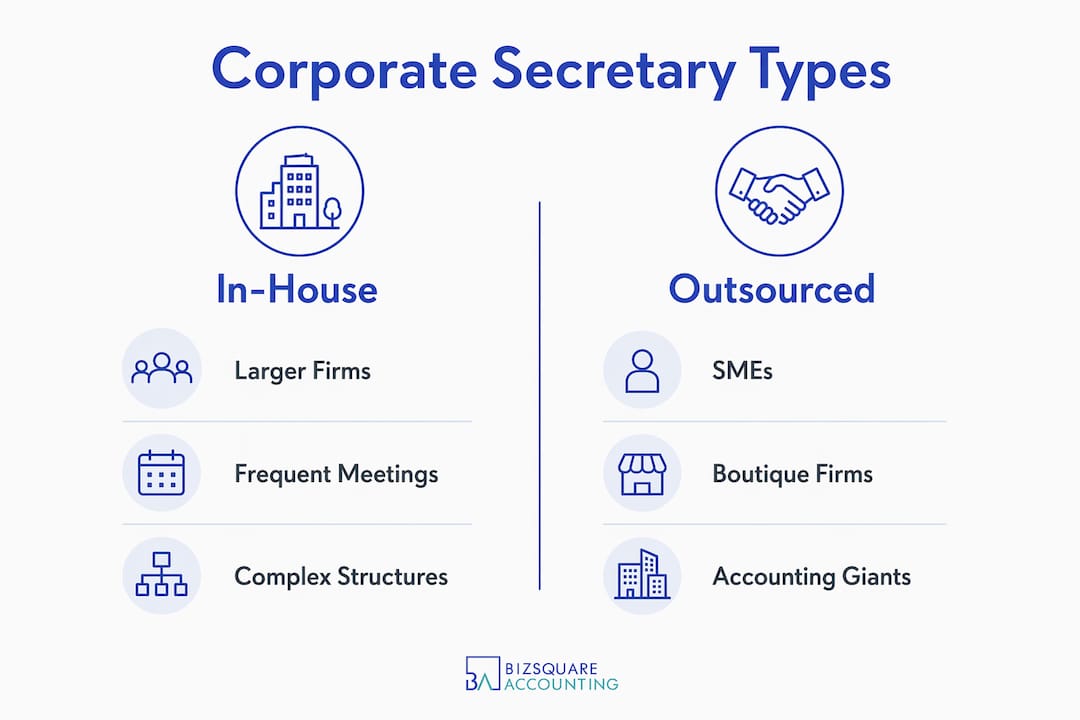
In-house secretary (employee)
This works for larger companies with frequent board activity, complex share structures, or listed status. An in-house secretary has deep familiarity with the company’s history and can respond immediately to director requests. The trade-off is cost: salary, CPF contributions, and training add up quickly for an SME.
Outsourced boutique corporate service provider
Most SMEs in Singapore use this model. A boutique CSP handles statutory filings, maintains registers, supports AGMs, and provides a named contact for compliance queries. Costs are predictable, and the firm’s team covers absence and continuity. This is the most practical starting point for founders who want compliance handled without hiring a full-time employee.
Large accounting firms
For companies with complex group structures, cross-border operations, or listed-company obligations, a large firm offers integrated legal, tax, and secretarial support under one roof. Fees are higher, but the breadth of expertise justifies the cost for the right company profile. The range of services available from established secretarial practices illustrates how far the scope can extend beyond basic filings.
ACRA-registered corporate service providers
Since June 2025, any firm providing corporate secretarial services for a fee must hold ACRA registration. This applies to boutique firms and large practices alike. Always verify registration status before engaging any provider.
Pro Tip: Ask any prospective provider how they handle staff turnover and client handovers. A firm with no documented handover process creates a continuity risk the moment your named contact leaves.
For a detailed comparison of outsourcing benefits versus in-house arrangements, the Bizsquare article on reasons to outsource your company secretary sets out the cost and risk case clearly.
How do you choose a corporate secretary in Singapore?
Use this eight-point checklist in every interview or procurement conversation.
Eight selection criteria
- ACRA registration: Confirm the firm holds current CSP registration. Ask for the registration number and verify it on the ACRA portal.
- Residency and eligibility: Confirm the named secretary meets the residency test under the Companies Act.
- Companies Act filing experience: Ask how many Annual Returns and AGM packs the firm files each year. Volume indicates process maturity.
- Industry experience: A firm familiar with your sector understands the specific compliance nuances, such as licensing obligations or regulated shareholding structures.
- Scope of services: Confirm what is included in the standard fee and what triggers an additional charge. Get this in writing.
- Technology and reporting: Ask how statutory registers are maintained, whether directors have online access, and how filing confirmations are communicated.
- Response times and SLA: Request a written service-level agreement specifying turnaround times for routine and urgent matters.
- Pricing transparency: A reputable firm provides a clear fee schedule. Avoid any provider who cannot give a written quote.
Red flags to avoid
- Vague scope with no written engagement letter.
- No written SLA or refusal to commit to turnaround times.
- Inability to show sample statutory register formats or a compliance calendar.
- Pricing that changes without explanation after the first invoice.
- Poor communication during the sales process, which rarely improves after signing.
Suggested document requests
Ask any shortlisted firm to provide: a sample compliance calendar, a sample board minutes template, and a copy of their ACRA CSP registration certificate. A competent firm produces all three without hesitation. This practical test, requesting a sample compliance calendar and minutes template, is one of the most reliable ways to judge a firm’s thoroughness before committing.
The Bizsquare guide on how to appoint a company secretary includes a sample board resolution template and a step-by-step appointment checklist.
What do corporate secretaries charge, and what does the fee cover?
Fees vary by provider type, scope, and company complexity. For SMEs using a bundled secretarial package, the market range falls within typical industry pricing for standard services. Bespoke arrangements, or those covering complex share structures and frequent board activity, fall outside this range.
Standard inclusions in most SME packages:
- Maintenance of statutory registers throughout the year.
- Preparation and lodgement of Annual Returns.
- AGM support, including notices, resolutions, and minutes.
- Board meeting minute preparation for routine matters.
- Registered office address service (in many packages).
- Filing of routine changes, such as director or address updates.
Common add-ons charged separately:
| Service | Typical status |
|---|---|
| Share transfer handling | Add-on |
| Issuance of share certificates | Add-on |
| Ad-hoc governance advisory | Add-on |
| Urgent or out-of-cycle filings | Add-on |
| Preparation of special resolutions | Add-on |
| Nominee director services | Separate engagement |
The key question to ask any provider is not just the annual fee, but what triggers an additional invoice. A low headline fee with a long list of add-ons can cost more than a higher all-inclusive package. Get the full scope in writing before signing.
What compliance deadlines does a company secretary monitor?
A capable secretary does not wait for founders to ask about deadlines. The secretary owns the compliance calendar and prompts directors in advance.
Critical deadlines to track:
- Annual Return filing: Companies must file their Annual Return with ACRA within the prescribed period after the financial year end. The exact deadline depends on company classification and should be confirmed with the company secretary. Confirm the exact deadline for your company’s profile with your secretary.
- AGM requirement: Private companies are currently exempt from holding AGMs if they send financial statements to members within five months of the financial year end. Public companies must hold an AGM within four months of the financial year end.
- Financial statements: Companies must prepare financial statements and, where applicable, have them audited before the Annual Return is filed.
- Change filings: Changes to directors, the company secretary, registered office address, or share capital must be filed with ACRA within 14 days of the change.
- Register of registrable controllers: Updates to this register must be made promptly when ownership or control changes occur.
A well-run secretarial engagement includes a 12-month compliance calendar issued at the start of each year. The secretary schedules board approval meetings, circulates draft financial statements for director sign-off, and lodges filings ahead of the deadline, not on the day. Founders should expect this calendar as a standard deliverable, not an optional extra.
The ACRA guidance on common offences for companies lists the specific penalties for late filings and missed AGMs.
Can anyone be a company secretary in Singapore?
No. The eligibility rules are specific, and they matter.
Quick answers to common questions:
- Can a foreigner be the company secretary? Yes, provided the individual is ordinarily resident in Singapore. An Employment Pass holder who meets the residency test qualifies.
- Can the sole director also be the company secretary? No. The Companies Act explicitly prohibits this. A company with a single director must appoint a separate person as secretary.
- Can a company (corporate body) be appointed as secretary? No. The secretary must be a natural person.
- Does the secretary need a professional qualification? There is no mandatory professional qualification for private company secretaries under the Companies Act, but ACRA-registered CSPs must meet the registration requirements introduced in 2025, which include fit-and-proper criteria for the firm and its qualified individuals.
- What if the company has no secretary for a period? This is an offence. ACRA can take action against the company and its directors for failing to maintain a secretary.
For a full breakdown of the legal requirements and appointment steps, the Bizsquare guide on company secretary requirements covers eligibility, exceptions, and the appointment process in detail.
What are the risks of poor secretarial practice?
The consequences of inadequate secretarial support extend well beyond a late-filing penalty.
Regulatory and legal risks:
- Late or missed Annual Return filings attract fines under the Companies Act. Directors can face personal liability for persistent non-compliance.
- Failure to hold an AGM where required, or to send financial statements within the prescribed period, is a separate offence.
- Inaccurate or missing statutory registers are a frequent finding during ACRA compliance inspections. Missing records are difficult to reconstruct after the fact.
- Failure to file changes in directors or company particulars within 14 days is a common offence listed in ACRA’s published guidance.
Non-regulatory risks:
- Poorly maintained share registers create disputes during share transfers or investor due diligence. A buyer who discovers register gaps will either reduce the offer price or walk away.
- Incomplete or unsigned board minutes leave the company exposed if a director later disputes a decision.
- Weak governance records damage investor confidence, particularly for companies seeking funding or preparing for a listing.
How good secretarial practice mitigates each risk:
- A compliance calendar with advance reminders prevents missed deadlines.
- Accurate, contemporaneous minute-taking creates an evidence trail that protects directors in disputes.
- Regular register reviews catch errors before they become material.
- Good secretarial practice builds an audit trail that matters when regulators review a company after complaints or irregular filings.
Engaging a firm with regulatory compliance expertise alongside your secretarial provider adds an additional layer of protection for companies navigating complex obligations.
Key takeaways
Appointing an ACRA-registered, ordinarily resident company secretary within six months of incorporation is a legal requirement in Singapore, and the 2025 CSP registration rules make provider verification a non-negotiable first step.
| Point | Details |
|---|---|
| Six-month appointment window | Appoint a qualifying secretary within six months of incorporation or face penalties. |
| Sole director rule | A sole director cannot act as secretary; plan a separate appointment from day one. |
| ACRA CSP registration | From June 2025, all outsourced providers must hold current ACRA CSP registration. |
| Eight hiring criteria | Check ACRA registration, residency, filing experience, scope, SLA, and pricing in writing. |
| Bizsquare | Bizsquare provides ACRA-aware corporate secretary services with clear SLAs and transparent pricing for Singapore SMEs. |
Why quality secretarial support matters more than most founders realise
Most founders treat the company secretary appointment as a box to tick during incorporation. That framing is understandable, but it misses the point of the role.
An experienced secretary is the compliance backbone of the company. Deadlines for Annual Returns, AGM requirements, and change filings do not pause because a director is travelling or the business is in a growth phase. A capable secretary tracks all of it, prompts directors in advance, and ensures the company’s records are always inspection-ready.
The governance dimension matters too, particularly as companies grow. For listed companies, the MAS Code of Corporate Governance operates on a comply-or-explain basis, and the Code explicitly states that directors have independent access to the company secretary. The appointment and removal of the secretary is a decision of the board as a whole, not a unilateral management call. That principle reflects how seriously Singapore’s regulators treat the role.
For private SMEs, the practical value shows up during share transfers, funding rounds, and director changes, precisely the moments when statutory registers and accurate minutes matter most. Owners who treat secretarial fees as a pure administrative cost often discover the real value of the role only when something goes wrong. An experienced secretary prevents inadvertent breaches during share transfers and director changes, which is a far better outcome than fixing them afterwards.
The MAS Code and ACRA’s inspection focus on statutory registers both point to the same conclusion: governance quality is visible in the records, and the records are the secretary’s responsibility.
Bizsquare makes corporate secretarial compliance straightforward
Bizsquare Accounting provides corporate secretary services for Singapore SMEs, startups, and foreign entities establishing a local presence. The service covers statutory register maintenance, Annual Return lodgement, AGM support, board minute preparation, and ad-hoc governance advisory, all delivered by a team that understands ACRA’s current requirements, including the 2025 CSP registration rules.

Founders who incorporate through Bizsquare can bundle company incorporation with secretarial services from day one, so post-incorporation filings are handled without a gap. Pricing is transparent, the scope is set out in writing, and service-level commitments are included in the engagement letter.
To request a proposal or an initial compliance health check, contact Bizsquare directly through the website. The team responds promptly and can advise on the right service scope for your company’s stage and structure.
Useful sources
The following official and authoritative sources are recommended for confirming statutory requirements and reading primary materials:
- ACRA: Appointing directors, company secretary and other key personnel — the primary ACRA guidance page for appointment rules, residency requirements, and the six-month timeline. Start here for statutory authority.
- ACRA: Corporate service providers — confirms the June 2025 CSP registration requirement and lists registered providers. Use this to verify any outsourced firm before engaging.
- ACRA: Register of registrable controllers — explains the register maintenance obligation and what ACRA inspects during compliance reviews.
- ACRA: Common offences for companies — lists penalties for late filings, missed AGMs, and other statutory breaches. Useful for understanding the consequences of non-compliance.
- Companies Act, Section 171 (AGC Singapore) — the statutory text governing the appointment and duties of the company secretary.
- MAS Code of Corporate Governance — the comply-or-explain framework for listed companies, relevant for growing companies and those preparing for a listing.
- Bizsquare: Corporate secretary in Singapore, complete guide 2026 — a practical guide covering requirements, procedures, and checklists for Singapore business owners.
- Bizsquare: Legal requirements for appointing a company secretary — step-by-step eligibility and appointment checklist with current regulatory context.
This article provides general information about Singapore corporate secretarial requirements. It is not legal or professional advice. Confirm current rules with ACRA or a qualified professional for your specific situation.
FAQ
1.) What does a corporate secretary do in Singapore?
A corporate secretary maintains statutory registers, prepares and files minutes, lodges Annual Returns with ACRA, and supports AGMs and board meetings. The role also includes advising directors on compliance procedures and filing changes in company particulars within the required timeframe.
2.) Can anyone be a corporate secretary in Singapore?
No. The secretary must be a natural person ordinarily resident in Singapore, which includes Singapore citizens, permanent residents, and qualifying Employment Pass holders. A corporate body cannot hold the role, and a sole director cannot simultaneously act as secretary.
3.) How much does a corporate secretary charge in Singapore?
SME bundled secretarial packages typically range from S$550–S$900 per year for standard services. Add-ons such as share transfers, special resolutions, and urgent filings are usually charged separately, so always confirm the full scope in writing.
4.) Does a sole director need to appoint a separate company secretary?
Yes. The Companies Act prohibits a sole director from also acting as company secretary. A separate individual who meets the residency and eligibility requirements must be appointed, and this appointment must be made within six months of incorporation.
5.) Do outsourced secretarial firms need ACRA registration?
Yes. From June 2025, all corporate service providers offering secretarial services for a fee must hold current ACRA CSP registration. Verify any outsourced provider’s registration status on the ACRA portal before signing an engagement.
6.) What happens if a company does not appoint a secretary?
Failing to maintain a company secretary is an offence under the Companies Act. ACRA can take action against the company and its directors, and persistent non-compliance can result in fines and director liability.
7.) What is the deadline for filing an Annual Return in Singapore?
For companies with share capital, the Annual Return must generally be filed within seven months of the financial year end for private companies. Listed companies face a shorter five-month deadline. A qualified company secretary tracks this deadline and schedules director approvals in advance.
8.) Can a foreign director appoint themselves as company secretary?
No. Even if a foreign director holds an Employment Pass and meets the residency test, a sole director cannot act as secretary. The two roles must be held by separate individuals.
9.) What records does ACRA inspect during a compliance review?
ACRA commonly inspects statutory registers, including the register of members, register of directors, and register of registrable controllers. Missing or inaccurate registers are a frequent compliance finding, so accurate year-round maintenance is critical.
10.) How does Bizsquare help with corporate secretarial compliance?
Bizsquare provides end-to-end corporate secretary services for Singapore companies, covering statutory register maintenance, Annual Return filings, AGM support, and governance advisory. Services are delivered by an ACRA-aware team with transparent pricing and written service-level commitments.