


Avoid IRAS Queries on Capital Allowances in Singapore, With Examples
Any Singapore company buying plant, machinery or equipment for its trade can claim capital allowances instead of accounting depreciation. You choose between four write-off routes: one year, two years for specified assessment years, three years, or the prescribed working life under the Sixth Schedule. Claims go into Form C, or sit in your schedules for Form C-S, and you need invoices and asset records ready before you file.
Overview:
- Choosing the right write-off method depends on your asset type, with options including a one-year full deduction for computers and low-value items or spread-out allowances over several years for machinery and equipment.
- Assets like private cars, building fixtures, and decorative items generally do not qualify for capital allowances, making proper classification critical to avoid IRAS disputes.
- Maintaining detailed records, including asset schedules, invoices, and a clear justification for subcontractor use, is essential for accurate claims and audit readiness.
- Accelerated options such as the one-year write-off offer immediate tax savings but require careful planning to align with your cash flow and future tax strategies.
- Engaging a professional accountant ensures correct classification, compliance with IRAS rules, and reduces the risk of disallowed claims or costly queries.
What qualifies for capital allowances in Singapore
The Inland Revenue Authority of Singapore treats capital allowances as the tax equivalent of depreciation. They exist because accounting depreciation, calculated under financial reporting standards, is not deductible for tax. Instead, IRAS allows a structured deduction for the wear and tear of qualifying fixed assets used in your trade. The legal basis sits in the Income Tax Act, mainly Sections 19 and 19A, alongside the Sixth Schedule which lists prescribed working lives for different asset classes.
Not every purchase counts as “plant and machinery”. The term covers assets that function as tools of your trade, rather than the setting in which the trade happens. Common qualifying assets include:
- Office equipment such as computers, printers and photocopiers
- Manufacturing and production machinery
- Furniture and fittings used in business premises
- Renovation items that qualify under specific IRAS provisions
- Commercial vehicles, vans and lorries registered for business use
Several categories fall outside the scope, and this is where many claims go wrong. S-plated private cars are excluded outright, because IRAS treats them as a benefit closer to employee perks than genuine trade tools. Decorative items, building structures, and fixtures that form part of the premises itself (rather than the equipment inside it) also fail to qualify. Assets bought using government grants may need adjustment, since the grant portion typically cannot form part of the claimable cost.
There is a subtler point worth flagging for group structures and outsourced production. If your company owns equipment but a subcontractor physically uses it, you can still claim capital allowances, provided you retain clear commercial justification. IRAS wants to see that the asset genuinely belongs to your trade and that the arrangement is not a disguised transfer of tax benefit.

Pro Tip: Keep a one-page note explaining why each subcontractor-used asset supports your business, written at the time of purchase. A contemporaneous explanation carries far more weight with IRAS than one drafted after a query lands.
How to calculate capital allowances: methods and when to use them
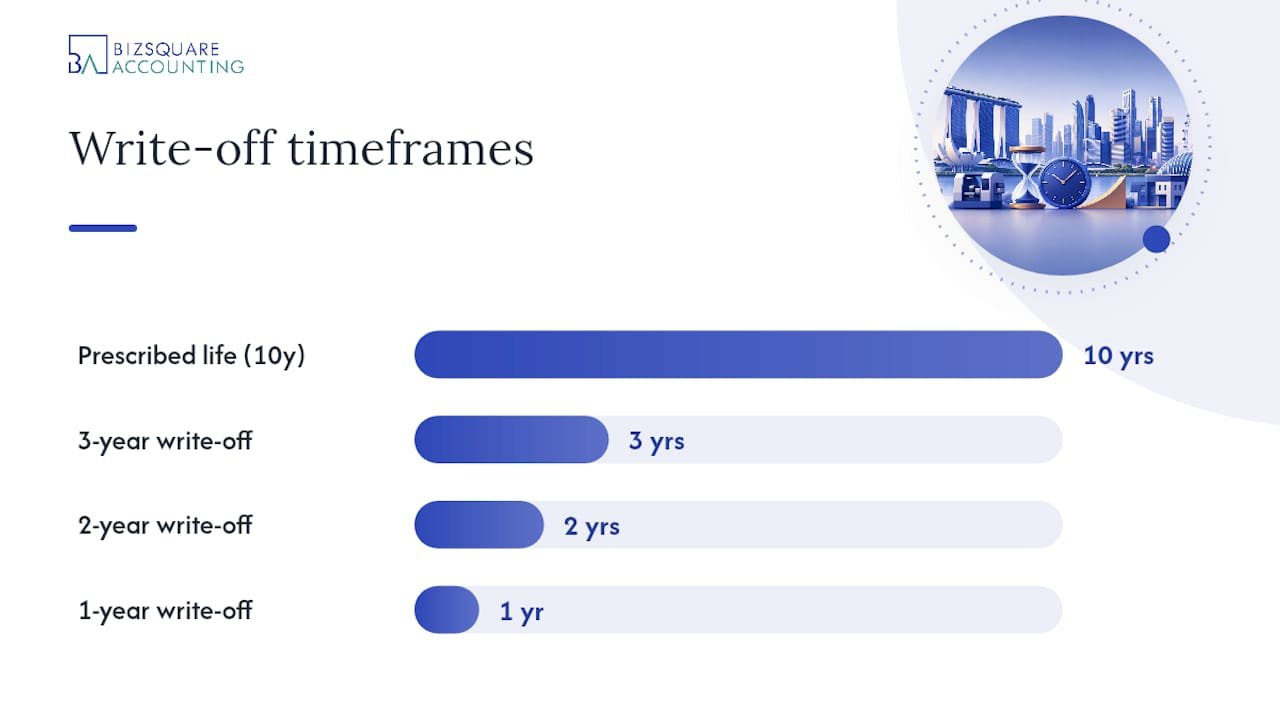
Singapore gives you four calculation routes, and picking the right one affects your cash flow for years. Here is how each one works.
1. Writing off over the prescribed working life (Section 19)
This is the default method when no accelerated option applies. You claim an initial allowance (IA) of 20% of the asset’s cost in the year of purchase, then an annual allowance (AA) calculated as 80% of cost divided by the asset’s prescribed working life, as set out in the Sixth Schedule. A machine costing S$100,000 with a ten-year working life gives an IA of S$20,000 and an AA of S$8,000 a year for ten years. Once you elect a working life for an asset class, that election is generally irrevocable, so it pays to think ahead before locking it in.
2. The 3-year write-off (Section 19A(1))
Here, the annual allowance is simply one-third of the asset’s cost, spread evenly across three consecutive years of assessment. There is no initial allowance component. You cannot defer a claim once you start, so the schedule runs automatically once elected.
3. The 2-year write-off (Section 19A(1E))
IRAS has periodically offered a time-limited two-year option for capital expenditure incurred in specified years of assessment, giving businesses faster relief during periods when cash flow support matters most. Unlike the 3-year route, this option is generally non-deferrable and tied strictly to the qualifying YA it was announced for, so check current IRAS guidance before assuming it still applies to your year of purchase.
4. The 1-year write-off (Sections 19A(2) and 19A(10A))
Computers and prescribed automation equipment can be written off entirely in the year of purchase under Section 19A(2). Separately, low-value assets costing S$5,000 or less per item can also be fully claimed in one year under Section 19A(10A), subject to a total cap of S$30,000 per year of assessment for that category.
| Method | Statutory basis | Allowance pattern | Deferrable? |
|---|---|---|---|
| Prescribed working life | Section 19 | 20% IA + 80% cost ÷ life (AA) | IA/AA can be deferred |
| 3 year write-off | Section 19A(1) | One-third of cost per year | No |
| 2 year write-off | Section 19A(1E) | Half of cost per year, specified YAs only | No |
| 1 year write-off | Section 19A(2) / 19A(10A) | 100% in year of purchase | No |
When you dispose of an asset before it is fully written down, two outcomes are possible. A balancing allowance arises when sale proceeds are lower than the tax written down value, giving you an additional deduction for the shortfall. A balancing charge arises when proceeds exceed the tax written down value, and that excess gets added back as taxable income, capped at the total allowances previously claimed. Getting this calculation wrong is one of the most common triggers for an IRAS query on disposal transactions.
How to claim capital allowances and the records to keep
Filing the claim correctly matters as much as calculating it correctly. Here is the practical sequence most Singapore companies and their tax agents follow.
- Prepare your tax computation. Start from net accounting profit, add back accounting depreciation, then deduct the capital allowances you are entitled to claim for the year.
- Complete the capital allowances schedule. List each asset, its cost, chosen write-off method, and the allowance claimed for the current year of assessment.
- Enter the figures in your tax return. Full computations and schedules go into Form C. For Form C-S or Form C-S (Lite), you generally do not submit schedules upfront, but IRAS can request them at any time, so retain them regardless.
- Carry forward the tax written down value. Whatever balance remains after this year’s claim rolls forward to next year’s computation.
- File within the annual deadline, matching your claim to the correct year of assessment for the financial year in question.
Retention is not optional. Keep invoices, delivery notes, purchase contracts, and evidence of how each asset is used in your trade. A capital allowances worksheet showing the opening balance, additions, disposals, and closing tax written down value should exist for every year, even when you file Form C-S.
Pro Tip: Build your fixed asset schedule as you buy, not at year end. Retrofitting eight months of purchases from scattered receipts is where most classification errors creep in.
Our guide to preparing tax filings for Singapore companies walks through the supporting documentation IRAS expects alongside your capital allowances schedule.
Common pitfalls and exclusions that trigger IRAS enquiries
A handful of recurring mistakes account for most capital allowance disputes. Recognising them before you file saves time later.
- Classifying building fixtures, like air conditioning ducting embedded in the structure, as plant and machinery when they actually form part of the premises.
- Attempting to claim capital allowances on S-plated private cars, which IRAS disallows to prevent disguised employee benefits, while commercial vehicles and certain foreign-registered cars used exclusively overseas remain eligible.
- Forgetting to add back accounting depreciation in the tax computation before applying capital allowances, which risks double counting the deduction.
- Weak or missing commercial justification when subcontractors physically use company-owned assets.
- Breaching the S$30,000 aggregate cap on low-value asset write-offs, or misapplying the time-limited two year option outside its qualifying year of assessment.
Most of these issues stem from treating capital allowances as a bookkeeping afterthought rather than a structured tax exercise. A short review before filing usually catches them.
Worked examples: step-by-step numerical calculations
Numbers make the mechanics clearer than any description. Four scenarios below cover the routes most Singapore companies actually use.
Example 1: 100% one-year write-off for computers
A company buys S$15,000 of computer equipment. Under Section 19A(2), the full amount is claimed in the year of purchase. At the prevailing 17% corporate tax rate, that generates a tax saving of S$2,550 in a single year, rather than spread across several.
Example 2: 3-year write-off
Machinery costing S$90,000 is written off under Section 19A(1). The annual allowance is one third of cost, or S$30,000, each year for three years.
Example 3: low-value assets and the cap
A company buys six items of office furniture, each costing S$4,500, totalling S$27,000. Since every item falls under the S$5,000 threshold and the total sits below S$30,000, the full amount is claimable in one year. Had the total reached S$35,000, the excess above the cap would need to be written off using the standard prescribed working life method instead.
Example 4: balancing charge on disposal
An asset with a tax written down value of S$10,000 is sold for S$18,000. The S$8,000 difference is a balancing charge, added back as taxable income, but capped at the total allowances previously claimed on that asset.
| Scenario | Method | Amount claimable | Tax effect at 17% |
|---|---|---|---|
| Computers, S$15,000 | 1 year write-off | S$15,000 | S$2,550 saving in year 1 |
| Machinery, S$90,000 | 3 year write-off | S$30,000 per year | S$2,550 saving in year 1 |
| Furniture, S$27,000 total | Low value cap | S$27,000 (within S$30,000 cap) | S$4,590 saving in year 1 |
| Disposal, proceeds S$18,000 vs TWDV S$10,000 | Balancing charge | S$8,000 added back | Taxable, capped at prior allowances |
These figures illustrate the mechanics using the standard corporate tax rate, and your actual saving will depend on your company’s overall taxable position for the year.
Practical pre-filing checklist for owners and tax agents
Before you submit your return, run through this list. It catches the errors that most often draw an IRAS query.
- Compile a full schedule of asset additions and disposals for the year, with dates, costs and invoice references attached.
- Decide your write-off method for each asset category, and record the reason behind that choice.
- Total your low-value asset claims and confirm they stay within the S$30,000 cap for the year of assessment.
- Cross-check that accounting depreciation has been added back before capital allowances are applied.
- Complete the capital allowances worksheet showing opening balance, additions, disposals and closing tax written down value.
- Assemble a folder of invoices, contracts and usage evidence in case IRAS raises questions later.
Pro Tip: Treat this checklist as a monthly habit rather than a year-end scramble. Companies that update their asset schedule quarterly rarely face last-minute reclassification headaches.
If your capital purchases involve financing, a business loan calculator can help you plan repayments alongside your write-off timeline, particularly when weighing accelerated allowances against loan servicing costs.
How Bizsquare Accounting helps with capital allowance claims
Getting the classification, method and documentation right takes practitioner judgement, not just a formula. Bizsquare Accounting’s corporate tax filing and advisory service handles tax computation preparation, asset classification, and audit support for companies across Singapore. Our team also offers outsourced CFO support for businesses planning larger capital expenditure programmes. Engaging an adviser makes particular sense once your asset base grows complex, spans multiple write-off methods, or involves subcontractor arrangements that need clear commercial justification on file.
Practical perspective: aligning capital purchases with tax options
Timing matters more than most business owners realise. If a time-limited write-off window applies to your year of assessment, bringing forward planned equipment purchases can meaningfully improve near-term cash flow. That said, accelerated relief today sometimes trades against smoother deductions over several years, so weigh the two against your actual funding position rather than defaulting to the fastest option. Whatever you choose, write down your reasoning when you make the election. A dated note explaining why you picked a method is worth more than memory when IRAS asks a question two years later.
Get expert help with your capital allowance claims
Correct capital allowance claims lower your tax bill and reduce the chance of an IRAS enquiry landing on your desk months after filing. Getting the classification, method and paperwork right the first time saves both money and stress.

Bizsquare Accounting is the alternative to piecing together tax computations yourself or hoping your bookkeeper catches every asset classification issue. Our corporate tax filing and advisory team prepares your capital allowances schedule, checks your write-off elections against current IRAS rules, and keeps your supporting documentation audit ready throughout the year. We also support newly incorporated companies from day one, so your fixed asset records start clean rather than needing retrospective fixes. If you are setting up a new entity, our company incorporation service pairs naturally with early tax planning. For existing companies, visit our corporate tax filing and advisory page to book a consultation and get your next filing handled properly.
Sources
For readers who want to verify the statutory detail directly, these primary sources cover everything referenced in this guide.
- Capital Allowances, Inland Revenue Authority of Singapore (IRAS)
- Singapore — Corporate — Deductions, PwC Worldwide Tax Summaries
This article is general information, not a substitute for advice from a qualified financial advisor. Consult a qualified financial professional about your own circumstances before acting on anything here.
FAQ
1.) What qualifies for capital allowance in Singapore?
Qualifying assets are plant and machinery used in your trade, including computers, office equipment, production machinery and commercial vehicles. Decorative items, building fixtures and S-plated private cars generally do not qualify.
2.) How do you calculate capital allowance?
You choose between writing off over the prescribed working life with an initial and annual allowance, a 3 year write-off, a time-limited 2 year option, or a 1 year write-off for computers and low-value items under S$5,000.
3.) What are the rules for claiming capital allowances?
Claims must be made in your annual tax return, with accounting depreciation added back first. Form C requires full schedules, while Form C-S filers must retain schedules and produce them if IRAS asks.
4.) What are the types of capital allowance?
The main types are the initial allowance and annual allowance under Section 19, the 3 year write-off under Section 19A(1), the 2 year write-off under Section 19A(1E), and the 1 year write-off under Section 19A(2) and 19A(10A).
5.) Can I claim capital allowance on a company car?
S-plated private cars are excluded from capital allowance claims. Commercial vehicles, vans, lorries and certain foreign-registered cars used exclusively overseas remain eligible.
6.) What happens if I sell an asset before it is fully written down?
You calculate a balancing allowance if sale proceeds are below the tax written down value, or a balancing charge if proceeds exceed it, capped at allowances previously claimed.
7.) Is there a cap on low-value asset write-offs?
Yes. Each item must cost S$5,000 or less, and the total claimed under this route cannot exceed S$30,000 per year of assessment.
8.) Do I need to submit capital allowance schedules with Form C-S?
Not upfront, but you must retain the schedules and produce them if IRAS requests them during a review or audit.
9.) Can capital allowances be claimed on assets used by subcontractors?
Yes, provided you retain clear commercial justification showing the asset genuinely belongs to your trade and the arrangement is not a disguised tax benefit transfer.
10.) What is the difference between capital allowance and depreciation?
Accounting depreciation follows financial reporting standards and is not tax deductible. Capital allowance is the tax equivalent, calculated under Sections 19 and 19A of the Income Tax Act.
11.) Can I change my write-off method after electing it?
Elections under the prescribed working life method are generally irrevocable once made. The 3 year and 2 year write-off routes also cannot be deferred once started.
12.) Why would I hire a tax adviser instead of calculating capital allowances myself?
An adviser reduces the risk of misclassification, missed caps and disallowed claims, particularly once your asset base spans multiple categories or involves subcontractor use. Bizsquare Accounting’s tax advisory service explains when this makes practical sense.


1 Comment
Spreadsheet Ready Input Tax Apportionment for Singapore SMEs
September 27, 2026, at 9:01 am[…] in the residual pool rather than being forced into a single category. Cross-check treatment against capital allowance rules where a purchase might also affect income tax […]