

Why Choose Accrual Accounting for Your Singapore Business
Overview
Accrual accounting records revenues and expenses when they are earned or incurred, not when cash flows. It provides a clearer view of profitability and supports better decision-making for growing businesses in Singapore. Transitioning early with professional support helps ensure compliance and builds valuable financial discipline.
Accrual accounting is defined as the method that records revenues and expenses when they are earned or incurred, not when cash changes hands. This distinction matters enormously for business owners in Singapore who want an accurate view of financial performance at any given time. The question of why choose accrual accounting comes down to one core truth: cash basis accounting tells you what happened to your bank account, while accrual accounting tells you what happened to your business. For companies managing inventory, long-term contracts, or growth plans, that difference is the foundation of sound financial decision-making.
What are the key benefits of accrual accounting for your Singapore business?
Accrual accounting gives business owners a complete and accurate picture of profitability. It aligns expenses with revenues in the correct period, which means your financial statements reflect what your business actually earned and spent, not just what cleared your bank. This is the foundation of precise margin analysis, especially for businesses managing long-term service contracts or product inventory.
The benefits of accrual accounting extend well beyond cleaner numbers. Here are the principal advantages for Singapore business owners:
- Clearer profitability analysis. Matching revenues with related expenses in the same period shows your true gross and net margins. A business that invoices in december but collects in february sees its real performance only under accrual.
- Better credit and cash flow management. Tracking accounts receivable and accounts payable gives you a live view of what you are owed and what you owe. This prevents surprises and supports disciplined cash planning.
- Compliance with financing standards. Lenders and investors require accrual-based, GAAP or IFRS-compliant financial statements. Accrual accounting is not optional if you plan to raise capital or secure a bank loan.
- Support for complex operations. Businesses with inventory, project-based billing, or multiple revenue streams need accrual accounting to track performance accurately across periods.
- Strategic decision-making. Accrual accounting provides deeper insight into profitability and business performance than cash basis. It supports budgeting, forecasting, and resource allocation with real data.
Pro Tip: If your business regularly invoices clients at month-end and collects 30–60 days later, your cash basis statements will consistently understate revenue. Accrual accounting corrects this distortion immediately.
The accrual accounting advantages compound over time. As your business grows, the financial clarity you build today becomes the foundation for credible reporting tomorrow.

How does accrual accounting compare with cash basis accounting?
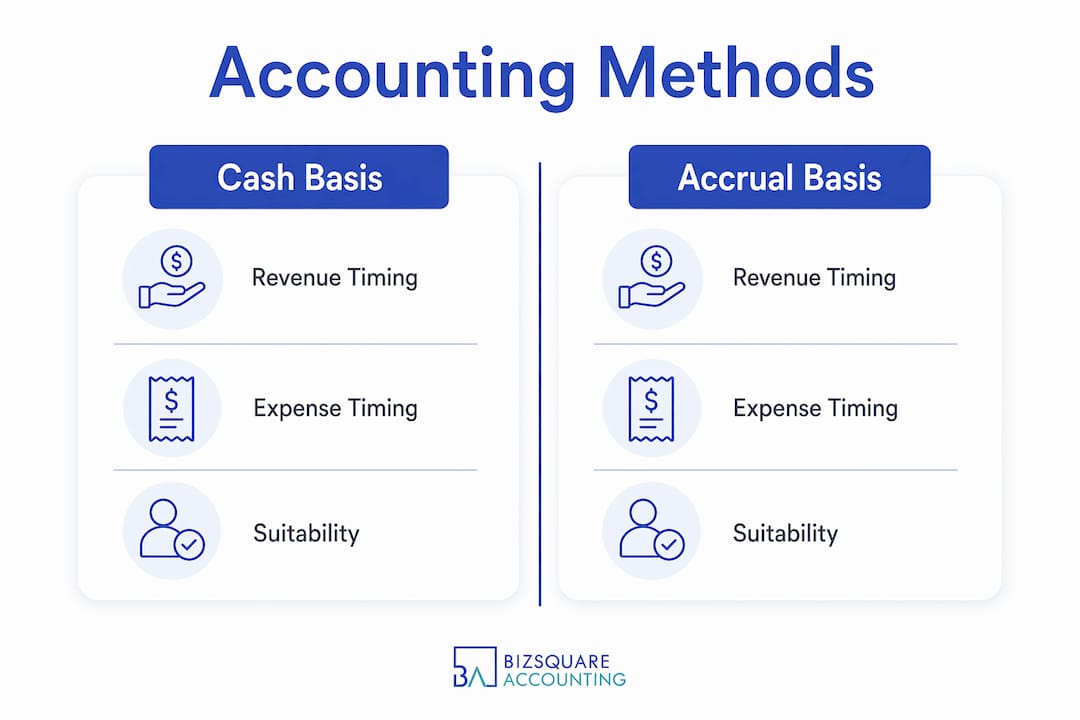
The fundamental difference between accrual and cash basis accounting is timing. Cash basis records a transaction only when money moves. Accrual basis records it when the obligation is created or the service is delivered.
Cash basis suits very small businesses with simple, immediate-payment transactions. A hawker stall or a sole proprietor with no credit terms has little to gain from accrual. The method is easy to maintain and requires minimal accounting support.
Accrual basis suits businesses with growth ambitions, complex transactions, or external stakeholders. It is the standard required under Singapore Financial Reporting Standards (SFRS), which align closely with IFRS. The table below contrasts the two methods across key dimensions.
| Feature | Cash basis | Accrual basis |
|---|---|---|
| Revenue recognition | When cash is received | When earned or invoiced |
| Expense recognition | When cash is paid | When incurred |
| Financial accuracy | Lower for complex businesses | Higher across all periods |
| Compliance with SFRS/GAAP | Not compliant | Fully compliant |
| Suitable for financing | Not accepted by lenders | Required by lenders and investors |
| Best for | Micro businesses, sole traders | SMEs, growing companies, regulated entities |
| Tax timing | Simpler, pay on receipt | May owe tax before cash arrives |
The accrual vs cash accounting debate resolves quickly for most Singapore SMEs. Businesses exceeding certain revenue thresholds, or those seeking external financing, have no practical choice. Under GAAP, businesses exceeding $25–$30 million in annual gross receipts must use accrual accounting. That threshold signals the regulatory floor, not the ideal starting point.
Pro Tip: Do not wait until you hit a revenue threshold to switch. Transitioning to accrual accounting mid-growth creates more complexity than starting early. Build the habit when your transaction volume is still manageable.
What are the practical steps for adopting accrual accounting?
Adopting accrual accounting requires a structured approach. The transition is not simply a software setting change. It involves new processes, new disciplines, and often new support.
Follow these steps to implement accrual accounting correctly:
- Map your current transaction flows. Identify all revenue streams, expense categories, and payment cycles. Know where timing gaps exist between invoicing and collection.
- Set up accounts receivable and accounts payable tracking. Rigorous management of receivables and payables is non-negotiable under accrual accounting. Every invoice issued and every obligation incurred must be recorded immediately.
- Establish a monthly closing process. Monthly adjusting entries are mandatory. These include prepaid expenses, depreciation, accrued liabilities, and deferred revenue. Skipping this step produces inaccurate statements.
- Prepare for tax timing differences. Under accrual accounting, businesses may owe tax on income not yet collected in cash. This “tax shock” catches many business owners off guard. Build a cash reserve to cover tax liabilities on earned but unpaid revenue.
- Engage skilled accounting support. Accrual accounting demands consistent, technically accurate entries. Errors in adjusting entries compound over time and distort financial statements. Professional bookkeeping or accounting support is not a luxury at this stage.
- Adjust your financial reporting cadence. Move to monthly financial statements rather than quarterly reviews. Accrual accounting produces its full value only when you read the numbers regularly and act on them.
The accounting methods available to Singapore businesses differ in complexity and compliance requirements. Understanding those differences before you transition saves time and avoids costly corrections later.
Pro Tip: Reconcile your bank statements against your accrual records every month without exception. Discrepancies between cash position and accrual balances are early warning signs of recording errors.
Common pitfalls to avoid
Three mistakes appear repeatedly when businesses adopt accrual accounting. First, they record revenue when cash arrives instead of when the invoice is issued. Second, they skip month-end adjusting entries because the process feels time-consuming. Third, they fail to plan for the cash flow gap between tax liability and cash collection. Each of these errors undermines the accuracy that accrual accounting is designed to deliver.
Who should choose accrual accounting, and why does it matter in Singapore?
Accrual accounting is the right choice for a specific and growing category of Singapore businesses. The reasons for accrual accounting become clearest when you examine the profile of businesses that benefit most.
The following business types gain the most from adopting accrual accounting:
- Businesses with revenue above SGD 500,000 annually. At this scale, cash basis statements no longer reflect operational complexity. Accrual accounting provides the granularity needed for informed decisions.
- Companies seeking bank financing or investor funding. Lenders and investors require GAAP or SFRS-compliant financials. Accrual accounting is the only method that meets this standard.
- Firms with inventory or long-term contracts. Project-based businesses and product companies cannot accurately match costs to revenues without accrual accounting. Cash basis distorts both margins and timing.
- Businesses planning an exit or acquisition. Businesses planning an exit benefit from adopting accrual accounting early. Buyers require audit-grade, transparent financial statements. Building that track record takes time.
- Companies with multiple operational units or subsidiaries. Consolidating financials across entities requires a consistent accrual framework. Cash basis creates reconciliation problems at the group level.
- Growing SMEs preparing for 2026 compliance requirements. Singapore’s regulatory environment continues to align with international standards. Businesses that adopt SFRS-compliant accrual accounting now avoid forced transitions later.
The strategic value of bookkeeping in Singapore extends directly into accrual accounting. Accurate, timely records are the input. Credible financial statements are the output. Both matter to regulators, lenders, and potential investors.
Accrual accounting also changes how you manage your business day to day. You stop making decisions based on your bank balance and start making them based on earned revenue and committed expenses. That shift in perspective is one of the most practical accrual accounting advantages a business owner can experience.
Key Takeaways
Accrual accounting is the most accurate and compliance-ready method for Singapore business owners managing growth, financing, or complex operations.
| Point | Details |
|---|---|
| Accuracy over cash position | Accrual records revenue when earned, giving a true picture of profitability each period. |
| Compliance with SFRS and GAAP | Lenders, investors, and regulators require accrual-based financial statements. |
| Tax timing awareness | Businesses must plan cash reserves for tax on earned but uncollected revenue. |
| Monthly close is non-negotiable | Adjusting entries for prepaid expenses and accrued liabilities must run every month. |
| Adopt early, not under pressure | Transitioning before you scale avoids complexity and builds audit-grade financials over time. |
Accrual accounting as a management discipline, not just a compliance checkbox
Vandro’s perspective on this topic cuts against the conventional framing. Most articles position accrual accounting as something you adopt because a regulator or lender forces you to. That framing is backwards.
The businesses I have seen manage growth well are the ones that adopted accrual accounting before they needed to. They did not wait for a bank to ask for GAAP-compliant statements. They built the discipline early, and by the time they needed credible financials, the track record was already there.
The uncomfortable truth about cash basis accounting is that it flatters you when clients pay fast and punishes you when they pay slow. Neither condition tells you anything reliable about your business. Accrual accounting removes that noise. You see what you earned, what you spent, and what you owe, regardless of when cash moved.
Switching to accrual changes how a business is managed. Period-over-period comparisons become meaningful. Budgets become grounded in real cost structures. Forecasts stop being guesses and start being projections with a defensible basis.
The businesses that struggle with accrual accounting are usually the ones that treat it as a reporting exercise rather than a management tool. They run the numbers at year-end for tax purposes and ignore the monthly statements. That approach captures none of the value. Accrual accounting pays dividends only when you read the statements, ask hard questions, and act on what you find.
Adopt it early. Build the process discipline. Use the numbers to run your business, not just to satisfy your accountant.
How Bizsquare supports your transition to accrual accounting
Transitioning to accrual accounting is a process that requires technical accuracy, consistent monthly discipline, and a clear understanding of Singapore’s financial reporting standards.
Bizsquare provides professional accounting and bookkeeping services tailored to Singapore SMEs at every stage of growth. The team handles monthly closing processes, adjusting entries, accounts receivable and payable management, and full financial statement preparation in line with SFRS requirements. Business owners who work with Bizsquare present credible, audit-ready financials to lenders and investors, not just year-end summaries. For companies at the point of company incorporation, starting with accrual accounting from day one is the cleanest path to long-term financial clarity.
FAQ
1.) What is accrual accounting?
Accrual accounting is a method that records revenues when earned and expenses when incurred, regardless of when cash is received or paid. It provides a more accurate view of financial performance than cash basis accounting.
2.) Is accrual accounting required in Singapore?
Singapore Financial Reporting Standards (SFRS) require accrual-based accounting for companies that prepare statutory financial statements. Most incorporated businesses in Singapore must comply with SFRS.
3.) What is the main difference between accrual and cash basis accounting?
Cash basis records transactions only when cash moves. Accrual basis records them when the obligation is created or the service is delivered, giving a more complete picture of financial position.
4.) When should a Singapore business switch to accrual accounting?
A business should switch to accrual accounting before it seeks external financing, exceeds SGD 500,000 in annual revenue, or begins managing inventory or long-term contracts. Earlier adoption avoids complexity during growth.
5.) Does accrual accounting affect how much tax I pay?
Accrual accounting does not change your total tax liability, but it changes the timing. You may owe tax on revenue earned but not yet collected, so maintaining a cash reserve for tax payments is necessary.
6.) Can a small business use accrual accounting?
Yes. Any business can adopt accrual accounting regardless of size. Smaller businesses with simple transactions may find cash basis easier to manage, but those with growth plans benefit from starting accrual accounting early.
7.) What are the biggest challenges of accrual accounting?
The main challenges are maintaining accurate monthly adjusting entries, managing the gap between tax liability and cash collection, and tracking accounts receivable and payable consistently. Professional accounting support addresses all three.
8.) How does accrual accounting help with business financing?
Lenders and investors require GAAP or SFRS-compliant financial statements. Accrual accounting is the only method that produces compliant statements, making it a prerequisite for bank loans and equity investment.
9.) What is a month-end close process?
A month-end close is a set of accounting procedures completed at the end of each month. It includes adjusting entries for prepaid expenses, depreciation, accrued liabilities, and deferred revenue to ensure financial statements are accurate.
10.) How does accrual accounting support business planning?
Accrual accounting produces period-accurate financial statements that support budgeting, forecasting, and margin analysis. Business owners can compare performance across months and years with confidence in the underlying data.
11.) What happens if I delay switching to accrual accounting?
Delaying the switch means your financial statements remain unreliable for financing and strategic planning. It also creates a more complex transition when you eventually must comply, particularly if historical records need restating.
12.) Does Bizsquare help businesses transition to accrual accounting?
Yes. Bizsquare provides accounting and bookkeeping services that include full accrual accounting setup, monthly closing processes, and SFRS-compliant financial statement preparation for Singapore businesses.