

TL;DR:
- Outsourcing finance functions involves hiring external teams to manage tasks like bookkeeping, payroll, and CFO advisory for efficiency and cost savings. Most businesses start with bookkeeping and gradually add controller and CFO services as complexity increases, benefiting from faster reporting and reduced risks. Proper planning, documentation, and clear SLAs are essential for a successful transition and ongoing value.
Outsourcing finance functions means hiring an external team to manage bookkeeping, payroll, tax, accounts payable and accounts receivable, and CFO-level work on your behalf. For Singapore-based businesses with U.S. compliance obligations, this model delivers faster reporting, lower fixed costs, and access to specialist expertise without a full-time headcount.
At a glance, the most commonly outsourced finance tasks are:
- Bookkeeping and general ledger maintenance
- Accounts payable and accounts receivable
- Payroll processing and tax withholding
- Tax filing and compliance (IRS, GAAP, Department of Labor)
- Controller and financial planning and analysis (FP&A) services
- Outsourced CFO advisory
Top two benefits: operational efficiency and a variable cost structure that scales with your business.
Table of Contents
- Which finance tasks do businesses most commonly outsource?
- Why outsourcing finance functions delivers measurable results
- How to tell if your business is ready to outsource finance work
- Step-by-step: how to implement outsourced finance functions
- What does outsourcing finance functions actually cost?
- Managing risks, internal controls, and U.S. compliance
- What technology should you expect from a finance outsourcing provider?
- How to measure whether outsourcing finance functions is working
- How to choose the right finance outsourcing provider
- How outsourcing affects company culture and employee morale
- Real examples of finance function outsourcing in practice
- Common outsourcing challenges and how to solve them
- Best practices for staying connected with your outsourced finance team
- Contract negotiation tips and key clauses to include
- Data privacy considerations beyond U.S. regulations
- Key Takeaways
- The case for sequencing, not rushing
- Bizsquare’s accounting and outsourced CFO services for Singapore businesses
- Useful sources
- FAQ
Which finance tasks do businesses most commonly outsource?
Outsourcing finance functions covers a broad range of activities. Here is a practical breakdown, from the most routine to the most strategic.
- Bookkeeping: Daily transaction recording, bank reconciliations, and general ledger upkeep. This is typically the first function to outsource because it is high-volume and low-strategy.
- Accounts payable (AP) and accounts receivable (AR): Invoice processing, vendor payments, collections, and aging reports.
- Payroll processing: Wage calculations, tax withholding, W-2 and 1099 preparation, and Department of Labor compliance.
- Tax filing and advisory: Federal and state income tax returns, IRS correspondence, quarterly estimated payments, and GAAP-compliant reporting.
- Controller services: Month-end close, financial statement preparation, and internal controls oversight.
- Financial planning and analysis (FP&A): Budgeting, forecasting, variance analysis, and management reporting.
- Outsourced CFO: Strategic financial guidance, board reporting, capital allocation, and investor relations support.
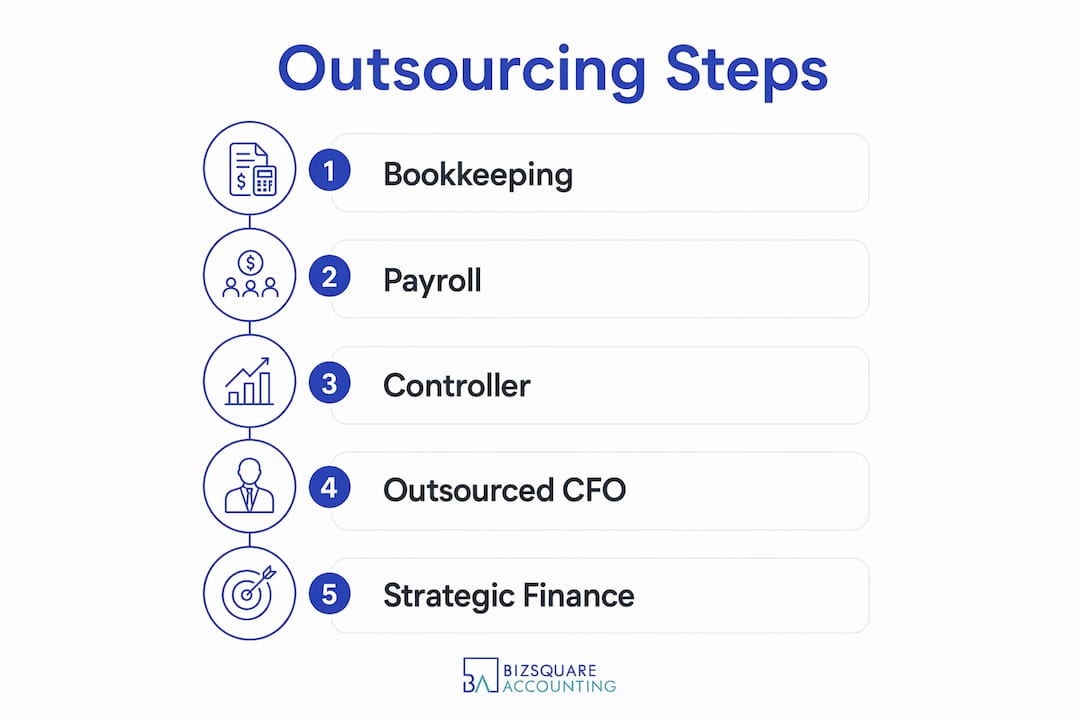
Most businesses start with bookkeeping and payroll, then add controller and outsourced CFO services as complexity grows.

Why outsourcing finance functions delivers measurable results
The efficiency gains from delegating finance work are well-documented. A 2026 survey found that 93% of CFOs outsource to fill open accounting positions, and 86% cite faster turnaround and efficiency as the primary impact.
Key statistic: 93% of CFOs outsource to fill accounting roles, and 86% report faster turnaround as the top outcome, according to a 2026 hybrid finance workforce survey.
Beyond speed, the benefits of finance outsourcing include:
- Cost flexibility: Fixed salaries, benefits, and office costs convert to a variable cost structure that scales with activity.
- Reduced turnover risk: Providers supply a stable, documented team, so one resignation does not disrupt your close cycle.
- Access to technology: Cloud accounting platforms, automated bank feeds, and reporting dashboards come included, without capital expenditure.
- Fraud risk reduction: Outsourced providers enforce segregation of duties and approval workflows that internal small teams often cannot maintain.
Outsourcing also frees owners from routine tasks, letting them redirect time toward revenue-generating work. A founder spending 15 hours a month on reconciliations, for example, can reallocate that time to client acquisition once bookkeeping is delegated.
Pro Tip: Start tracking how many hours per week your team spends on transactional finance tasks. If the total exceeds 20 hours, the efficiency case for outsourcing is almost certainly positive.
How to tell if your business is ready to outsource finance work
Certain operational signals indicate that outsourcing finance functions is the right next step.
Concrete triggers to watch for:
- Month-end close takes longer than 10 business days
- Financial reports arrive too late to inform decisions
- High staff turnover in the finance team disrupts continuity
- Cash flow visibility is inconsistent or unreliable
- The business is growing faster than the finance team can track
Revenue and complexity thresholds:
| Stage | Typical Revenue | Recommended Starting Point |
|---|---|---|
| Early | Under $1M | Bookkeeping and payroll |
| Growth | $1M–$10M | Add controller and tax services |
| Scale | $10M+ | Add FP&A and outsourced CFO |
Readiness checklist:
- [ ] Finance tasks are consuming more than 20 hours per week internally
- [ ] You have missed a tax deadline or received an IRS notice
- [ ] You cannot produce a cash flow forecast within 48 hours
- [ ] A key finance employee has recently resigned
- [ ] You are entering a new market or adding a new entity
Step-by-step: how to implement outsourced finance functions
A structured approach reduces risk and shortens the time to value. The typical implementation runs across six phases.
- Assessment (Weeks 1–2): Map current finance processes, identify gaps, and document all recurring tasks and deadlines.
- Vendor selection (Weeks 3–4): Issue a request for proposal, evaluate providers against a scoring template, and check references.
- Contract and SLA agreement (Week 5): Finalize scope, pricing, service level agreements, and data security terms.
- Onboarding (Weeks 6–8): Transfer documentation, grant system access, share sample data, and run parallel reconciliations.
- Stabilization (Weeks 9–12): Complete the first full close cycle with the provider, review accuracy, and resolve gaps.
- Optimization (Month 4 onward): Introduce automation, refine reporting, and expand scope as confidence grows.
Onboarding checklist:
- Chart of accounts and historical trial balances
- Bank and credit card access credentials
- Payroll records and employee tax forms
- Vendor and customer master lists
- Prior-year tax returns and IRS correspondence
- Existing SLAs and software login credentials
Pro Tip: Sequence the work carefully. Start with bookkeeping, then add controller services once the ledger is clean. Add an outsourced CFO only after the reporting foundation is solid.
Poor documentation at the transition stage is one of the most common failure points. Transition planning and documented processes are critical for smooth provider changes, and they also protect you if you ever need to switch vendors later.
What does outsourcing finance functions actually cost?
Providers use several pricing models. Understanding each one helps you negotiate effectively.
| Pricing Model | How It Works | Best For |
|---|---|---|
| Hourly | Billed per hour of work performed | Variable or project-based needs |
| Fixed monthly fee | Set scope for a flat monthly rate | Predictable, recurring tasks |
| Subscription tier | Bundled services at tiered price points | SMEs wanting all-in-one coverage |
| Outcome-based | Priced on deliverables or KPIs met | Performance-linked engagements |
Fractional vs. full-time cost example: A business needing 15 hours per month of controller work would pay a fraction of a $140,000 annual full-time salary by using a fractional controller priced at a monthly retainer. The math favors outsourcing at low-to-moderate hour requirements.
Hidden fees to watch for:
- Setup and data migration charges
- Out-of-scope task fees billed at premium hourly rates
- Software license pass-throughs
- Fees for additional users or entities
Negotiation levers:
- Lock in a fixed monthly scope with a defined change-order process.
- Request a 90-day trial period before committing to a long-term contract.
- Negotiate SLA credits if turnaround times are missed.
Managing risks, internal controls, and U.S. compliance
Regulatory accountability stays with your organization even when execution shifts to an external provider. This is a non-negotiable point under IRS rules, Department of Labor regulations, and GAAP standards.
Top risks to address:
- Weak segregation of duties allowing unauthorized transactions
- Data breaches exposing payroll or tax records
- Payroll misfiling triggering IRS penalties or Department of Labor audits
- Vendor lock-in from undocumented processes
Internal controls to require from any provider:
- Segregation of duties between transaction entry and approval
- Documented approval workflows for payments above defined thresholds
- Monthly bank reconciliations with management sign-off
- Audit trails for all journal entries and adjustments
Compliance note: The IRS holds the employer responsible for accurate payroll tax deposits and timely Form 941 filings, regardless of whether a third-party provider processes payroll. The AICPA recommends that businesses retain oversight of all tax filings and verify submissions independently.
Sample SLA items to include in your contract:
- Month-end close delivered within five business days
- Payroll processed with zero errors, or a defined remediation process
- Response to finance queries within one business day
- Annual SOC 2 Type II report provided by the vendor
Cloud-based finance and accounting outsourcing solutions improve reporting, reduce manual errors, and support audit readiness through documented journal workflows.
What technology should you expect from a finance outsourcing provider?
Modern providers operate on a cloud-first stack. Knowing what to expect helps you evaluate fit before signing.
Common technology stack:
- Cloud accounting platforms such as QuickBooks Online, Xero, or NetSuite
- Payroll platforms such as Gusto, ADP, or Paychex
- Automated bank feeds and reconciliation tools
- Reporting dashboards connected to your general ledger
Integration expectations:
- Data mapping between your ERP and the provider’s platform
- Single sign-on (SSO) access for authorized internal users
- API connections for bank feeds and payment processors
- A defined data migration schedule with rollback procedures
Security checklist:
- AES-256 encryption for data at rest and in transit
- Role-based access controls limiting data visibility by function
- Automated daily backups with tested recovery procedures
- A documented incident response plan with notification timelines
- Data residency confirmation for cross-border engagements
Pro Tip: Request a copy of the provider’s SOC 2 Type II report before onboarding. This report confirms that their security controls have been independently audited, which is the baseline standard for any provider handling U.S. financial data.
| Technology Area | What to Confirm |
|---|---|
| Cloud accounting | Platform name, version, and your access level |
| Payroll | Compliance with IRS e-file and state requirements |
| Reporting | Dashboard access and refresh frequency |
| Security | SOC 2 Type II certification and data residency |
How to measure whether outsourcing finance functions is working
Tracking the right KPIs tells you quickly if the engagement is delivering value.
- Month-end close days: Target five business days or fewer.
- Report accuracy rate: Aim for zero restatements per quarter.
- Accounts receivable days outstanding (DSO): Compare to your pre-outsourcing baseline.
- Accounts payable days outstanding (DPO): Monitor for payment timing improvements.
- Payroll error rate: Target zero errors per pay cycle.
- Cost per transaction: Track AP and AR processing costs monthly.
Simple ROI calculation:
| Cost Item | In-House | Outsourced |
|---|---|---|
| Salary and benefits (controller) | $140,000/year | Included in monthly fee |
| Software licenses | — | Included |
| Total estimated annual cost | $140,000 | Varies by scope |
Providers and experts recommend specific KPIs and a quarterly review schedule to track vendor performance against agreed SLAs.
Recommended review cadence:
- Monthly: KPI dashboard review with the provider’s account manager
- Quarterly: Full SLA performance review and scope adjustment discussion
- Annually: Contract renewal assessment and benchmarking against market rates
How to choose the right finance outsourcing provider
A structured evaluation process reduces the risk of a poor fit. Use this framework in selection meetings.
Selection checklist:
- CPA or CMA certifications held by senior staff
- Demonstrated experience in your industry vertical
- Technology stack compatible with your existing systems
- Written SLAs with defined remediation for missed targets
- SOC 2 Type II or equivalent security certification
- Sample reports provided before contract signing
Interview questions to ask:
- How do you handle IRS notices or payroll tax discrepancies?
- Who is our dedicated point of contact, and what is their response time commitment?
- How do you manage scope changes and out-of-scope requests?
- What is your process for month-end close, and who reviews the final output?
- How do you maintain segregation of duties within your team?
- What happens to our data if we terminate the engagement?
- Can you provide references from clients of similar size and industry?
Red flags to watch for:
- No written SLAs or vague turnaround commitments
- Reluctance to provide a SOC 2 report or security documentation
- Pricing that seems unusually low without a clear scope definition
- No dedicated account manager or single point of contact
- Inability to demonstrate experience with IRS compliance or GAAP reporting
Pro Tip: Ask for a sample month-end close package before signing. A provider confident in their output will share one readily. If they hesitate, that hesitation is informative.
For Singapore-based businesses evaluating providers, Bizsquare’s provider selection guide offers a locally-tailored checklist worth reviewing alongside this framework.
How outsourcing affects company culture and employee morale
Outsourcing finance functions changes the internal team’s role, and that shift requires careful management. When transactional tasks move externally, internal finance staff often experience uncertainty about their position. Transparent communication about the rationale, the new scope of internal roles, and the career development opportunities that come with focusing on strategic work is critical to maintaining morale.
The most successful transitions reframe outsourcing as a promotion for the internal team, not a threat. Internal staff who previously spent time on data entry and reconciliations can redirect their energy toward analysis, business partnering, and decision support. That shift tends to increase job satisfaction over time, provided leadership communicates it clearly from the outset.
Real examples of finance function outsourcing in practice
A manufacturing SME with $4 million in annual revenue outsourced its bookkeeping and payroll to a third-party provider. Within three months, the month-end close shortened from 18 days to six days. The owner reclaimed approximately 12 hours per week previously spent on finance administration.
A professional services firm with U.S. and Singapore operations outsourced its controller function to manage GAAP-compliant reporting across both jurisdictions. The firm avoided hiring a full-time controller at $140,000 per year by using a fractional engagement priced at a monthly fixed fee. For businesses exploring outsourcing as a path to growth, the fractional model consistently delivers the strongest early return.
Common outsourcing challenges and how to solve them
| Challenge | Practical Solution |
|---|---|
| Loss of visibility into daily transactions | Require a live dashboard with daily refresh and read-only access |
| Communication delays across time zones | Set fixed weekly check-in times and a maximum 4-hour response SLA |
| Inconsistent report quality in early months | Run parallel closes for the first two months before fully transitioning |
| Scope creep driving unexpected costs | Define scope in writing with a formal change-order process |
| Data security concerns | Require SOC 2 Type II certification and review the incident response plan |
Transition friction is highest in the first 90 days. Most issues resolve once the provider has completed two or three full close cycles with your data.
Best practices for staying connected with your outsourced finance team
Consistent communication is the single most reliable predictor of a successful outsourcing engagement. William C. Watts, Finance Transformation Managing Partner at Crowe, notes that “some of the best and most insightful information is often transmitted simply by having regular touchpoints to discuss the business.”
Practical communication practices:
- Assign one internal owner responsible for the provider relationship
- Hold a fixed weekly or biweekly call with a standing agenda
- Use a shared project management tool for task tracking and deadlines
- Agree on escalation paths for urgent issues before they arise
- Document all decisions and scope changes in writing
Contract negotiation tips and key clauses to include
A well-drafted contract protects both parties and sets clear expectations from day one.
Key clauses to negotiate:
- Scope of services: Define every deliverable, frequency, and output format explicitly.
- SLA and remediation: Specify turnaround times and the credit or remedy if they are missed.
- Data ownership: Confirm that all financial data remains your property at all times.
- Termination and transition: Require a 60-to-90-day transition period with full data handover.
- Confidentiality: Include non-disclosure obligations covering all financial and employee data.
- Liability cap: Agree on a maximum liability amount tied to fees paid in the prior 12 months.
- Change-order process: Define how out-of-scope requests are priced and approved.
Never sign a contract that lacks a data handover clause. Recovering your own records from an uncooperative provider is far more disruptive than any other transition risk.
Data privacy considerations beyond U.S. regulations
U.S. businesses operating internationally, or Singapore-based businesses with U.S. obligations, face overlapping data privacy frameworks. The General Data Protection Regulation (GDPR) applies when any EU resident’s data is processed, regardless of where the provider is located. Singapore’s Personal Data Protection Act (PDPA) governs the collection and use of personal data within Singapore.
When selecting a provider, confirm their compliance with the applicable framework for your jurisdiction. Key questions include: where is data stored, who has access, and how are cross-border data transfers handled? Providers handling payroll data must also comply with IRS Publication 15 requirements for record retention, which mandates keeping payroll records for at least four years.
Minimum data privacy requirements to confirm with any provider:
- GDPR compliance documentation if EU data is involved
- PDPA compliance for Singapore-based operations
- IRS record retention policy aligned to Publication 15
- Encryption standards for data in transit and at rest
- A written data breach notification procedure with defined timelines
Key Takeaways
Outsourcing finance functions delivers the strongest results when businesses start with bookkeeping, build on a clean ledger, and expand to controller and CFO services as complexity grows.
| Point | Details |
|---|---|
| Start with bookkeeping | Bookkeeping is the highest-volume, lowest-strategy function and the right first step to outsource. |
| 93% of CFOs outsource | A 2026 survey confirms 93% of CFOs outsource to fill accounting roles, with 86% citing faster turnaround. |
| Fractional cost advantage | A business needing 15 hours per month of controller work saves significantly versus a $140,000 full-time hire. |
| Compliance stays with you | IRS and Department of Labor accountability remains with the employer, even when a provider processes payroll. |
| Bizsquare covers the full scope | Bizsquare provides bookkeeping, tax filing, controller services, and outsourced CFO support for Singapore SMEs. |
The case for sequencing, not rushing
The most common mistake businesses make when outsourcing finance functions is trying to hand over everything at once. A rushed transition, without clean documentation or a stabilized ledger, creates more problems than it solves. The smarter approach is deliberate sequencing: start with the highest-volume, lowest-risk function, prove the model works, then expand.
The 93% CFO adoption figure cited earlier is striking, but the more instructive number is the 86% who report faster turnaround. Speed improvements do not come from simply handing work to an external team. They come from providers who operate documented processes, use cloud tools, and enforce SLAs that internal teams rarely have the structure to match. The efficiency gain is real, but it is earned through preparation, not delegation alone.
Two practical guardrails worth applying from the start: first, require written documentation of every process before the provider goes live, because undocumented processes are the primary reason transitions fail. Second, establish a monthly KPI review from month one, not month six, so performance gaps surface early when they are still easy to correct.
Bizsquare’s accounting and outsourced CFO services for Singapore businesses
Bizsquare Accounting works with Singapore-based entrepreneurs and SMEs who need reliable, expert-led finance support without the cost of a full in-house team. The services cover the full outsourcing spectrum: accounting and bookkeeping, corporate tax filing and advisory, and outsourced CFO and corporate advisory for businesses that need strategic financial guidance.
Before a consultation, prepare the following: your most recent financial statements, a list of recurring finance tasks and their current owners, any outstanding IRS or tax authority correspondence, and your current software stack. This preparation shortens the scoping conversation and leads to a more accurate proposal.
Contact Bizsquare to discuss your finance outsourcing needs and receive a tailored scope recommendation for your business.
Useful sources
- U.S. Chamber of Commerce: Signs You Should Outsource Your Small Business Accounting, practical indicators and provider selection criteria.
- AccountingToday: How the Hybrid Finance Workforce Creates New Value, source of the 2026 CFO outsourcing survey data.
- RSM: More Than a Back Office, Finance and Accounting Outsourcing, cost structure and audit readiness analysis.
- Finsightic: Building a Finance Team, When to Hire vs. When to Outsource, sequencing advice and fractional cost examples.
- Andersen NZ: The Benefits of Outsourcing Your Finance Function for SMEs, SME-focused cost savings and expertise access.
- Consero Global: The Complete Guide to Outsourcing Finance and Accounting, KPI frameworks and vendor performance measurement.
- IRS Publication 15 (Circular E), Employer’s Tax Guide, governing payroll tax obligations and record retention.
- AICPA guidance on internal controls and audit readiness for outsourced finance engagements.
- U.S. Department of Labor, Fair Labor Standards Act compliance resources for payroll outsourcing.
FAQ
What is outsourcing finance functions in simple terms?
Outsourcing finance functions means hiring an external provider to handle tasks such as bookkeeping, payroll, tax filing, and CFO advisory, so your internal team can focus on strategic work.
Which finance function should a business outsource first?
Bookkeeping is the recommended starting point because it is high-volume, well-defined, and low-risk, making it the easiest function to transfer to an external provider.
Does outsourcing payroll remove IRS liability from the employer?
No. The IRS holds the employer responsible for accurate payroll tax deposits and timely filings, regardless of whether a third-party provider processes payroll.
How much does outsourcing finance functions cost compared to hiring in-house?
A business needing 15 hours per month of controller work pays significantly less through a fractional engagement than through a full-time hire at $140,000 per year, making outsourcing cost-effective at low-to-moderate hour requirements.
What KPIs should you track to measure outsourcing success?
Key metrics include month-end close days, accounts receivable days outstanding, payroll error rate, and cost per transaction, reviewed monthly against the agreed SLA targets.
How do you protect data when outsourcing finance work?
Require AES-256 encryption, role-based access controls, SOC 2 Type II certification, and a written data breach notification procedure from any provider handling your financial records.
Can Singapore businesses outsource finance functions for U.S. operations?
Yes. Singapore-based businesses with U.S. entities can outsource finance functions to providers experienced in IRS compliance, GAAP reporting, and Department of Labor payroll requirements.
What is an outsourced CFO, and when does a business need one?
An outsourced CFO provides strategic financial guidance, board reporting, and capital allocation support on a fractional basis, typically suited to businesses at the $5 million revenue mark and above.
What should a service level agreement with a finance provider include?
An SLA should specify month-end close timelines, payroll accuracy standards, query response times, data security obligations, and a remediation process for missed targets.
How long does it take to fully transition finance functions to an outsourced provider?
Most businesses complete the transition within 8–12 weeks, covering assessment, onboarding, and the first stabilized close cycle, before moving into ongoing optimization.