
Financial Planning for SMEs: A 2026 Singapore Guide
Overview
– Most SME financial plans fail due to lack of ongoing commitment, not insufficient knowledge.
– Updating a living financial plan monthly ensures better cash flow management and strategic decision-making.
Financial planning for SMEs is the strategic process of managing business finances to drive profitability and sustainable growth. Yet 60% of small businesses operate without a formal financial plan, leaving them exposed to insolvency during economic shifts. This guide covers every critical component of SME financial management, from cash flow forecasting to tax planning, with practical frameworks built for Singapore business owners in 2026. The goal is to give you a clear, step-by-step path to stronger financial control and smarter decision-making.
What are the essential components of an SME financial plan?
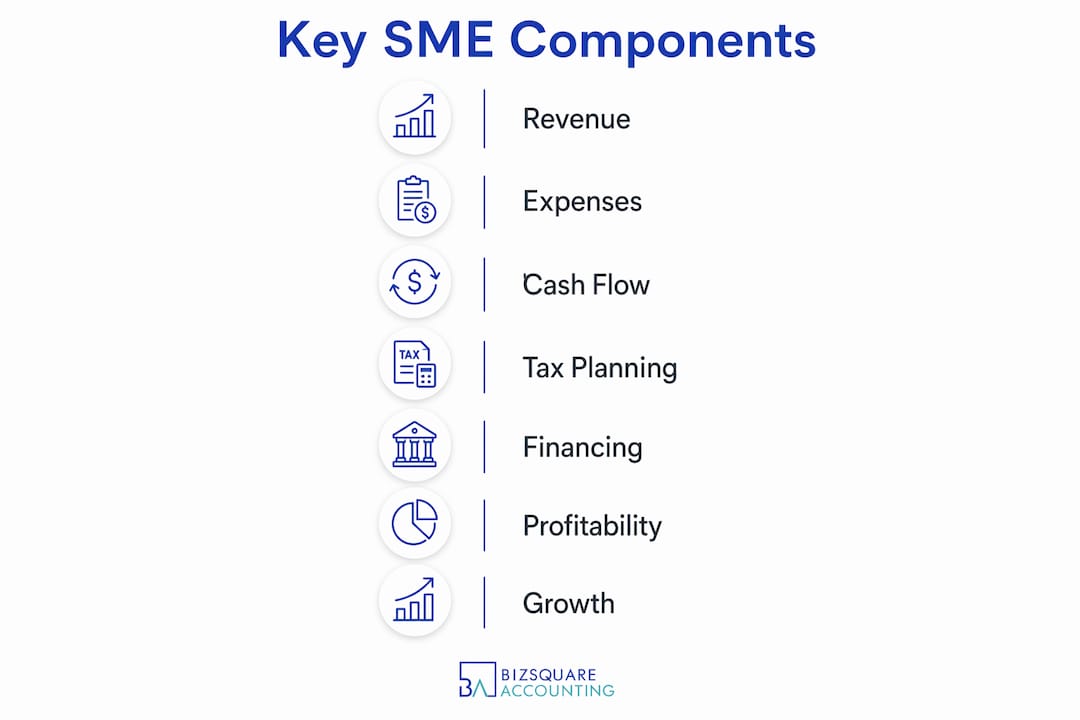
A well-structured financial plan connects every business decision back to the numbers that determine survival and growth. For Singapore SMEs, this means covering seven core pillars without exception.
1. Revenue planning
Revenue planning starts with forecasting expected income by product line, service type, or customer segment. Diversification matters here. An SME that relies on one client for 60% of revenue carries significant concentration risk. Build forecasts using historical data, confirmed contracts, and realistic pipeline estimates.

2. Expense management
Separate fixed costs (rent, salaries, software subscriptions) from variable costs (materials, commissions, freelance fees). Conduct a quarterly subscriptions audit. Many SMEs discover they are paying for tools they no longer use, which quietly erodes margins.
3. Cash flow management
Cash flow management focuses on the timing of incoming and outgoing cash, not just the total amounts. This is a critical distinction. A profitable business can still fail if it runs out of cash while waiting for invoices to be paid. Effective cash flow management is the single most important short-term survival skill for any SME.
4. Tax planning
Proactive tax planning can save SMEs 20 to 40% on their tax bill compared to reactive preparation. In Singapore, this includes optimizing your entity structure, claiming allowable deductions under the Income Tax Act, and leveraging schemes such as the Startup Tax Exemption and the Partial Tax Exemption for established companies.
5. Debt and financing strategy
Identify the right mix of equity, bank loans, government grants, and trade credit. Enterprise Singapore offers multiple grant schemes, including the Enterprise Development Grant, that can reduce the cost of growth capital significantly.
6. Profitability analysis
Service-based SMEs should target a net profit margin of 15 to 25%, while product-based businesses typically aim for 5 to 15%. These benchmarks vary by industry, but they give owners a concrete reference point for evaluating performance.
7. Growth and investment planning
Allocate capital deliberately. The 50/30/20 budgeting rule provides a practical starting framework: 50% to operating costs, 30% to growth investments, and 20% to profit and reserves. This structure balances day-to-day operations with long-term capacity building.
Pro Tip: Run a subscriptions audit every quarter. List every recurring charge, assign it to a cost center, and cancel anything that does not directly support revenue or compliance.
| Component | What it covers |
|---|---|
| Revenue planning | Income forecasting by segment and diversification strategy |
| Cash flow management | Timing of cash inflows and outflows, not just profit |
| Tax planning | Entity optimization, deductions, and Singapore-specific exemptions |
| Profitability analysis | Margin benchmarking against industry targets |
| Growth investment | Capital allocation using structured frameworks like 50/30/20 |
How to build a practical financial plan for your SME step by step
Building a financial plan does not require a finance degree. It requires discipline, the right structure, and consistent execution. Follow these steps to build a plan that actually works.
Step 1: Gather your financial statements
Pull together your income statement, balance sheet, and cash flow statement for the past 12 to 24 months. If these documents do not exist or are incomplete, start by engaging a bookkeeping service to reconstruct them. Accurate historical data is the foundation of any reliable forecast.
Step 2: Set clear financial goals
Define specific, measurable targets. Examples include: reach SGD 1.2 million in annual revenue by Q4, reduce operating costs by 8% within six months, or build a three-month cash reserve by year-end. Vague goals produce vague results.
Step 3: Build your financial models
Construct three core models: an income statement projection, a balance sheet forecast, and a cash flow forecast. For cash flow, start with a 13-week rolling forecast updated weekly. This approach spots cash shortfalls two to three weeks in advance, giving you time to act before a crisis develops.
Step 4: Choose your budgeting approach
Two methods dominate the budgeting process for SMEs. Zero-based budgeting requires every expense to be justified from scratch each period. Incremental budgeting adjusts the previous period’s figures by a percentage. Zero-based budgeting is more rigorous and often reveals hidden waste. Incremental budgeting is faster and suits stable businesses with predictable cost structures.
| Budgeting method | Best for | Key advantage |
|---|---|---|
| Zero-based budgeting | SMEs with variable costs or rapid growth | Eliminates legacy spending and forces prioritization |
| Incremental budgeting | Stable businesses with predictable costs | Faster to prepare and easier to manage monthly |
Step 5: Build scenario plans
Create three versions of your financial plan: a base case (most likely outcome), an upside case (strong growth), and a downside case (revenue shortfall or cost spike). Scenario planning prepares SMEs for uncertain market conditions and prevents reactive decision-making during downturns.
Step 6: Set a monthly review cadence
A financial plan updated monthly with actual data takes 30 to 60 minutes per session. The initial build may take a full weekend, but the ongoing maintenance is manageable. Schedule a fixed date each month, compare actuals to forecasts, and adjust forward projections accordingly.
Pro Tip: Use accounting software such as Xero or QuickBooks to automate data extraction. Pair it with a forecasting tool like Float or Cube to generate rolling cash flow projections without manual spreadsheet work.
Tools worth considering for Singapore SMEs include Xero for accounting, Float for cash flow forecasting, and Cube for financial planning and analysis. For compliance-specific guidance, the accounting best practices guide from Bizsquare covers software selection and regulatory requirements in detail.
What common mistakes do SMEs make in financial planning?
Most financial planning failures trace back to a small set of recurring errors. Recognizing them early saves significant time and money.
- Relying on intuition instead of data. Many SME owners make pricing, hiring, and expansion decisions based on gut feel. Financial models exist precisely to test assumptions before committing capital.
- Confusing budgeting with cash flow management. Budgeting tracks planned income and expenses. Cash flow management tracks when money actually moves. An SME can be profitable on paper and still miss payroll if receivables are delayed. These are two separate disciplines, and both require dedicated attention.
- Ignoring variances over 10%. Flag any budget variance over 10% immediately and investigate the cause. A variance of this size could indicate a timing issue, an overspend, or a revenue shortfall that requires a plan adjustment.
- Not updating plans regularly. A financial plan written in January and reviewed in December is not a plan. It is a historical document. Monthly updates are non-negotiable for the plan to remain useful.
- Failing to build cash reserves. A contingency buffer of 5 to 15% of operating expenses protects against liquidity crises caused by timing gaps or unexpected costs. Most Singapore SMEs hold far less than this.
- Overlooking tax planning opportunities. Reactive tax preparation, filing only when deadlines approach, costs significantly more than proactive planning. Singapore’s tax framework offers multiple legitimate avenues for reduction, including capital allowances, productivity grants, and R&D deductions.
“A financial plan that is not reviewed regularly is not a plan. It is a wish list.”
The most damaging mistake is treating financial planning as a one-time exercise. SME financial management requires ongoing attention, not a single annual effort. For a deeper look at how cash flow errors specifically affect small businesses, the cash flow management guide from Bizsquare provides practical corrective steps.
Which tools support financial planning for Singapore SMEs?
The right tools reduce the time burden of financial planning and improve accuracy significantly. Singapore SMEs have access to a strong range of software and professional services.
Accounting and forecasting software
- Xero is the most widely adopted cloud accounting platform among Singapore SMEs. It integrates with IRAS e-filing and supports multi-currency transactions.
- QuickBooks Online suits SMEs that need strong expense tracking and invoicing features alongside basic reporting.
- Float connects directly to Xero or QuickBooks and generates rolling cash flow forecasts automatically.
- Cube is designed for financial planning and analysis, offering scenario modeling and budget consolidation for growing businesses.
- Agicap specializes in cash flow management and is particularly useful for SMEs with complex payment cycles.
Professional advisory options
A fractional CFO provides senior financial leadership on a part-time basis. Advisory service costs range from SGD 1,500 for a one-time engagement to SGD 8,000 per month for ongoing fractional CFO support. For SMEs that are not yet ready for that investment, outsourced bookkeeping and accounting services provide a cost-effective foundation. The accounting services guide from Bizsquare outlines how to select the right level of support for your business stage.
Singapore-specific resources
Enterprise Singapore’s SME Portal provides access to grant information, financial toolkits, and industry benchmarks. IRAS publishes detailed guidance on deductible expenses, capital allowances, and GST registration thresholds. Both resources are free and regularly updated.
DIY vs. professional support
| Approach | Best for | Key consideration |
|---|---|---|
| DIY with software | Early-stage SMEs with simple finances | Requires owner time and basic financial literacy |
| Outsourced bookkeeping | SMEs needing accurate records without a full-time hire | Frees owner time; supports compliance |
| Fractional CFO | Growth-stage SMEs needing strategic financial guidance | Higher cost; highest strategic value |
For SMEs at the growth stage, the business advisory insights from Bizsquare explain when professional financial guidance delivers the clearest return on investment.
Key takeaways
Effective financial planning for SMEs requires a living document, updated monthly, that covers cash flow, tax, profitability, and growth investment in a single integrated framework.
| Point | Details |
|---|---|
| Build a living financial plan | Update monthly with actual data; initial build takes a weekend, reviews take 30 to 60 minutes. |
| Separate cash flow from budgeting | Budgeting tracks planned figures; cash flow tracks timing. Both require dedicated management. |
| Use the 50/30/20 rule | Allocate 50% to operations, 30% to growth, and 20% to profit and reserves as a baseline framework. |
| Flag variances over 10% immediately | Investigate the cause and adjust the plan before the variance compounds into a larger problem. |
| Build a contingency buffer | Maintain 5 to 15% of operating expenses as a reserve to absorb unexpected costs or cash timing gaps. |
Why most SME financial plans fail before they start
The most common failure in SME financial planning is not a lack of knowledge. It is a lack of commitment to the process. Many business owners build a financial plan once, file it away, and return to running the business on instinct. The plan then becomes irrelevant within 60 days.
The financial plan must function as a management tool, not a compliance document. This means reviewing it monthly, comparing actuals to forecasts, and making decisions based on what the numbers show. A business that does this consistently gains a measurable advantage over competitors who do not.
Singapore’s 2026 economic context adds urgency to this discipline. Rising operating costs, tighter credit conditions, and increased regulatory scrutiny from IRAS all create pressure on SME margins. The businesses that navigate this environment successfully are those with clear visibility into their financial position at all times.
The mindset shift that matters most is moving from reactive to proactive. Reactive financial management means responding to problems after they appear. Proactive financial management means using forecasts to anticipate problems and act before they become crises. The 13-week rolling cash flow forecast is the single most practical tool for making this shift.
For SMEs that find the process overwhelming, the right response is not to delay. It is to seek qualified help. A fractional CFO or outsourced accounting partner can build the initial framework and train the owner to maintain it. The cost of professional support is almost always lower than the cost of a financial crisis caused by poor planning.
How Bizsquare supports your SME’s financial planning
Bizsquare provides Singapore SMEs with the financial infrastructure they need to plan, grow, and stay compliant. From bookkeeping and accounting to outsourced CFO services, Bizsquare’s consultants work directly with business owners to build financial plans that reflect real business conditions.
The accounting and bookkeeping services from Bizsquare cover everything from monthly reconciliations and management accounts to cash flow reporting and tax-ready financial statements. For SMEs that need strategic guidance beyond compliance, the outsourced CFO service delivers senior financial expertise without the cost of a full-time hire. Contact Bizsquare today to schedule a consultation and take the first step toward a stronger financial foundation for your business.
FAQ
1.) What is financial planning for SMEs?
Financial planning for SMEs is the process of forecasting revenue, managing expenses, controlling cash flow, and allocating capital to achieve specific business goals. It connects every major business decision to measurable financial outcomes.
2.) How often should an SME update its financial plan?
A financial plan should be updated monthly with actual performance data. Monthly updates take 30 to 60 minutes and keep the plan accurate and useful for decision-making.
3.) What is the difference between budgeting and cash flow management?
Budgeting tracks planned income and expenses over a period. Cash flow management tracks the timing of actual cash movements. A business can show a profit in its budget while still running out of cash if payments are delayed.
4.) What cash reserve should a Singapore SME maintain?
SMEs should maintain a contingency buffer of 5 to 15% of operating expenses, plus a minimum of three to six months of operating costs as a cash reserve to cover unexpected disruptions.
5.) What budgeting method works best for SMEs?
Zero-based budgeting works best for SMEs with variable costs or rapid growth, as it forces every expense to be justified. Incremental budgeting suits stable businesses with predictable cost structures and limited time for detailed reviews.
6.) How much can proactive tax planning save an SME?
Proactive tax planning can save SMEs 20 to 40% on their tax bill compared to reactive preparation. Singapore-specific strategies include entity structure optimization, capital allowance claims, and productivity-related deductions.
7.) What is a 13-week rolling cash flow forecast?
A 13-week rolling cash flow forecast is a short-term financial tool that tracks expected cash inflows and outflows over the next 13 weeks, updated weekly. It helps SMEs spot cash shortfalls two to three weeks in advance.
8.) When should an SME hire a fractional CFO?
An SME should consider a fractional CFO when it reaches a growth stage that requires strategic financial guidance beyond basic bookkeeping. Costs range from SGD 1,500 for a one-time engagement to SGD 8,000 per month for ongoing support.
9.) What tools support financial planning for Singapore SMEs?
Xero and QuickBooks handle accounting and compliance. Float and Agicap specialize in cash flow forecasting. Cube supports financial planning and analysis for growing businesses with more complex reporting needs.
10.) What is the 50/30/20 rule in business budgeting?
The 50/30/20 rule allocates 50% of revenue to operating costs, 30% to growth investments, and 20% to profit and reserves. It provides a structured framework for balancing current operations with long-term financial health.
11.) How do I know if my SME’s profit margin is healthy?
Service-based SMEs should target a net profit margin of 15 to 25%. Product-based businesses typically aim for 5 to 15%. Margins below these benchmarks signal a need to review pricing, cost structure, or both.
12.) What grants are available for Singapore SMEs in 2026?
Enterprise Singapore administers several grant schemes, including the Enterprise Development Grant, which supports capability building, market expansion, and innovation. Eligibility criteria and funding caps are updated periodically on the Enterprise Singapore website.
13.) What happens if I ignore budget variances?
Ignoring variances greater than 10% allows small financial problems to compound into larger ones. Immediate investigation of significant variances allows faster course correction and maintains the accuracy of the financial plan over time.