

TL;DR:
- GST registration enables Singapore businesses to legally collect and remit Goods and Services Tax once their taxable turnover exceeds S$1 million. Businesses must register within 30 days after crossing or forecasting the threshold, with the process managed online through IRAS’s portal. Being GST-registered offers input tax recovery, enhanced credibility, and access to larger contracts, but requires ongoing compliance with filing and record-keeping obligations.
GST registration is the official process by which a Singapore business obtains authorization from the Inland Revenue Authority of Singapore (IRAS) to collect and remit Goods and Services Tax. The standard rate currently stands at 9%, applied to most goods and services sold locally. Every business that crosses the S$1 million taxable turnover/gst-registration-deregistration/do-i-need-to-register-for-gst) threshold must register, by law, with IRAS. Missing that deadline carries real financial penalties. This guide explains who must register, how the process works step by step, and what obligations follow registration, so business owners can act with confidence.
What is GST registration and who needs it in Singapore?
GST registration is the formal enrollment of a business into Singapore’s Goods and Services Tax system. Once registered, a business charges GST on its taxable sales, files periodic returns, and remits the net tax to IRAS. The registration threshold, not the business size or structure, determines legal obligation.

IRAS applies two tests to determine whether a business must register.
The retrospective view looks backward. A business must register if its taxable turnover exceeded/gst-registration-deregistration/do-i-need-to-register-for-gst) S$1 million in the past calendar year. The calendar year runs from january 1 to december 31. If the threshold is crossed by december 31, the business must apply within 30 days of the year’s end.
The prospective view looks forward. A business must register if it reasonably expects its taxable turnover to exceed S$1 million in the next 12 months. The registration application/gst-registration-deregistration/do-i-need-to-register-for-gst) must be submitted within 30 days of making that forecast. IRAS then registers the business effective 31 days after the forecast date.
What counts as taxable turnover?
Taxable turnover/gst-registration-deregistration/do-i-need-to-register-for-gst) is the total value of standard-rated and zero-rated supplies a business makes in Singapore. It excludes exempt supplies, such as financial services and residential property rentals, and out-of-scope supplies. A business that sells both taxable and exempt goods must calculate turnover carefully, because only the taxable portion counts toward the S$1 million threshold.
Voluntary and overseas vendor registration
Not every business that registers is legally required to do so. Voluntary registration/gst-registration-deregistration/do-i-need-to-register-for-gst) is available to businesses below the threshold that want to claim input tax credits on their purchases. This option suits businesses with significant GST costs on supplies. Separately, overseas vendors/gst-registration-deregistration/do-i-need-to-register-for-gst) supplying digital services or low-value goods to Singapore consumers must register under the Overseas Vendor Registration regime, even without a physical presence in Singapore.
Pro Tip: If your business buys heavily from GST-registered suppliers but your sales are below S$1 million, voluntary registration can recover significant input tax costs. Calculate your annual GST costs on purchases before deciding.
How to complete the GST registration process
The GST registration process runs entirely online through the IRAS myTax Portal. The steps below apply to most Singapore-incorporated businesses. Follow each step carefully to avoid delays or rejection.
Step-by-step registration guide
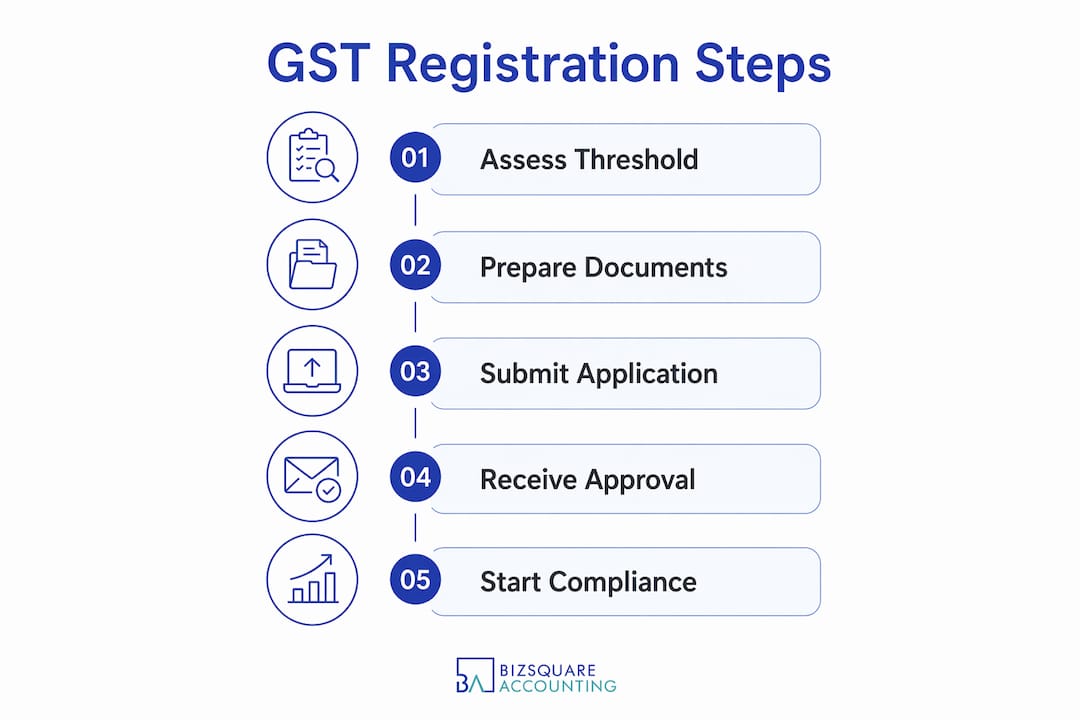
Log in to myTax Portal. Access the portal at mytax.iras.gov.sg using your Singpass or Corppass credentials. Directors and authorized personnel can log in on behalf of the company.
Select “Register for GST.” Navigate to the GST section and choose the registration application. The portal guides you through a series of questions about your business type and turnover.
Declare your registration basis. State whether you are registering under the retrospective view, the prospective view, or voluntarily. Each basis requires different supporting information.
Provide business details. Enter your Unique Entity Number (UEN), business activity description, financial year end, and expected taxable turnover figures.
Upload supporting documents. For prospective registration, documentary evidence/gst-registration-deregistration/do-i-need-to-register-for-gst) such as signed contracts, sales projections, or business plans is required. For retrospective registration, provide financial statements or sales records confirming the turnover exceeded S$1 million.
Submit the application. Review all entries before submitting. IRAS typically processes straightforward applications within 10 working days. Complex cases may take longer.
Receive your GST registration number. IRAS issues a GST registration number upon approval. Display this number on all tax invoices issued to customers.
Set up your accounting system. Configure your accounts to track output tax collected and input tax paid separately. This separation is critical for accurate GST return filing.
Key deadlines to remember
The retrospective deadline is 30 days after the end of the calendar year in which turnover exceeded S$1 million. The prospective deadline is 30 days after the date the business forecasts it will exceed the threshold. Missing either deadline exposes the business to IRAS penalties.
Pro Tip: Set a calendar reminder every december to review your annual taxable turnover. Early awareness gives you time to prepare documents and file on time, rather than scrambling in january.
For businesses that also need to understand broader Singapore tax filing obligations, reviewing corporate tax requirements alongside GST registration creates a cleaner compliance picture.
Benefits and obligations of being GST-registered
GST registration is not only a compliance requirement. It carries tangible financial and reputational benefits for Singapore businesses.
Key benefits of GST registration
- Input tax recovery. GST-registered businesses/gst-registration-deregistration/do-i-need-to-register-for-gst) can claim input tax credits on GST paid for business purchases. This directly reduces operating costs and improves cash flow.
- Business credibility. Customers and corporate partners often view GST registration as a sign of an established, compliant business. It signals that the company has crossed a meaningful revenue threshold.
- Access to larger contracts. Many government agencies and large corporations prefer or require their suppliers to be GST-registered. Registration opens doors to contracts that would otherwise be unavailable.
- Accurate financial records. The discipline required for GST compliance, including systematic record-keeping, strengthens overall financial management.
Ongoing obligations after registration
Registration brings responsibilities that must be met consistently. GST returns must be filed/filing-gst) through the IRAS myTax Portal by the due dates, typically within one month after the end of each accounting period. Most businesses file quarterly, though some file monthly. The net GST payable is the output tax collected minus the input tax credits claimed.
Authorized users/filing-gst/overview-of-gst-e-filing-process) can file GST returns directly or through a tax agent authorized via Corppass. Businesses must assign the correct digital roles in Corppass to allow agents or employees to file on their behalf. Failure to assign roles correctly causes filing delays.
Record-keeping is a core obligation. IRAS requires businesses to retain all tax invoices, receipts, and accounting records for at least five years. These records support any input tax claims made in GST returns.
Penalties for late registration/gst-registration-deregistration/do-i-need-to-register-for-gst) or non-compliance are real and material. IRAS may impose fines and require the business to pay GST it should have collected from the date it was first liable to register. That backdated liability can be substantial for a fast-growing business. For a broader view of how IRAS tax compliance works in practice, professional accounting guidance is the most reliable safeguard.
Common challenges and expert tips for GST compliance
GST compliance is straightforward in principle but demands consistent attention in practice. Several common issues trip up business owners, particularly those managing GST for the first time.
Turnover tracking and forecasting
Many businesses underestimate how quickly taxable turnover accumulates. A business with multiple revenue streams, including consulting fees, product sales, and service retainers, must add all taxable supplies together. Exempt supplies, such as interest income, do not count, but every taxable dollar does.
- Maintain a monthly revenue tracker. Update it with all taxable sales, not just invoiced amounts. Accrual-basis accounting gives a more accurate picture than cash receipts alone.
- Review turnover at the six-month mark each year. If you are on track to exceed S$1 million by december, begin preparing your registration documents in advance.
- Keep contracts and sales projections on file. These serve as documentary evidence if IRAS asks you to justify a prospective registration.
Overseas vendor registration nuances
Overseas businesses selling digital services or low-value goods to Singapore consumers face a separate registration path. The Overseas Vendor Registration regime requires these vendors to register, collect, and remit GST even without a Singapore entity. Singapore-based businesses that purchase services from unregistered overseas vendors may need to account for GST under the reverse charge mechanism. Understanding which transactions trigger reverse charge is critical for accurate return filing.
Record-keeping best practices
- Issue tax invoices for every taxable sale above S$1,000. For sales below S$1,000, a simplified tax invoice is acceptable.
- Reconcile your GST accounts monthly, not quarterly. Monthly reconciliation catches errors before they compound into a larger problem at filing time.
- Store digital copies of all invoices and receipts in an organized folder structure, sorted by accounting period.
Pro Tip: Use accounting software that separates output tax and input tax automatically. Manual spreadsheets work at low volume but become error-prone as transaction counts grow. A clean digital audit trail also speeds up any IRAS review.
When to seek professional help
GST compliance becomes complex when a business has mixed supplies, overseas transactions, or rapid revenue growth. A qualified accounting firm can review your turnover calculations, prepare your registration application, and manage ongoing filings. For Singapore SMEs, the cost of professional accounting and bookkeeping services is typically far lower than the cost of a penalty or a backdated GST liability.
Key Takeaways
GST registration in Singapore is a mandatory legal obligation for businesses with taxable turnover exceeding S$1 million, and missing the deadline triggers backdated tax liability plus IRAS penalties.
| Point | Details |
|---|---|
| Registration threshold | Businesses must register when taxable turnover exceeds S$1 million, retrospectively or prospectively. |
| Application deadline | Submit the GST registration application within 30 days of crossing or forecasting the threshold. |
| Input tax recovery | Registered businesses claim input tax credits on purchases, reducing net GST costs. |
| Filing obligation | GST returns must be filed via IRAS myTax Portal, typically quarterly, within one month of each period end. |
| Penalty risk | Late or missed registration triggers backdated GST liability and IRAS fines from the date of first liability. |
GST registration is a growth signal, not just a compliance box
From my perspective, the business owners who handle GST registration best are the ones who treat it as a financial milestone rather than a bureaucratic burden. Crossing S$1 million in taxable turnover is a meaningful achievement. The registration process is IRAS’s way of formally recognizing that your business has reached a scale where it participates in the broader tax system.
The most common mistake I see is reactive turnover tracking. Business owners wait until december, realize they have crossed the threshold, and then scramble to file within 30 days. That scramble leads to errors, missing documents, and sometimes late submissions. The fix is simple: track taxable turnover monthly, review it at mid-year, and prepare your registration package before you need it.
Voluntary registration deserves more attention than it gets. A business spending heavily on GST-bearing inputs, such as equipment, professional services, or imported goods, can recover those costs through input tax credits. For capital-intensive startups, voluntary registration can meaningfully improve cash flow in the early years.
Staying current with IRAS rule changes is non-negotiable. The Overseas Vendor Registration regime, the reverse charge mechanism, and the GST rate adjustments in recent years all demonstrate that Singapore’s GST framework evolves. Subscribing to IRAS e-Tax guides and working with a qualified accounting firm keeps your business ahead of those changes, not behind them.
— Vandro
How Bizsquare can support your GST registration and compliance
GST registration is one of several compliance obligations that grow with your business. Bizsquare Accounting helps Singapore entrepreneurs and SMEs manage the full compliance cycle, from company incorporation and GST registration to ongoing bookkeeping and corporate tax filing.

Bizsquare’s team of consultants reviews your taxable turnover, prepares your IRAS application, and sets up your accounting system to track output and input tax accurately. After registration, Bizsquare manages your quarterly GST returns, reconciles your accounts, and flags any compliance risks before they become penalties. Business owners who work with Bizsquare spend less time on tax administration and more time on growing their companies. Reach out to Bizsquare to discuss your GST registration needs and get your compliance calendar in order.
FAQ
What is GST registration in Singapore?
GST registration is the process of enrolling a business with IRAS to legally collect and remit Goods and Services Tax. It is mandatory for businesses whose taxable turnover exceeds S$1 million.
Who needs to register for GST?
Any Singapore business with taxable turnover exceeding S$1 million in the past calendar year or expected to exceed S$1 million in the next 12 months must register. Overseas vendors supplying digital services or low-value goods to Singapore consumers must also register under the Overseas Vendor Registration regime.
What documents are needed for GST registration?
For prospective registration, IRAS requires documentary evidence supporting the turnover forecast, such as signed contracts, sales records, or business plans. For retrospective registration, financial statements confirming turnover above S$1 million are required.
How do I file GST returns after registration?
GST returns are filed electronically through the IRAS myTax Portal. Authorized users or tax agents with Corppass access can submit returns on behalf of the business, typically within one month after each quarterly accounting period ends.
What happens if I register for GST late?
IRAS may impose fines and require the business to pay GST it should have collected from the date it first became liable to register. That backdated liability applies even if the business did not charge customers GST during the unregistered period.
Can a small business register for GST voluntarily?
A business below the S$1 million threshold can apply for voluntary GST registration. This is beneficial for businesses with significant GST costs on purchases, as registration allows them to claim input tax credits and recover those costs.
How long does GST registration take?
IRAS typically processes straightforward GST registration applications within 10 working days. Complex cases or incomplete applications may take longer.
What is taxable turnover for GST purposes?
Taxable turnover is the total value of standard-rated and zero-rated supplies made in Singapore. It excludes exempt supplies such as financial services and residential property rentals, and out-of-scope supplies.
How often do GST-registered businesses need to file returns?
Most GST-registered businesses file returns quarterly. Some businesses file monthly, depending on their accounting period as approved by IRAS. Returns are due within one month after the end of each accounting period.
What is the current GST rate in Singapore?
The current GST rate in Singapore is 9%, applicable to most standard-rated goods and services. Zero-rated supplies, such as exports and international services, are taxed at 0%.
Can a tax agent file GST returns on my behalf?
A tax agent authorized through Corppass can file GST returns on behalf of a registered business. The business must assign the appropriate Corppass digital roles to the agent before filing can proceed.
What records must a GST-registered business keep?
GST-registered businesses must retain all tax invoices, receipts, and accounting records for at least five years. These records support input tax claims and must be available for any IRAS audit or review.