

TL;DR:
- Company registration in Singapore legally creates a business entity with separate legal status under ACRA. It offers limited liability, tax benefits, and enhanced credibility, essential for growth and financing. The process involves online application, document preparation, and compliance with legal requirements, with personalized support from firms like Bizsquare.
Company registration is the legal process of creating a business entity that is separate from its owners, allowing it to operate, own assets, and enter contracts under Singapore law. This process is formally known as business incorporation, and the two terms are used interchangeably in Singapore’s regulatory context. The governing body is the Accounting and Corporate Regulatory Authority, commonly known as ACRA, which administers all registrations under the Singapore Companies Act. Entrepreneurs who complete this process gain legal recognition, limited liability protection, and access to government schemes that unregistered businesses cannot use. Understanding the company registration process from the start saves time, money, and avoids costly compliance errors later.
What is company registration and why does it matter in Singapore?
Company registration is defined as the formal act of incorporating a business entity with ACRA, giving it a distinct legal identity separate from its founders. This separation is the foundation of limited liability, meaning the personal assets of directors and shareholders are protected if the company faces debt or legal action. Without registration, a business operates as a sole proprietorship or informal arrangement, which offers no such protection.

Singapore’s Companies Act sets the legal framework for all incorporated entities. The Act specifies the rights and duties of directors, shareholders, and company secretaries. Every registered company receives a Unique Entity Number (UEN) from ACRA, which serves as its official identifier for all government and business transactions.
The distinction between company registration and business incorporation is subtle but worth noting. Registration refers to the broader act of recording a business with the authorities. Incorporation specifically refers to creating a company with a separate legal personality, which is the most common and preferred structure for entrepreneurs in Singapore.
What are the key legal requirements for registering a company in Singapore?
Singapore sets clear and accessible requirements for company registration. Any person above 18 can register a company, regardless of nationality. This means foreign entrepreneurs can incorporate in Singapore without needing to be a citizen or permanent resident, provided they meet other conditions.
The core legal requirements are as follows:
- At least one resident director: At least one director must ordinarily reside in Singapore. This person can be a Singapore citizen, permanent resident, or an Employment Pass or Dependent Pass holder. Foreign founders who do not reside in Singapore must appoint a local nominee director.
- At least one shareholder: A Singapore company requires a minimum of one shareholder. The shareholder can be an individual or a corporate entity. A single person can serve as both the sole director and the sole shareholder.
- Minimum paid-up capital of S$1: Companies can register with a paid-up capital as low as S$1. This capital can be increased at any time after incorporation, making entry accessible for early-stage founders.
- A company secretary within six months: A resident company secretary must be appointed within six months of incorporation. The company secretary handles statutory filings and ensures ongoing compliance with ACRA.
- A registered Singapore office address: The company must have a physical Singapore address as its registered office. A P.O. box does not qualify. This address is publicly listed in ACRA’s records.
- A company constitution: This document governs the internal rules of the company, including how decisions are made and how shares are managed. ACRA provides a model constitution, but companies can draft a customized version.
Pro Tip: Foreign entrepreneurs who cannot serve as a resident director should engage a professional nominee director service early. Delays in appointing a resident director are one of the most common reasons incorporation applications stall.
Directors must be at least 18 years old and must not be bankrupt or have been convicted of certain offenses. These conditions apply to all directors, regardless of nationality. Checking eligibility before submitting the application prevents unnecessary rejections.
What are the steps involved in the company registration process in Singapore?
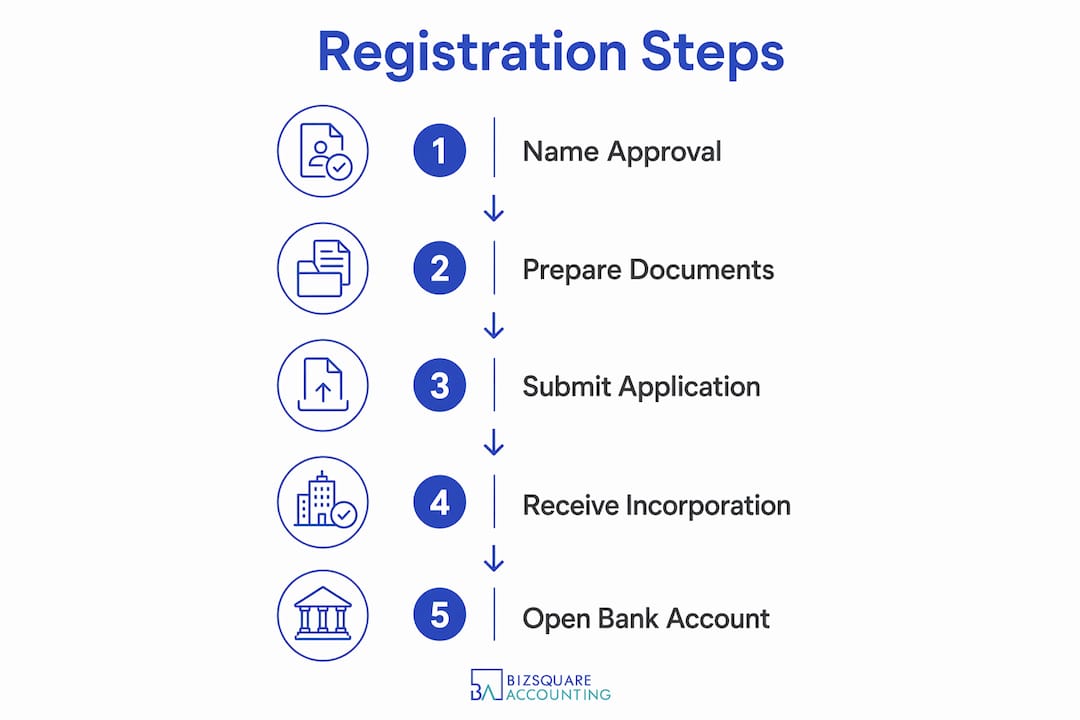
The company registration process in Singapore is conducted entirely online through ACRA’s BizFile+ portal. The process is straightforward when documents are prepared correctly in advance. Here are the steps to register a business in Singapore:
Check and reserve your company name. Search the BizFile+ portal to confirm your preferred name is available. ACRA charges S$15 for name approval. Names that are identical to existing companies, offensive, or restricted by law will be rejected. Approved names are reserved for 120 days.
Prepare your statutory documents. These include the company constitution, the consent to act as director (Form 45), and the consent to act as company secretary. Each director and the company secretary must sign their respective consent forms before submission.
Gather identification documents. All directors and shareholders must provide identification. Singapore residents submit their NRIC numbers. Foreign individuals submit passport copies and proof of residential address.
Submit the incorporation application on BizFile+. The application is filed online. The registration fee is S$300, bringing the total government fee to S$315 when combined with the name approval fee. Most applications are approved within one to three business days.
Receive your Certificate of Incorporation. ACRA issues an electronic Certificate of Incorporation upon successful registration. This certificate confirms the company’s legal existence and includes the UEN. No physical certificate is issued.
Obtain your Business Profile. After incorporation, download the company’s Business Profile from BizFile+. This document contains key details such as the registered address, directors, and shareholders. Banks and government agencies use it to verify the company’s status.
Open a corporate bank account. A corporate bank account is separate from personal accounts and is required for proper financial management. Most banks in Singapore require the Certificate of Incorporation and Business Profile to open an account.
Pro Tip: Prepare all documents before starting the BizFile+ application. Incomplete submissions cause delays and may require resubmission. A checklist reviewed by a corporate secretary saves significant time.
The steps to register a business are designed to be completed quickly. Entrepreneurs who prepare thoroughly can complete the entire process within a week. Engaging a professional firm like Bizsquare to handle the incorporation steps reduces errors and speeds up approval.
What are the different types of companies available for registration in Singapore?
Singapore offers several business structures, and selecting the right one affects taxation, liability, and governance. The most common structure for entrepreneurs is the private limited company, but understanding all options helps founders make an informed decision.
| Business Structure | Members / Owners | Liability | Best For |
|---|---|---|---|
| Private Limited Company (Pte. Ltd.) | 1–50 members | Limited to share capital | Startups, SMEs, growing businesses |
| Public Company Limited by Shares | More than 50 members | Limited to share capital | Large enterprises seeking public investment |
| Sole Proprietorship | 1 owner | Unlimited personal liability | Freelancers, very small operations |
| General Partnership | 2–20 partners | Unlimited personal liability | Small professional practices |
| Limited Liability Partnership (LLP) | Minimum 2 partners | Limited for each partner | Professional firms, joint ventures |
Private companies in Singapore are capped at 50 members and are not listed on the Singapore Exchange (SGX). This structure is the preferred choice for startups and SMEs because it combines limited liability with simpler governance requirements compared to public companies.
The private limited company structure is the most tax-efficient option for most entrepreneurs. It qualifies for the Start-Up Tax Exemption scheme and other IRAS incentives that sole proprietorships and partnerships do not access. The company also continues to exist independently of its owners, which means ownership can be transferred through share sales without disrupting operations.
Sole proprietorships and general partnerships are simpler to set up but carry unlimited personal liability. This means the owner’s personal savings, property, and assets are at risk if the business incurs debts. For any entrepreneur planning to grow, a private limited company is the more protective and credible structure.
What are the benefits and ongoing compliance obligations after company registration?
Registering a company in Singapore delivers concrete advantages that extend well beyond legal recognition. The benefits of company registration include limited liability, tax incentives, and access to financing that unregistered businesses simply cannot obtain.
Key benefits include:
- Limited liability protection: The company is a separate legal entity. Shareholders are only liable up to the value of their shares, protecting personal assets from business debts.
- Tax advantages: Singapore’s corporate tax rate is capped at 17%, and newly incorporated companies qualify for the Start-Up Tax Exemption, which reduces tax on the first S$200,000 of chargeable income for the first three years.
- Business credibility: Registered companies signal governance standards to clients, suppliers, and investors. A “Pte. Ltd.” designation builds trust that sole proprietorships cannot match.
- Access to funding: Banks, venture capital firms, and government grants require a registered company. Unregistered businesses are excluded from most formal financing channels.
- Perpetual succession: The company continues to exist even if directors or shareholders change, providing operational stability.
Pro Tip: Apply for the Start-Up Tax Exemption through IRAS immediately after incorporation. Missing the eligibility window in the first year of assessment is a common and costly oversight.
Post-registration compliance is mandatory and ongoing. Annual filing with ACRA keeps the company in good standing. Key obligations include:
- Filing annual returns with ACRA within the prescribed deadlines
- Holding an Annual General Meeting (AGM) unless the company is exempt
- Maintaining proper accounting records and financial statements
- Appointing an auditor if the company does not qualify for audit exemption
- Updating ACRA promptly when directors, shareholders, or the registered address changes
Accounting and bookkeeping obligations begin from the first day of business. Accurate records support tax filing, investor reporting, and compliance audits. Entrepreneurs who engage professional accounting and bookkeeping services from the start avoid the costly task of reconstructing records later.
The most common compliance pitfalls are missing annual return deadlines, failing to appoint a company secretary on time, and neglecting to update ACRA when company details change. ACRA imposes financial penalties for late filings, and persistent non-compliance can result in the company being struck off the register.
Key Takeaways
Company registration in Singapore is the legal act of incorporating a separate business entity with ACRA, and completing it correctly from the start determines the company’s legal standing, tax eligibility, and long-term compliance health.
| Point | Details |
|---|---|
| Legal identity through ACRA | Registration creates a separate legal entity governed by the Singapore Companies Act. |
| Resident director is mandatory | At least one director must ordinarily reside in Singapore before registration is approved. |
| Government fees total S$315 | Name approval costs S$15 and registration costs S$300, payable to ACRA via BizFile+. |
| Private limited company is preferred | This structure offers limited liability, tax exemptions, and credibility for startups and SMEs. |
| Compliance starts at incorporation | Annual ACRA filings, a company secretary within six months, and proper bookkeeping are all mandatory. |
Why the company constitution deserves more attention than most founders give it
Most first-time founders treat the company constitution as a formality. They accept ACRA’s model constitution without reading it carefully, sign the documents, and move on. That approach works until it doesn’t.
The company constitution is the foundational legal document that governs how the company is managed, how decisions are made, and how disputes between shareholders are resolved. A generic constitution may not reflect the actual intentions of the founders. For example, it may not specify pre-emption rights, which give existing shareholders the first right to buy shares before they are sold to outsiders. Without this clause, a co-founder could sell their stake to an unwanted third party.
The BizFile+ portal and the registration process itself are genuinely efficient. Singapore has built one of the most accessible incorporation systems in the world. The technology is not the problem. The problem is that entrepreneurs focus on speed and underestimate the legal weight of the documents they are signing.
Engaging a professional corporate secretary or a firm like Bizsquare to review the constitution before submission is not an unnecessary expense. It is the single most cost-effective legal step a founder can take at incorporation. Disputes over governance that arise years later cost far more to resolve than a proper constitution costs to draft.
The registration process is the right moment to get this right. Once the company is operating and shareholders have different interests, amending the constitution requires agreement from all parties, which is rarely simple.
— Vandro
How Bizsquare helps entrepreneurs register a company in Singapore
Starting a business in Singapore is straightforward when you have the right support. Bizsquare provides company incorporation services that cover every step, from name reservation and document preparation to submission with ACRA and post-registration compliance.
Bizsquare’s team handles the full Singapore incorporation process on your behalf, including drafting the company constitution, coordinating resident director appointments, and setting up corporate secretarial support from day one. Entrepreneurs get a registered company quickly, with all statutory documents in order and no compliance gaps. For ongoing needs, Bizsquare also provides accounting, bookkeeping, and corporate advisory services to keep your business in good standing with ACRA and IRAS year after year.
FAQ
What is company registration in Singapore?
Company registration is the legal process of incorporating a business entity with ACRA under the Singapore Companies Act. It gives the company a separate legal identity, a Unique Entity Number, and the right to conduct business in Singapore.
How much does it cost to register a company in Singapore?
The total government fee is S$315, which covers S$15 for name approval and S$300 for the registration application, both payable to ACRA through the BizFile+ portal.
Who can register a company in Singapore?
Any person above 18 years of age can register a company in Singapore, regardless of nationality. At least one director must ordinarily reside in Singapore.
What documents are needed for company registration?
Required documents include the company constitution, signed consent forms from all directors and the company secretary, and identification documents for all directors and shareholders.
How long does the company registration process take?
Most applications submitted through BizFile+ are approved within one to three business days, provided all documents are complete and accurate.
What is the minimum paid-up capital to register a company in Singapore?
The minimum paid-up capital is S$1. This amount can be increased at any time after the company is incorporated.
Do foreign entrepreneurs need a local director to register a company in Singapore?
Yes. At least one director must ordinarily reside in Singapore. Foreign entrepreneurs who do not reside in Singapore must appoint a nominee resident director to meet this requirement.
What is a company secretary and when must one be appointed?
A company secretary is a statutory officer responsible for compliance filings and record-keeping. Singapore law requires one to be appointed within six months of incorporation.
What is the difference between a sole proprietorship and a private limited company?
A sole proprietorship carries unlimited personal liability, meaning the owner’s personal assets are at risk. A private limited company limits liability to the value of shares held, protecting personal assets.
What happens after a company is registered in Singapore?
After registration, ACRA issues an electronic Certificate of Incorporation. The company must then open a corporate bank account, appoint a company secretary, and begin meeting annual filing and accounting obligations.
What is the company constitution and why does it matter?
The company constitution is a legal document that governs the internal management and shareholder relations of the company. A carefully drafted constitution prevents governance disputes and protects founders’ interests.
Can a single person own and run a registered company in Singapore?
Yes. One person can serve as both the sole director and the sole shareholder of a Singapore private limited company, provided they meet the residency and age requirements.
What are the ongoing compliance requirements after company registration?
Registered companies must file annual returns with ACRA, maintain proper accounting records, hold AGMs unless exempt, and update ACRA when company details change. Professional corporate secretary services help manage these obligations efficiently.