

TL;DR:
- Company incorporation in Singapore establishes a separate legal entity, limiting personal liability and enhancing credibility. The process involves reserving a name, preparing documents, appointing a resident director and secretary, and establishing a local address, typically completed within days. Incorporation offers significant advantages over registration, including access to funding, tax benefits, and long-term business stability.
Company incorporation is the formal legal process of registering a business as a separate legal entity from its owners. This means the company can own assets, incur debt, and enter contracts in its own name. The Accounting and Corporate Regulatory Authority, known as ACRA, governs this process in Singapore. Incorporation also limits the personal liability of shareholders and directors, which is one of its most significant advantages. For entrepreneurs building a business in Singapore, understanding what company incorporation means, and what it requires, is the first step toward making a sound structural decision.
What is company incorporation and why does it matter?
Incorporation is the legal process of forming a corporation as a distinct legal entity, separate from the individuals who own or manage it. This distinction carries real legal weight. Once incorporated, the company holds its own rights and obligations under Singapore law.
The most practical consequence of this separation is limited liability. Shareholders are not personally responsible for company debts beyond the value of their shares. This protection is not available to sole proprietors or general partners, who remain personally exposed to all business liabilities.
Incorporation also signals credibility. Banks, investors, and government agencies treat incorporated entities differently from unregistered businesses. A registered company under ACRA carries a level of governance that a freelancer or informal business simply cannot match.
The term “company registration” is sometimes used interchangeably with incorporation, but the two are not identical. Registration may only record a business name or license. Incorporation, by contrast, creates a separate legal entity with its own legal standing, which is a fundamentally different outcome.
What are the key steps to incorporate a company in Singapore?
The company registration process in Singapore follows a clear sequence. ACRA manages all filings through its BizFile+ portal, which is the official online platform for business registration and compliance.
Reserve your company name. Submit your proposed company name through BizFile+. ACRA reviews names for uniqueness and compliance with naming guidelines. Approval typically takes one to two business days.
Prepare your incorporation documents. This includes the company’s constitution (formerly called the Memorandum and Articles of Association), details of shareholders, directors, and the company secretary, and the registered office address in Singapore.
File the Articles of Incorporation with ACRA. Filing the Articles of Incorporation requires providing the business purpose, share structure, and company details. This step officially creates the corporation under Singapore law.
Appoint a resident director. Singapore law requires every company to have at least one resident director who is ordinarily resident in Singapore. This means the person must be a Singapore citizen, permanent resident, or EntrePass or Employment Pass holder. Foreign founders who do not qualify must appoint a nominee director.
Appoint a company secretary. A qualified company secretary must be appointed within six months of incorporation. The secretary handles statutory filings, maintains registers, and supports ACRA compliance. Bizsquare provides corporate secretary services that cover these obligations fully.
Establish a registered office address. The company must have a physical Singapore address, open to the public during business hours, for official correspondence.
Once all documents are submitted and approved, ACRA typically completes incorporation within one to three business days for straightforward applications.
Pro Tip: Prepare all director and shareholder identification documents, including passport copies and proof of residential address, before starting the BizFile+ filing. Missing documents are the most common cause of delays.

What are the benefits of company incorporation compared to other business structures?
The benefits of company incorporation extend well beyond legal protection. Incorporated companies access financing options, tax incentives, and operational continuity that other business structures cannot offer.
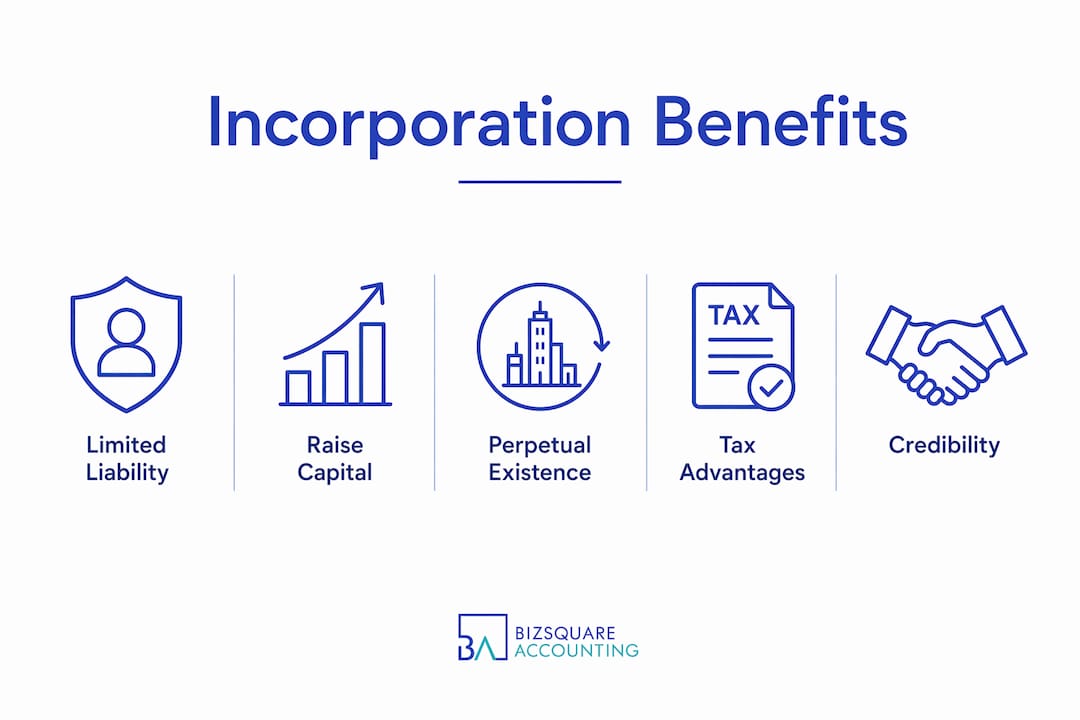
Limited liability protection
Incorporation protects shareholders and directors from losing personal assets due to company debts or legal actions. A sole proprietor, by contrast, risks personal savings, property, and other assets if the business fails or faces a lawsuit.
Ability to raise capital
An incorporated company can issue shares to investors. This makes it possible to attract venture capital, angel investment, or equity financing. Sole proprietorships and partnerships cannot issue shares, which limits their funding options significantly.
Perpetual existence
A company continues to exist even when shareholders or directors change. This continuity is critical for long-term business planning, succession, and attracting institutional investors who require stability.
Tax advantages
Singapore’s corporate tax rate is capped at 17%, and new companies may qualify for the Start-up Tax Exemption scheme. Under this scheme, qualifying companies pay no tax on the first S$100,000 of chargeable income and 50% tax on the next S$100,000 for the first three years. Sole proprietors are taxed at personal income tax rates, which can be higher for profitable businesses. For a deeper look at how these advantages apply, Bizsquare’s guide on Singapore incorporation benefits covers the compliance side in detail.
The table below compares the three most common business structures in Singapore:
| Feature | Sole Proprietorship | Partnership | Private Limited Company |
|---|---|---|---|
| Legal entity | No | No | Yes |
| Personal liability | Unlimited | Unlimited | Limited to share capital |
| Can issue shares | No | No | Yes |
| Perpetual existence | No | No | Yes |
| Corporate tax rate | Personal rate | Personal rate | Up to 17% |
| Credibility with banks | Low | Low | High |
The key takeaway from this comparison is clear. A private limited company, which is the most common incorporated structure in Singapore, offers protections and advantages that unincorporated structures cannot replicate.
Key benefits of incorporation at a glance:
- Personal assets are protected from business liabilities
- The company can enter contracts, own property, and sue or be sued in its own name
- Shares can be issued to raise equity capital
- The business survives changes in ownership or management
- Access to corporate tax exemptions and incentives
- Greater credibility with banks, suppliers, and government agencies
What are the common costs involved in incorporating a company in Singapore?
Cost is one of the first questions entrepreneurs ask when they consider how to incorporate a business. The mandatory ACRA fee for company incorporation is S$315, covering name reservation and registration. This is the baseline government fee that every applicant pays, regardless of service provider.
Beyond the ACRA fee, costs vary based on the founder’s residency status and the level of professional support required.
| Cost Item | Estimated Range |
|---|---|
| ACRA incorporation fee | S$315 (fixed) |
| Nominee director (per year) | S$1,800 to S$4,000 |
| Corporate secretary (per year) | S$300 to S$800 |
| Registered office address (per year) | S$200 to S$600 |
| Full-service incorporation package | S$500 to S$2,000+ |
For foreign founders who need a nominee director, Year 1 total costs typically range from S$2,500 to S$15,000 or more, depending on the service tier and nominee director provider selected. Local founders with Singapore residency can keep Year 1 costs significantly lower by handling some filings independently.
One cost that many entrepreneurs overlook is the statutory audit. Small private companies in Singapore may qualify for an audit exemption if they meet all three thresholds: total annual revenue under S$10 million, total assets under S$10 million, and fewer than 50 employees. Qualifying companies save the cost of a statutory audit, which can run from S$3,000 to S$10,000 per year for small businesses.
Pro Tip: If you are a foreign founder, confirm whether your service provider includes nominee director liability insurance in their package. Some providers charge this separately, and it can add S$500 to S$1,000 to your annual cost.
Workplace compliance is another area where costs can surprise new business owners. Platforms like Citation Group provide compliance frameworks that help newly incorporated companies manage employment obligations from day one, reducing the risk of regulatory penalties.
How does incorporation differ from business registration, and why does it matter?
The distinction between incorporation and registration is one of the most misunderstood concepts in Singapore business law. Registration and incorporation are not the same thing, and treating them as equivalent can lead to serious legal and financial exposure.
Registration, in its simplest form, records a business name or license with a government authority. It does not create a new legal entity. The business owner and the business remain legally the same person. This means the owner is personally liable for all debts, contracts, and legal claims against the business.
Incorporation, by contrast, establishes a separate legal entity with its own legal standing. The company can own property, sign contracts, and be sued, all independently of its shareholders and directors.
Here is how the two structures differ in practice:
- Asset ownership: An incorporated company owns its own assets. A registered sole proprietor’s assets belong to the individual, making them vulnerable to personal creditors.
- Contracts: A company signs contracts in its own name. A sole proprietor signs personally, creating personal exposure if the contract leads to a dispute.
- Financing: Banks and investors prefer lending to incorporated entities because the company’s finances are separate from the owner’s personal finances.
- Tax treatment: Incorporated companies access corporate tax rates and exemptions. Registered sole proprietors pay personal income tax on all business profits.
- Business credibility: Government tenders, large corporate clients, and institutional partners typically require suppliers to be incorporated entities.
Registration may be sufficient for very small, low-risk operations, such as a freelance consultant or a home-based food business. The moment a business takes on employees, signs significant contracts, or seeks external funding, incorporation becomes the structurally sound choice. The steps to successful incorporation in Singapore are well-defined, and the process is faster than most entrepreneurs expect.
Key Takeaways
Company incorporation in Singapore creates a separate legal entity under ACRA, providing limited liability, tax advantages, and the ability to raise capital that unincorporated structures cannot offer.
| Point | Details |
|---|---|
| Core definition | Incorporation creates a separate legal entity, distinct from its owners, under Singapore law. |
| Resident director requirement | Every Singapore company needs at least one ordinarily resident director, or a nominee director for foreign founders. |
| ACRA baseline cost | The mandatory ACRA fee is S$315; total Year 1 costs for foreign founders range from S$2,500 to S$15,000+. |
| Incorporation vs. registration | Registration records a business name; incorporation creates a legally distinct entity with its own rights and liabilities. |
| Audit exemption | Small companies with revenue, assets, and employees below ACRA thresholds qualify for audit exemption, reducing annual costs. |
Why the resident director rule catches most foreign founders off guard
The resident director requirement is the single most common point of confusion for foreign entrepreneurs setting up in Singapore. Most people research the ACRA fee, the corporate tax rate, and the share capital requirement. Very few think about the residency condition until they are mid-way through the BizFile+ filing and realize they do not qualify.
The practical implication is significant. A foreign founder without an Employment Pass or permanent residency must appoint a nominee director before the company can be incorporated. Nominee director fees range from S$1,800 to S$4,000 per year, and the quality of providers varies considerably. Some charge low headline fees but add costs for every document they sign. Others include liability coverage and compliance support in a flat annual fee.
The long-term benefits of incorporation far outweigh the initial setup costs and administrative requirements. A properly incorporated company in Singapore opens doors to government grants, institutional financing, and international business relationships that a sole proprietorship simply cannot access. The Start-up Tax Exemption alone can save a profitable early-stage company tens of thousands of dollars in the first three years.
The advice here is straightforward: budget realistically, understand the resident director requirement before you start, and work with a professional service provider who explains costs upfront. Bizsquare handles the full incorporation process, including nominee director arrangements and corporate secretary appointments, with transparent pricing and no hidden fees.
— Vandro
How Bizsquare simplifies company incorporation in Singapore
Setting up a company in Singapore is faster and more affordable than most entrepreneurs expect, especially with the right support.
Bizsquare offers company incorporation services designed for both local entrepreneurs and foreign founders. Packages include ACRA filing, nominee director arrangements, corporate secretary appointments, and registered office address, all handled by experienced consultants who know Singapore’s regulatory requirements. Bizsquare’s team guides clients through every ACRA requirement, from name reservation to post-incorporation compliance, so founders can focus on building their business rather than managing paperwork. For entrepreneurs who want a reliable, transparent, and affordable path to incorporation, Bizsquare is the practical choice.
FAQ
What is company incorporation in simple terms?
Company incorporation is the legal process of registering a business as a separate legal entity from its owners. The incorporated company can own assets, sign contracts, and incur debts independently of its shareholders.
How long does it take to incorporate a company in Singapore?
ACRA typically completes the incorporation process within one to three business days after all documents are submitted correctly. Name reservation may take an additional one to two business days.
What is the minimum share capital required to incorporate in Singapore?
Singapore requires a minimum paid-up share capital of S$1 to incorporate a private limited company. There is no minimum capital threshold beyond this nominal amount.
Do I need a resident director if I am a foreign founder?
Yes. Singapore law requires at least one director who is ordinarily resident in Singapore. Foreign founders who do not hold an Employment Pass or permanent residency must appoint a nominee director to satisfy this requirement.
What is the difference between incorporation and business registration?
Incorporation creates a separate legal entity with its own rights and liabilities. Business registration, such as registering a sole proprietorship, only records a business name and does not separate the owner’s personal liability from the business.
Can a foreigner own 100% of a Singapore company?
Yes. Singapore allows 100% foreign ownership of a private limited company. The only mandatory local requirement is the appointment of at least one resident director.
What taxes does an incorporated company pay in Singapore?
Singapore’s corporate tax rate is capped at 17%. New companies may qualify for the Start-up Tax Exemption, which reduces tax on the first S$100,000 of chargeable income to zero for the first three years.
What is a nominee director, and is it safe?
A nominee director is a Singapore resident who fulfills the legal residency requirement on behalf of a foreign founder. Reputable service providers include liability protections and clear agreements that limit the nominee’s operational involvement.
What documents are needed to incorporate a company in Singapore?
Required documents include passport copies for all directors and shareholders, proof of residential address, the company’s constitution, and details of the proposed share structure and business activity.
Does a Singapore company need a company secretary?
Yes. Every Singapore company must appoint a qualified company secretary within six months of incorporation. The secretary manages statutory filings and maintains the company’s registers under ACRA requirements.
What is the audit exemption for small companies in Singapore?
Small private companies qualify for audit exemption if they meet all three thresholds: annual revenue under S$10 million, total assets under S$10 million, and fewer than 50 employees. Qualifying companies do not need to conduct a statutory audit.
What is the difference between a private limited company and a sole proprietorship in Singapore?
A private limited company is an incorporated entity with limited liability and a separate legal identity. A sole proprietorship is an unincorporated business where the owner bears full personal liability for all debts and obligations.
Can I incorporate a company in Singapore without visiting in person?
Yes. The entire incorporation process can be completed remotely through ACRA’s BizFile+ portal and authorized corporate service providers. Physical presence in Singapore is not required for incorporation.