
What Is a Service Agreement? A Guide for Singapore Businesses
Overview
A service agreement is a legally binding contract outlining service scope, payment, and liability. It includes detailed clauses to protect both parties and is essential for clear business relationships under Singapore law. Using properly customized, written agreements reduces risks of disputes and legal issues.
A service agreement is a legally binding contract that defines how services are delivered between a provider and a client. It specifies the scope of work, payment terms, timeline, deliverables, and liability for both parties. For business owners in Singapore, understanding the service agreement definition is not optional. It is the foundation of every professional relationship you enter, from hiring a freelance designer to engaging a long-term IT vendor. This article covers what a service agreement includes, the common types used by businesses, how it differs from other contracts, and why it matters for protecting your company under Singapore contract law.
What is a service agreement and what does it include?
A service agreement is a legally binding contract that defines scope of work, payment terms, timeline, deliverables, and liability between a service provider and a client. It operates as a framework specifically for service delivery. Without one, both parties rely on vague assumptions that rarely hold up when a dispute arises.

The industry standard term for this document is a “service contract,” though “service agreement” is used interchangeably in practice. Both terms refer to the same legally enforceable instrument. The distinction matters because some business owners confuse a service agreement with a simple quote or proposal, which carries no legal weight.
Six core components make a service agreement enforceable: scope of services, payment terms, timeline, confidentiality provisions, dispute resolution mechanisms, and liability clauses. Each element serves a specific protective function. Together, they reduce dispute risks and clarify mutual expectations before work begins.
The six essential clauses explained
- Scope of services: Defines exactly what the provider will deliver. Vague scope is the leading cause of scope creep, where clients request additional work without additional payment.
- Payment terms: Specifies the fee structure, payment schedule, and consequences for late payment. This includes milestone payments, retainer fees, or lump-sum arrangements.
- Timeline and deadlines: Sets clear start and end dates, along with interim milestones. A timeline clause gives both parties a basis for measuring performance.
- Confidentiality provisions: Protects sensitive business information shared during the engagement. This is especially critical in consulting and technology services.
- Dispute resolution: Outlines how disagreements are handled, whether through mediation, arbitration, or litigation. In Singapore, many businesses specify the Singapore International Arbitration Centre (SIAC) as the arbitration body.
- Liability and indemnification: Caps the financial exposure of each party. Without this clause, a single project failure could expose your business to unlimited claims.
One clause that business owners frequently overlook is intellectual property ownership. Failing to define IP ownership explicitly can cause businesses to pay for deliverables without owning the usage rights. A developer could build your software and legally retain ownership of the code if the agreement is silent on the matter.
Pro Tip: Always include a clause specifying who owns the work product upon full payment. This single addition prevents the most common and costly post-project disputes.
What are the common types of service agreements?
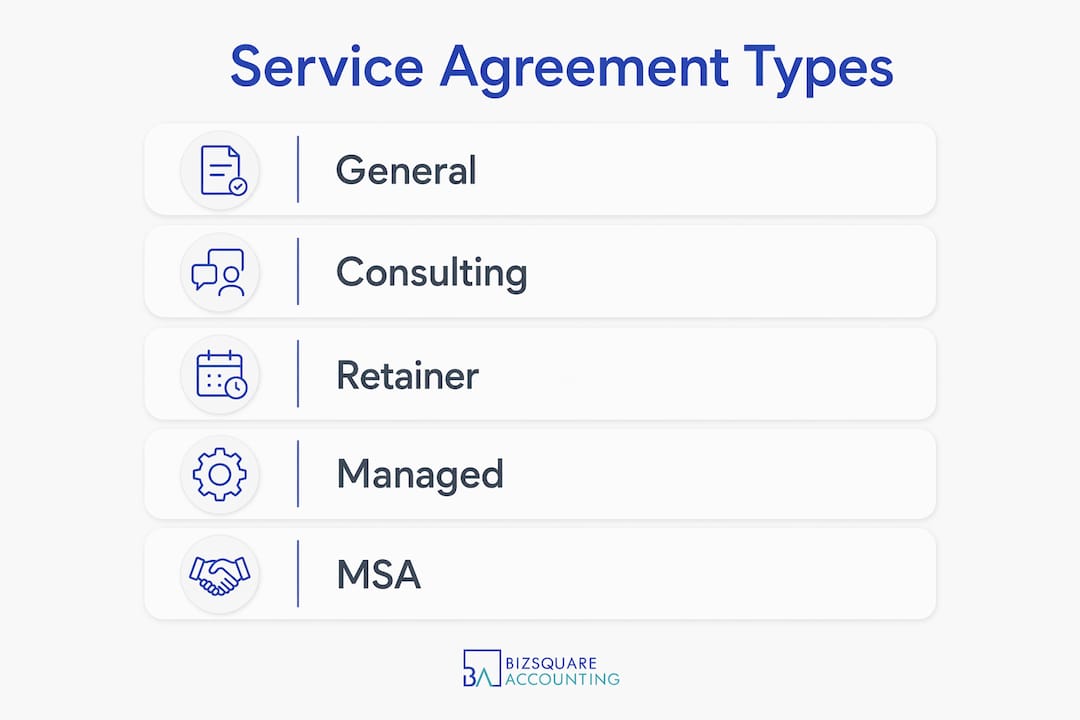
Common types of service agreements include the General Service Contract, Consulting Service Contract, Retainer Service Contract, Managed Service Contract, and Master Service Agreement (MSA). Each type serves a different business relationship and duration. Choosing the wrong type creates gaps in legal protection.
Five types and when to use each
General Service Contract covers project-based work with a defined start and end. A Singapore SME hiring a graphic designer for a product launch would use this type. It is the most straightforward format and works well for one-time engagements.
Consulting Service Contract governs fixed-term advisory engagements. A company bringing in a financial consultant for a three-month restructuring project would use this format. It typically includes deliverable milestones and a clear termination date.
Retainer Service Contract applies to ongoing support arrangements where the client pays a fixed monthly fee for access to services. Law firms, PR agencies, and accounting firms commonly operate on retainer agreements. This format suits businesses that need consistent, recurring support without negotiating terms each month.
Managed Service Contract covers long-term operational management, such as outsourced IT infrastructure or facilities management. The provider takes responsibility for a defined operational function. This type often includes service level agreement (SLA) metrics that define minimum performance standards.
Master Service Agreement (MSA) acts as an umbrella contract governing the entire relationship between two parties across multiple projects. Individual projects are then documented through a Statement of Work (SOW). The SOW is operational, describing deliverables, whereas the MSA governs the entire relationship legally, including liability and IP ownership. A SOW alone is insufficient without an overarching MSA.
| Type | Duration | Primary purpose | Typical use case |
|---|---|---|---|
| General Service Contract | Project-based | Define one-time service terms | Freelance design, event management |
| Consulting Service Contract | Fixed term | Advisory and deliverable milestones | Strategy consulting, audits |
| Retainer Service Contract | Ongoing monthly | Recurring access to services | Legal, PR, accounting support |
| Managed Service Contract | Long-term | Operational management with SLAs | IT outsourcing, facilities management |
| Master Service Agreement | Ongoing, multi-project | Legal framework for all engagements | Technology vendors, agency partnerships |
Pro Tip: For any vendor relationship that spans more than one project, start with an MSA. It saves time and legal fees on every subsequent engagement.
How does a service agreement differ from other contracts?
A service agreement focuses specifically on service delivery terms, whereas a general contract can govern any legal obligation between parties. The distinction matters because different contract types carry different legal implications under Singapore law.
The key differences are:
- Service agreement vs. employment contract: An employment contract governs an employer-employee relationship under the Employment Act (Singapore). A service agreement governs an independent contractor or vendor relationship. Misclassifying an employee as a contractor using a service agreement creates serious legal and tax liability.
- Service agreement vs. lease agreement: A lease governs the use of property or assets. A service agreement governs the delivery of work or expertise. Confusing the two is rare but can occur in equipment-as-a-service arrangements where the line between asset use and service delivery blurs.
- Service agreement vs. general contract: A general contract can cover sales, partnerships, or any legal obligation. A service agreement is a specialized contract that focuses on service delivery specifics, including performance standards and deliverable acceptance criteria.
A service agreement replaces vague implied obligations with explicit, legally binding terms that protect against liabilities, IP disputes, and payment defaults. This risk-management function is what separates a professional business relationship from a handshake deal.
Oral service agreements are legally fragile. Written and signed contracts provide clearer enforceability and reduce disputes. Verbal agreements create “he-said-she-said” situations that are difficult to resolve in court or arbitration. Singapore courts recognize written contracts as the primary evidence of agreed terms.
The practical implication is straightforward. Every service relationship your business enters, regardless of size or duration, deserves a written agreement. A one-page document signed by both parties is legally stronger than a detailed email chain.
What practical benefits do service agreements provide to Singapore businesses?
Service agreements serve as vital risk management tools that business owners consistently underestimate. Clear, written terms protect against unforeseen liabilities and disputes before they escalate into costly legal proceedings. For Singapore entrepreneurs, this protection aligns directly with compliance obligations under the Contracts Act (Cap. 53).
The practical benefits are concrete and measurable:
- Protection against scope creep: A defined scope of services clause gives you the legal basis to decline additional work requests or charge for them separately. Without it, clients can expand the project indefinitely without additional compensation.
- Payment security: Explicit payment terms, including due dates and late payment penalties, reduce the risk of non-payment. Singapore’s Small Claims Tribunal handles disputes up to S$20,000, but a written agreement strengthens any claim filed there.
- Clear performance expectations: Both parties know exactly what success looks like. This reduces friction during delivery and makes acceptance criteria objective rather than subjective.
- Reduced legal and financial risk: Liability caps and indemnification clauses limit your financial exposure. A well-drafted clause can protect your business from claims that exceed the value of the contract itself.
- Support for business growth: Investors, banks, and larger corporate clients often require service agreements before entering a relationship. Having standard agreements ready signals operational maturity and builds credibility.
Utilizing modern e-signatures with audit trails strengthens service agreement enforceability in commercial disputes. The signing process is as important as the document content. Singapore’s Electronic Transactions Act recognizes electronic signatures as legally valid, making digital signing tools a practical choice for fast-moving businesses.
Templates provide a starting point, but critical engagements require custom terms on liability limits and termination notices. A generic template downloaded from the internet will not account for Singapore-specific regulatory requirements or your industry’s risk profile. Customization aligns the agreement with your specific business risks. For guidance on maintaining compliance across your business operations, the business compliance tools available to Singapore SMEs provide a useful reference point.
Pro Tip: Review and update your service agreements at least once a year. Business relationships evolve, and an outdated agreement may no longer reflect the actual scope or risk of the engagement.
For broader financial compliance that complements sound agreement management, tax planning best practices for small business owners offer practical guidance on keeping your business protected on multiple fronts.
Key Takeaways
A service agreement is the single most effective tool for protecting your business from payment disputes, scope creep, and IP conflicts before they occur.
| Point | Details |
|---|---|
| Core definition | A service agreement is a legally binding contract covering scope, payment, timeline, and liability. |
| Six essential clauses | Scope, payment terms, timeline, confidentiality, dispute resolution, and liability are all required for enforceability. |
| Choose the right type | Match the agreement type to the relationship: project-based, retainer, managed service, or MSA for multi-project vendors. |
| Written beats verbal | Oral agreements are legally fragile; written and signed contracts provide documented clarity in Singapore courts. |
| Customize, do not copy | Generic templates miss Singapore-specific risks; customize liability caps and termination terms for every critical engagement. |
Why most service agreement mistakes are avoidable
The most common service agreement failures come from one source: business owners treating the document as a formality rather than a working tool. Vague scope definitions, missing IP clauses, and unsigned agreements are not legal technicalities. They are business risks that materialize into real financial losses.
The IP ownership issue deserves particular attention. Many entrepreneurs assume that paying for a deliverable automatically transfers ownership. It does not. Specific IP terms explicitly defining ownership and usage rights prevent costly legal ambiguities after service delivery. A software vendor, a content creator, or a product designer can legally retain rights to their work unless the agreement says otherwise.
Digital signing tools have removed the last practical excuse for unsigned agreements. Platforms that provide e-signatures with audit trails meet Singapore’s Electronic Transactions Act requirements and create a timestamped record of consent. The audit trail alone has resolved disputes that would otherwise have required months of litigation.
The advice to start with a template is sound, but the follow-through matters. Customizing service agreement templates to specific contract risks enhances their protective value, especially regarding liability and termination. A template is a checklist, not a finished document. Treat it as the starting point, then add the terms that reflect your actual business relationship.
Finally, agreements should evolve with your business. A retainer agreement signed three years ago may not reflect the current scope of work, the current fee structure, or the current regulatory environment. Reviewing agreements annually is not bureaucratic overhead. It is basic risk management.
How Bizsquare supports Singapore businesses with compliance and contracts
Bizsquare works with entrepreneurs and SMEs across Singapore to build businesses that are legally sound from day one. Setting up the right contractual framework is part of that foundation, alongside company incorporation and ongoing corporate compliance.
Bizsquare’s consultants help Singapore business owners understand their contractual obligations, structure their service relationships correctly, and maintain the financial records that support those agreements. From accounting and bookkeeping services to corporate advisory, Bizsquare provides the operational backbone that growing companies need. Reach out to Bizsquare to discuss how professional support can protect your business and keep it compliant as it scales.
FAQ
1.) What is a service agreement in simple terms?
A service agreement is a written contract between a service provider and a client that specifies what work will be done, how much it costs, and when it will be completed. It is legally binding and protects both parties if a dispute arises.
2.) What is the difference between a service agreement and a service level agreement?
A service agreement covers the full terms of a service relationship, including payment, scope, and liability. A service level agreement (SLA) is a specific component that defines measurable performance standards, such as uptime percentages or response times, and is often embedded within a broader service agreement.
3.) Is a verbal service agreement legally valid in Singapore?
A verbal agreement can be legally recognized in Singapore, but it is extremely difficult to enforce. Written and signed contracts provide documented clarity and are far stronger evidence in court or arbitration proceedings.
4.) What happens if there is no service agreement?
Without a service agreement, both parties rely on implied obligations, which are vague and hard to enforce. This creates significant risk of payment disputes, scope disagreements, and IP ownership conflicts with no clear legal resolution.
5.) Who needs a service agreement?
Any business that provides or receives services needs a service agreement. This includes freelancers, consultants, IT vendors, marketing agencies, and professional service firms of all sizes.
6.) Does a service agreement need to be notarized in Singapore?
Notarization is not required for a service agreement to be legally valid in Singapore. A written contract signed by both parties, including via electronic signature under the Electronic Transactions Act, is fully enforceable.
7.) What is a Master Service Agreement (MSA)?
A Master Service Agreement is an umbrella contract that governs the entire legal relationship between two parties across multiple projects. Individual projects are then documented through a Statement of Work (SOW), which describes specific deliverables without repeating the legal terms.
8.) Can a service agreement be terminated early?
A service agreement can be terminated early if it includes a termination clause specifying the conditions and notice period required. Without this clause, early termination may expose either party to breach of contract claims.
9.) What should I do if the other party breaches a service agreement?
Document the breach in writing immediately and refer to the dispute resolution clause in the agreement. In Singapore, options include mediation through the Singapore Mediation Centre, arbitration through the SIAC, or filing a claim in the appropriate court depending on the amount in dispute.
10.) How often should a service agreement be updated?
A service agreement should be reviewed and updated at least once a year, or whenever the scope of work, fee structure, or business relationship changes significantly. Outdated agreements may not reflect current obligations or regulatory requirements.
11.) What is the difference between a service agreement and an employment contract?
A service agreement governs an independent contractor or vendor relationship. An employment contract governs an employer-employee relationship under Singapore’s Employment Act. Misclassifying an employee as a contractor using a service agreement creates legal and tax liability for the business.
12.) Do e-signatures make a service agreement legally binding in Singapore?
Electronic signatures are legally valid in Singapore under the Electronic Transactions Act. Using a platform that provides e-signatures with audit trails further strengthens enforceability by creating a timestamped record of consent.
13.) What is a Statement of Work (SOW) and how does it relate to a service agreement?
A Statement of Work is an operational document that describes specific deliverables, timelines, and responsibilities for a single project. It works alongside a Master Service Agreement, which provides the overarching legal framework. A SOW alone does not provide the legal protections that a full service agreement offers.