

The Role of a Business Consultant for Singapore SMEs
Overview:
Business consultants diagnose problems, advise on strategy, and support implementation for businesses that lack internal resources. They help improve operational efficiency, guide strategic decisions, and accelerate business growth through expert analysis and hands-on support. The most effective engagement models include project-based work for specific problems and fractional executives for ongoing leadership needs.
A business consultant is an external expert who helps companies improve their operations and strategies by diagnosing problems, recommending solutions, and supporting execution. The role of a business consultant covers three core facets: diagnostic analysis, advisory guidance, and implementation support. For business owners and managers in Singapore, understanding this role is the first step toward making smarter decisions about growth, efficiency, and organizational capacity. Bizsquare works with SMEs across Singapore to deliver exactly this kind of expert support, from corporate advisory to outsourced CFO services. The benefits of business consulting become most visible when a company faces a problem it cannot solve with internal resources alone.
What are the primary functions and responsibilities of business consultants?
Business consultants perform four core functions: diagnosing problems, analyzing data, recommending solutions, and supporting implementation. Each function builds on the previous one, forming a structured engagement that moves from insight to action.

Diagnosing the root cause
Effective consulting starts with a rigorous current-state analysis, not a quick fix for visible symptoms. Consultants use structured diagnostic methodologies and data collection to identify root causes rather than surface-level issues. This phase typically involves stakeholder interviews, process mapping, and financial data review. The goal is to build an accurate picture of where the business actually stands, not where leadership assumes it stands.
Advising on strategy, operations, and finance
After diagnosis, the consultant moves into the advisory phase. This is where business consultant responsibilities expand to cover strategy design, operational redesign, and financial modeling. A consultant working with a Singapore SME might recommend a new pricing structure, a revised organizational chart, or a cost reduction plan backed by financial data. The advice is grounded in evidence, not opinion.
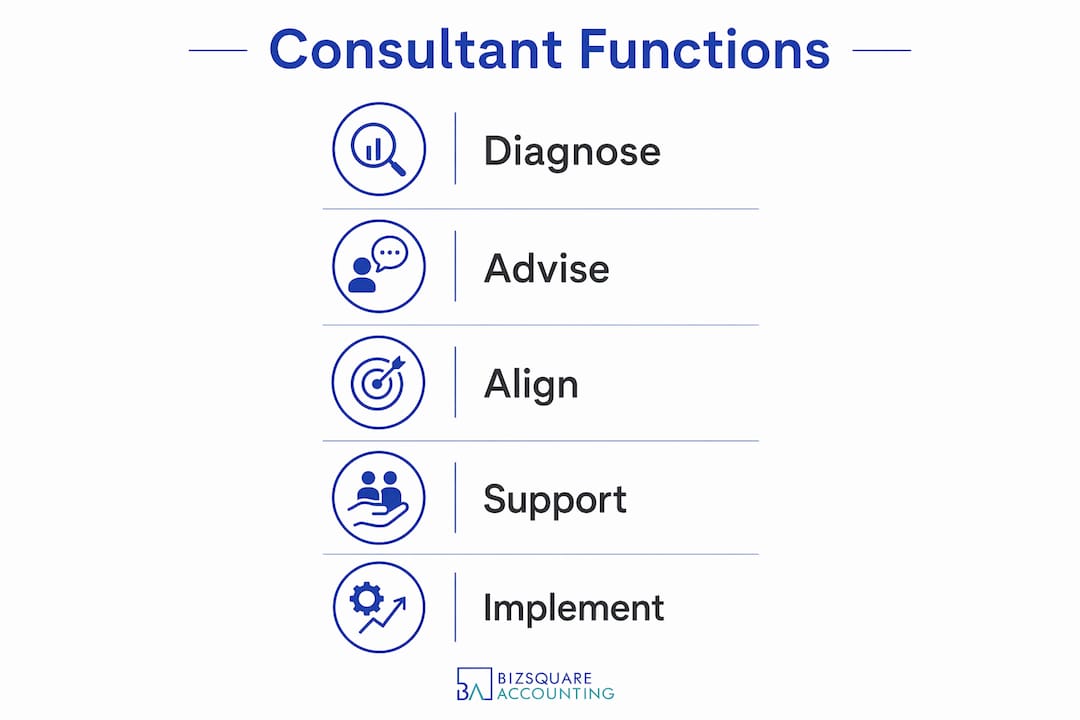
Facilitating leadership alignment
One of the most underrated functions of a business consultant is facilitating alignment among leadership teams. Consultants present findings, challenge assumptions, and help executives agree on priorities. Without this alignment, even the best recommendations fail at the execution stage.
Supporting implementation
Consultants build implementation roadmaps that assign clear owners, timelines, and success metrics. This is where the advisory role transitions into a hands-on support role. The consultant does not simply hand over a report. Instead, they work alongside the team to track progress and adjust plans as conditions change.
Pro Tip: Ask any consultant you are evaluating to show you a sample implementation roadmap from a past engagement. A consultant who only delivers reports without execution plans adds limited value to most SMEs.
Why do businesses in Singapore hire business consultants?
Singapore business owners hire consultants for three primary reasons: to fill expertise gaps, to gain an unbiased external perspective, and to add capacity without the cost of a full-time hire.
Filling the expertise and bandwidth gap
Most SMEs do not have in-house specialists for every function. A growing company earning between $2M and $10M in annual revenue rarely has a dedicated CFO, operations director, and strategy lead on its payroll. Consultants fill these gaps on demand. The advisory services available to Singapore SMEs cover exactly these organizational capacity needs.
Gaining an objective view
Consultants provide a fresh and unbiased perspective, often spotting inefficiencies that internal staff miss due to familiarity or office politics. This objectivity is one of the clearest advantages of business consulting. An internal team member who has worked in the same process for three years often stops questioning whether that process is the best approach.
Speed and cost flexibility
The average hiring process for a full-time expert takes over 23 days, while consulting firms deploy specialized teams within days. That speed difference matters when a business faces a time-sensitive problem. Beyond speed, the project-based cost model means a company pays for expertise only when it needs it, rather than carrying a permanent salary.
Here are the four most common problems Singapore business owners bring to consultants:
- Declining profit margins with no clear explanation from internal financial reports
- Rapid growth without structure, where processes and team roles have not kept pace with revenue
- Compliance gaps, particularly around corporate tax filing, corporate secretary obligations, and ACRA requirements
- Stalled expansion, where the business wants to enter new markets but lacks a clear plan
Each of these problems benefits from an external expert who has solved the same issue across multiple industries. Consultants accelerate problem solving by applying cross-industry experience, which avoids the costly trial-and-error that internal teams often go through.
What are the main consulting engagement models?
The two primary consulting engagement models are project-based consulting and fractional executive consulting. Choosing the right model depends on the nature of the problem and the business’s capacity to execute.
Project-based consulting
Project-based consulting has a defined scope, a set of deliverables, and a clear exit point. The consultant comes in, completes the work, and leaves. This model suits businesses that need a specific problem solved, such as a market entry analysis, a financial audit, or a process redesign. The engagement is time-bound, and the cost is predictable.
Fractional executive consulting
Fractional executive consulting places an experienced leader, such as a CFO, COO, or CMO, inside the business on a part-time basis. This model suits small businesses needing ongoing leadership and accountability to implement strategy effectively. The fractional executive attends leadership meetings, manages teams, and drives execution over months rather than weeks.
| Engagement model | Best suited for | Key benefit | Main limitation |
|---|---|---|---|
| Project-based | Defined, time-bound problems | Predictable cost and scope | No ongoing execution support |
| Fractional executive | Growth-stage SMEs needing leadership | Sustained accountability and implementation | Higher total cost over time |
| Advisory retainer | Businesses needing periodic guidance | Flexible access to expertise | Less hands-on than fractional |
Small businesses earning $2M–$10M benefit more from a combination of strategic planning plus fractional executive leadership than from one-off projects. The reason is simple: strategy without execution support rarely produces lasting results.
Pro Tip: If your business has tried project-based consulting before and the recommendations were never fully implemented, a fractional executive model is likely the better fit. The accountability structure is built into the engagement.
How do business consultants improve operational efficiency and strategic decision-making?
Business consultants improve operational efficiency by redesigning processes, identifying waste, and building systems that scale. They improve strategic decision-making by providing data-driven analysis and an external frame of reference that internal teams often lack.
Operational diagnostics and redesign
A consultant conducting an operational review will map every key process from end to end. They identify steps that add no value, bottlenecks that slow output, and handoff points where errors occur. For a Singapore SME, this might mean redesigning the accounts payable process, restructuring the sales pipeline, or clarifying team roles to reduce duplicated effort. Sound cash flow management practices are often one of the first areas a consultant addresses, because cash flow problems are frequently a symptom of operational inefficiency rather than a revenue problem.
Strategic planning and risk assessment
On the strategic side, consultants help business owners move from reactive decision-making to planned, evidence-based choices. They build financial models, assess market risks, and define clear growth targets. For businesses considering expansion into new markets, including regional markets like Indonesia, a consultant provides the structured analysis needed to make that decision with confidence.
Measurable outcomes
Companies that implemented consultant recommendations improved productivity by 10%, with consistent results across multiple countries and industries. That figure represents a meaningful gain for any SME operating on tight margins. Consultants also serve as force multipliers who amplify existing growth capabilities, helping SMEs overcome bottlenecks by integrating temporarily into leadership teams.
The practical benefits of hiring a business consultant for operational and strategic improvement include:
- Process efficiency: Removing redundant steps and automating manual tasks
- Financial clarity: Building accurate reporting that supports faster decisions
- Risk reduction: Identifying compliance gaps before they become penalties
- Team alignment: Ensuring every department works toward the same goals
- Growth readiness: Preparing the business structure for the next stage of scale
For Singapore businesses with digital growth ambitions, SEO and digital marketing consultancy is another area where external expertise delivers measurable returns, particularly for SMEs competing in crowded online markets.
What should Singapore business owners consider when choosing a consultant?
Choosing the right consultant requires clarity about the problem before the engagement begins. A vague brief produces vague results.
Follow these steps to select and work effectively with a business consultant:
- Define the problem clearly. Write a one-paragraph problem statement before speaking to any consultant. Include the symptom, the suspected cause, and the business impact. This forces clarity and helps you evaluate whether a consultant’s proposed approach actually addresses your situation.
- Evaluate implementation involvement. Ask directly whether the consultant will support execution or only deliver a report. Consulting engagements that fail to assign internal implementation ownership see lower success rates. A consultant who plans to hand over a document and leave is not the right fit for most SMEs.
- Assign internal ownership. Designate one internal team member as the project lead for the consulting engagement. This person coordinates data access, schedules stakeholder interviews, and tracks deliverables. Without this role, projects stall.
- Set measurable outcomes upfront. Agree on two or three specific metrics that will define success before the engagement starts. These might include a target reduction in operating costs, a revenue growth figure, or a compliance milestone.
- Plan for ongoing collaboration. Consulting success depends on a collaborative partnership that maintains alignment between the consultant and leadership teams. Schedule regular check-ins and treat the consultant as a temporary member of your leadership team, not an outside vendor.
Pro Tip: Review the scope of corporate advisory services before shortlisting candidates. Comparing engagement models, industry experience, and client outcomes will sharpen your evaluation criteria significantly.
Key Takeaways
The role of a business consultant is to convert objective analysis and expert recommendations into measurable operational and strategic improvements for businesses that cannot achieve those outcomes with internal resources alone.
| Point | Details |
|---|---|
| Core consultant functions | Consultants diagnose problems, advise on strategy, align leadership, and support implementation. |
| Primary hiring reasons | Businesses hire consultants for expertise gaps, objectivity, and faster deployment than full-time hiring. |
| Engagement model choice | Project-based suits defined problems; fractional executive suits SMEs needing ongoing leadership. |
| Productivity impact | Companies that follow consultant recommendations improve productivity by 10% on average. |
| Effective partnership | Assign internal ownership and set measurable outcomes before the engagement begins. |
The shift I see in how Singapore SMEs use consultants
The consulting market in Singapore has changed noticeably over the past few years. Business owners used to hire consultants for reports. Now the better-run SMEs hire them for outcomes. That shift matters because it changes everything about how an engagement is structured, measured, and valued.
The most common mistake I see is treating a consulting engagement as a one-way information transfer. The business owner expects the consultant to arrive, observe, and produce a document that solves the problem. That model rarely works. Consulting requires a collaborative partnership to succeed, and the businesses that get the most value are the ones that treat the consultant as a temporary leadership team member, not an outside vendor.
The fractional executive model is growing in Singapore for a good reason. SMEs at the $2M to $10M revenue stage often have the ambition to grow but not the leadership depth to execute. A fractional CFO or COO fills that gap without the cost of a full-time hire. This model also builds internal capability over time, because the team learns from working alongside an experienced operator.
The future of consulting for Singapore SMEs points toward integrated engagements that combine financial advisory, compliance support, and operational guidance in one relationship. Businesses that separate these functions across multiple providers often find that the advice from one area contradicts the constraints of another. A single advisory partner who understands the full picture delivers more consistent results.
How Bizsquare supports your business consulting goals
Bizsquare provides Singapore business owners with the expert advisory support needed to turn consulting insights into real business results.
From company incorporation in Singapore to outsourced CFO services and corporate tax advisory, Bizsquare covers the full range of business management needs that growing SMEs face. The team works directly with entrepreneurs and managers to build financial clarity, meet compliance obligations, and support strategic decisions with accurate data. For businesses ready to move from planning to execution, Bizsquare’s corporate advisory services provide the structured guidance and implementation support that makes the difference between a plan on paper and a business that grows.
FAQ
1.) What is the role of a business consultant?
A business consultant diagnoses organizational problems, recommends solutions, and supports implementation to improve efficiency and growth. The role covers strategy, operations, finance, and organizational design depending on the engagement.
2.) What are the main benefits of hiring a business consultant?
The main benefits include access to specialized expertise, an objective external perspective, faster problem resolution, and cost flexibility compared to full-time hiring. Companies that follow consultant recommendations improve productivity by 10% on average.
3.) How do business consultants help with operational efficiency?
Consultants map existing processes, identify bottlenecks and waste, and redesign workflows to improve output and reduce costs. They also build reporting systems that give leadership clearer data for faster decisions.
4.) What is the difference between project-based and fractional consulting?
Project-based consulting addresses a defined problem with a set scope and exit point. Fractional consulting places an experienced executive inside the business on a part-time basis for ongoing leadership and implementation accountability.
5.) How long does a typical consulting engagement last?
Project-based engagements typically run from four to twelve weeks depending on scope. Fractional executive arrangements often run for six to eighteen months, aligned with the business’s growth or transformation timeline.
6.) What should I prepare before hiring a business consultant?
Write a clear problem statement that describes the symptom, suspected cause, and business impact. Also identify one internal team member who will own the project coordination role throughout the engagement.
7.) Do business consultants work with small businesses in Singapore?
Yes. Consultants work with businesses across all sizes, and SMEs earning $2M–$10M in annual revenue are among the most common clients for both project-based and fractional executive engagements in Singapore.
8.) How do I measure the success of a consulting engagement?
Set two or three specific metrics before the engagement starts, such as a target reduction in operating costs, a revenue growth figure, or a compliance milestone. Review these metrics at regular intervals during the project.
9.) Can a business consultant help with compliance in Singapore?
Yes. Consultants with expertise in Singapore regulations help businesses meet ACRA requirements, corporate tax filing obligations, and corporate secretary standards. Addressing compliance gaps early prevents penalties and operational disruptions.
10.) What is a fractional CFO and how does it differ from a full-time CFO?
A fractional CFO provides the same financial leadership as a full-time CFO but works on a part-time or project basis. This model gives SMEs access to senior financial expertise at a fraction of the cost of a permanent hire.
11.) Why do consulting engagements sometimes fail?
Engagements fail most often when internal implementation ownership is not assigned, when the problem statement is vague, or when the business treats the consultant as an outside vendor rather than a collaborative partner.
12.) How quickly can a consultant be deployed compared to hiring full-time?
Consulting firms deploy specialized teams within days. The average full-time hiring process takes over 23 days, making consultants significantly faster to engage when a business faces an urgent problem.
13.) What industries do business consultants in Singapore typically serve?
Consultants in Singapore serve a wide range of industries including financial services, manufacturing, retail, technology, and professional services. Most experienced consultants apply cross-industry frameworks that transfer across sectors.


1 Comment
S$100,000 Cap Coming: Singapore SMEs and the EDG Grant
September 08, 2026, at 9:31 am[…] though internal staff and certain specialist engagements are exempt. Before engaging anyone, our guide to working with a business consultant explains what credentials to verify. The most common pitfalls remain incomplete paperwork, starting […]