

Fix Statutory Registers in Singapore Now: RORC 7 Day, ACRA 2 Day
All Singapore companies must keep statutory registers under the Companies Act, covering members, directors, secretaries, charges, and registrable controllers. The immediate action for any director is simple: confirm your registered office details are current, and check whether your Register of Registrable Controllers exists or whether your company qualifies for an exemption.
Overview:
- Companies incorporated after June 16, 2025, must establish their registers of registrable controllers at incorporation unless exempted, with updates required within seven days of controller changes.
- Electronic or physical registers must be stored at the company’s registered office or an approved Singapore location, and should be regularly backed up and reconciled against filings made through BizFile.
- Failing to update registers on time or providing incomplete controller information can lead to significant penalties, audits, and potential impact on company standing.
- Public access varies: member and director registers are generally accessible, while controllers, nominee directors, and nominee shareholders registers remain private.
- Regular, disciplined reviews of all statutory registers, ideally quarterly, prevent compliance gaps and reduce risks during official audits or inspections.
Table of Contents
- What are the key statutory registers required under the Companies Act?
- What information must each register contain?
- Where must you keep statutory registers, and in what format?
- What deadlines apply to creating and updating registers?
- Who can inspect your registers, and what stays private?
- What penalties apply for register non-compliance?
- What changed with ACRA’s centralisation of controller registers?
- How can you check your registers are compliant this week?
- Why disciplined register checks matter more than most directors think
- Get help maintaining your statutory registers with Bizsquare
- Sources
- FAQ
What are the key statutory registers required under the Companies Act?
Singapore company compliance rests on a handful of core registers, each with a specific statutory basis. Missing even one can trigger penalties during an ACRA review, so directors need to know exactly what applies to their entity.
- Register of members: records every shareholder’s identity and shareholding. Local companies keep this privately, but foreign companies operating branches in Singapore often face different public disclosure rules.
- Register of directors, secretaries and CEOs: required under the Companies Act’s statutory provisions, listing appointment dates, identification details, and residential addresses for each office holder.
- Register of charges: tracks any mortgages, debentures, or security interests over company assets.
- Register of directors’ shareholdings: separate from the general members register, this tracks each director’s personal stake in the company.
- Register of auditors: relevant where statutory audit requirements apply.
- Register of Registrable Controllers (RORC): identifies individuals or entities with significant control over the company.
- Register of Nominee Directors (ROND) and Register of Nominee Shareholders (RONS): apply only where nominee arrangements exist.
Some companies qualify for exemption from RORC, ROND, or RONS obligations, typically where ownership sits entirely with a public authority or a listed entity. Directors should confirm their exemption status rather than assume it applies, because the assumption itself is a common source of missed filing requirements Singapore authorities pursue during spot checks.
What information must each register contain?
Each statutory register has its own set of mandatory fields, and getting these wrong is one of the most common compliance slips among small companies. The Companies Act’s provisions on directors, secretaries, and auditors set out exactly what the register of directors and secretaries must record, and similar precision applies to every other register.
- Member records: full name, identification number, share class, number of shares held, and the date each entry was made.
- Position holder records: appointment and cessation dates, national identification details, nationality, and residential address for every director, secretary, and CEO.
- Charge records: a description of the charge, the assets secured, the amount involved, and the date of creation or discharge.
- RORC details: the controller’s full identification, the nature and extent of their control, and supporting documentary proof where ACRA guidance requires it.
Pro Tip: Keep a single master spreadsheet cross-referencing every register’s last update date. It takes ten minutes a month and catches gaps before ACRA does.
Where must you keep statutory registers, and in what format?
Singapore law requires registers to be kept at the registered office, or another approved location within Singapore, such as a corporate service provider’s office. Both electronic and physical formats are accepted, provided records stay accessible and current.
- Store registers at the registered office address filed with ACRA, or at your corporate secretary’s office if they hold them on your behalf.
- Electronic registers should be backed up and version controlled, since a corrupted file offers no legal protection during an audit.
- You can download free copies of your company’s registers directly through BizFile, though these downloads only reflect your last filing.
That last point matters more than it sounds. A BizFile download is a snapshot, not a live feed, so reconciling it against your internal records regularly prevents nasty surprises later.
What deadlines apply to creating and updating registers?
Timing failures cause more compliance breaches than missing information does. The rules tightened further for companies incorporated after mid-2026, so directors should treat these dates as fixed, not flexible.
- Companies incorporated from 16 June 2025 must set up their RORC at the point of incorporation, unless an exemption applies.
- Once a controller notifies a change, the private RORC must be updated within seven days.
- Where central filing applies, the updated information must reach ACRA’s central register within two business days of the private update.
- Companies must issue an annual notice to registrable controllers requesting confirmation of their details.
- Any register updated internally should be reconciled against BizFile within 14 days to avoid falling foul of update penalties.
Who can inspect your registers, and what stays private?
Public access varies significantly by register type, and confusing the two categories is a common, avoidable mistake. The register of members and the register of directors, secretaries, and CEOs are generally open to inspection by members and, in some cases, the public, depending on company type. The RORC, ROND, and RONS remain private and are not open for public inspection.
- Respond to legitimate inspection requests promptly, and only redact information the law permits you to withhold.
- Keep personal data such as residential addresses secured, accessible only to those with a genuine compliance need.
- Retain historical register entries even after updates, since removed information may still matter for audit purposes.
Pro Tip: If a shareholder requests inspection, provide a written response within a reasonable timeframe rather than an informal verbal answer. It protects you if a dispute arises later.
What penalties apply for register non-compliance?
Failing to maintain accurate statutory registers carries real financial consequences, and ACRA does check. Common offences include failing to set up a required register, missing update deadlines, and providing incomplete controller information.
- Late or missing RORC filings can attract penalties under the Companies Act’s enforcement provisions.
- Incomplete director or secretary registers often surface during routine ACRA compliance audits or annual return filings.
- Persistent non-compliance can affect a company’s standing and, in serious cases, lead to director-level liability.
If you discover a gap, correct it immediately, document the correction, and file any required updates with ACRA without delay.
What changed with ACRA’s centralisation of controller registers?
ACRA issued updated guidance and practice directions on 16 June 2025, tightening how RORC, ROND, and RONS obligations work in practice. The changes primarily affect newly incorporated companies and those previously relying on informal exemption assumptions.
- Companies incorporated from that date must file central RORC updates within two business days, where central filing applies.
- Certain exempted categories, such as companies wholly owned by government bodies, remain unaffected by the new timelines.
- Practical filing now runs through BizFile, with guidance PDFs detailing documentary evidence expected for nominee and controller entries.
How can you check your registers are compliant this week?
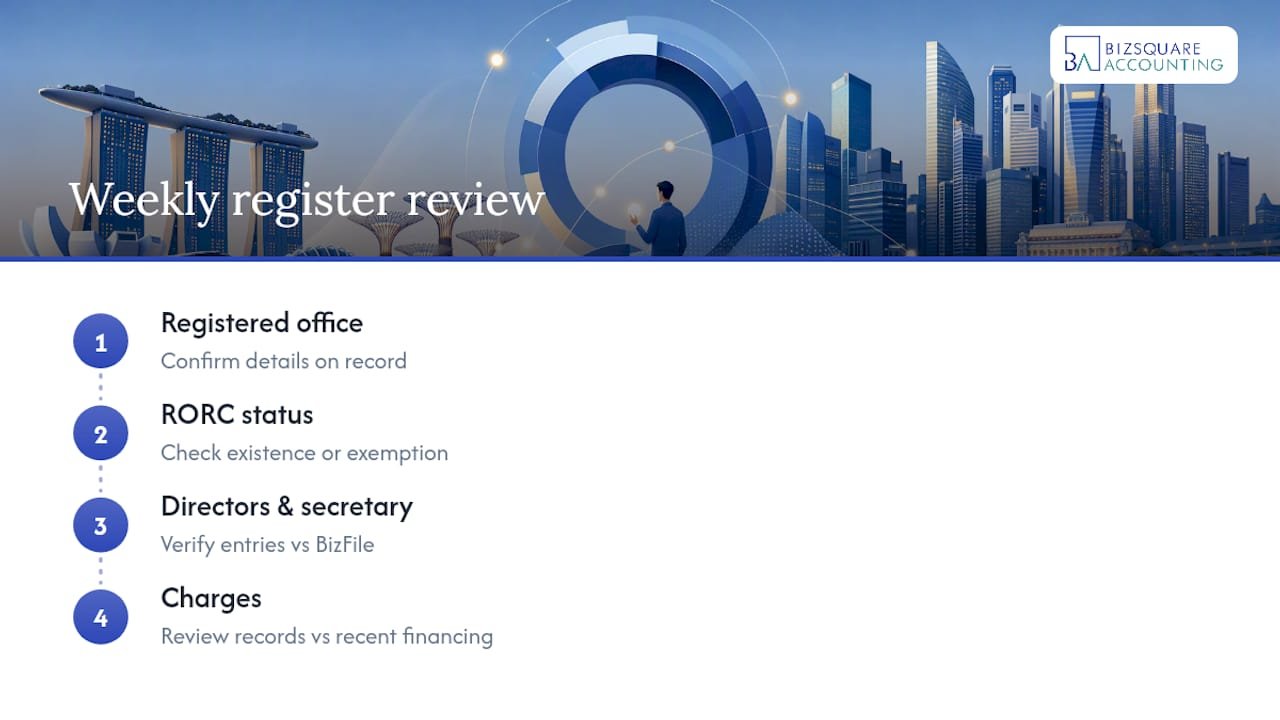
A single focused review session can clear most gaps. Work through your registers in this order: confirm registered office details, check RORC existence or exemption status, verify director and secretary entries against BizFile, and review charge records against any recent financing.
Corporate secretary services handle exactly this workload day to day, managing registered office duties, RORC updates, and BizFile reconciliations so directors aren’t left guessing. Bizsquare’s corporate secretarial services cover statutory register upkeep directly, while company incorporation support ensures registers are set up correctly from day one.
Why disciplined register checks matter more than most directors think
Most directors treat statutory registers as paperwork, something a secretary handles quietly in the background. That mindset is the mistake. Registers are the legal record of who controls a company, and errors there compound quietly until an audit or dispute exposes them. Building a quarterly review into governance routine, rather than reacting after ACRA flags a gap, is the difference between control and catch up.
Get help maintaining your statutory registers with Bizsquare
Bizsquare is the practical alternative to managing statutory registers alone, especially once RORC filing deadlines and BizFile reconciliations start competing with running your business. Instead of tracking seven-day update windows and two-business-day filing rules yourself, Bizsquare’s corporate secretarial team handles register maintenance, registered office duties, and ACRA filings as part of ongoing compliance support.

Bizsquare’s Corporate Secretarial Services cover register upkeep, RORC updates, and annual filing obligations directly. Companies still setting up should look at Company Incorporation, which includes registered office address services and nominee director support where required, with current prices available on Bizsquare’s website. For businesses needing broader financial oversight, Accounting and Bookkeeping Services support the reconciliation work that keeps registers and financial records aligned. Directors who also want structured governance training can explore the ESG Training Institute’s corporate advisory programmes. Reach out to Bizsquare to arrange a compliance review of your current statutory registers.
Sources
- Company registers: Requirements & deadlines | ACRA
- Downloading free company registers | ACRA
- Companies Act 1967 – section on registers of directors, CEOs, secretaries and auditors | Singapore Statutes Online
FAQ
1.) What are statutory registers in Singapore?
Statutory registers are legally required records every company must keep under the Companies Act, covering members, directors, secretaries, charges, and controllers. They document who owns and controls the company, and ACRA can request access during compliance checks.
2.) Do all Singapore companies need a Register of Registrable Controllers?
Most companies need an RORC, but certain entities, such as those wholly owned by government bodies, qualify for exemption. Companies incorporated from 16 June 2025 must set up their RORC at incorporation unless exempted.
3.) How quickly must I update my RORC after a change?
The private RORC must be updated within seven days of a controller notifying a change. Where central filing applies, the update must reach ACRA’s central register within two business days.
4.) Can I download my company’s statutory registers from BizFile?
Yes, companies can download registers for free through BizFile at any time. These downloads reflect only the last filing, so reconcile them against your internal records regularly.
5.) Are statutory registers public documents?
It depends on the register. The register of members and register of directors, secretaries, and CEOs are generally open to inspection by members, while the RORC, ROND, and RONS remain private under current ACRA rules.
6.) What happens if my company misses a register update deadline?
Late updates can attract penalties under the Companies Act, and repeated failures may affect director accountability. Correct any gaps immediately and file the necessary updates with ACRA without delay.
7.) Who is responsible for keeping statutory registers accurate?
Company directors carry ultimate responsibility for accurate statutory registers, even where a corporate secretary manages the day to day filing. Many companies outsource this through corporate secretarial services to reduce the administrative burden.
8.) Where should statutory registers be physically kept?
Registers must be kept at the company’s registered office, or another approved Singapore location such as a corporate service provider’s premises. Electronic storage is accepted, provided the records remain accessible and properly backed up.
9.) What is the difference between ROND and RONS?
ROND records nominee directors, while RONS records nominee shareholders, and both apply only where nominee arrangements exist. Guidance on both registers is detailed in ACRA’s RORC, ROND and RONS practice directions.
10.) Does Bizsquare help set up statutory registers during incorporation?
Yes, Bizsquare’s Company Incorporation service includes registered office address support and helps establish required registers correctly from the outset. Ongoing register maintenance is then handled through corporate secretarial services.
11.) What triggers an ACRA review of my registers?
Late annual return filings, incomplete controller information, or discrepancies between BizFile records and internal registers commonly trigger closer review. Regular reconciliation against BizFile downloads helps avoid these triggers before they escalate.
12.) How often should I review my company’s statutory registers?
A quarterly review catches most gaps before they become compliance issues, though any change in shareholding, directorship, or control should trigger an immediate update. Annual notices to registrable controllers also serve as a natural checkpoint.