


Singapore Tax Deadlines 2026: Key Dates for Businesses
Overview:
Singapore taxpayers must file individual and corporate taxes on fixed deadlines in 2026 to avoid penalties. The IRAS myTax Portal facilitates online submissions, with key dates including April 18 for individuals and November 30 for companies. Proper planning and early preparation are essential to meet these deadlines and ensure compliance.
Singapore tax deadlines 2026 are the fixed filing and payment dates mandated by the Inland Revenue Authority of Singapore (IRAS) for individuals and companies to meet their tax obligations on time. Missing these dates carries real consequences, from composition fines starting at S$200 to estimated assessments that can overstate your actual tax liability. The key dates business owners and financial professionals must track include april 18 for individual e-filing, november 30 for corporate income tax returns, and quarterly GST submission deadlines throughout the year. This guide covers every major deadline, the forms involved, and the steps to file correctly through the IRAS myTax Portal.
What are the key Singapore tax deadlines 2026 for individual taxpayers?
Individual income tax filing for Year of Assessment (YA) 2026 runs from march 1 to april 18, 2026. The filing window covers income earned in the 2025 calendar year. Paper filing closed earlier, on april 15, 2026. All submissions go through the IRAS myTax Portal, Singapore’s central platform for tax compliance.
Auto-Inclusion Scheme (AIS) and pre-filled returns
The Auto-Inclusion Scheme (AIS) is the most significant time-saver for employed individuals. Under AIS, employers submit income data directly to IRAS. Employees then log in to myTax Portal and find their salary, bonuses, and CPF contributions already populated. The task becomes verification, not data entry. Experts confirm that AIS greatly reduces errors and saves time during tax season.
The personal income tax relief cap for YA 2026 is S$80,000. This cap applies to the total of all personal reliefs claimed, including CPF relief, NSman relief, and course fees relief. Claiming reliefs above this cap provides no additional tax benefit. Business owners who also draw employment income must factor this cap into their personal tax planning.
Key individual tax dates and payment process
| Tax Event | Date | Method |
|---|---|---|
| E-filing window opens | March 1, 2026 | IRAS myTax Portal |
| Paper filing deadline | April 15, 2026 | Hardcopy submission |
| E-filing deadline | April 18, 2026 | IRAS myTax Portal |
| Notice of Assessment issued | May to September 2026 | myTax Portal or mail |
| Tax payment due | Within 1 month of bill | GIRO, AXS, internet banking |
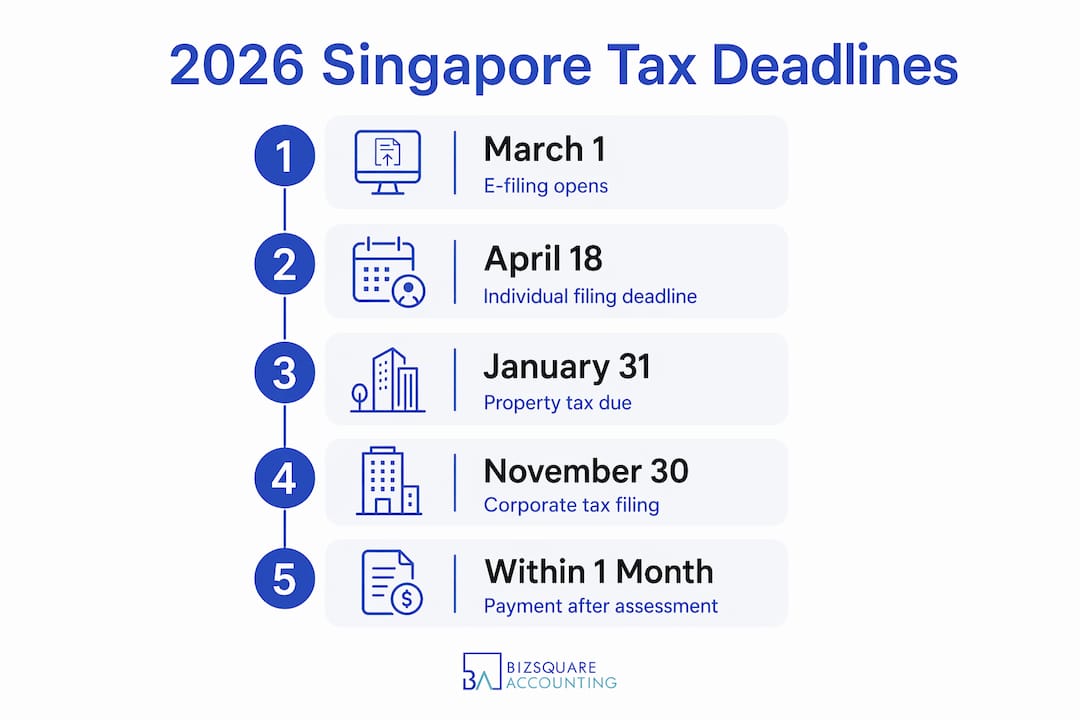
After IRAS issues the Notice of Assessment (NOA), tax payment is due within one month from the bill date. Payment methods include GIRO, AXS stations, and internet banking. IRAS issues refunds automatically if tax credits exist after assessment. Payment obligations remain in force even if a taxpayer disputes the assessment amount.
Penalties for late individual filing
Late filing penalties start at S$200 for a first offence and increase for repeat offences. IRAS can also issue an estimated assessment if a return is not filed. An estimated assessment may overstate the actual tax liability, creating a larger payment obligation than necessary. Filing on time is the only way to avoid this outcome.
Pro Tip: Set a calendar reminder for march 15 each year. This gives you three weeks before the april 18 deadline to gather documents, verify AIS data, and claim all eligible reliefs without rushing.
For a full breakdown of personal tax rates and relief categories, the personal tax rates guide from Bizsquare covers YA 2026 in detail.
What are the main 2026 corporate income tax deadlines for Singapore companies?
All Singapore companies must file their Corporate Income Tax Return for YA 2026 by november 30, 2026 via the IRAS myTax Portal. This deadline applies regardless of whether the company made a profit, a loss, or had no activity during the year. Missing this date triggers composition fines starting at S$200. Repeat non-compliance can lead to court summons and higher penalties.
Estimated Chargeable Income (ECI) filing
Before the annual return, companies must file their Estimated Chargeable Income (ECI). ECI must be filed within 3 months after the financial year end (FYE). The specific ECI deadline depends on when the company’s financial year closes:
- December 31 FYE: ECI due by march 31, 2026
- March 31 FYE: ECI due by june 30, 2026
- June 30 FYE: ECI due by september 30, 2026
- September 30 FYE: ECI due by december 31, 2026
ECI is an estimate of taxable income. It is not the final tax return. Companies that qualify for ECI waivers, typically those with annual revenue below S$5 million and zero chargeable income, do not need to file ECI but must still file the annual return.
Corporate tax forms: C, C-S, and C-S Lite
Singapore companies file one of three forms depending on their size and complexity:
- Form C: For companies with complex tax matters, capital allowances, or specific tax treatments
- Form C-S: For smaller companies with annual revenue of S$5 million or below and straightforward tax positions
- Form C-S Lite: A simplified version of Form C-S for companies with even simpler financial profiles
Newly incorporated companies often qualify for Form C-S or C-S Lite in their early years. Dormant companies with no income or expenses may apply for a filing waiver from IRAS, though this must be requested proactively. Loss-making companies still file but report zero chargeable income.
Key corporate tax deadlines at a glance
- ECI filing: within 3 months of FYE
- Corporate Income Tax Return (Form C/C-S/C-S Lite): november 30, 2026
- All filings submitted via IRAS myTax Portal using CorpPass
- Fines for late filing start at S$200 per offence
Pro Tip: Use the corporate tax checklist from Bizsquare to track every filing step from ECI to final submission. A checklist prevents missed forms and last-minute errors.
For a detailed walkthrough of the full filing process, the complete guide to filing corporate tax covers every form, waiver, and submission step for Singapore companies.
How do GST and property tax deadlines affect Singapore businesses in 2026?
GST and property tax operate on separate schedules from income and corporate tax. Business owners managing multiple tax types must track these dates independently to avoid compounding compliance failures.
GST filing deadlines for 2026
GST returns are due one month after each accounting period ends. For businesses on a standard quarterly GST cycle, the 2026 deadlines are:
| GST Quarter | Period Covered | Filing and Payment Deadline |
|---|---|---|
| Q1 2026 | October to December 2025 | January 31, 2026 |
| Q2 2026 | January to March 2026 | April 30, 2026 |
| Q3 2026 | April to June 2026 | July 31, 2026 |
| Q4 2026 | July to September 2026 | October 31, 2026 |
GST-registered businesses file Form GST F5 for standard returns and Form GST F8 for final returns when deregistering. Both the filing and the payment of net GST owed are due on the same date. IRAS requires submission even if there was no business activity during the quarter. Late filing attracts penalties and interest on unpaid GST.
Property tax deadline for 2026
The 2026 property tax bill for residential and commercial properties is due by january 31, 2026. IRAS calculates property tax based on the Annual Value of the property and the applicable tax rate. Owners of commercial premises used for business operations must budget for this payment at the start of the year. GIRO installment arrangements are available for property tax and reduce the risk of missing the lump-sum deadline.
Managing multiple tax deadlines together
Business owners face a compressed compliance calendar in the first quarter of the year. January 31 brings both the Q1 GST deadline and the property tax payment. April 18 closes individual income tax e-filing. The overlap demands a coordinated approach to cash flow and document preparation. A shared tax calendar across the finance team is the most practical tool for avoiding missed dates.
For a broader view of what tax changes affect Singapore businesses this year, the tax trends in 2026 article from Bizsquare provides useful context.
How to file tax returns on IRAS myTax Portal: step-by-step
The IRAS myTax Portal is the single platform for all individual and corporate tax filings in Singapore. Filing online is faster, more accurate, and provides instant acknowledgment of submission.
Step-by-step filing process
- Log in with SingPass (individuals) or CorpPass (companies). SingPass is the national digital identity for Singapore residents. CorpPass is the corporate digital identity used by authorized company representatives.
- Navigate to the correct tax return. For individuals, select “File Income Tax Return” under the “Individuals” tab. For companies, select “File ECI” or “File Form C/C-S” under the “Corporate Tax” section.
- Verify pre-filled income data. AIS participants will see employer-submitted income already populated. Review each field carefully. Correct any discrepancies before proceeding.
- Enter additional income sources. Rental income, freelance income, and overseas income must be added manually. Each income type has a designated field in the return form.
- Claim eligible tax reliefs. Input CPF contributions, course fees, NSman relief, and other applicable reliefs. The portal calculates the total automatically and flags if the S$80,000 relief cap is exceeded.
- Review the summary and submit. The portal generates a summary of chargeable income and estimated tax before final submission. Review this carefully. Submit only when all figures are confirmed.
- Save the filing acknowledgment. After submission, download and save the acknowledgment receipt. This is proof of timely filing and is needed if IRAS raises any queries.
- Handle amendments if needed. If an error is found after submission, log back in to myTax Portal and file an amendment before the NOA is issued. Post-NOA amendments require a formal objection within 30 days of the assessment date.
Pro Tip: Keep digital copies of all supporting documents, including payslips, CPF statements, and receipts for claimed reliefs, for at least five years. IRAS can audit past returns within this window.
For a structured preparation guide, the how to prepare tax filings resource from Bizsquare walks through document checklists and common filing errors for Singapore companies.
Key Takeaways
Meeting every Singapore tax deadline in 2026 requires tracking separate filing windows for individual income tax, corporate returns, ECI, GST, and property tax, each with distinct forms, portals, and payment methods.
| Point | Details |
|---|---|
| Individual e-filing deadline | April 18, 2026 is the final date to submit via IRAS myTax Portal. |
| Corporate return deadline | All companies must file their YA 2026 return by november 30, 2026. |
| ECI filing rule | File ECI within 3 months of your financial year end to avoid penalties. |
| GST quarterly deadlines | GST F5 returns and payments are due january 31, april 30, july 31, and october 31. |
| Penalty for late filing | First-offence fines start at S$200, plus risk of an inflated estimated assessment. |
Why early preparation is the only reliable tax strategy
Tax compliance in Singapore is not complicated, but it is unforgiving on timing. The IRAS myTax Portal works well, the AIS pre-fills most employment data, and the forms are clearly structured. The real risk is not complexity. It is complacency.
Business owners who treat tax filing as a year-end task consistently run into the same problems: missing documents, unreconciled accounts, and last-minute errors that require amendments. The companies that file cleanly and on time are the ones that maintain organized financial records throughout the year, not just in march and november.
The S$200 fine for late filing sounds minor. The real cost is the estimated assessment IRAS issues when a return is missing. That estimate can significantly overstate actual income, and disputing it requires a formal objection process that consumes time and professional fees far exceeding the original fine.
One practical shift makes a measurable difference: treat the ECI filing date as the start of your tax year, not the end. When a company files ECI accurately within 3 months of its financial year end, it forces a timely close of accounts and a realistic view of tax exposure. That discipline carries forward into the annual return and reduces the risk of surprises at november 30.
For companies with complex structures, multiple revenue streams, or cross-border transactions, working with a professional tax advisor is not a luxury. It is the most cost-effective way to meet every deadline accurately. Proactive communication with IRAS, especially when circumstances change mid-year, also prevents penalties that could have been avoided with a simple notification.
How Bizsquare supports Singapore businesses with 2026 tax compliance
Tracking multiple tax deadlines across individual, corporate, GST, and property tax obligations is a full-time responsibility for any finance team.

Bizsquare provides corporate tax filing and advisory services specifically designed for Singapore companies managing YA 2026 obligations. From ECI preparation to Form C-S submission, Bizsquare’s consultants handle the full filing cycle so business owners can focus on operations. The team also supports accounting and bookkeeping to keep financial records audit-ready throughout the year. For companies planning to incorporate or restructure, Bizsquare’s company incorporation service ensures tax compliance is built into the business from day one. Contact Bizsquare for a consultation on your 2026 tax obligations.
FAQ
1.) What is the individual income tax filing deadline for YA 2026?
The e-filing deadline for individual income tax in YA 2026 is april 18, 2026 via the IRAS myTax Portal. Paper filing closed on april 15, 2026.
2.) When must Singapore companies file their corporate income tax return for YA 2026?
All Singapore companies must file their Corporate Income Tax Return for YA 2026 by november 30, 2026 via the IRAS myTax Portal.
3.) What is the ECI filing deadline for Singapore companies?
ECI must be filed within 3 months after the company’s financial year end. For a december 31 FYE, the ECI deadline is march 31, 2026.
4.) What are the GST filing deadlines for 2026?
GST-registered businesses on a quarterly cycle must file and pay by january 31, april 30, july 31, and october 31, 2026. Filing is required even if there was no business activity.
5.) What happens if a company or individual misses a tax deadline in Singapore?
Late filing penalties start at S$200 for a first offence. IRAS may also issue an estimated assessment that overstates the actual tax liability, creating a larger payment obligation than the correct return would have produced.
6.) What is the property tax payment deadline in Singapore for 2026?
The 2026 property tax bill is due by january 31, 2026. IRAS calculates the amount based on the Annual Value of the property and the applicable tax rate.
7.) How does the Auto-Inclusion Scheme simplify individual tax filing?
Under AIS, employers submit income data directly to IRAS. Employees log in to myTax Portal and verify pre-filled details rather than entering income manually, which reduces errors and speeds up filing.
8.) What is the personal income tax relief cap for YA 2026?
The personal income tax relief cap for YA 2026 is S$80,000. Total reliefs claimed across all categories cannot exceed this amount.
9.) How do I pay my income tax after receiving the Notice of Assessment?
Tax is payable within one month from the date of the Notice of Assessment. Payment methods include GIRO, AXS stations, and internet banking.
10.) Can a dormant company apply for a waiver from filing a corporate tax return?
Dormant companies may apply to IRAS for a filing waiver, but the waiver must be requested proactively. Without an approved waiver, the november 30 filing deadline still applies.
11.) What forms do Singapore companies use to file corporate income tax?
Companies file Form C for complex tax matters, Form C-S for those with annual revenue of S$5 million or below, and Form C-S Lite for the simplest financial profiles.
12.) What login credentials are needed to file taxes on IRAS myTax Portal?
Individuals use SingPass to log in. Companies use CorpPass, the corporate digital identity assigned to authorized company representatives.
13.) How long should tax records be kept in Singapore?
Tax records and supporting documents should be kept for at least five years, as IRAS can audit past returns within this period.


3 Comments
Before April 2031: IRAS Invoice Checklist for Singapore Businesses
September 12, 2026, at 9:01 am[…] Singapore Tax Deadlines 2026: Key Dates for Businesses […]
Avoid $200 Fines: Singapore GST Filing Cycle and Deadlines
October 06, 2026, at 9:59 am[…] Singapore Tax Deadlines 2026: Key Dates for Businesses […]
Singapore SMEs: Get InvoiceNow and Peppol GST Ready by Your IRAS Date
October 08, 2026, at 11:53 am[…] Singapore Tax Deadlines 2026: Key Dates for Businesses […]