

S$1M/S$100K: OVR in Singapore for Finance Teams
You must register under Singapore’s Overseas Vendor Registration regime if your global turnover exceeds S$1,000,000 and your business-to-consumer supplies to Singapore exceed S$100,000/gst-and-digital-economy/overseas-businesses) a year. This threshold applies to remote services and low-value goods sold to non-GST-registered customers in Singapore. Check the Inland Revenue Authority of Singapore and Singapore Customs pages directly, then prepare your registration documents.
Overview:
The regime applies primarily to remote services and low-value goods sold directly to consumers, with distinctions from reverse charge rules for business buyers.
Registration is simplified to a pay-only process where vendors charge GST without claiming input credits, and invoices must show GST-inclusive prices and the vendor’s registration number.
Marketplace operators controlling transaction elements can be treated as the supplier, requiring their registration under OVR for certain imports and sales.
Continuous revenue tracking and forecasting are essential to avoid late registration penalties and ensure compliance with IRAS requirements.
What is the Overseas Vendor Registration regime and how does it differ from reverse charge?
Overseas vendor registration, known as OVR, requires foreign suppliers of remote services and low-value goods to charge and account for GST on sales made to consumers in Singapore. The Inland Revenue Authority of Singapore treats GST as a tax on local consumption, so the real test is whether your Singapore customer is GST-registered, not where your company sits.
OVR covers business-to-consumer transactions. Reverse charge covers business-to-business transactions, where the Singapore buyer, not the overseas seller, accounts for the GST.
Typical examples include:
- Streaming subscriptions, downloadable software and online course fees bought by individuals
- Low-value goods shipped directly to consumers, generally valued at S$400 or below
- Cloud storage and app purchases made by non-GST-registered buyers
Getting this distinction right matters operationally. Charge GST to the wrong customer type and you either overcharge a business buyer or underreport your own liability.
Who must register: thresholds, counting supplies and forecasting turnover
Two numeric tests decide whether registration becomes compulsory, both measured over a rolling 12-month period.
- Your global turnover exceeds S$1,000,000, counting all worldwide sales, not just Singapore ones.
- Your B2C supplies to Singapore of remote services and low-value goods exceed S$100,000 in the same period.
Both conditions must be met before registration becomes compulsory. When counting supplies, include sales made through electronic marketplaces, redeliverer arrangements and any local branch revenue that channels through your business.
If you expect to cross both thresholds soon, you can register in advance, but IRAS expects supporting evidence for that forecast. Keep these ready:
- Recent sales invoices showing the trend in Singapore-bound orders
- Signed contracts or purchase agreements with Singapore customers
- A revenue schedule projecting turnover for the next 12 months
Weak forecasting is one of the most common reasons registration gets delayed or queried.
Step by step: how to register under the pay only OVR regime
The OVR regime uses a simplified pay-only registration. This means you charge and remit GST, but you cannot claim input tax credits under this simplified path, according to IRAS registration guidance. Here is the practical sequence.
- Confirm whether registration is compulsory (both thresholds met) or voluntary (below threshold but registering anyway for business reasons).
- Gather your business registration documents, revenue schedules and bank account details.
- Complete the GST registration form on the IRAS portal, specifying that you are applying under the pay-only OVR track.
- Submit supporting evidence for your turnover forecast if you are registering ahead of crossing the threshold.
- Receive your GST registration number once IRAS approves the application.
- File GST returns on the schedule IRAS confirms, typically quarterly.
Before you submit, check that you have:
- A clear breakdown of B2C versus B2B Singapore sales for the past year
- Contact details for the person managing your GST obligations
- A record of the marketplaces or platforms through which you sell into Singapore
Our guide to GST registration in Singapore walks through the standard application fields in more detail.
How to charge, invoice and account for GST correctly
Once registered, every invoice to a Singapore consumer must show the GST-inclusive price and your GST registration number. Business buyers who are themselves GST-registered can give you their GST number, and you should not charge them OVR GST, since their purchase falls under reverse charge rules instead.
Practical steps for your invoicing and accounting:
- Display the GST rate and amount separately from the base price on every customer-facing invoice
- Verify a buyer’s GST status before deciding whether to charge OVR GST or apply reverse charge treatment
- Keep quarterly filing records that match your invoicing system, not just your bank statements
- Retain supporting documents for at least five years in case IRAS requests them during a review
Pro Tip: Set up a simple flag in your billing system for “GST number provided” so your finance team never has to manually check invoices one by one.
Our separate invoice requirements checklist covers formatting rules many overseas vendors miss on their first few filings, and our reverse charge guide explains the buyer’s side of this arrangement.
Marketplaces, redeliverers and low value goods: what customs requires
Electronic marketplace operators and redeliverers can be treated as the supplier for GST purposes, which means the platform, not the individual seller, may need to register under OVR. This applies when the operator controls key elements of the transaction, such as payment collection or delivery terms.
From 1 January 2023, GST on low-value goods imported by air or post falls under the OVR regime. Singapore Customs requires specific data for these consignments to clear import permits correctly.
- The consignment must carry a GST paid flag confirming GST has already been charged at the point of sale
- The GST registration number of the OVR-registered supplier or marketplace must accompany the shipment data
- The Place of Receipt Code and Product Code fields must be marked “OVR” for correct permit processing
- CIF value thresholds determine whether import permit relief applies to a given consignment
Sellers, marketplaces and logistics partners each carry a piece of this chain, so a breakdown at any single point delays clearance. Guidance on product registration steps for goods entering Singapore offers useful background on the wider import process that sits alongside these GST rules.
Compliance checklist and mistakes that trip up overseas vendors
Work through this sequence before you file anything.
- Review every customer type, splitting consumer sales from GST-registered business sales.
- Calculate your rolling 12-month global turnover and Singapore B2C supplies separately.
- Prepare forecast evidence if you expect to cross both thresholds within the next few months.
- Register through the IRAS portal under the pay-only OVR track.
- Update your billing system to display GST correctly on every invoice.
- File returns on schedule and retain records for at least five years.
Common mistakes worth avoiding: treating a business buyer as a consumer, leaving marketplace sales out of your turnover calculation, forecasting without supporting documents, and gaps in invoice records that surface only during an IRAS query.
Pro Tip: Reconcile your marketplace sales reports against your own accounting system every quarter, not just at year-end.
Bizsquare supports overseas vendors through GST filing and advisory, registration guidance and IRAS audit support when a filing gets queried.
Why overseas vendors underestimate this obligation
Most overseas vendors assume GST registration is a Singapore-incorporated company’s problem. That assumption costs them once their B2C sales quietly cross S$100,000 without anyone noticing, because nobody was tracking marketplace-channelled revenue separately from direct sales.
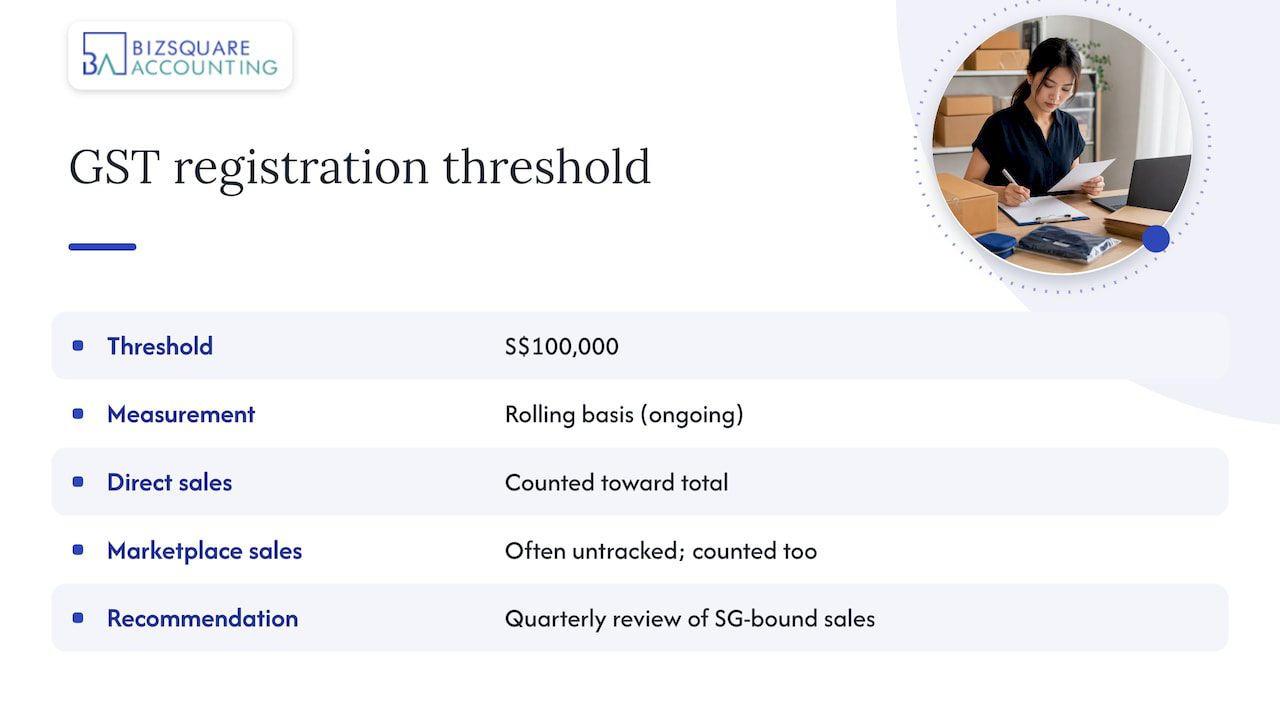
The conventional advice treats registration as a one-time compliance task. It is not. The thresholds are measured on a rolling basis, which means a business sitting comfortably below S$100,000 in January can find itself compulsorily registrable by September, purely from growth in existing markets.
What actually matters is the forecasting discipline, not the registration form itself. The form takes an afternoon. Building a revenue tracking habit that flags an approaching threshold takes ongoing attention, and that is where most overseas finance teams fall short. Prioritise a quarterly review of your Singapore-bound sales over a one-off compliance check, and the registration decision becomes straightforward rather than reactive.
Get help registering and staying compliant with Bizsquare
Registering for OVR is only the starting point. Ongoing GST filing, invoice formatting and IRAS correspondence take steady attention that many overseas finance teams cannot spare. Specialist firms can support foreign businesses through the full compliance cycle, not just the initial application.

Relevant services for overseas vendors include:
- GST Filing & Advisory for registration, quarterly filing and IRAS correspondence
- Company Incorporation if you decide a local presence suits your Singapore operations better
- Accounting and Bookkeeping Services to keep your invoicing and records aligned with OVR requirements
Share your recent revenue schedules and customer breakdown, and our team can confirm whether registration is compulsory for your business today. Contact Bizsquare to start the conversation.
Sources
FAQ
1.) What is an overseas vendor under Singapore GST rules?
An overseas vendor is a business based outside Singapore that supplies remote services or low-value goods to customers in Singapore. Once its global turnover and Singapore B2C supplies both cross the thresholds set by IRAS, it must register for GST.
2.) What are the requirements for registering an offshore company in Singapore?
Registering an offshore company in Singapore for OVR purposes does not require local incorporation. It requires business registration documents from your home jurisdiction, turnover records and evidence supporting your forecast if you register ahead of crossing the thresholds.
3.) Can I charge GST to overseas customers?
GST under the OVR regime applies specifically to supplies made to customers located in Singapore, not to overseas customers outside Singapore. Sales to customers based elsewhere fall outside this regime and follow the GST or tax rules of that customer’s own jurisdiction.
4.) Is GST applicable to overseas services in Singapore?
Yes, remote services supplied by overseas businesses to non-GST-registered consumers in Singapore attract GST once the supplier is registered under OVR. GST-registered business buyers in Singapore instead account for the tax themselves through reverse charge.
5.) How do I know if my business must register for OVR?
Check whether your global turnover exceeds S$1,000,000 and your B2C supplies to Singapore exceed S$100,000 within a rolling 12-month period. Both conditions must be met before registration becomes compulsory.
6.) What happens if I register late for OVR?
Late registration can lead to backdated GST liabilities and penalties assessed by IRAS once the compulsory threshold date is identified. Reviewing your turnover regularly helps you register before the deadline rather than after it.
7.) Do electronic marketplaces need to register for OVR themselves?
Marketplace operators can be treated as the supplier for GST purposes when they control payment collection or delivery terms for sellers using their platform. In that case, the marketplace, not the individual seller, carries the OVR registration obligation.
8.) What counts as a low-value good under the OVR regime?
Low-value goods generally refer to imported items valued at S$400 or below that would otherwise not attract GST at the border. Since 1 January 2023, GST on these goods is collected through the OVR regime instead.
9.) Can a GST-registered business buyer avoid being charged OVR GST?
Yes, a GST-registered business buyer in Singapore can provide its GST registration number to the overseas supplier. This confirms the purchase falls under reverse charge rather than OVR, so the supplier should not add GST to that invoice.
10.) How often must OVR-registered vendors file GST returns?
OVR-registered vendors typically file GST returns quarterly, following the schedule confirmed by IRAS during registration. Records supporting each return should be retained for at least five years.