

TL;DR:
- The KITAS is a temporary residence permit that allows foreign nationals to live and work legally in Indonesia with proper sponsorship. Proper preparation, including meeting strict document requirements and understanding the process, is essential to avoid rejection delays. Long-term residency relies on obtaining the KITAP after five consecutive years of holding a valid KITAS.
The KITAS, formally known as the Kartu Izin Tinggal Terbatas or Limited Stay Permit, is the official document that allows foreign nationals to legally reside and work in Indonesia under a sponsoring entity. Every foreigner planning to live in Indonesia beyond a short visit must secure this permit before starting employment, running a business, or joining a spouse. The KITAS application Indonesia process involves multiple government agencies, including the Ministry of Manpower and the Directorate General of Immigration. Understanding the requirements, document checklist, and step-by-step process is the difference between a smooth approval and a costly rejection.
What are the KITAS requirements for a successful application in Indonesia?
The KITAS application in Indonesia requires a specific set of documents and eligibility conditions. Meeting every requirement before submission is the most reliable way to avoid delays.
Core eligibility conditions
The three non-negotiable prerequisites are passport validity, formal sponsorship, and financial proof. Passport validity must be at least 18 months for a one-year KITAS. This strict threshold catches many applicants off guard, especially those with passports nearing expiration.

Formal sponsorship is mandatory for all KITAS types. The sponsor can be an Indonesian company, a registered institution, or an Indonesian spouse. Without a legally registered and compliant sponsor, the application cannot proceed.
Financial proof is also required. Applicants must show a minimum bank balance of approximately USD 2,000. This demonstrates the ability to support oneself during the stay.
Document checklist by KITAS type
The documents required vary depending on the type of KITAS. The table below outlines the core requirements for each category.
| KITAS Type | Key Documents Required |
|---|---|
| Work KITAS | Passport (18+ months), employment contract, RPTKA approval, company sponsor letter, health insurance, police clearance, medical exam results |
| Investor KITAS | Passport, proof of investment, company registration documents, sponsor letter from PT PMA or BKPM |
| Spouse KITAS | Passport, marriage certificate, sponsor letter from Indonesian spouse, family registration card (KK) |
| Remote Worker KITAS | Passport, proof of foreign employment or client contracts, financial proof, health insurance |
Work KITAS applicants face the most rigorous requirements. Applicants must demonstrate at least 5 years of relevant work experience and meet a salary threshold of approximately IDR 25–30 million per month. This five-year experience requirement was introduced in the 2024 reform and is now strictly enforced.
Pro Tip: Gather all documents in both original and notarized copy form before starting the application. Immigration offices frequently request notarized translations for documents not in Bahasa Indonesia or English.
Beyond the core checklist, the employer must also submit a Rencana Penggunaan Tenaga Kerja Asing (RPTKA), which is the Foreign Worker Utilization Plan. The RPTKA process requires companies to justify the foreign hire and designate an Indonesian counterpart for knowledge transfer. This is a frequent point of failure for companies that have not prepared the justification in advance.
How to apply for KITAS in Indonesia: step-by-step process for 2026
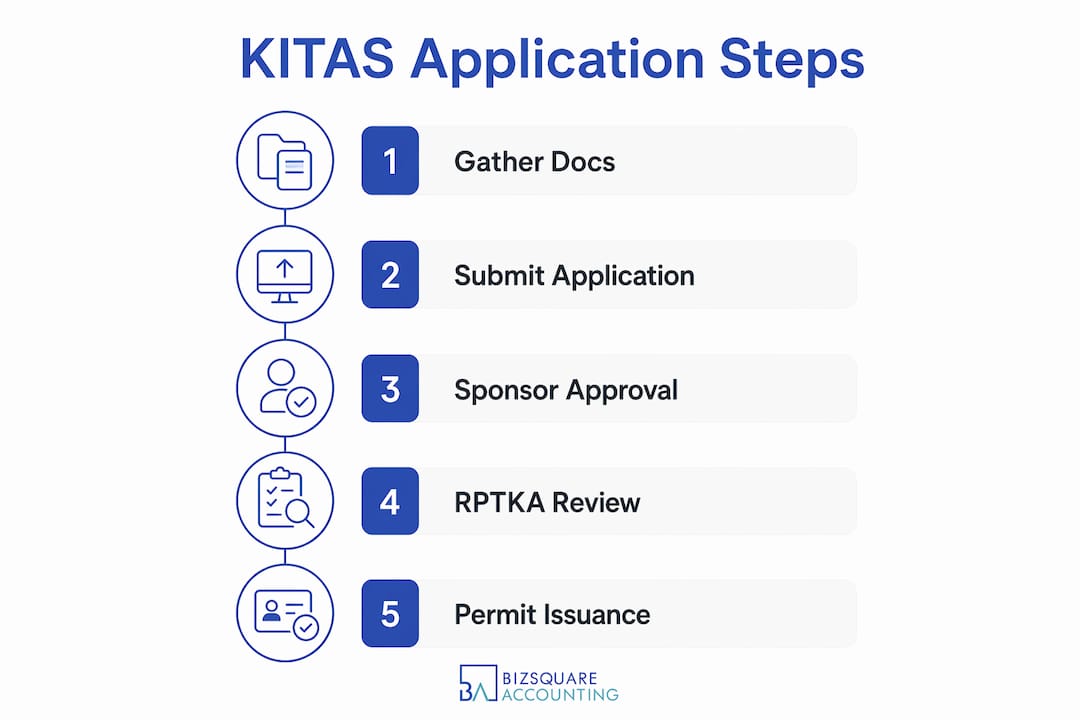
The KITAS process in Indonesia involves several government agencies and distinct stages. The full timeline, from sponsorship to permit issuance, can take 1–3 months depending on the application type and completeness of documents.
Step-by-step application process
Secure sponsorship. The employer or sponsoring entity must be legally registered and in good standing with the Ministry of Manpower. The sponsor initiates the entire process, so their compliance status directly affects your timeline.
Submit the RPTKA via TKA Online. The employer submits the Foreign Worker Utilization Plan through the Ministry of Manpower’s TKA Online portal. This step requires the company to justify the foreign hire and name an Indonesian counterpart for knowledge transfer.
Obtain the work permit (Notifikasi or IMTA). After RPTKA approval, the employer applies for the work permit notification. This document authorizes the company to employ a specific foreign national in a specific role.
Apply for the VITAS (Limited Stay Visa) through the Directorate General of Immigration. The employer submits a visa reference request online. Once approved, the foreign national receives a VITAS, which is an entry visa that allows conversion to a KITAS upon arrival.
Enter Indonesia using the VITAS. The foreign national travels to Indonesia and enters using the approved VITAS. This entry triggers the onshore conversion process.
Complete biometric registration. Upon arrival, the applicant visits the local Immigration Office (Kantor Imigrasi) to submit biometric data, including fingerprints and photographs. Digital reforms since 2024 have streamlined application workflows, but physical biometric registration remains mandatory.
Receive the KITAS card. The KITAS issuance itself takes approximately 7–14 working days after biometric registration. The full process, including employer paperwork, typically runs 30 days for onshore applications.
Register with the local civil registry (Disdukcapil). After receiving the KITAS, the permit holder must report to the local civil registry office. This step is legally required and often overlooked by first-time applicants.
Onshore vs. offshore application timelines
| Application Route | Estimated Total Timeline |
|---|---|
| Onshore (already in Indonesia) | Approximately 30 days after initiation |
| Offshore (applying from abroad) | Generally 1–2 months |
| Full process including RPTKA | Up to 3 months in complex cases |
Onshore KITAS conversion is possible without leaving Indonesia when the applicant holds a valid initial visa such as a 211A. This option saves time and travel costs, but the employer-led paperwork still takes 2–3 months to complete in full.
Pro Tip: Track your RPTKA and VITAS application status through the official TKA Online portal and the Directorate General of Immigration’s online system. Early detection of document issues prevents last-minute delays.
What are the common mistakes in the KITAS application process?
Common rejection causes include mismatched document names, incorrect job titles, missing sponsorship letters, and outdated company profiles. Each of these errors is avoidable with careful preparation.
The most frequent errors applicants make
Passport name mismatches. The name on the passport must exactly match the name on all submitted documents. Even minor discrepancies, such as a middle name appearing in one document but not another, trigger rejections.
Incorrect job titles. The job title in the employment contract must match the title in the RPTKA and the work permit notification. Any inconsistency signals a compliance problem to immigration officers.
KBLI classification mismatches. The company’s KBLI business classification must align with the foreign worker’s job title. A mismatch between the registered business activity and the role being filled is a frequent reason for denial and often requires a company amendment before reapplication.
Sponsor non-compliance. Sponsor compliance with the Ministry of Manpower’s annual manpower report is critical. Sponsors who have not filed their annual reports face processing delays and, in some cases, automatic rejection of sponsored applications.
Expired or insufficient passport validity. Submitting an application with a passport that has less than 18 months of validity is an immediate disqualifier. Renew the passport before starting the process.
Incomplete health and insurance documents. Health insurance coverage and medical exam results must be current and from recognized providers. Outdated or incomplete health documentation is a common oversight.
Important: Indonesian immigration authorities conduct spot-checks on sponsor validity. Sponsors must be legally registered and compliant entities. A sponsor found to be non-compliant can trigger immediate KITAS revocation, even after the permit has been issued.
Thorough document preparation is the single most effective way to avoid rejection. Cross-check every document against the official checklist from the Directorate General of Immigration before submission. Working with a reputable agent or consultancy reduces the risk of overlooking critical details.
How do different types of KITAS compare and which is right for you?
The KITAS is not a single permit. It comes in four main types, each with distinct eligibility criteria, sponsorship requirements, and validity periods. Choosing the correct type from the start prevents costly reapplications.
Comparison of KITAS types
| KITAS Type | Validity | Sponsor | Key Eligibility |
|---|---|---|---|
| Work KITAS | 1–2 years (renewable) | Indonesian employer | Employment contract, RPTKA, 5 years experience |
| Investor KITAS | 1–2 years (renewable) | PT PMA or BKPM-registered company | Proof of investment, company registration |
| Spouse KITAS | 1 year (renewable) | Indonesian citizen spouse | Valid marriage certificate, KK |
| Remote Worker KITAS | 1 year | Foreign employer or self-sponsored | Proof of foreign income, financial proof |
Key differences to understand
The Work KITAS is the most common type for foreign professionals. It requires the most documentation and involves the RPTKA process through the Ministry of Manpower. The employer carries significant administrative responsibility throughout.
The Investor KITAS suits foreign nationals who hold equity in an Indonesian company, typically a PT PMA (foreign-owned limited liability company). This type does not require an employment contract but does require proof of active investment.
The Spouse KITAS is sponsored by an Indonesian citizen and does not require employment documentation. It is renewable annually and allows the holder to live in Indonesia without a work permit. Note that a Spouse KITAS alone does not authorize the holder to work. A separate work permit is needed for employment.
The Remote Worker KITAS, sometimes called the Digital Nomad Visa, is a relatively newer category. It targets foreign nationals who work for companies outside Indonesia and earn income from abroad. This type requires proof of foreign employment or client contracts and financial self-sufficiency.
Pro Tip: After holding a KITAS for five consecutive years, foreign nationals may become eligible to apply for a KITAP (Permanent Stay Permit). Review the KITAP vs. KITAS comparison to understand the transition requirements before your fifth renewal.
Applicants often confuse KITAS and KITAP, missing the eligibility window for long-term residency. The KITAS is a temporary permit, while the KITAP grants indefinite residency rights. Planning for the transition from the start of your first KITAS is a practical approach to long-term residency in Indonesia.
Key takeaways
The KITAS application in Indonesia requires verified sponsorship, accurate documentation aligned with RPTKA and KBLI requirements, and strict adherence to the Ministry of Manpower and Directorate General of Immigration processes.
| Point | Details |
|---|---|
| Passport validity is non-negotiable | Your passport must have at least 18 months of validity before submitting any KITAS application. |
| RPTKA approval is the critical first step | Employers must justify the foreign hire and name an Indonesian counterpart through the TKA Online portal. |
| KBLI and job title must match | Mismatches between business classification and role are a leading cause of rejection and require company amendments. |
| Sponsor compliance affects your permit | A non-compliant sponsor can delay processing or trigger revocation even after the KITAS is issued. |
| KITAS to KITAP transition requires planning | Five consecutive years on a KITAS opens eligibility for permanent residency, so plan your renewals carefully. |
Why the KITAS process rewards preparation over speed
The KITAS application process is one of the more document-intensive permit systems in Southeast Asia. After reviewing hundreds of applications and working with foreign nationals across multiple industries, one pattern stands out clearly. The applicants who struggle most are those who treat the process as a checklist to rush through rather than a compliance exercise to get right the first time.
The 2024 reforms introduced stricter RPTKA requirements and the five-year work experience threshold. These changes were not widely publicized outside of specialist immigration circles. Many applicants and even some employers were caught off guard by the new salary and experience thresholds. The result was a wave of rejections that could have been avoided with updated guidance.
Sponsor due diligence is the area I see most consistently underestimated. A sponsor’s annual manpower report compliance is not just a formality. Immigration spot-checks are real, and a sponsor with outstanding compliance issues can bring down an otherwise perfect application. Before committing to a sponsor, verify their Ministry of Manpower filing status directly.
The digital reforms since 2024 have made the TKA Online portal and the immigration system more accessible. However, the physical steps, including biometric registration and civil registry reporting, still require in-person attendance. Applicants who assume the entire process is now fully digital miss these mandatory steps and face permit delays.
For foreign nationals planning to stay in Indonesia long-term, the KITAS is not just a visa. It is the foundation of legal residency. Getting it right from the first application sets the tone for every renewal and, eventually, for the KITAP transition. Working with a consultancy that understands both the immigration and business registration sides of the process is the most reliable way to avoid the common pitfalls outlined in this guide.
— Vandro
How Bizsquare can support your KITAS application and business setup
Foreign nationals managing a KITAS application while also establishing a business presence in Indonesia face a complex dual compliance challenge. Bizsquare provides professional support across both tracks, from coordinating sponsor documentation and RPTKA preparation to guiding Indonesia business registration for PT PMA structures that qualify as KITAS sponsors.
Bizsquare’s consultants understand the intersection of immigration compliance and corporate registration requirements. A properly incorporated Indonesian entity is the foundation of a valid Work or Investor KITAS sponsorship. If your company structure is not aligned with KBLI requirements, your permit application is at risk before it even begins. Reach out to Bizsquare to review your sponsorship structure and document readiness before submitting your application.
FAQ
What is a KITAS and who needs one in Indonesia?
A KITAS is the Limited Stay Permit required for all foreign nationals who intend to reside in Indonesia beyond a short-term visit. This includes foreign workers, investors, spouses of Indonesian citizens, and remote workers.
How long does the KITAS application process take?
The full process, including RPTKA approval and permit issuance, takes approximately 1–3 months. The KITAS card itself is issued within 7–14 working days after biometric registration.
What documents are required for a Work KITAS application?
Work KITAS applicants need a passport valid for at least 18 months, an employment contract, RPTKA approval, a company sponsor letter, health insurance, a police clearance certificate, and medical exam results.
Can I apply for a KITAS without leaving Indonesia?
Yes, onshore conversion is possible using an initial valid visa such as a 211A. The full employer-led process still takes 2–3 months to complete even for onshore applications.
What is the difference between a KITAS and a KITAP?
A KITAS is a temporary stay permit valid for 1–2 years and renewable annually. A KITAP is a permanent stay permit available to foreign nationals who have held a KITAS for five consecutive years.
What happens if my sponsor is non-compliant?
A sponsor found to be non-compliant with Ministry of Manpower reporting requirements can cause your application to be delayed or rejected. In severe cases, an issued KITAS can be revoked.
Do I need a separate work permit with a Spouse KITAS?
Yes. A Spouse KITAS allows legal residency in Indonesia but does not authorize employment. A separate work permit is required if the holder intends to work.
What is the RPTKA and why does it matter?
The RPTKA is the Foreign Worker Utilization Plan that employers must submit to the Ministry of Manpower. It justifies the need for a foreign hire and designates an Indonesian counterpart for knowledge transfer. Without RPTKA approval, a Work KITAS cannot be issued.
What is the minimum salary requirement for a Work KITAS?
Work KITAS applicants must meet a salary threshold of approximately IDR 25–30 million per month, as established by the 2024 reform. This threshold is verified through the employment contract submitted during the application.
How do I renew my KITAS before it expires?
The KITAS renewal process follows the same general steps as the initial application. Renewal should be initiated at least 30 days before the current permit expires to avoid overstay penalties.
Can a KITAS holder transition to a KITAP?
Yes. Foreign nationals who have held a valid KITAS for five consecutive years may apply for a KITAP, which grants indefinite residency rights in Indonesia. Planning for this transition from the first KITAS renewal is advisable.
What is the Remote Worker KITAS and who qualifies?
The Remote Worker KITAS is designed for foreign nationals employed by companies outside Indonesia who earn income from abroad. Applicants must provide proof of foreign employment or client contracts and demonstrate financial self-sufficiency.
Why do KITAS applications get rejected most often?
The most common rejection causes are mismatched document names, incorrect job titles, KBLI classification mismatches, missing sponsorship letters, and outdated company profiles. Thorough document review before submission prevents most of these errors.