

How to Reduce Tax Liability for Singapore Businesses
Overview
Singapore’s 2026 tax incentives include automatic rebates and grants that help businesses lower their corporate tax bills. Utilizing deductions, exemptions, and credits strategically can significantly reduce payable taxes and improve overall tax efficiency. Professional tax advisory ensures businesses claim all available benefits correctly and maintain compliance throughout the year.
Reducing tax liability means lowering the amount of corporate tax your business pays through legal strategies like rebates, deductions, and credits. Singapore’s tax system offers business owners a clear set of tools to achieve this, especially with the 2026 Year of Assessment (YA 2026) bringing new rebates and enhanced incentives. The standard corporate tax rate sits at a flat 17%, but the effective rate drops significantly when businesses apply the right strategies. This guide covers the most practical, compliant methods for Singapore business owners and financial decision-makers to lower their tax burden and improve overall tax efficiency.
What tax rebates and government incentives reduce corporate tax liability in 2026?
Singapore’s government has introduced direct financial relief for YA 2026. The 40% Corporate Income Tax rebate applies to all tax-paying companies, capped at a total benefit of S$30,000. This rebate is automatic, meaning the Inland Revenue Authority of Singapore (IRAS) applies it without requiring a separate application.
Companies that employed local staff in 2025 receive an additional benefit. A S$1,500 cash grant is available to qualifying companies, and the total combined benefit, including the rebate and the cash grant, is capped at S$30,000. This means a company with a smaller tax payable can still receive cash support if it meets the employment condition.
Beyond the rebate, Budget 2026 introduced enhanced schemes that directly reduce taxable income. Key incentives include:
- Double Tax Deduction for Internationalisation (DTDi): Businesses expanding overseas can claim up to S$400,000 in deductions for qualifying internationalization expenditures. This is a significant increase from previous caps and directly lowers taxable income.
- Market Readiness Assistance (MRA) Grant: SMEs venturing into international markets can receive up to 70% support on qualifying costs. This reduces out-of-pocket expenses and improves the tax efficiency of overseas expansion.
- Enterprise Development Grant (EDG): This grant supports business capability building, innovation, and market access, all of which carry deductible cost components.
| Incentive | Benefit | Eligibility Condition |
|---|---|---|
| CIT Rebate (YA 2026) | 40% of tax payable, capped at S$30,000 | All tax-paying companies |
| Cash Grant | S$1,500 (total capped at S$30,000) | Companies employing local staff in 2025 |
| DTDi Enhanced Cap | Up to S$400,000 in deductions | Qualifying internationalization expenses |
| MRA Grant | Up to 70% of qualifying costs | SMEs expanding internationally |
Pro Tip: The CIT rebate is automatic, but the cash grant requires that your company employed at least one local employee in 2025. Verify your payroll records now to confirm eligibility before filing.
How can business owners use deductions and exemptions to minimize taxable income?
Tax deductions and exemptions reduce the amount of income that is subject to tax. The lower your chargeable income, the lower your tax bill. Singapore provides two primary exemption schemes that apply before any rebate calculation.

Startup Tax Exemption (SUTE)
The Startup Tax Exemption scheme gives qualifying new companies a major reduction in their first three years of assessment. Under SUTE, companies receive a 75% exemption on the first S$100,000 of chargeable income and a 50% exemption on the next S$100,000. In practice, a startup with S$200,000 in chargeable income pays tax on only S$75,000. That is a substantial reduction in effective tax rate, and it applies automatically to qualifying companies incorporated in Singapore.
Partial Tax Exemption (PTE)
Companies that no longer qualify for SUTE move to the Partial Tax Exemption scheme. PTE provides a 75% exemption on the first S$10,000 of chargeable income and a 50% exemption on the next S$190,000. This ongoing relief benefits most Singapore-resident companies and continues indefinitely, making it a reliable long-term tax liability reduction tool.
Common deductible business expenses
Beyond exemptions, businesses can reduce taxable income by claiming deductible expenses. The following categories are among the most impactful for Singapore SMEs and established companies:
- Research and Development (R&D): Qualifying R&D expenditures attract enhanced deductions under Section 14C and 14D of the Income Tax Act.
- Intellectual Property (IP) licensing fees: Payments for the use of IP in business operations are generally deductible.
- Employee training and development: Course fees, certification costs, and structured training programs qualify as deductible expenses.
- Business travel and overseas marketing: Costs directly tied to generating income, including trade fair participation, are deductible.
- Renovation and refurbishment: Capital expenditure on business premises may qualify under the Renovation and Refurbishment (R&R) deduction, capped at S$300,000 over three consecutive years.
Pro Tip: Keep every receipt and invoice organized by expense category throughout the year. IRAS requires documentation to support deduction claims. Missing records mean missed deductions.
For a broader view of legally reducing your tax bill, the same principles of documented, compliant deductions apply across most jurisdictions, reinforcing why record-keeping is non-negotiable.
What practical tax planning steps should business owners take throughout the year?
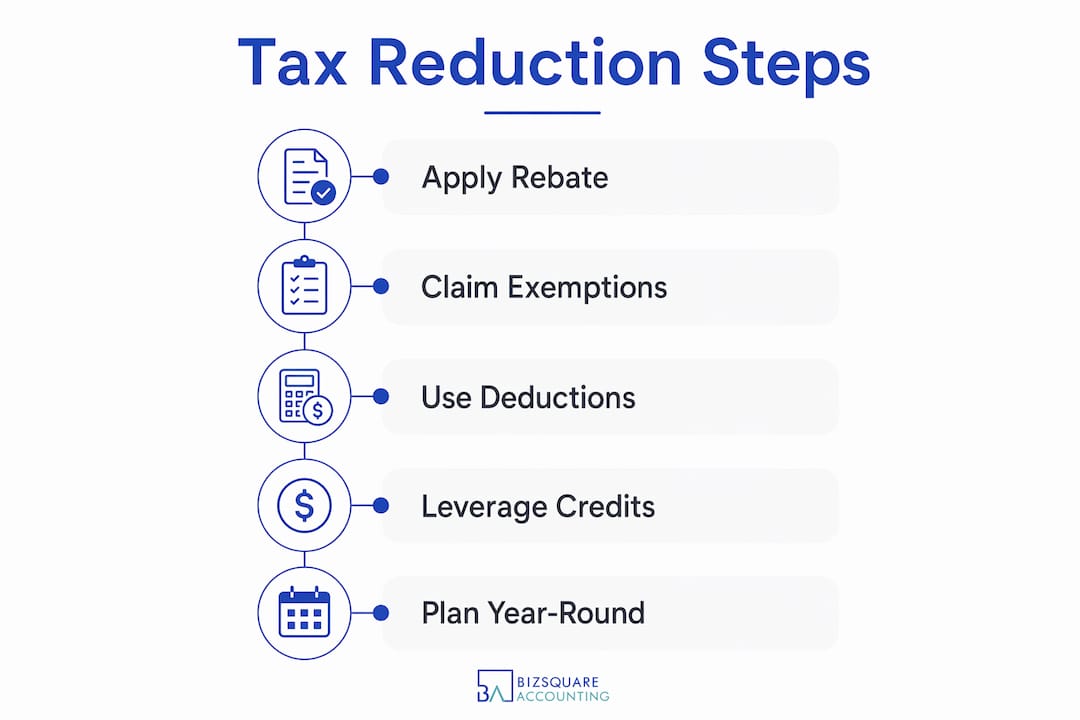
Tax planning is not a once-a-year activity. Businesses that treat it as a year-round discipline consistently pay less tax than those that scramble before the filing deadline. The following steps form a practical framework for ongoing tax liability reduction.
- Maintain accurate, up-to-date bookkeeping. Accurate financial records are the foundation of every tax saving strategy. Proper bookkeeping ensures that all deductible expenses are captured, categorized correctly, and ready for filing. Errors in records lead to missed deductions or, worse, penalties from IRAS.
- Time your expenses and income recognition strategically. Businesses can legally accelerate deductible expenses into the current year or defer income recognition where permissible. For example, prepaying a qualifying subscription or training program before the financial year ends brings the deduction forward. This timing approach directly reduces taxable income for the current assessment year.
- Review your corporate structure annually. The right corporate structure affects your tax position significantly. A company that has grown beyond the startup phase may benefit from restructuring to access different exemption tiers or group relief provisions. Consult a tax advisor before making structural changes.
- Engage a professional tax advisory service. Professional tax advisory services help companies identify deductions they would otherwise miss, apply rebates correctly, and avoid compliance errors. Errors in corporate tax filings attract penalties and interest charges from IRAS, which offset any savings.
- File on time and review estimated chargeable income (ECI). Singapore companies must file their ECI within three months of their financial year end. Filing early and accurately avoids late filing penalties and gives IRAS a clear picture of your tax position.
- Conduct a mid-year tax review. A mid-year review, typically in the sixth or seventh month of the financial year, allows businesses to adjust spending, accelerate deductions, and identify any incentives not yet claimed. This prevents end-of-year surprises.
Pro Tip: Set a recurring calendar reminder for a mid-year tax review. Pair it with your management accounts review so that financial and tax planning happen together, not separately.
Common mistakes that increase tax liability include failing to claim all eligible deductions, missing filing deadlines, and misclassifying capital expenditure as revenue expenditure or vice versa. Each of these errors is avoidable with proper planning and professional support.
How do tax credits and grants complement deductions in reducing total tax liability?
Tax credits and grants work differently from deductions, and understanding the distinction matters. A tax deduction reduces your chargeable income, which then reduces the tax calculated on that income. A tax credit reduces tax payable dollar-for-dollar. This makes credits more powerful on a per-dollar basis than equivalent deductions.
For example, a S$1,000 deduction at a 17% tax rate saves S$170 in tax. A S$1,000 tax credit saves S$1,000 in tax. This difference explains why the CIT rebate and cash grant are particularly valuable: they reduce the final tax payable directly, not just the income base.
Singapore businesses in 2026 can access the following credits and grants that complement deductions:
- CIT Rebate (40%): Applied directly against tax payable, this is the most immediate tax credit available for YA 2026.
- Cash Grant (S$1,500): Paid to qualifying companies as a direct cash benefit, separate from the rebate calculation.
- Productivity Solutions Grant (PSG): Supports adoption of pre-approved IT solutions and equipment. Funded costs reduce capital outlay and carry deductible components.
- Enterprise Development Grant (EDG): Covers up to 50% of qualifying project costs for business transformation, innovation, and market access.
To illustrate the combined effect, consider a company with S$500,000 in chargeable income. After applying PTE, the taxable amount drops to approximately S$310,000. Tax at 17% equals S$52,700. The 40% CIT rebate then reduces this by S$21,080, bringing the final tax payable to S$31,620. If the company also employed local staff, the S$1,500 cash grant further offsets costs. The combined effect of exemptions, deductions, and credits produces a materially lower effective tax rate than the headline 17%.
For a complete walkthrough of corporate tax filing procedures in Singapore, including how to apply these credits correctly, Bizsquare’s filing guide covers each step in detail.
Key Takeaways
Singapore businesses that combine rebates, exemptions, deductions, and credits achieve the most significant reductions in corporate tax liability, well below the headline 17% rate.
| Point | Details |
|---|---|
| CIT rebate for YA 2026 | Claim the automatic 40% rebate, capped at S$30,000, plus S$1,500 cash grant for local employers. |
| Startup and partial exemptions | Use SUTE or PTE to reduce chargeable income before any rebate is applied. |
| Deduction strategies | Claim R&D, IP, training, and internationalization costs to lower taxable income year-round. |
| Tax credits vs. deductions | Credits reduce tax payable dollar-for-dollar; prioritize claiming all available credits first. |
| Year-round planning | Accurate bookkeeping and mid-year reviews prevent missed deductions and filing penalties. |
The case for treating tax planning as a business discipline
Tax planning deserves the same attention as sales forecasting or cash flow management. Many business owners treat it as a compliance task, something to handle once a year before the IRAS deadline. That approach leaves money on the table.
The 2026 rebates provide immediate relief, and they are welcome. But they are temporary measures. The real, lasting reduction in tax liability comes from building deduction strategies into how a business operates every day. Claiming R&D costs, timing capital expenditure, and structuring internationalization spending under the DTDi scheme are decisions made throughout the year, not at filing time.
The risk of getting this wrong is real. IRAS imposes penalties for incorrect filings, late submissions, and unsupported claims. A business that aggressively claims deductions without proper documentation faces audits and penalties that erase any savings. Professional tax advisory is not an optional extra for growing companies. It is the mechanism that makes tax efficiency sustainable and compliant.
Business owners who engage qualified advisors consistently pay less tax than those who manage filings internally without specialist knowledge. That is not an opinion. It reflects the complexity of Singapore’s tax code and the number of incentives that require specific documentation and eligibility conditions to claim correctly.
How Bizsquare supports your tax liability reduction goals
Bizsquare works with Singapore SMEs, entrepreneurs, and growing companies to build tax-efficient structures from the ground up.
Bizsquare’s corporate tax advisory services cover everything from YA 2026 rebate claims to long-term deduction planning under SUTE, PTE, and the DTDi scheme. The team handles corporate tax filing, bookkeeping accuracy, and compliance, so business owners focus on growth rather than paperwork. For companies considering the right structure from the start, Bizsquare’s company incorporation service ensures the business is set up to access every available tax benefit from day one. Reach out to Bizsquare for a consultation tailored to your company’s tax position.
FAQ
1.) What is the corporate tax rate in Singapore for 2026?
Singapore’s corporate tax rate is a flat 17% on chargeable income. For YA 2026, qualifying companies receive a 40% rebate on tax payable, capped at S$30,000.
2.) Who qualifies for the 2026 CIT cash grant?
Companies that employed at least one local staff member in 2025 qualify for the S$1,500 cash grant. The total benefit, including the rebate and grant, is capped at S$30,000.
3.) What is the difference between SUTE and PTE?
The Startup Tax Exemption (SUTE) applies to qualifying new companies for their first three years, offering 75% exemption on the first S$100,000 of chargeable income. Partial Tax Exemption (PTE) applies to all other companies, covering 75% on the first S$10,000 and 50% on the next S$190,000.
4.) Can Singapore companies claim deductions for overseas expansion costs?
Yes. The Double Tax Deduction for Internationalisation (DTDi) scheme allows qualifying companies to claim up to S$400,000 in deductions for internationalization expenditures under Budget 2026.
5.) How does a tax credit differ from a tax deduction?
A tax deduction reduces chargeable income, which lowers the tax calculated on that income. A tax credit reduces the final tax payable directly, making it more valuable on a per-dollar basis than an equivalent deduction.
6.) What expenses are deductible for Singapore companies?
Common deductible expenses include R&D costs, IP licensing fees, employee training, business travel, overseas marketing, and qualifying renovation expenditures under the R&R deduction scheme.
7.) When must Singapore companies file their Estimated Chargeable Income?
Companies must file their ECI with IRAS within three months of their financial year end. Late filing attracts penalties, which offset any tax savings achieved through planning.
8.) Is the 40% CIT rebate automatic or does it require an application?
The 40% CIT rebate for YA 2026 is automatic. IRAS applies it without requiring a separate application from the company.
9.) What is the Market Readiness Assistance grant and who can apply?
The Market Readiness Assistance (MRA) grant supports SMEs expanding into international markets, covering up to 70% of qualifying costs. Singapore-registered SMEs with annual sales below S$100 million are eligible.
10.) How does professional tax advisory help reduce tax liability?
Professional tax advisors identify deductions and credits that businesses commonly miss, apply exemptions correctly, and ensure filings meet IRAS compliance standards, reducing the risk of penalties and audits.
11.) Can a company claim both the CIT rebate and tax exemptions like SUTE?
Yes. SUTE or PTE reduces chargeable income first, and the 40% CIT rebate then applies to the resulting tax payable. Both benefits apply in the same year of assessment.
12.) What happens if a company misses a deduction claim?
Companies can file an amended return with IRAS within a specified period to claim missed deductions. Bizsquare’s tax saving strategies guide covers the amendment process and common missed claims in detail.