
How to Ensure Compliance in Singapore: 2026 Guide
Overview:
Regulatory compliance in Singapore requires businesses to meet ongoing legal and statutory obligations across multiple domains.
Key areas include corporate governance, data protection, employment law, and tax filing, with strict deadlines and penalties for non-compliance.
Regulatory compliance in Singapore is defined as the ongoing obligation of every registered business to meet legal, administrative, and statutory requirements set by government authorities. Knowing how to ensure compliance in Singapore means managing duties across multiple domains at once, including corporate governance, data protection, employment law, and tax filing. The key regulatory bodies are the Accounting and Corporate Regulatory Authority (ACRA), the Inland Revenue Authority of Singapore (IRAS), the Personal Data Protection Commission (PDPC), and the Ministry of Manpower (MOM). Missing a single deadline or overlooking an appointment requirement can trigger automatic fines, enforcement actions, or even company liquidation. This guide walks through each compliance pillar, the tools available, and a practical system for staying ahead of every obligation.
How to ensure compliance in Singapore: core requirements
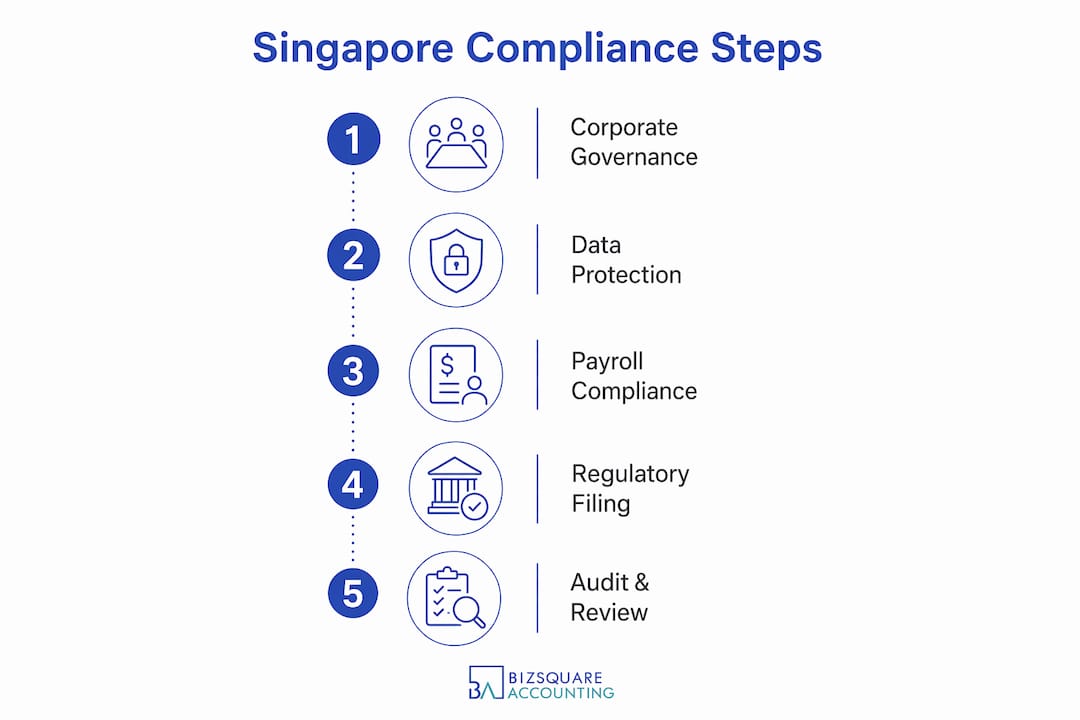
Regulatory compliance in Singapore covers five distinct areas. Each area has its own deadlines, responsible officers, and penalties for non-compliance. Business owners and compliance officers must treat all five as equally critical.
1. Corporate governance and statutory appointments
The Companies Act requires every Singapore-incorporated company to appoint at least one resident director and a qualified company secretary. At least one director must be a Singapore resident, and the company secretary must be appointed within six months of incorporation. This requirement is non-negotiable, and failure to comply gives ACRA grounds to take enforcement action.

Under the Corporate Service Providers Act 2024 (CSP Act), corporate secretaries and corporate service providers must now be registered with ACRA to legally perform secretarial and compliance filings. Business owners must verify their corporate secretary’s registration status before engaging their services. Appointing an unregistered provider exposes the company to legal liability.
The statutory filing calendar for private limited companies includes four critical deadlines:
- Estimated Chargeable Income (ECI): Submit within three months after the financial year end (FYE).
- Annual General Meeting (AGM): Hold within six months after FYE.
- Annual Return: File with ACRA within seven months after FYE.
- Corporate Tax Return (Form C or Form C-S): Submit by November 30 each year.
Missing these deadlines can result in automatic fines and, in severe cases, company liquidation. Each deadline is fixed and non-extendable under normal circumstances.
2. Data protection obligations under PDPA
Every organization that collects, uses, or discloses personal data must comply with the Personal Data Protection Act (PDPA). All organizations must appoint a Data Protection Officer (DPO) and implement data protection policies aligned with PDPC guidelines. The DPO is responsible for policy implementation, staff training, breach management, and maintaining a data protection culture within the organization.
The PDPC provides two practical frameworks to help businesses get started:
- Data Protection Essentials (DPE) Framework: A baseline standard for SMEs to assess and improve their data protection practices.
- PATO Assessment Tool: A free self-assessment tool that helps organizations identify gaps in their PDPA compliance.
DPO registration with PDPC is voluntary, but registered DPOs gain access to regulatory updates, training resources, and direct communication channels with the PDPC. Registration is strongly recommended for any business handling significant volumes of personal data.
3. Employment Act and payroll compliance
MOM’s Employment Act sets clear obligations for every employer in Singapore. Employers must pay salaries within seven days after the end of each salary period. Late payment is a statutory offense, not merely an administrative oversight.
Key employment compliance requirements include:
- Form IR8A: File annually with IRAS by March 1 for all employees who earned income in the preceding year.
- Form IR21: File at least one month before a foreign employee’s departure or cessation of employment.
- Statutory records: Retain employee records, payroll data, and leave records for at least two years.
- Right-to-work verification: Scan and securely store NRIC or valid work pass details at the point of onboarding.
Quarterly payroll reconciliations are a best practice that prevents costly misclassifications. Reconciling payroll every three months catches errors before they compound into larger compliance failures at year end.
Which tools and resources simplify compliance management in Singapore?
The Singapore government provides several digital tools that reduce the administrative burden of compliance. Using these tools correctly cuts processing time and reduces the risk of manual errors.
Government portals every business must use
- BizFile+: ACRA’s primary portal for filing annual returns, updating company information, and registering changes to directors or shareholders.
- Singpass: The national digital identity platform used to authenticate all government transactions, including IRAS filings and MOM submissions.
- Corppass: The corporate digital identity system that grants employees authorized access to government digital services on behalf of the company.
Every compliance officer should have active Corppass access configured for their role before any filing deadline arrives. Setting this up in advance prevents last-minute authentication failures.
Grants and software for compliance efficiency
Enterprise Singapore’s Productivity Solutions Grant (PSG) covers up to 50% of pre-approved compliance software costs. This grant applies to payroll software, accounting systems, and data protection management tools. SMEs that have not yet applied for PSG are leaving a significant cost offset on the table.
Automated compliance tools, including BizFile+ integrations and payroll software, reduce reliance on expensive reactive legal services for routine filings. Consultants and legal advisors are best reserved for complex regulatory changes, risk assessments, and non-standard situations.
| Compliance Area | Recommended Tool or Resource | Purpose |
|---|---|---|
| Corporate filings | BizFile+ | Annual returns, director updates, share changes |
| Tax filing | myTax Portal (IRAS) | ECI, Form C, GST returns |
| Data protection | PDPC PATO Tool | Self-assessment and gap identification |
| Payroll | PSG-approved payroll software | Salary processing, IR8A generation |
| Identity verification | Singpass / Corppass | Authentication for all government portals |
Pro Tip: Set up Corppass access for at least two authorized users in your company. If the primary compliance officer is unavailable during a filing window, a backup user can complete the submission without delay.
How to build a compliance calendar that prevents missed deadlines
A compliance calendar is the single most effective tool for maintaining regulatory compliance in Singapore. The lack of a coordinated compliance calendar is the most common cause of missed deadlines and the penalties that follow.
Step-by-step calendar setup
- Anchor all deadlines to your financial year end. Map out ECI (3 months post-FYE), AGM (6 months post-FYE), Annual Return (7 months post-FYE), and Corporate Tax Return (November 30) on a single master calendar.
- Set layered reminders for each deadline. Use reminders at four weeks, two weeks, and three days before each due date. This three-layer system catches delays before they become violations.
- Add employment compliance dates. Include the March 1 IR8A deadline, quarterly payroll reconciliation dates, and any IR21 filing triggers tied to foreign employee departures.
- Assign ownership using a RACI model. For each compliance task, identify who is Responsible, Accountable, Consulted, and Informed. Ambiguous ownership is the second most common cause of missed filings.
- Schedule quarterly compliance audits. A 30-minute internal review each quarter confirms that statutory records are current, registers are updated, and no new regulatory changes have been overlooked.
The financial year end compliance checklist published by Bizsquare provides a structured reference for SMEs managing this calendar independently.
Pro Tip: Sync your compliance calendar with your accounting software’s reporting cycle. When your bookkeeper closes the monthly accounts, that is the natural trigger to check whether any compliance task is due within the next 30 days.
What are the common compliance pitfalls in Singapore businesses?
Most compliance failures in Singapore are not caused by ignorance of the law. They are caused by poor systems, unclear ownership, and reactive rather than proactive management.
The most frequent compliance failures
- Late statutory filings. Companies that miss ECI, AGM, or Annual Return deadlines face automatic financial penalties. Repeated late filings can escalate to director disqualification.
- Skipping right-to-work checks at onboarding. Many SMEs neglect right-to-work verification at the point of hiring. MOM enforcement outcomes for this failure include fines and restrictions on future work pass applications.
- Underestimating PDPA obligations. Businesses that collect customer data without a formal data protection policy, a designated DPO, or a breach notification procedure are in violation of the PDPA. A data breach without a proper response protocol compounds the regulatory exposure significantly.
- Outdated statutory registers. ACRA requires companies to maintain accurate registers of directors, shareholders, and beneficial owners. Failing to update these registers after any change is a statutory offense.
- Engaging unregistered corporate secretaries. Since the CSP Act 2024 took effect, business owners must verify that their appointed corporate secretary is registered with ACRA. An unregistered secretary cannot legally perform filings on the company’s behalf.
Compliance is not a one-time exercise. Treating it as a recurring operational discipline, with assigned owners, scheduled audits, and automated reminders, is the only reliable way to avoid enforcement actions in Singapore’s regulatory environment.
The most damaging pattern is relying solely on reactive legal support. Engaging a lawyer only after a penalty notice arrives is far more expensive than building a proactive compliance system from the start. Automated tools combined with qualified consultants for complex issues represent the most cost-effective approach for SMEs.
Key Takeaways
Maintaining compliance in Singapore requires a coordinated system covering corporate governance, data protection, employment, and tax obligations, supported by automated tools and clearly assigned ownership.
| Point | Details |
|---|---|
| Meet all statutory deadlines | File ECI within 3 months, AGM within 6 months, Annual Return within 7 months, and tax return by November 30. |
| Appoint required officers | Every company needs a resident director and a CSP Act-registered corporate secretary from day one. |
| Implement PDPA controls | Appoint a DPO, use the PDPC PATO tool, and maintain a documented breach response procedure. |
| Build a layered calendar | Set reminders at 4 weeks, 2 weeks, and 3 days before each deadline to prevent costly missed filings. |
| Combine tools with expert support | Use BizFile+, PSG-approved software, and qualified consultants for complex compliance decisions. |
Compliance is an operational discipline, not a legal checkbox
Compliance is often misunderstood as a legal department’s responsibility. In practice, compliance is primarily an ongoing operational discipline that requires constant vigilance, internal controls, and leadership engagement.
The businesses that consistently avoid penalties are not the ones with the best lawyers on retainer. They are the ones that have built compliance into their daily workflows. Payroll is processed on schedule. Registers are updated the same week a director change occurs. The DPO reviews data handling practices quarterly, not annually.
A risk-based approach to compliance is more effective than a checklist approach. Rather than treating every obligation as equally urgent, compliance officers should rank tasks by the severity of the penalty for non-compliance and the likelihood of a gap occurring. High-severity, high-likelihood risks get automated systems and dedicated owners. Lower-risk tasks get calendar reminders and periodic reviews.
The CSP Act 2024 has added a new layer of accountability. Business owners who assumed their corporate secretary was handling everything correctly now need to verify that their provider is properly registered with ACRA. This is a five-minute check that can prevent serious legal exposure.
Staff awareness also matters. A compliance culture does not develop from a single training session. It develops when employees understand why data protection policies exist, why payroll must be processed on time, and why statutory records must be accurate. Leadership sets the tone, and the systems enforce it.
How Bizsquare helps Singapore businesses stay fully compliant
Singapore’s compliance requirements span multiple regulatory bodies, deadlines, and technical obligations. Managing all of them internally is demanding, particularly for SMEs and growing companies without a dedicated compliance team.

Bizsquare provides corporate secretary services, professional bookkeeping, and tax filing support tailored to Singapore’s regulatory environment. The team handles ACRA filings, AGM coordination, annual return submissions, and statutory record maintenance, so business owners can focus on running their operations. Bizsquare also guides clients through PSG grant applications for compliance software and advises on PDPA obligations. For companies at any stage, from company incorporation through to ongoing corporate governance, Bizsquare provides the structure and expertise to keep every compliance obligation on track. Contact Bizsquare today to schedule a consultation.
FAQ
1.) What is compliance in Singapore for businesses?
Compliance in Singapore means meeting all legal, regulatory, and administrative obligations set by ACRA, IRAS, MOM, and PDPC. This includes statutory filings, officer appointments, payroll obligations, and data protection requirements.
2.) What are the key filing deadlines for Singapore companies?
Private limited companies must file ECI within three months after FYE, hold an AGM within six months, submit the Annual Return within seven months, and file the Corporate Tax Return by November 30 each year.
3.) Does every Singapore company need a Data Protection Officer?
Yes. Every organization that collects or manages personal data must appoint a DPO under the PDPA. DPO registration with PDPC is voluntary but provides access to regulatory resources and updates.
4.) What happens if a company misses a statutory filing deadline?
Missing deadlines triggers automatic financial penalties from ACRA or IRAS. Repeated violations can escalate to director disqualification or, in severe cases, company liquidation.
5.) How do I verify that my corporate secretary is legally registered?
Under the CSP Act 2024, all corporate service providers must be registered with ACRA. Business owners can verify their secretary’s registration status directly through the BizFile+ portal.
6.) What is the Productivity Solutions Grant and how does it help with compliance?
The PSG is an Enterprise Singapore grant that covers up to 50% of pre-approved software costs. It applies to payroll, accounting, and data protection management tools that support regulatory compliance.
7.) How often should a company conduct a compliance audit?
A quarterly internal compliance audit is the recommended best practice. Each review should confirm that statutory records are current, registers are updated, and no new regulatory obligations have been missed.
8.) What are the employment compliance requirements under the Employment Act?
Employers must pay salaries within seven days after the salary period ends, file Form IR8A by March 1, file Form IR21 before foreign employee departures, and retain statutory records for at least two years.
9.) What is BizFile+ and how is it used for compliance?
BizFile+ is ACRA’s official portal for corporate filings. Companies use it to submit annual returns, update director and shareholder information, and manage other statutory corporate records.
10.) What is the RACI model and how does it apply to compliance management?
RACI stands for Responsible, Accountable, Consulted, and Informed. Applying it to compliance tasks assigns clear ownership to each obligation, preventing the ambiguity that leads to missed filings.
11.) Can a Singapore company handle all compliance tasks without external help?
Small companies with simple structures can manage routine filings using government portals and PSG-approved software. Complex regulatory changes, risk assessments, and non-standard situations benefit from qualified consultants or a corporate secretary service.
12.) What is the CSP Act 2024 and why does it matter?
The Corporate Service Providers Act 2024 requires all corporate secretaries and service providers to register with ACRA. Business owners must verify their provider’s registration status to avoid legal exposure from unregistered filings.
13.) How does the PDPC PATO tool help with PDPA compliance?
The PATO tool is a free self-assessment resource from PDPC that helps organizations identify gaps in their data protection practices. It is the recommended starting point for businesses building their PDPA compliance framework.