

Did you know that a single missed compliance deadline in Singapore can result in instant penalties, escalating fines, and even prosecution for company directors?
In one of the world’s most efficient yet rigorously regulated business environments, ignorance is not bliss, it’s a financial liability. The difference between a thriving, good-standing company and one struggling under the weight of IRAS and ACRA penalties often comes down to disciplined timing and expert execution of core statutory obligations.
That’s why mastering your Financial year end compliance Singapore process is non-negotiable. It’s a complex calendar of key submissions, from the early, mandatory ECI filing Singapore that locks in your tax payment plan, to the crucial Annual return filing Singapore with ACRA, and the final deadline for your corporate tax filing. Fail to manage even one, and the domino effect can be costly.
Guide to Financial Year End Compliance in Singapore: Key Deadlines & Filings
As the financial year closes in, many Singapore businesses scramble to complete their reports, prepare statements, and meet multiple government deadlines. Missing even one requirement can lead to penalties, unnecessary stress, and disrupted operations. That’s why financial year end compliance in Singapore isn’t just an accounting routine, it’s a legal responsibility that protects your business.
This guide breaks down the core tasks every company must complete before closing its books, along with key compliance deadlines and how to avoid costly mistakes.
Why Financial Year-End Compliance Matters
Singapore has strict regulations under ACRA (Accounting and Corporate Regulatory Authority) and IRAS (Inland Revenue Authority of Singapore). Companies must follow a structured timeline for filing reports and taxes.
Proper compliance helps your business to:
- Avoid penalties and audits
- Maintain a good legal standing
- Get tax savings and government incentives
- Build trust with investors, partners, and banks
Phase 1 – Setting the Foundation: Accounts and Estimated Income
The compliance journey begins immediately after your Financial Year End (FYE). Preparation is critical, as several important deadlines loom shortly thereafter.
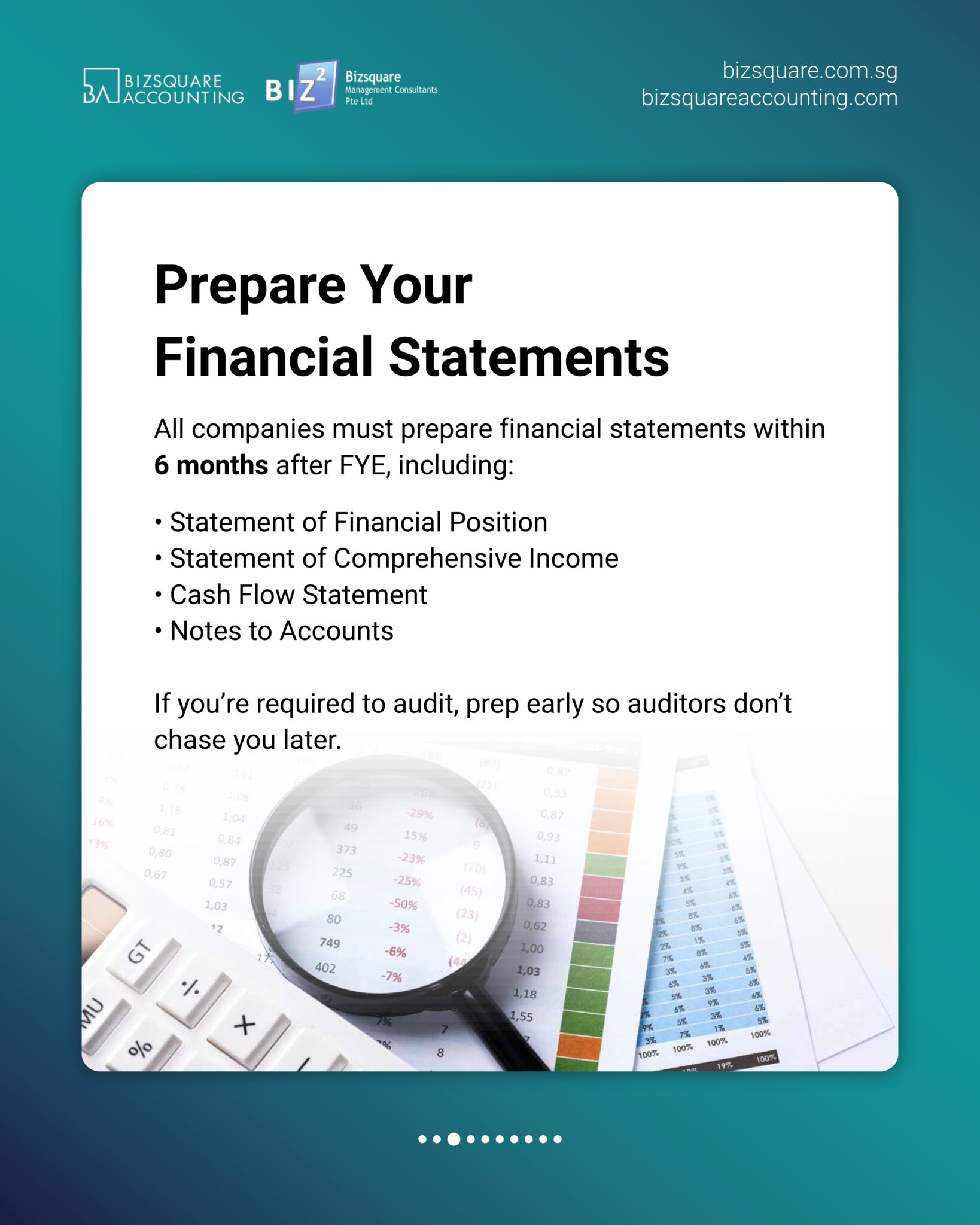
1. Finalise and Prepare Financial Statements
Before any submission, companies must first close their accounts properly. This includes ensuring that all invoices, expense records, provisions, and bank reconciliations are accurate.
You must prepare the following financial statements:
- Statement of Financial Position
- Statement of Comprehensive Income
- Cash Flow Statement
- Notes to Accounts
📌 Deadline: Within 6 months after Financial Year End (FYE)
These documents will later be used for annual return filing Singapore and corporate tax submissions.
Requirement: All companies must prepare statutory financial statements (Statement of Financial Position, Statement of Comprehensive Income, etc.) within 6 months after their FYE. If your company does not qualify for audit exemption (based on the “Small Company” or “Small Group” criteria), prepare early to allow ample time for the external audit process.
2. Mandatory ECI Submission
One of the earliest deadlines you face is the submission of the Estimated Chargeable Income (ECI) form.
The ECI filing Singapore deadline is typically three months after your company’s FYE. The ECI is an estimate of your company’s taxable income for the relevant Year of Assessment (YA).
| Key ECI Benefit | Description |
| Tax Installment Plan | Filing your ECI within one month of your FYE qualifies you for up to 10 interest-free installment payments. |
| Waiver | Companies with annual revenue up to S$5 million and zero Estimated Chargeable Income for the relevant YA may be exempt from filing ECI. |
Why ECI Filing Matters
Submitting ECI early allows you to:
- Pay corporate taxes with an instalment plan
- Manage cash flow better during tax season
📌 Deadline: Within 3 months after FYE
If you file late or miss the ECI deadline, you may forfeit the right to pay tax in installments, and IRAS will issue a Notice of Assessment based on its own estimate, potentially leading to immediate tax payment demands.
Phase 2 – Core Regulatory Filings with ACRA and IRAS
Once your financial figures are finalised, the focus shifts to the two primary statutory submissions: the Annual Return and the Corporate Tax Return.
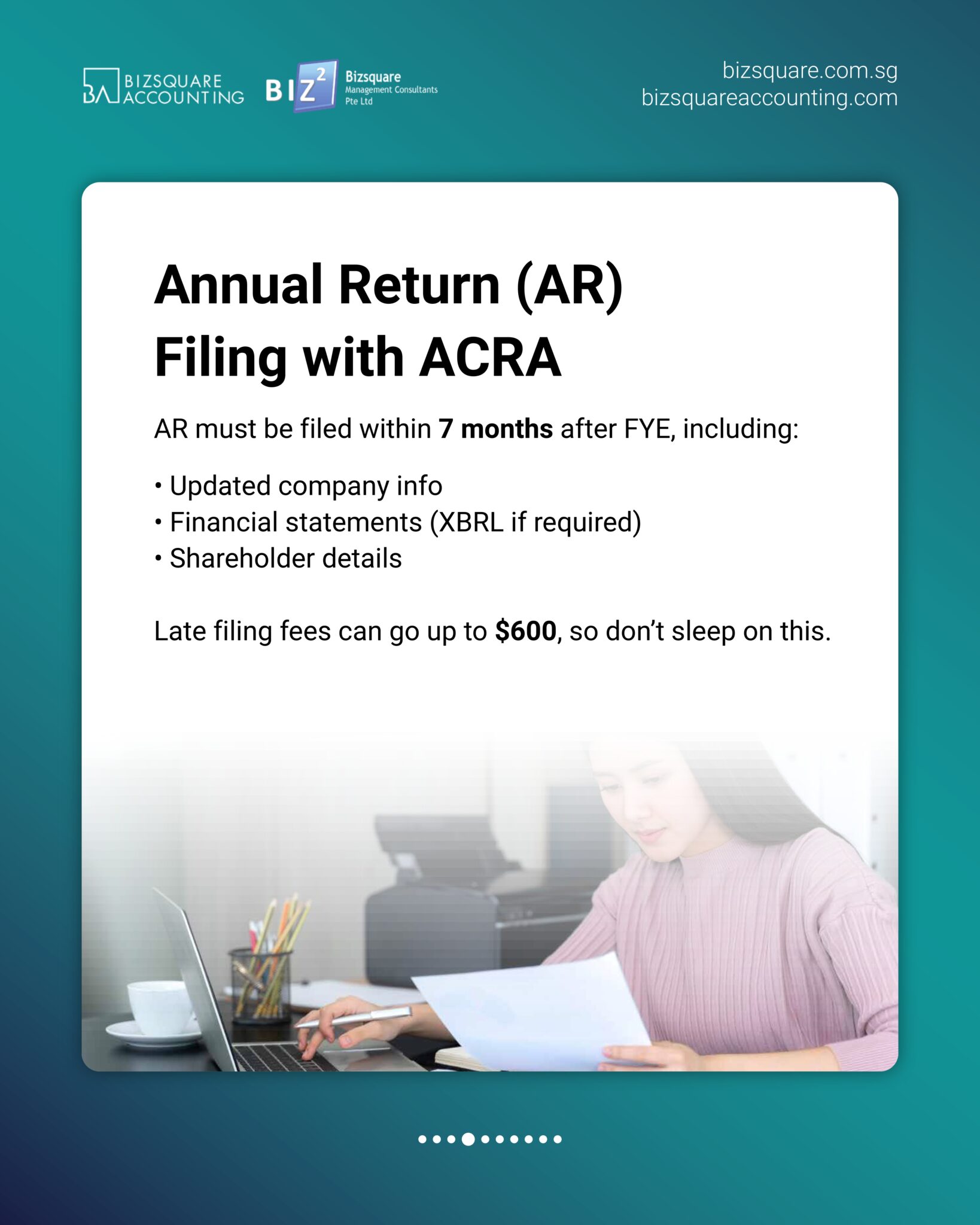
3. ACRA Annual Return Filing
The Annual return filing is mandatory for all companies, unless specifically exempted, and confirms that your company’s statutory records are up-to-date with ACRA.
All companies must file their Annual Return to ACRA within 7 months after FYE. This step confirms your company’s financial health and corporate information.
Your Annual Return should include:
- Updated company and shareholder details
- Financial statements (XBRL format, if required)
Failing to file on time can result in late penalties of up to $600.
Companies often search for annual return filing services because the XBRL requirement can be complex, especially for SMEs without internal accountants.
Key Point: For small, non-listed private companies that are exempt from holding an AGM, the AR must still be filed within 7 months after the FYE. Failure to file the AR on time will result in compounded late filing penalties from ACRA, and eventually, court prosecution for directors.
4. Corporate Tax Filing
The final critical submission is your company’s income tax return to IRAS. The Corporate tax filing deadline is annually on November 30 (paper filing) or December 15 (e-filing) of the subsequent year.
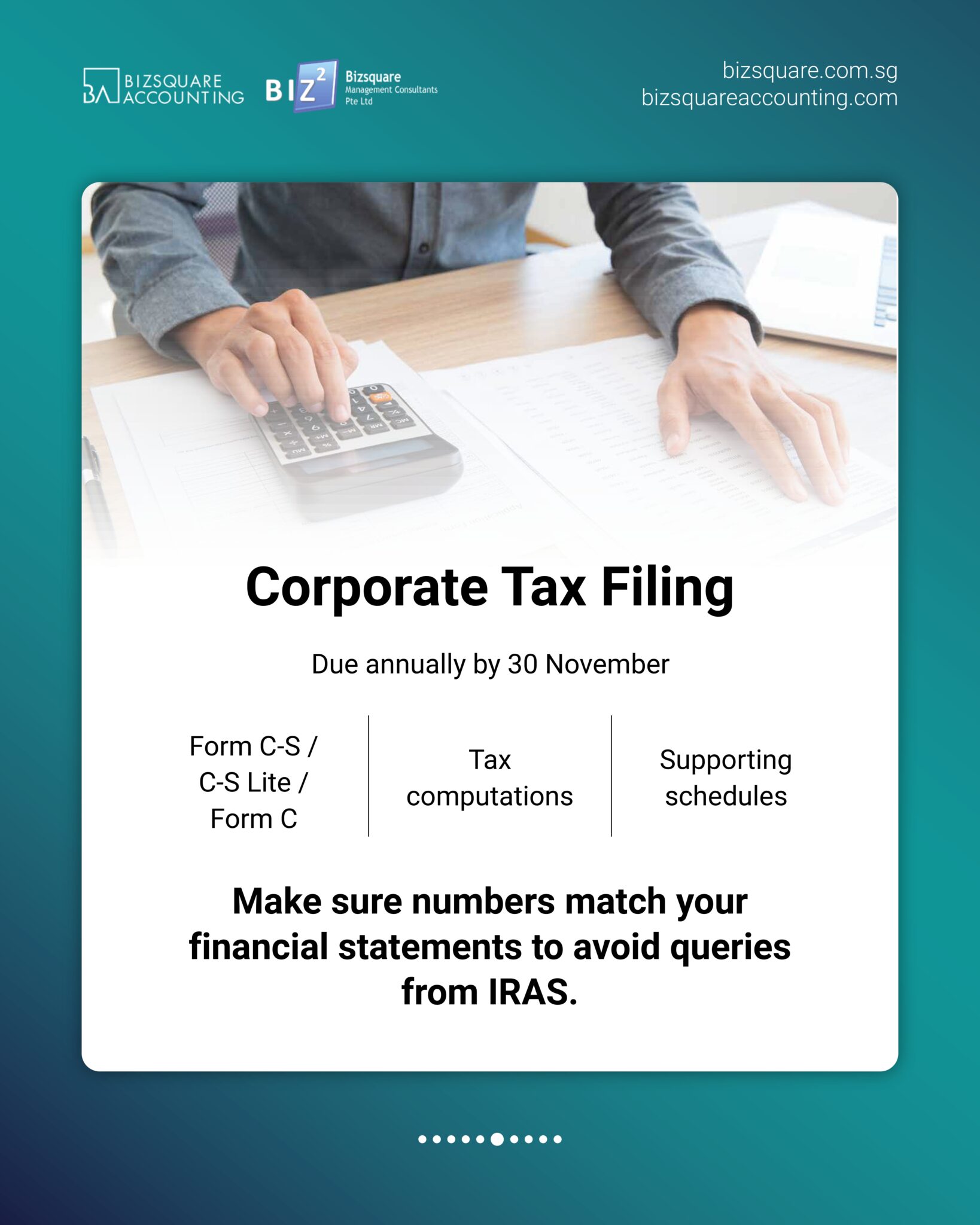
Companies must lodge one of the following forms:
- Form C-S Lite: For smaller companies meeting specific criteria (e.g., annual revenue of S$200,000 or less, satisfying the qualifying conditions for the corporate tax exemption scheme, etc.).
- Form C-S: For companies meeting certain conditions (e.g., annual revenue of S$5 million or less, deriving income only subject to the 17% tax rate, etc.).
- Form C: For companies that do not qualify for C-S or C-S Lite. This requires submitting full financial statements and tax computations.
To minimise tax exposure, remember to review all legitimate claims for deductions, capital allowances, and unutilised losses or donation carryovers before completing this return.
Phase 3 – Supporting Compliance and Optimising Claims
Beyond the primary ACRA and IRAS submissions, two other areas require diligent attention at the financial year end.
5. GST Compliance
If your business is registered for the Goods and Services Tax (GST), either voluntarily or due to meeting the S$1 million annual turnover threshold, consistent filing is crucial.
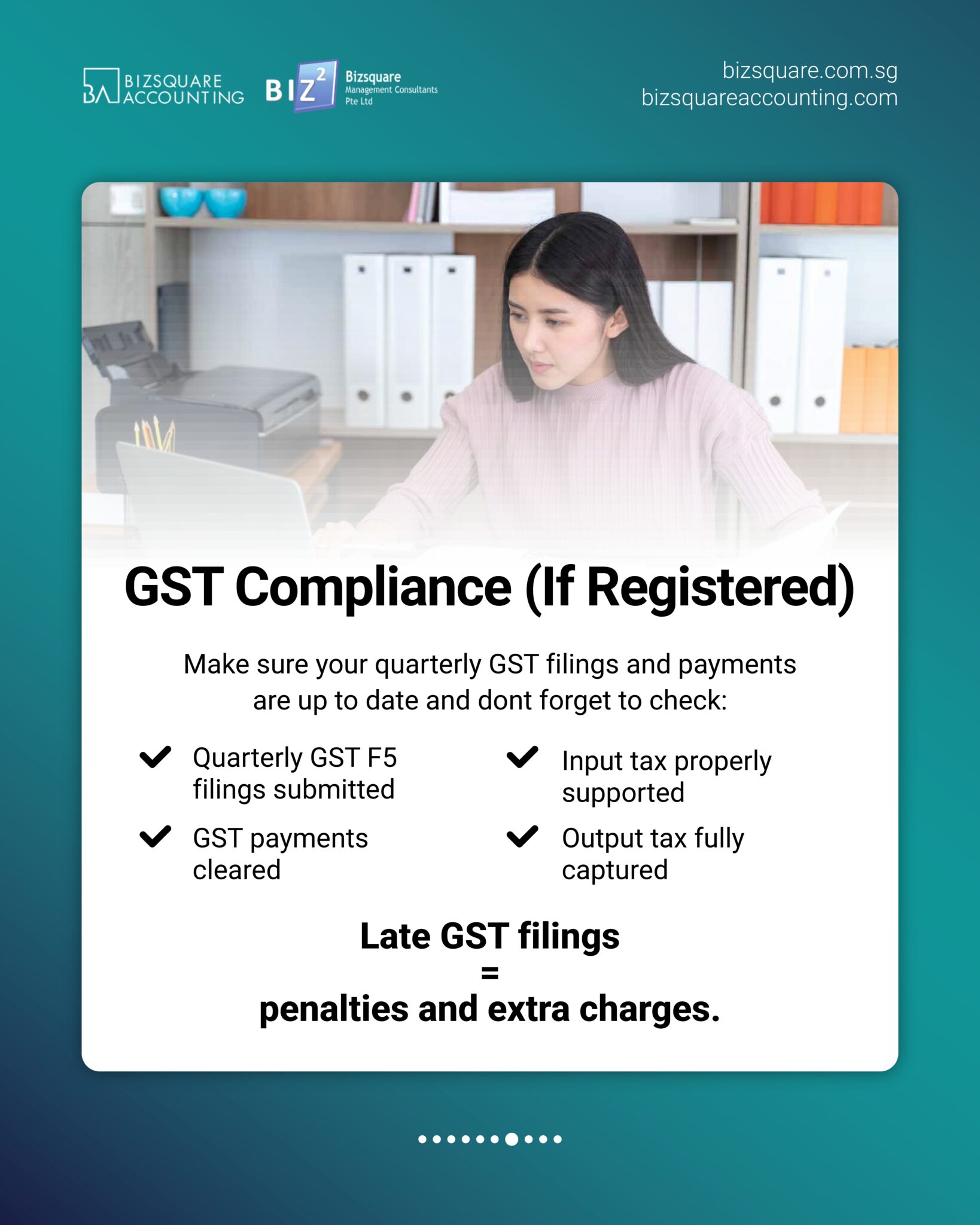
The GST filing Singapore requirement means you must submit your GST returns (Form 5) and make payment to IRAS within one month after the end of each prescribed accounting period (usually quarterly).
If your business is GST-registered, quarterly GST filing is required. Ensure both input and output taxes are accurately recorded.
Your GST compliance checklist should include:
- GST F5 returns submitted on time
- GST payments cleared
- Input tax claims properly supported
- Output tax fully captured
Late or incorrect submissions can lead to penalties, interest, and IRAS investigations.
Key Takeaway: Ensure your input tax (tax paid on purchases) is properly supported and claimed, and your output tax (tax collected on sales) is fully captured and accounted for. Late GST filings are met with strict penalties and extra charges, impacting your cash flow.
6. Payroll, Claims & Reliefs
While not strictly a year-end compliance task, the accuracy of your payroll is reviewed during the tax process and requires an annual administrative task.
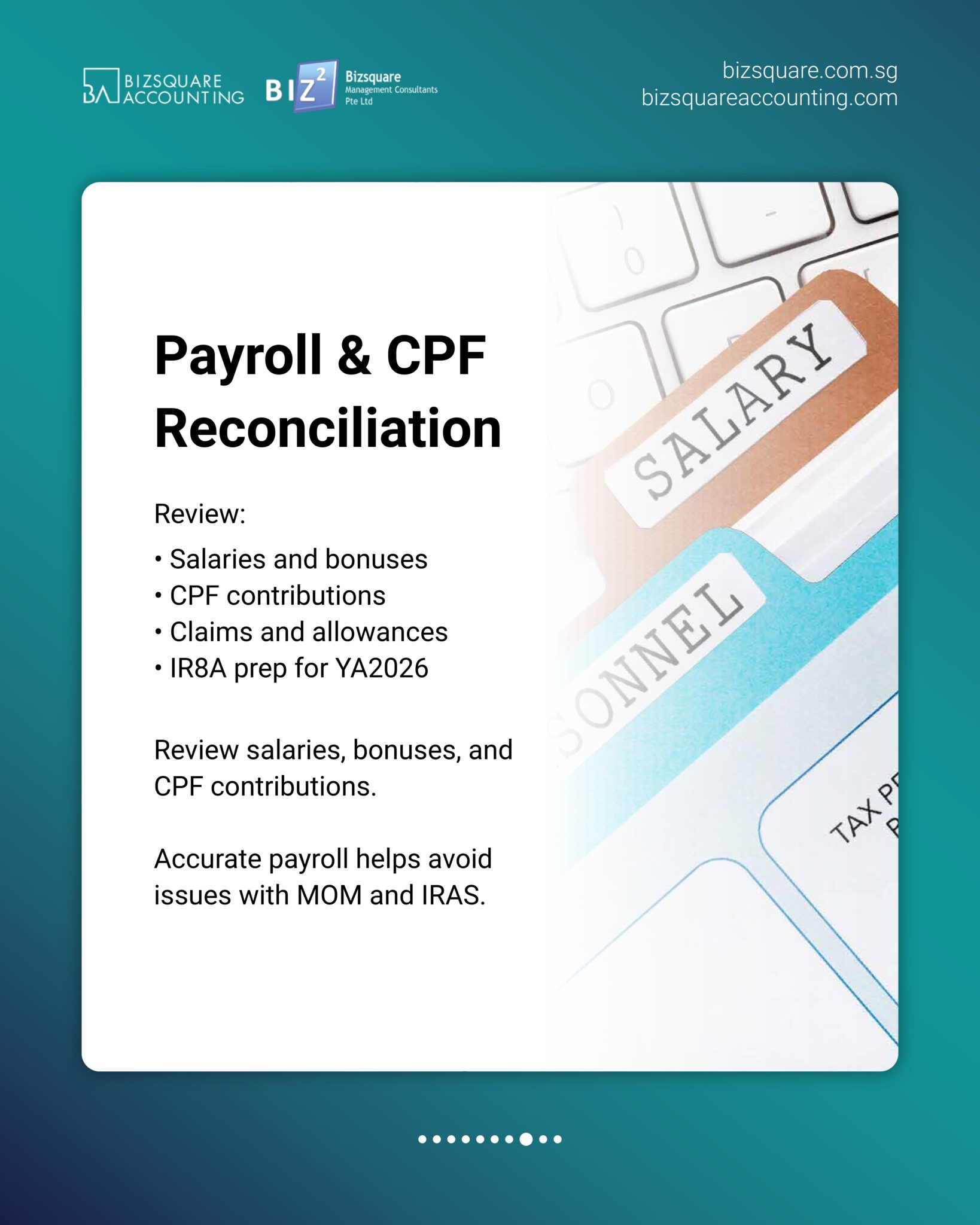
- IR8A Submission: Companies employing staff must prepare and submit Form IR8A (or its appendix/supplements) to IRAS by March 1 each year via the Auto-Inclusion Scheme (AIS) portal (mandatory for companies with 5 or more employees). Accurate payroll helps your employees file their personal tax returns and avoids issues with both the Ministry of Manpower (MOM) and IRAS.
- Maximise Claims: Before closing your books, check your eligibility for tax reliefs and claims, such as:
- Capital Allowances: Deductions for the wear and tear of fixed assets.
- Renovation & Refurbishment (R&R) Claims: Deductions for qualifying expenses incurred on R&R works.
- Carryovers: Utilising unutilised tax losses or capital allowances from previous years.
Want Hassle-Free Compliance?
All of these compliance tasks don’t have to be overwhelming. With Bizsquare Accounting, your entire year-end process is handled accurately, efficiently, and ahead of deadline. No penalty risks, no last-minute panic, and no wasted hours figuring out ACRA and IRAS requirements.
📞 Request a free consultation today and get personalised advice for your company’s year-end compliance.