

TL;DR:
- Applying for a KITAS requires the correct category, compliant sponsor, and complete documentation to avoid rejection. The process involves digital registration, submitting visa requests, biometric enrollment, and timely renewal to maintain legal residence. Professional support helps navigate complex requirements and ensures smooth application and compliance in Indonesia.
KITAS, formally known as the Izin Tinggal Terbatas or Temporary Stay Permit, is the official residence permit that allows foreign nationals to live and work legally in Indonesia. Knowing how to apply for KITAS correctly is the difference between a smooth entry and a costly rejection. The process involves four core stages: securing a qualified sponsor, preparing the right documents, applying for a VITAS (Limited Stay Visa) through Indonesia’s digital portals, and completing biometric registration upon arrival. This guide covers every stage in detail, including the four main KITAS categories, document checklists, processing timelines, and the most common mistakes that cause delays in 2026.
What are the different types of KITAS and how to select the right one?
Selecting the correct KITAS type is the single most important decision in the entire application process. Selecting an incorrect KITAS category often leads to rejection or immediate permit cancellation under Indonesian immigration law. Each category strictly limits what the holder can do, so a mismatch between your actual activities and your permit type creates serious legal risk.
The four main KITAS categories are:
- Work KITAS. Tied to a specific Indonesian employer. The employer must hold a valid RPTKA (Manpower Utilization Plan for Foreign Workers) approval from the Ministry of Manpower before the application can proceed. This category is for foreign professionals employed by an Indonesian legal entity.
- Investor KITAS. Designed for foreign nationals who have made a qualifying investment in an Indonesian company. Applicants must meet minimum investment thresholds set by the Indonesia Investment Coordinating Board (BKPM).
- Family KITAS. Granted to spouses and dependents of existing KITAS or KITAP holders. The sponsoring family member must have valid legal status in Indonesia.
- Retirement KITAS. Available to foreign retirees aged 55 and above. A licensed retirement sponsor agency registered with Indonesian immigration must sponsor the application.
Each KITAS type also defines which activities the holder is permitted to perform. A Family KITAS holder, for example, cannot engage in paid employment. An Investor KITAS holder cannot perform technical work functions outside the scope of their investment role.
Pro Tip: Before submitting any application, verify the specific permitted activities listed under your chosen KITAS category with a licensed immigration consultant. Assumptions about what each permit allows are the leading cause of post-approval violations.
What documents are required for applying for KITAS?
The document requirements for a KITAS application depend on the category, but several items apply across all types. Preparing a complete and accurate document set is the fastest way to avoid rejection.

Core documents for all KITAS applicants
| Document | Requirement |
|---|---|
| Valid passport | Minimum 18 months validity for Work KITAS; 12 months for most other categories |
| Passport-style photos | Recent, white background, matching official Indonesian immigration dimensions |
| Completed application form | Must use the current official version from the Directorate General of Immigration |
| Health insurance | Valid international or Indonesian health coverage for the full permit duration |
| Sponsor letter | Signed and stamped by the sponsoring entity (employer, spouse, agency) |
Beyond the core list, each KITAS type requires additional supporting documents:
- Work KITAS: Employment agreement, RPTKA approval letter, company deed, and employer’s NIB (Business Identification Number)
- Investor KITAS: Proof of investment, company shareholder documents, BKPM approval
- Family KITAS: Marriage certificate or birth certificate (for dependents), sponsor’s KITAS copy
- Retirement KITAS: Proof of pension or retirement income, sponsor agency agreement
Most foreign documents must be officially translated into Bahasa Indonesia and notarized where required by Indonesian immigration rules. Skipping this step is one of the most common reasons applications stall at the verification stage.
The sponsor’s legal standing matters as much as the applicant’s documents. A sponsor’s corporate compliance, including NIB registration and current tax status, is electronically verified before the application can proceed. Outdated or non-compliant sponsor documents will block the entire application automatically.
Pro Tip: Cross-check every name, date of birth, and passport number across all documents before submission. Even a single character difference between your passport and your employment agreement will trigger a rejection.
How to apply for KITAS step by step
The KITAS application process now uses integrated digital systems, allowing most steps to be completed remotely. The only exceptions are biometric enrollment and physical card collection, which require in-person attendance at an Indonesian immigration office.
Step-by-step KITAS application process
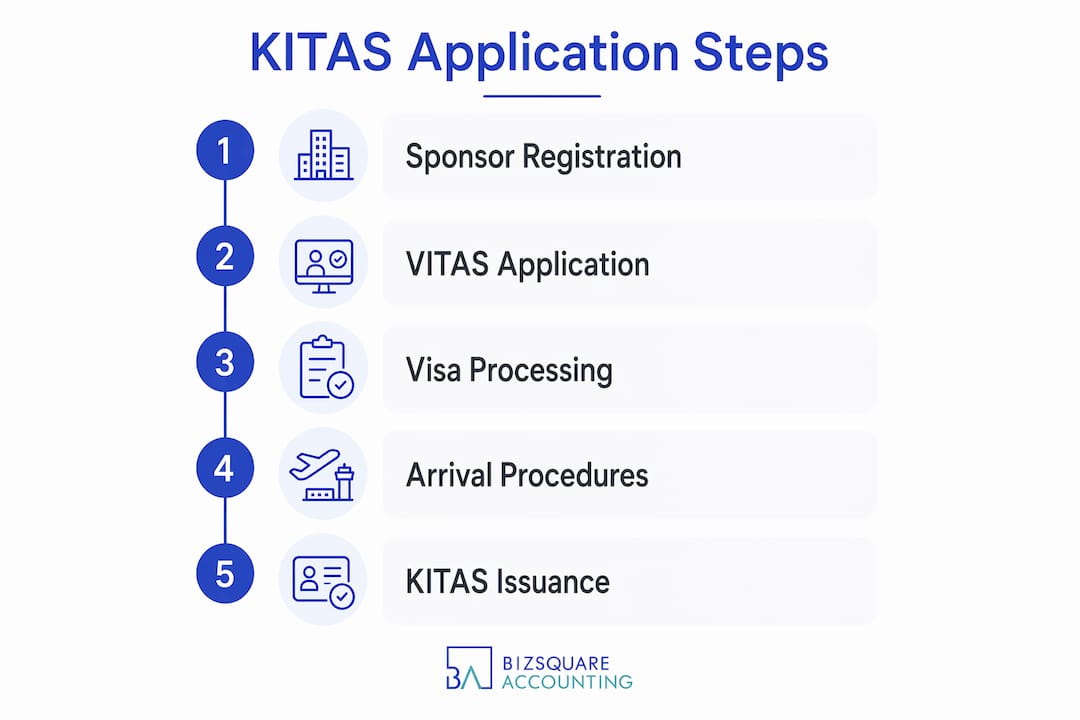
Sponsor registration on Visa-Online. The Indonesian sponsor (employer, spouse, or agency) registers and verifies their account on the Visa-Online portal managed by the Directorate General of Immigration. Corporate sponsors must pass the electronic compliance check covering NIB and tax status at this stage.
Sponsor submits visa sponsorship request. Once verified, the sponsor submits a sponsorship request for the applicant through the Visa-Online system. This generates a reference number for the applicant to use in the next step.
Applicant applies for VITAS via the e-Visa portal. The applicant logs into Indonesia’s official e-Visa portal, uploads all required documents, and pays the applicable visa fee. The VITAS is the Limited Stay Visa that allows entry into Indonesia for the purpose of converting to a KITAS.
Receive e-Telex Visa approval. After document review, the Directorate General of Immigration issues an e-Telex Visa approval. The applicant must receive this approval before traveling to Indonesia. Do not book a one-way ticket before this approval arrives.
Enter Indonesia using the VITAS. The applicant enters Indonesia through an authorized port of entry using the approved VITAS. Immigration officers at the port will stamp the entry and note the 30-day conversion window.
Report to the local immigration office within 30 days. Applicants must complete biometric enrollment at the local immigration office within 30 days of arrival. This includes photo capture and fingerprint scanning. Missing this deadline invalidates the VITAS and requires a new application.
VITAS converts to KITAS. After biometric enrollment, the immigration office processes the conversion. The applicant receives either a physical KITAS card or a digital e-KITAS, along with a MERP (Multiple Exit Re-entry Permit) for international travel.
Typical processing times and fees
| Stage | Estimated Duration |
|---|---|
| Sponsor registration and verification | 3–7 business days |
| VITAS application review | 7–14 business days |
| e-Telex Visa issuance | 3–5 business days after approval |
| Biometric and KITAS conversion | 7–14 business days after enrollment |
Fees vary by KITAS type and validity period. Government fees are paid through the e-Visa portal during the VITAS application stage. Additional notarization, translation, and agency fees apply depending on the document requirements for each category.
Pro Tip: Start the sponsor registration process at least six weeks before the intended travel date. Delays in sponsor verification are the most common cause of missed travel windows.
What are the most common KITAS application mistakes?
A large share of KITAS rejections trace back to preventable errors. Clerical errors like inconsistent passport details and improper photos cause frequent rejections. These are not minor inconveniences. Each rejection resets the timeline and may require the sponsor to resubmit their verification as well.
The most frequent mistakes include:
- Name inconsistencies. The applicant’s full name must appear identically on the passport, application form, employment agreement, and all supporting documents. Middle names, hyphens, and initials must match exactly.
- Incorrect photo specifications. Indonesian immigration requires specific dimensions, background color, and recency for passport photos. Photos taken more than six months ago or printed at the wrong size are rejected.
- Using outdated application forms. The Directorate General of Immigration updates its forms periodically. Submitting a previous version triggers automatic rejection.
- Sponsor document gaps. If the sponsor’s NIB or tax registration has lapsed, the system blocks the application before it reaches a human reviewer.
- Unauthorized activities. Performing work or business activities not permitted under the specific KITAS type is a violation of Indonesian immigration law. Penalties include permit cancellation and deportation.
Changing employers on a Work KITAS is not a simple update. A completely new application including a new RPTKA evaluation is mandatory. Foreign professionals who switch jobs without reapplying are technically in violation of their permit conditions.
For rejected applications, the recommended course of action is to request a written explanation from the immigration office, correct every identified error, and resubmit with a complete document set. Do not resubmit without addressing the specific reason for rejection.
Pro Tip: Use a KITAS application checklist reviewed by a licensed immigration consultant before every submission. A second pair of expert eyes catches errors that applicants consistently miss.
What happens after KITAS approval?
Receiving KITAS approval is not the end of the compliance process. Several obligations begin immediately after the permit is issued, and failing to meet them can result in fines or permit cancellation.
Key post-approval responsibilities include:
- Receive and register e-KITAS. The digital e-KITAS serves as the official residence document. Keep it accessible at all times. The MERP attached to the permit allows multiple exits and re-entries during the validity period.
- Report address changes. Any change of residential address must be reported to the local immigration office within a set timeframe. Failure to report is a compliance violation.
- Report employer changes. Work KITAS is tied to a specific employer and KBLI business code. A job change requires a full new application, including a new RPTKA assessment from the Ministry of Manpower.
- Renew before expiry. KITAS validity periods typically range from one to two years depending on the category. Renewal applications should be submitted at least 30 days before the current permit expires. Overstaying carries daily fines and can result in deportation and a re-entry ban.
- Maintain sponsor compliance. The sponsor’s legal status must remain valid throughout the permit period. If the sponsoring company loses its NIB or tax compliance, the KITAS may be subject to cancellation.
The renewal process mirrors the original application in terms of document requirements. Updated employment agreements, renewed health insurance, and current sponsor compliance documents are all required for a successful renewal.
Key Takeaways
Applying for KITAS in Indonesia requires the right permit category, a compliant sponsor, complete documentation, and strict adherence to the 30-day biometric enrollment deadline after arrival.
| Point | Details |
|---|---|
| Choose the correct KITAS type | Mismatched categories cause rejection or cancellation; verify permitted activities before applying. |
| Sponsor compliance is critical | The sponsor’s NIB and tax status are verified electronically; outdated documents block the application. |
| Complete biometrics within 30 days | Biometric enrollment at the local immigration office must happen within 30 days of arrival. |
| Name consistency across all documents | Every document must show identical name details to avoid clerical rejection. |
| Renew before the permit expires | Submit renewal applications at least 30 days before expiry to avoid fines and re-entry bans. |
The KITAS process rewards preparation, not speed
Most KITAS applications that fail do so because of preparation gaps, not because the applicant was ineligible. The digital transition has made the process faster and more accessible, but it has also made the system less forgiving. Automated compliance checks on the Visa-Online portal reject sponsor accounts with any lapse in NIB or tax registration before a human reviewer ever sees the file.
The choice of KITAS type deserves more attention than most applicants give it. Foreign professionals often assume their situation fits the Work KITAS category, then discover their employer has not obtained the required RPTKA from the Ministry of Manpower. That single missing document delays the entire process by weeks. Investors sometimes apply under the wrong category because their investment structure does not meet the BKPM thresholds for an Investor KITAS.
The 30-day biometric window after arrival is the most time-sensitive obligation in the process. Missing it does not result in a warning. It invalidates the VITAS entirely. Foreign professionals who travel on business or take short trips immediately after arrival sometimes miss this deadline without realizing it.
Professional assistance is not a luxury for complex KITAS applications. For corporate-sponsored Work KITAS, the sponsor’s compliance preparation alone involves multiple government systems. A licensed consultant who works with the Visa-Online portal and the Ministry of Manpower regularly will spot compliance gaps before they become application blocks. The cost of professional support is a fraction of the cost of a rejected application and a delayed start date.
— Vandro
How Bizsquare can support your KITAS application
Foreign professionals and companies navigating the KITAS process for the first time face a layered compliance requirement that touches immigration law, manpower regulations, and corporate registration simultaneously.
Bizsquare provides end-to-end support for foreign nationals and companies applying for KITAS in Indonesia. From Indonesia business registration and RPTKA preparation to document verification and sponsor compliance checks, Bizsquare’s consultants handle the procedural complexity so applicants can focus on their work. The team also supports KITAS renewal and post-approval compliance reporting. Contact Bizsquare for a consultation and get your application prepared correctly from the first submission.
FAQ
What is KITAS and who needs it?
KITAS is Indonesia’s Temporary Stay Permit, required by any foreign national who intends to reside in Indonesia for more than 60 days. It covers categories including work, investment, family, and retirement.
How long does the KITAS application take?
The full process from sponsor registration to KITAS card issuance typically takes four to eight weeks. Delays in sponsor verification or document corrections extend this timeline.
What is a VITAS and how does it relate to KITAS?
A VITAS (Limited Stay Visa) is the entry visa that allows a foreign national to enter Indonesia for the purpose of converting to a KITAS. The conversion must be completed within 30 days of arrival through biometric enrollment.
Does a Work KITAS allow the holder to change employers?
No. Work KITAS is tied to a specific employer. Changing employers requires a completely new application, including a new RPTKA assessment from the Ministry of Manpower.
What documents does the sponsor need to provide?
The sponsor must provide a valid NIB, current tax compliance certificate, company deed, and a signed sponsorship letter. Corporate sponsors must also pass the electronic compliance verification on the Visa-Online portal before the application proceeds.
Can a KITAS be renewed?
Yes. KITAS permits are renewable, and the renewal process requires updated documents from both the applicant and the sponsor. Applications should be submitted at least 30 days before the current permit expires.
What happens if the 30-day biometric deadline is missed?
Missing the 30-day biometric enrollment deadline invalidates the VITAS. The applicant must exit Indonesia and restart the application process from the beginning.
Is health insurance mandatory for KITAS?
Yes. Valid health insurance covering the full duration of the permit is a mandatory document for all KITAS categories. Indonesian immigration accepts both international and local Indonesian health coverage.
Can a Family KITAS holder work in Indonesia?
No. A Family KITAS does not authorize paid employment. Holders who wish to work must apply for a Work KITAS through a qualifying Indonesian employer.
What is an RPTKA and why does it matter for Work KITAS?
An RPTKA is a Manpower Utilization Plan for Foreign Workers, issued by Indonesia’s Ministry of Manpower. Work KITAS requires an RPTKA obtained by the employer before the visa application can begin. Without it, the application cannot proceed.
What are the consequences of overstaying a KITAS?
Overstaying results in daily fines, potential deportation, and a possible re-entry ban. Renewal applications submitted before the expiry date prevent overstay violations.
Where can foreign professionals get help with the KITAS application process?
Licensed immigration consultants and business registration firms such as Bizsquare provide professional support for KITAS applications in Indonesia, covering document preparation, sponsor compliance, and post-approval reporting.