

TL;DR:
- Singapore companies must hold their first AGM within 18 months of incorporation and then annually, with strict deadlines for non-listed and listed firms. Private companies can dispense with AGMs if all members agree and send financial statements, while public firms face mandatory meetings and filings. Failure to comply risks legal penalties, disqualification of directors, and damage to reputation, so early preparation and professional support are essential.
An Annual General Meeting (AGM) is a legally required yearly meeting where Singapore companies present financial results and allow shareholders to vote on key decisions. Under the Companies Act and rules set by the Accounting and Corporate Regulatory Authority (ACRA), every company must hold an AGM unless a specific exemption applies. Understanding how AGM works in Singapore protects directors from legal liability and keeps the company in good standing with regulators. This guide covers deadlines, formats, notice rules, exemptions, and penalties, so business owners can manage their AGM obligations with confidence.
What are the legal requirements and timelines for holding an AGM in Singapore?
AGM regulations in Singapore set firm deadlines that every company must follow. Missing these deadlines exposes directors to prosecution, fines, and disqualification. The rules differ slightly depending on the company’s listing status and financial year.

Key statutory deadlines
The Companies Act establishes the following timeline requirements:
- First AGM: Companies must hold their first AGM within 18 months of incorporation. This gives new companies enough time to prepare their first set of financial statements.
- Subsequent AGMs: After the first meeting, AGMs must be held annually, with no more than 15 months between consecutive meetings.
- Non-listed companies: These companies must hold their AGM within 6 months from the end of their financial year.
- Listed companies: Companies listed on the Singapore Exchange (SGX) must hold their AGM within 4 months from the financial year end.
The distinction between listed and non-listed companies matters because listed firms have more shareholders and stricter public disclosure obligations. A private limited company with a december financial year end, for example, must hold its AGM by june 30 of the following year.
Applying for an extension of time
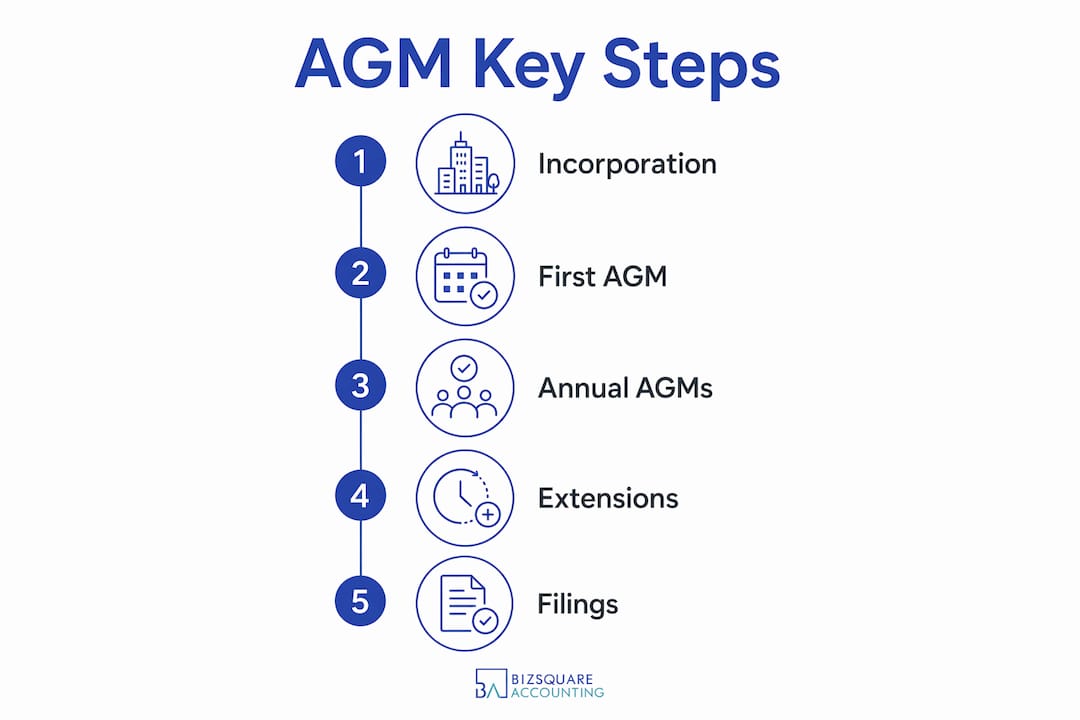
Companies that cannot meet the AGM deadline may apply to ACRA for an extension. A company may apply for a 60-day extension by paying a fee of SGD 200. This extension is not automatic. The company must submit the application before the original deadline passes, and ACRA has discretion to approve or reject the request.
Pro Tip: Apply for an extension of time at least two weeks before the deadline. Last-minute applications risk rejection, which leaves directors fully exposed to penalties.
AGM versus annual return filing
The AGM and the annual return are two separate obligations. The AGM is the physical or virtual meeting where shareholders gather. The annual return is a statutory filing submitted to ACRA after the AGM, confirming the company’s key details. Both must be completed, and completing one does not substitute for the other.
How is an AGM conducted in Singapore?
Understanding how to conduct an AGM in Singapore requires knowing the permitted formats, the notice rules, and the standard agenda. Each element has specific legal requirements.
Permitted meeting formats
AGMs can be conducted physically, electronically (virtual), or as hybrid meetings, provided the company’s constitution allows it. This flexibility became more relevant after the COVID-19 pandemic, when many companies adopted virtual formats. A hybrid meeting combines in-person attendance with a live digital option for shareholders who cannot travel.
Before choosing a virtual or hybrid format, directors must check whether the company’s constitution explicitly permits it. If the constitution is silent on virtual meetings, the company may need to amend it first. Practitioners recommend annual review of company constitutions to accommodate virtual AGM formats, avoiding legal exposure.
Notice requirements
The notice of AGM must be sent to all shareholders, directors, and auditors before the meeting date. The minimum notice period is at least 14 days for ordinary resolutions. If the company’s constitution or SGX listing rules require a longer period, the longer period applies.
The notice must include:
- The date, time, and location (or virtual meeting link) of the AGM
- The agenda, listing all business to be transacted
- Proxy appointment information, including the deadline for submitting proxy forms
- Copies of financial statements and directors’ reports to be tabled
Failing to give proper notice is a statutory offense. Improper AGM notice is an offense by the officers in default, meaning directors and the company secretary can be held personally liable.
Proxy appointments
Shareholders who cannot attend the AGM in person may appoint a proxy to vote on their behalf. Shareholders may appoint up to two proxies per meeting, unless the constitution states otherwise. The proxy form must be submitted to the company at least 48 hours before the meeting, unless the constitution specifies a different deadline.
Standard AGM agenda items
A typical AGM in Singapore covers the following items in order:
- Tabling of financial statements: Directors present the audited financial statements and directors’ report for the past financial year.
- Declaration of dividends: Shareholders vote to approve any dividend recommended by the directors.
- Re-election of directors: Directors who are retiring by rotation are put forward for re-election.
- Appointment or re-appointment of auditors: Shareholders vote to appoint the company’s auditor and authorize the directors to fix the auditor’s remuneration.
- Any other business: Additional resolutions, such as approving share issuances or amendments to the constitution, are tabled as special business.
The company secretary plays a central role in preparing the AGM notice, drafting resolutions, and ensuring all documents are sent on time. Engaging a qualified corporate secretary in Singapore reduces the risk of procedural errors that could invalidate the meeting.
What are the common exemptions and alternatives to holding an AGM?
Not every Singapore company must hold a full AGM every year. The Companies Act provides specific exemptions for private companies that meet certain conditions.
Private company exemption
Private companies may dispense with AGMs if all members pass a resolution to do so and the company sends its financial statements to members within the required timeframe. This exemption applies only to private companies. Public companies and listed companies must hold AGMs without exception.
The conditions for this exemption include:
- All members must agree, by resolution, to dispense with the AGM.
- The company must send audited financial statements to all members within 5 months of the financial year end (for non-listed private companies).
- Any member retains the right to request that an AGM be held. If a member makes such a request, the company must convene an AGM within 6 months of the financial year end.
This exemption is practical for small private companies where all shareholders are also directors. In those cases, the formal meeting adds little value beyond what directors already discuss in their day-to-day management.
Written resolutions as an alternative
Private companies may also pass resolutions in writing, without convening a physical or virtual meeting. A written resolution is valid when all members entitled to vote sign it. This approach works well for routine decisions, such as re-appointing auditors or approving financial statements, where no debate is expected.
Dormant companies
A dormant company, defined as one that has had no accounting transactions during the financial year, qualifies for relief from preparing full financial statements. Dormant companies are also exempt from the requirement to appoint an auditor. However, they must still file an annual return with ACRA and may still need to hold an AGM unless they qualify for the private company exemption above.
Pro Tip: Even if your company qualifies for the AGM exemption, keep records of the members’ resolution and the date financial statements were sent. ACRA may request these documents during a compliance review.
What are the consequences of failing to comply with AGM requirements?
Non-compliance with AGM requirements in Singapore carries serious legal and reputational consequences. Directors cannot treat AGM obligations as optional or low-priority.
Director liability and penalties
Directors who fail to comply with AGM requirements may face prosecution and disqualification. ACRA actively monitors annual return filings and can identify companies that have missed their AGM deadlines. The consequences for non-compliance include:
- Prosecution: Directors and company officers can be prosecuted under the Companies Act.
- Fines: Financial penalties apply to the company and its officers.
- Disqualification: Persistent non-compliance can result in a director being disqualified from holding directorship in any Singapore company.
- Debarment: Officers in default may be debarred from acting as company directors or secretaries.
Impact on company reputation and shareholder trust
Beyond legal penalties, failing to hold an AGM damages the company’s credibility with shareholders, banks, and business partners. Shareholders have a statutory right to receive financial information and vote on key decisions. Denying them this right, even unintentionally, can trigger disputes and legal challenges.
A company that misses its AGM deadline also risks having its annual return filing rejected, which creates a cascading compliance problem. Banks and investors often conduct due diligence checks that include verifying ACRA filings. An incomplete compliance record can delay loan approvals or investment rounds.
Common mistakes that lead to non-compliance
Many AGM compliance failures stem from procedural errors rather than deliberate neglect. The most frequent mistakes include:
- Sending AGM notices too late or to the wrong addresses
- Failing to include required documents, such as audited financial statements, with the notice
- Not updating the company’s registered address with ACRA, causing notices to be misdirected
- Overlooking the proxy submission deadline, which invalidates proxy votes
- Failing to file the annual return promptly after the AGM
Engaging a professional corporate secretary service addresses all of these risks. A qualified secretary tracks deadlines, prepares notices, and files documents with ACRA on time.
Key Takeaways
Singapore’s AGM framework requires strict adherence to statutory deadlines, proper notice procedures, and accurate filings, with non-compliance exposing directors to prosecution, fines, and disqualification.
| Point | Details |
|---|---|
| First AGM deadline | Companies must hold their first AGM within 18 months of incorporation. |
| Annual interval rule | Subsequent AGMs must occur every year, with no more than 15 months between meetings. |
| Notice period | Send AGM notices at least 14 days before the meeting, with all required documents attached. |
| Private company exemption | Private companies may skip the AGM if all members agree by resolution and receive financial statements on time. |
| Director liability | Non-compliance can result in prosecution, fines, and disqualification from holding directorships. |
AGM compliance is simpler than most business owners expect
Many business owners treat the AGM as a bureaucratic hurdle, something to get through once a year with minimal effort. That view creates risk. The AGM is the one formal moment each year when shareholders, directors, and auditors are all accountable to each other. Getting the process right protects everyone involved.
The most common mistake I see is companies that have never updated their constitution since incorporation. A constitution written in 2015 may not permit virtual meetings, which means a company that held a Zoom AGM without amending its constitution technically held an invalid meeting. That is a real legal exposure, and it is entirely avoidable. Practitioners consistently recommend reviewing the company constitution annually, especially as ACRA updates its guidance on new regulatory requirements.
The second mistake is treating the company secretary role as a formality. A good corporate secretary does not just sign documents. They track deadlines, flag constitution issues, prepare compliant notices, and coordinate with auditors. For foreign-owned companies in particular, the corporate secretary is often the person who bridges the gap between local regulatory requirements and the parent company’s expectations. The article on corporate secretary support for foreign companies explains this role in detail.
Early preparation is the most practical advice available. Start the AGM process at least six weeks before the deadline. That window gives the auditors time to finalize statements, the secretary time to prepare notices, and the directors time to review resolutions. Companies that start two weeks before the deadline are the ones applying for extensions and paying the SGD 200 fee unnecessarily.
— Vandro
Bizsquare makes AGM compliance straightforward for Singapore businesses
Running a business in Singapore means staying on top of multiple compliance deadlines at once. AGM obligations sit alongside tax filings, annual returns, and financial reporting requirements. Missing any one of them creates a chain reaction of problems.

Bizsquare provides corporate secretarial and incorporation services that cover every step of the AGM process, from drafting compliant notices to filing annual returns with ACRA. The team monitors deadlines, prepares resolutions, and coordinates with auditors so nothing falls through the gaps. Business owners who want to focus on growing their company, rather than tracking regulatory calendars, can rely on Bizsquare to keep their governance record clean and current. Contact Bizsquare today to get your AGM compliance on track.
FAQ
What is an AGM in Singapore?
An AGM (Annual General Meeting) is a mandatory yearly meeting where a Singapore company presents its financial statements to shareholders and votes on key governance matters under the Companies Act.
When must a company hold its first AGM in Singapore?
The first AGM must be held within 18 months of the company’s incorporation date, as required by the Singapore Companies Act.
How much notice is required for an AGM in Singapore?
Companies must give at least 14 days’ notice for an AGM involving ordinary resolutions. The company’s constitution or SGX listing rules may require a longer notice period.
Can a private company in Singapore skip the AGM?
Yes. A private company may dispense with the AGM if all members pass a resolution to do so and the company sends financial statements to members within the required timeframe.
What happens if a company misses its AGM deadline in Singapore?
Directors may face prosecution, fines, and disqualification under the Companies Act. ACRA monitors compliance and can take enforcement action against officers in default.
Can an AGM be held virtually in Singapore?
Yes. AGMs can be held physically, virtually, or as hybrid meetings, provided the company’s constitution permits the chosen format.
How many proxies can a shareholder appoint for an AGM?
A shareholder may appoint up to two proxies per AGM, unless the company’s constitution specifies a different limit.
What is the AGM deadline for non-listed companies in Singapore?
Non-listed companies must hold their AGM within 6 months from the end of their financial year.
What is the AGM deadline for listed companies in Singapore?
Listed companies on the Singapore Exchange must hold their AGM within 4 months from the end of their financial year.
Can a company apply for an extension to hold its AGM?
Yes. A company may apply to ACRA for a 60-day extension by paying a fee of SGD 200, provided the application is submitted before the original deadline.
What documents must be included in the AGM notice?
The AGM notice must include the agenda, audited financial statements, directors’ report, and proxy appointment information with the submission deadline.
What is the difference between an AGM and an annual return in Singapore?
The AGM is the shareholder meeting itself. The annual return is a separate statutory filing submitted to ACRA after the AGM to confirm the company’s key details.
Do dormant companies in Singapore need to hold an AGM?
Dormant companies may qualify for relief from preparing financial statements and appointing auditors, but they must still file an annual return with ACRA and may need to hold an AGM unless the private company exemption applies.
What role does the company secretary play in an AGM?
The company secretary prepares the AGM notice, drafts resolutions, coordinates with auditors, and files documents with ACRA, making them central to a compliant AGM process.
What are written resolutions and when can they be used?
Written resolutions allow private companies to pass decisions without holding a formal meeting. They are valid when all members entitled to vote sign the resolution, and they work well for routine matters like re-appointing auditors.