

Avoid 4–8 Week Bank Delays When Registering in Singapore as a Foreigner
Yes, foreigners can register a company in Singapore and own it entirely, but the process comes with strict conditions. You cannot self-file with ACRA as a non-resident, so a registered filing agent must submit your incorporation. You also need at least one director ordinarily resident in Singapore, whether that person is a citizen, permanent resident, or nominee.
Overview:
- Foreign founders need at least one Singapore-ordinarily-resident director, which can be a citizen, permanent resident, or nominee, to incorporate a company.
- The total government fee for registration is approximately S$315, with bank account opening often taking 4 to 8 weeks, making it typically the longest step in the process.
- Engaging a registered filing agent is mandatory for non-residents, as they cannot submit applications on BizFile themselves, and document notarisation or apostille certification may be required.
- Most companies choose the private limited structure because it offers full foreign ownership, limited liability, and access to local tax incentives; other structures include subsidiaries, branches, or representative offices.
- After incorporation, companies must appoint a secretary within six months, file annual returns, and comply with tax, payroll, and bookkeeping obligations to maintain good standing.
Table of Contents
- Eligibility and core requirements for foreigners registering a company in Singapore applications
- Which business structure suits your Singapore plans?
- How do you complete Singapore business registration as a foreigner?
- What are your resident director options as a foreigner?
- What does it cost, and how long does the process really take?
- What compliance duties follow incorporation?
- What founders consistently get wrong
- How Bizsquare helps foreign founders get operational, not just incorporated
- Sources
- FAQ
Eligibility and core requirements for foreigners registering a company in Singapore applications
Before you approach a filing agent, check that you meet the basic conditions ACRA sets for every applicant, local or foreign. Any director must be at least 18 years old, and cannot be an undischarged bankrupt or previously disqualified from directorship in Singapore. These rules apply equally to residents and foreigners, so age and clean legal standing come first.
Foreign entrepreneurs can own 100% of a private limited company, and the paid-up capital minimum starts at just S$1. That ownership freedom is genuinely rare among Asian jurisdictions, but it comes paired with a filing restriction most first-time founders overlook. Non-residents cannot lodge their own application on BizFile. Instead, a registered filing agent must handle the submission, performing know-your-customer and anti-money-laundering checks on every director, shareholder, and beneficial owner before anything reaches ACRA’s system.
The eligibility checklist for foreign founders typically covers:
- At least one director ordinarily resident in Singapore (citizen, permanent resident, or eligible work-pass holder)
- Engagement of a licensed corporate service provider to act as your filing agent
- Appointment of a qualified company secretary within six months of incorporation
- A registered office address in Singapore, which can be commercial or provided by your service agent
- Verified identity documents for every director, shareholder, and beneficial owner
A local director requirement trips up more foreign applicants than any other single rule, mainly because people assume ownership and directorship are the same thing. They are not. You can hold every share from overseas, yet the law still demands someone accountable on the ground.
Which business structure suits your Singapore plans?
Most foreign founders default to a private limited company, and for good reason. It offers limited liability, a separate legal identity, and full foreign ownership, making it the standard vehicle for startups and small teams entering Singapore. Shareholders risk only their invested capital, never personal assets, which matters enormously if your venture involves contracts, leases, or hiring.
That said, several structures exist for foreign businesses, each carrying different legal and tax consequences:
- Private limited company: a separate legal entity, full foreign ownership allowed, ideal for founders building a real Singapore operation
- Subsidiary: technically a private limited company owned by a foreign parent, taxed as a local resident entity with access to tax exemptions
- Branch office: an extension of the foreign parent, not a separate legal entity, so the parent bears full liability
- Representative office: allowed to conduct market research only, cannot generate income or sign contracts, useful for testing demand before committing
- Re-domiciliation: transferring your company’s legal home to Singapore while keeping its business history intact, suited to established firms relocating headquarters
Startups and market testers usually pick the private limited company or, cautiously, a representative office if they want to observe the market first. Established foreign parents expanding into Singapore often weigh subsidiary against branch structures, largely because subsidiaries can access local tax incentives that branches cannot.
How do you complete Singapore business registration as a foreigner?
The path from decision to operating company follows a fairly predictable sequence, though timing varies depending on how quickly documents come together. Here is the realistic order of events.
- Engage a registered filing agent. Since non-residents cannot self-file, your first real step is appointing a corporate service provider. They will run KYC checks on directors and shareholders, confirm your intended company structure, and prepare the paperwork ACRA expects.
- Reserve your company name on BizFile. Your agent submits a proposed name through BizFile, ACRA’s online filing portal. Names get rejected for being identical or too similar to existing companies, containing restricted words like “bank” or “trust” without approval, or breaching trademark rights. Approval usually takes minutes if the name is clean.
- Gather your documentation checklist. You will need certified copies of passports for all directors and shareholders, proof of residential address, your company’s constitution, details of share structure, and beneficial ownership declarations. Foreign documents often require notarisation or apostille certification.
- File the incorporation application. Your agent submits the full application on BizFile along with the government fee. Standard applications typically receive ACRA approval within 1 to 3 business days, though referred cases involving sensitive industries or complex ownership structures take longer.
- Handle post-approval essentials. Once incorporated, appoint your company secretary, register for GST if your turnover is expected to exceed the threshold, and begin the corporate bank account process.
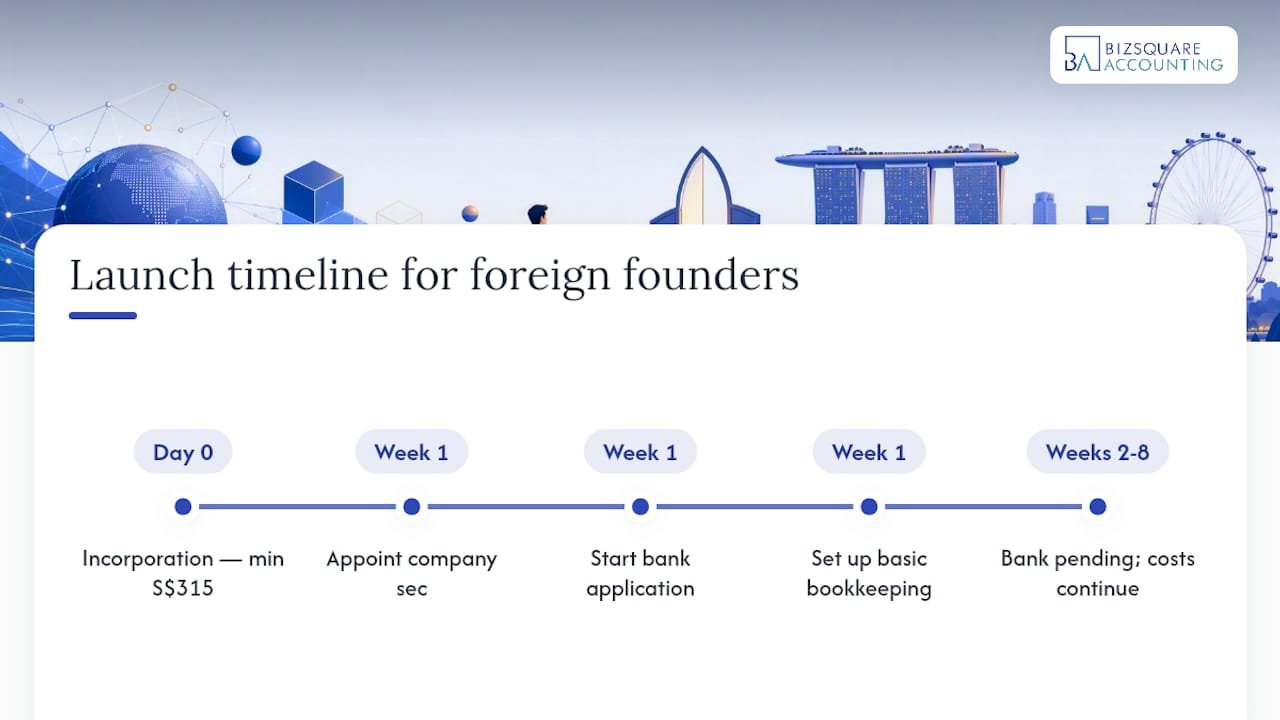
Pro Tip: Start your bank account application the same week you incorporate. Banks run their own KYC independently of ACRA, and non-resident applications routinely take longer than founders expect, so early submission protects your operating timeline.
Read a fuller walkthrough of the BizFile process and government fees if you want the complete procedural detail before instructing your agent.
What are your resident director options as a foreigner?
Satisfying the resident director rule generally comes down to three realistic paths, and each carries different trade-offs for control and cost.
- Appoint a local co-founder or hire a resident executive who can serve as director, giving you genuine operational input from someone based in Singapore
- Sponsor your own work pass, such as an EntrePass, and act as director yourself once approved
- Engage a nominee director service through your corporate service provider, a purely administrative appointment that satisfies the legal requirement without transferring business control
EntrePass and Employment Pass rules directly affect who can serve as your resident director. An Employment Pass holder taking on a secondary directorship may need a Letter of Consent from the Ministry of Manpower, and there are limits on how many directorships a pass holder can hold simultaneously. This is not a minor technicality, it determines whether your chosen director arrangement is even legal.
Nominee directors typically do not hold operational authority or bank signatory rights, which keeps shareholder control intact. Some banks may apply extra scrutiny to companies relying solely on nominee directors during account opening. A nominee director arrangement works well as a bridge solution, but most founders eventually transition toward a genuine resident director or their own work pass as the business grows.
What does it cost, and how long does the process really take?
Government fees are fixed and modest. Name reservation costs S$15, and incorporation itself costs S$300, bringing the total government outlay to roughly S$315. Everything beyond that, filing agent fees, nominee director charges, and registered office costs, varies by provider.
| Stage | Typical Timeframe |
|---|---|
| Document preparation and KYC | 1 to 3 business days |
| ACRA approval | 1 to 3 business days |
| Company secretary appointment | Within six months |
| Corporate bank account opening | 4 to 8 weeks |
| Fully operational milestone | 5 to 9 weeks |
Bank account opening is consistently the longest bottleneck for foreign-owned companies, often stretching past a month because banks apply tightened KYC on non-resident directors and shareholders. Electronic money institutions and fintech providers offer faster alternatives, though these usually function as e-money accounts rather than full banking relationships, so weigh that trade-off against your operational needs.
Pro Tip: Budget for your first year holistically, not just the incorporation fee. Between agent fees, a nominee director if needed, and a registered office, first-year costs commonly run well beyond the S$315 government minimum, so ask your provider for a bundled quote upfront.
What compliance duties follow incorporation?
Incorporation is the beginning, not the finish line. Singapore expects ongoing compliance, and falling behind can trigger penalties or even company strike-off.
- Appoint a qualified company secretary within six months and keep statutory registers current
- File Annual Returns with ACRA and hold your Annual General Meeting within the required deadlines
- Submit corporate tax filings to IRAS annually, even in years with no profit
- Register for CPF contributions and payroll compliance the moment you hire local employees
- Maintain proper bookkeeping records that support both tax filing and any future fundraising or audit
Good bookkeeping habits from day one save enormous stress later, particularly once GST registration or investor due diligence enters the picture. Many foreign founders find that outsourcing corporate secretarial duties alongside accounting removes a genuine administrative burden, letting them focus on running the business rather than chasing filing deadlines.
As your company grows, it is worth reassessing whether a nominee director still fits, or whether a resident director or outsourced CFO service better supports your next stage. Businesses scaling toward fundraising or multi-market operations tend to outgrow the minimal nominee setup fairly quickly.
What founders consistently get wrong
The single biggest mistake foreign founders make is underestimating bank KYC timelines and nominee director costs when budgeting their launch. People plan for incorporation fees and forget that a corporate bank account can take two months, during which they still owe rent, salaries, and service fees.
Bundling company secretarial work with accounting from day one removes a surprising amount of friction. Founders juggling separate providers for each function often lose track of deadlines, simply because nobody owns the whole compliance picture.
In week one after incorporation, sensible founders confirm their company secretary appointment, start the bank account application immediately, register for any relevant tax schemes, and set up basic bookkeeping before the first invoice ever goes out. Waiting until month two to organise finances almost always costs more time than it saves.
How Bizsquare helps foreign founders get operational, not just incorporated
Bizsquare Accounting works specifically with foreign founders navigating the gap between “incorporated on paper” and “actually trading.” Rather than handing you a certificate and disappearing, Bizsquare bundles company incorporation, nominee director services, and registered office address support into one coordinated engagement, so you are not juggling three separate providers during the most confusing weeks of setup.

A starter engagement typically begins with a scoping conversation about your structure, resident director needs, and expected timeline, followed by document collection and BizFile submission handled entirely by Bizsquare’s team. Once incorporated, corporate secretarial services keep your statutory registers and annual filings on schedule, while accounting support ensures your books are audit ready from the first transaction rather than patched together retroactively.
If you are weighing your options before committing, request a quote through the company incorporation page and get a clear picture of what your specific structure will require before you spend a dollar.
Sources
- Accounting and Corporate Regulatory Authority (ACRA)
- GoBusiness — register your business
- Ministry of Manpower — EntrePass
FAQ
1.) Can a foreigner be a director of a company in Singapore?
Yes, a foreigner can be a director, but the company still needs at least one director who is ordinarily resident in Singapore. Foreign directors who are not residents can serve alongside that resident director without restriction.
2.) How much does it cost to register a company on ACRA?
The government fee is S$15 for name reservation and S$300 for incorporation, totalling roughly S$315. Service provider fees for filing agents, nominee directors, or registered office address add to that base cost.
3.) How can I register my company in Singapore as a foreigner?
You engage a registered filing agent, since non-residents cannot self-file on BizFile. The agent handles KYC checks, name reservation, document preparation, and submission to ACRA on your behalf.
4.) Do I need to live in Singapore to register a company?
No, you do not need to live in Singapore to own or register a company here. You do need at least one director who is ordinarily resident, which can be satisfied through a nominee director service.
5.) What documents do I need to register a company in Singapore?
You need certified passport copies, proof of residential address, your proposed company constitution, and beneficial ownership details for all directors and shareholders. Foreign documents often require notarisation before submission.
6.) How long does Singapore company registration take for foreigners?
ACRA approval typically takes 1 to 3 business days once your filing agent submits a complete application. The full process, including bank account opening, usually takes 5 to 9 weeks to become fully operational.
7.) Can I open a business bank account in Singapore as a foreigner?
Yes, but expect the bank’s own KYC process to take 4 to 8 weeks for non-resident directors and shareholders. Some founders use electronic money institutions as a faster interim solution while bank accounts are processed.
8.) What is a nominee director and do I need one?
A nominee director satisfies the resident director requirement without taking operational control of your company. You need one only if you lack a Singapore-resident co-founder, employee, or your own valid work pass.
9.) Does Bizsquare help with nominee director and registered office services?
Yes, Bizsquare offers nominee director and registered office address services alongside incorporation support for foreign founders. These services are bundled to reduce coordination between separate providers.
10.) What happens if I don’t appoint a company secretary in time?
Singapore law requires appointing a qualified company secretary within six months of incorporation. Failing to do so risks penalties and can affect your company’s compliance standing with ACRA.
11.) Can I use an EntrePass holder as my resident director?
An EntrePass holder can act as director, but secondary directorships may require a Letter of Consent from the Ministry of Manpower. Rules vary depending on the specific pass and existing employment arrangement.
12.) Is 100% foreign ownership really allowed in Singapore?
Yes, foreign entrepreneurs can own 100% of a private limited company in Singapore across most industries. A small number of regulated sectors, such as media and certain financial services, carry additional ownership restrictions.
13.) Should I choose a subsidiary, branch, or representative office?
A subsidiary suits most operating businesses since it accesses local tax exemptions and limits liability to the Singapore entity. A representative office suits market testing only, since it cannot generate income or sign contracts.