

Avoid XBRL errors with a 10 step financial model for Singapore SMEs
A driver-based financial model turns your revenue, costs and cash position into linked forecasts that support real decisions. The simplest next step is to build a three-statement, driver-linked spreadsheet, or bring in a firm like Bizsquare to build one with you. Every Singapore-incorporated company also needs to keep an eye on ACRA and IRAS obligations, because your model’s numbers eventually feed into statutory filings.
Overview:
Most SMEs benefit from a three-statement model that automatically links revenue, costs, and cash flow to prevent profit illusions and cash shortages.
Building a driver-based model involves collecting 12 to 24 months of historical data, then linking assumptions directly on one dedicated tab to avoid errors.
Regular updates, including monthly actuals and quarterly revisions of assumptions, are critical to keep the model accurate and reflective of current business conditions.
Scenario testing quickens decision-making by allowing easy toggling between base, upside, and downside assumptions for key drivers like sales or payment delays.
The model’s forecasts must reconcile with statutory filings in XBRL for ACRA and IRAS to avoid errors and facilitate compliance in Singapore.
Table of Contents
- What does a useful financial model for SMEs include?
- Common model types and when SMEs should use each
- How do you build a driver-based model step by step?
- How does driver-based forecasting improve scenario planning?
- How often should SMEs review their financial model?
- How does the model connect to ACRA and IRAS filings?
- How does an outsourced CFO use your model day to day?
- Why realistic assumptions matter more than clever formulas
- Get your financial model built properly with Bizsquare
- Sources
- FAQ
What does a useful financial model for SMEs include?
A working model links three statements together, so a change in one flows through to the others automatically. The profit and loss account, balance sheet, and cash flow statement should move as one connected system, not three separate tabs. This integration matters because three-statement integration is what stops a business looking profitable on paper while running out of cash in the bank.
Beyond the three statements, a usable model needs a clear set of drivers and outputs that management can actually read.
- Revenue drivers such as unit price, sales volume, and conversion rate
- Cost drivers split between fixed overheads and variable costs tied to sales
- Working capital assumptions, including debtor days and creditor days
- A cash runway figure and a break-even point
- A simple dashboard showing gross margin, net margin, and monthly cash position
Pro Tip: Keep your drivers on one tab. If you bury an assumption inside a formula on another sheet, you will forget it exists within a few months.
Common model types and when SMEs should use each
Not every business question needs the same tool. Matching the model type to the decision saves time and avoids unnecessary complexity.
- Three-statement model. The backbone for most SMEs, linking P&L, balance sheet, and cash flow for a full financial picture.
- Rolling forecast. Updated monthly or quarterly rather than fixed once a year, giving driver-based forecasting the flexibility static budgets lack.
- Scenario and sensitivity model. Tests base, upside, and downside cases against a single change in a key driver.
- Budget versus actual model. Compares planned figures against real results monthly, flagging variances early.
- Basic discounted cash flow (DCF). Useful when valuing the business or assessing a large investment, less relevant for day-to-day management.
Most SMEs get the most value from a three-statement model with scenario variants layered on top, rather than juggling five separate spreadsheets.
How do you build a driver-based model step by step?
Building your first model feels daunting, but the process is more mechanical than creative. Follow the sequence below and you avoid the two mistakes that derail most first attempts: starting without a clear purpose, and mixing assumptions into formulas.
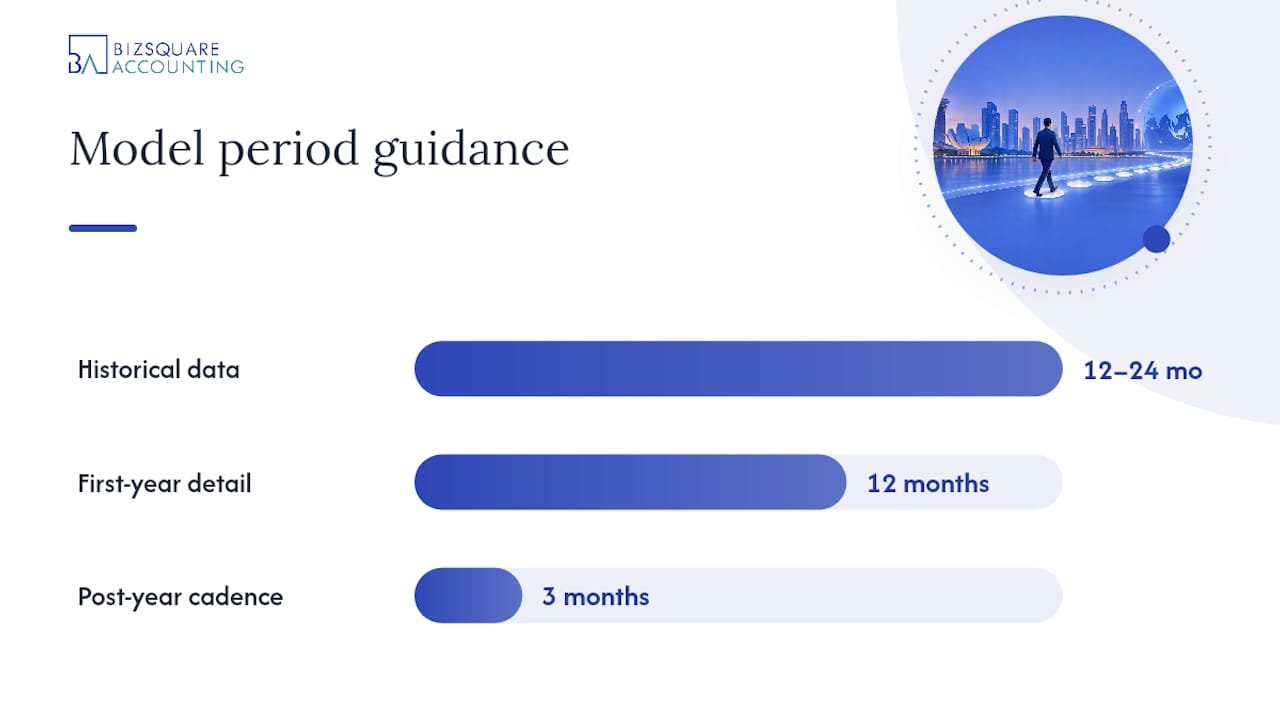
- Define the purpose, horizon, and cadence. Decide whether the model supports fundraising, cash planning, or budgeting. Choose monthly periods for the first 12 months, then quarterly beyond that.
- Gather historical data. Pull at least 12 to 24 months of past financial statements from your accounting software.
- Build a dedicated inputs sheet. List every driver here, separating fixed costs like rent from variable costs like materials or commissions.
- Construct the linked P&L. Revenue flows from your volume and price drivers, costs flow from your fixed and variable assumptions.
- Build the balance sheet. Link retained earnings to the P&L, and tie debtor and creditor balances to your working capital assumptions.
- Build the cash flow statement. This should reconcile automatically from the P&L and balance sheet movements, never as a standalone guess.
- Add checks. Insert a balance sheet check row that flags zero when assets equal liabilities plus equity. If it shows anything else, a formula has broken.
- Add a dashboard. Summarise gross margin, net margin, cash runway, and key ratios on one page for quick review.
- Layer in scenarios. Add a toggle or dropdown that switches key drivers between base, upside, and downside values.
- Document every assumption. Note the source and date for each figure, whether it came from a sales forecast, a supplier quote, or a past trend.
Use named ranges for your core drivers rather than hardcoded cell references. This single habit prevents the most common mapping error, where a formula quietly points to the wrong row after you insert a new line. AI-assisted forecasting tools can help refine assumptions and flag timing risks, but always reconcile the output against your actual accounting records before trusting it.
Pro Tip: Build your model in Excel or Google Sheets first, even if you plan to migrate to accounting software later. You will understand the mechanics far better than if a tool builds it for you.
How does driver-based forecasting improve scenario planning?
Centralising your drivers in one place means a single change updates every dependent calculation automatically. This is the core discipline behind building a driver-based forecast, where all variables link back to a data library rather than being scattered across the model.
Once your drivers sit in one place, scenario testing becomes fast rather than a rebuild exercise.
- Set a base case using your most likely assumptions for the next 12 months
- Build an upside case, perhaps assuming a 10% lift in sales volume
- Build a downside case, testing what happens if a major customer delays payment by 60 days
- Use a sensitivity table to see how one driver, like price, moves your net margin
A retail SME might use this to test whether hiring a second sales rep pays for itself within six months. This is where driver-based forecasting earns its keep, giving owners a fast answer instead of a guess.
How often should SMEs review their financial model?
A model left untouched after the first build becomes useless within a quarter. Cadence matters as much as construction.
Run a monthly operational review comparing actuals against forecast, ideally owned by whoever manages day-to-day accounts. Add a quarterly strategic review where owners or an outsourced CFO step back and question the bigger assumptions, not just the variances.
- Gross margin and net margin trends month on month
- Cash runway in months, updated with every actual figure
- Debtor days and creditor days, to catch working capital drift early
- Budget versus actual variance by department or cost line
Pro Tip: Keep a simple change log next to your model. Note every time you alter a driver, and why, so you can trace a forecast miss back to its cause.
Common mistakes include hardcoding numbers instead of linking formulas, forgetting to update seasonal assumptions, and building a model so complex nobody else in the business can maintain it. A rolling forecast approach avoids the trap of treating a once-a-year budget as gospel for twelve months straight.
How does the model connect to ACRA and IRAS filings?
Your financial model does not exist in isolation from your statutory obligations. The figures you forecast should eventually reconcile against the accounts you file.
- ACRA requires Singapore-incorporated companies to prepare and file financial statements using specified XBRL templates that vary depending on company size.
- Common XBRL filing errors include currency mismatches and parent-child total errors, both avoidable with careful mapping.
- IRAS sets out corporate income tax filing options, including Form C-S thresholds and the November deadline for the relevant year of assessment.
- Using a best-fit mapping principle when tagging unique line items reduces validation errors during XBRL submission.
Reconciling your model’s outputs to your statutory accounts each year end catches discrepancies before they become filing headaches. Guidance on XBRL filing requirements can walk you through the mapping process in more detail.
How does an outsourced CFO use your model day to day?
An outsourced CFO or accounting adviser turns your model from a static file into a governance tool. Bizsquare’s Corporate Advisory & Outsourced CFO Services cover cash flow and budget management, financial performance analysis, and strategic planning built around your model’s outputs.
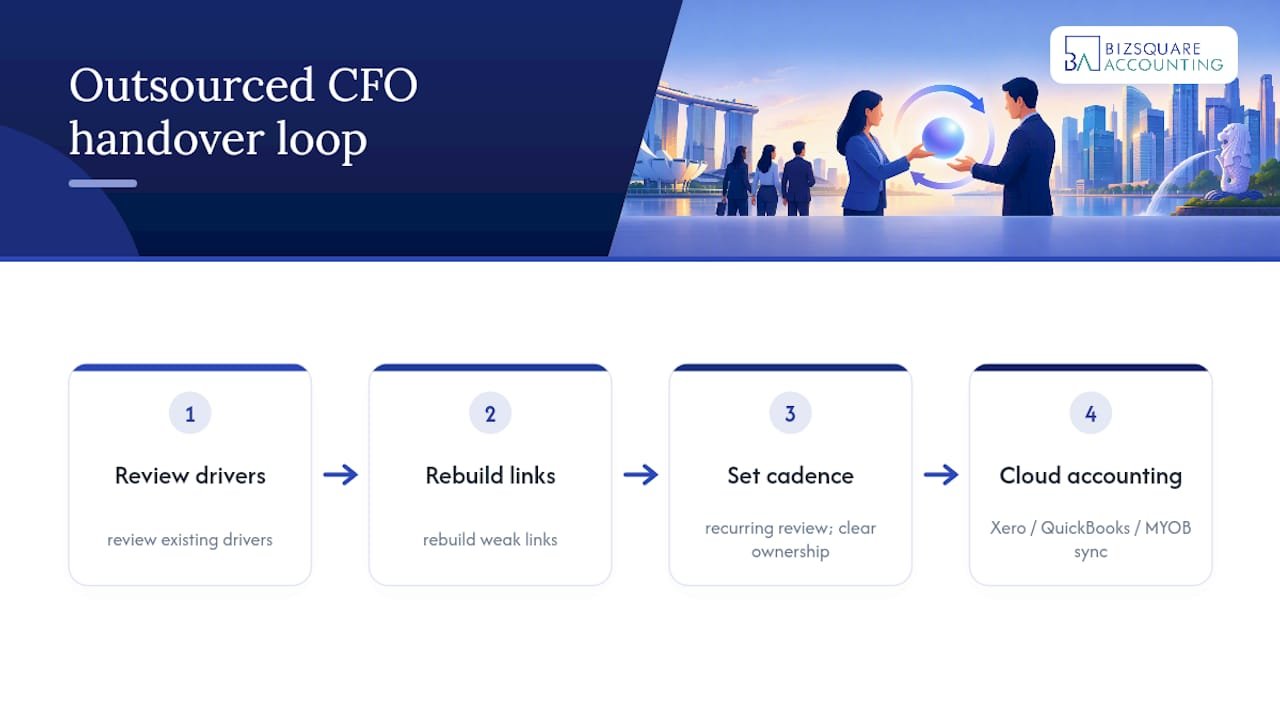
Consider bringing in help if you lack time to update the model monthly, if your business has grown past simple spreadsheets, or if you need XBRL-ready accounts. A typical handover involves reviewing your existing drivers, rebuilding weak links, and setting a recurring review cadence with clear ownership. Cloud accounting setup using Xero, QuickBooks, or MYOB often follows, keeping your model synced to real transaction data.
Why realistic assumptions matter more than clever formulas
The best models fail when drivers are too optimistic and nobody logs what changed or why. A model built on conservative, well-documented assumptions, reviewed monthly and revised honestly, beats a complex spreadsheet nobody trusts. Realism and a habit of updating it are what keep a model useful past month three.
Get your financial model built properly with Bizsquare
Building a driver-based model yourself teaches you the mechanics, but keeping it accurate every month while running a business is a different job entirely. An outsourced CFO service can take that ongoing work off your plate, pairing your model with monthly bookkeeping, cash flow tracking, and the XBRL and tax filing preparation that ACRA and IRAS require.

Instead of rebuilding your spreadsheet every quarter, you get a finance function that already speaks the language of your accounts. Bizsquare’s Corporate Advisory & Outsourced CFO Services cover cash flow and budget management, financial performance analysis, and fundraising advisory built directly from your model’s numbers. If your accounts and filings need attention alongside the model itself, Accounting and Bookkeeping Services keep your books reconciled and ready for year end. Consider getting in touch with a professional business consultancy to scope your model and set up a review cadence that actually gets used.
Sources
Keep ACRA’s XBRL filing requirements, IRAS corporate tax filing guidance and the driver-based planning guide close at hand. For cash-specific planning, this cash flow forecasting guide covers the same principles from a different angle.
- Types of financial models, Corporate Finance Institute
- Filing financial statements in XBRL format, ACRA
- Tips and useful information for filing XBRL, ACRA
- Build a driver-based forecast, Modelreef help
FAQ
1.) What is financial modelling for SMEs?
Financial modelling for SMEs means building a spreadsheet that links revenue, costs, and cash into one forecast. It helps owners test decisions before committing money, using three-statement integration as its backbone.
2.) How do I create a financial model from scratch?
Start by defining your model’s purpose and time horizon, then gather 12 to 24 months of historical data. Build linked P&L, balance sheet, and cash flow tabs, then add scenario toggles once the core links work.
3.) What is driver-based modelling?
Driver-based modelling links your forecast to operational metrics like sales volume or headcount, rather than fixed percentage assumptions. This gives the model flexibility to update automatically when a single driver changes.
4.) What financial ratios should small businesses track?
Gross margin, net margin, debtor days, creditor days, and cash runway are the ratios most SMEs need monthly. These sit on a simple dashboard pulled directly from your linked model.
5.) How often should I update my SME financial model?
Review actuals against forecast monthly, and revisit your bigger assumptions quarterly. A model left untouched for months quickly stops reflecting reality.
6.) What is the difference between a budget and a forecast?
A budget is a fixed annual target set once a year, while a forecast is an ongoing tool updated regularly as conditions change. Many SMEs benefit from a rolling forecast instead of a rigid annual budget.
7.) Do I need XBRL filing for my company’s financial statements?
Most Singapore-incorporated companies must file financial statements in ACRA’s specified XBRL templates, with the exact template depending on company size. Exemptions apply to certain small or dormant companies, so check your specific status.
8.) What are the most common XBRL filing errors?
Currency tagging mistakes, rounding inconsistencies, and parent-child total mismatches are among the most frequent XBRL errors. Careful mapping using the best-fit principle reduces these significantly.
9.) When is the corporate tax filing deadline in Singapore?
IRAS sets the corporate income tax filing deadline for November each year of assessment, with Form C-S available for qualifying smaller companies. Filing formats and thresholds depend on company revenue and structure.
10.) What software works best for SME financial modelling?
Excel or Google Sheets remain the most flexible starting points for building your first model. Once your model matures, cloud accounting tools like Xero, QuickBooks, or MYOB help keep it synced with real transaction data.
11.) What is a break-even analysis and why does it matter?
Break-even analysis shows the sales volume needed to cover all fixed and variable costs. It helps SMEs judge pricing decisions and set realistic sales targets before launching a new product line.
12.) How does Bizsquare help with financial modelling?
Bizsquare’s outsourced CFO and advisory services help SMEs build and maintain driver-based models tied to real accounting data. Its corporate advisory team also supports cash flow management and financial performance analysis on an ongoing basis.
13.) What mistakes should I avoid when building my first model?
Avoid hardcoding numbers instead of linking formulas, and never bury assumptions inside complex formulas where they are hard to find. Keep a change log so you can trace any forecast miss back to the assumption that caused it.
14.) How much historical data do I need to start a model?
Twelve to 24 months of past financial statements gives enough history to identify seasonal patterns and realistic growth rates. Less than six months of data makes your drivers little more than guesswork.