

TL;DR:
- The UK’s financial year end marks the closing date of a 12-month accounting period, which differs for companies and individuals. Missing reporting deadlines incurs penalties from Companies House and HMRC, so timely reconciliation and filings are essential. Managing both the company’s accounting reference date and personal tax year separately reduces errors and penalties.
A financial year end is the date a business or individual closes a 12-month accounting period and locks the figures used for statutory accounts and tax returns. For UK companies, Companies House uses this date, known as the accounting reference date (ARD), to determine when annual accounts must be delivered. For individuals, HMRC uses the fixed personal tax year running from 6 April to 5 April each year. Both cycles carry firm deadlines, and missing either one triggers financial penalties.
Here are the critical dates and authorities to know right now:
- Personal tax year: 6 April to 5 April, reported through HMRC self-assessment
- Company ARD: set individually per company, usually the last day of the month of incorporation
- Companies House accounts filing: generally several months after the ARD for private companies
- Corporation Tax return: due 12 months after the end of the company’s accounting period
- Corporation Tax payment: due before the return, typically nine months and one day after the accounting period ends for smaller companies
- Two official authorities: Companies House and HMRC
The immediate action: confirm your ARD, reconcile key accounts, and check your filing deadlines against both authorities, today.
Table of Contents
- What are the key UK filing dates and deadlines?
- How does the personal tax year differ from a company’s financial year?
- How is a company’s year end set and how do you change it?
- How to prepare for your financial year end
- What happens if you miss a filing or payment deadline?
- Common questions about the year-end close and financial statements
- Key takeaways
- Why treating year end as a year-round habit saves money
- How Bizsquare can support your year-end compliance
- Useful sources
- FAQ
What are the key UK filing dates and deadlines?
Understanding the financial year end process starts with knowing exactly which dates apply to you. The table below sets out the main deadlines for individuals and companies.
| Obligation | Deadline | Authority |
|---|---|---|
| Personal self-assessment tax return (online) | the January following the 5 April tax year end | HMRC |
| Personal self-assessment tax return (paper) | the October following the 5 April tax year end | HMRC |
| Company annual accounts (private company) | several months after the ARD | Companies House |
| Company annual accounts (public company) | several months after the ARD | Companies House |
| Corporation Tax return (CT600) | within a year after the end of the accounting period | HMRC |
| Corporation Tax payment (smaller companies) | several months after the accounting period ends | HMRC |
| First company accounts | within approximately two years after incorporation | Companies House |
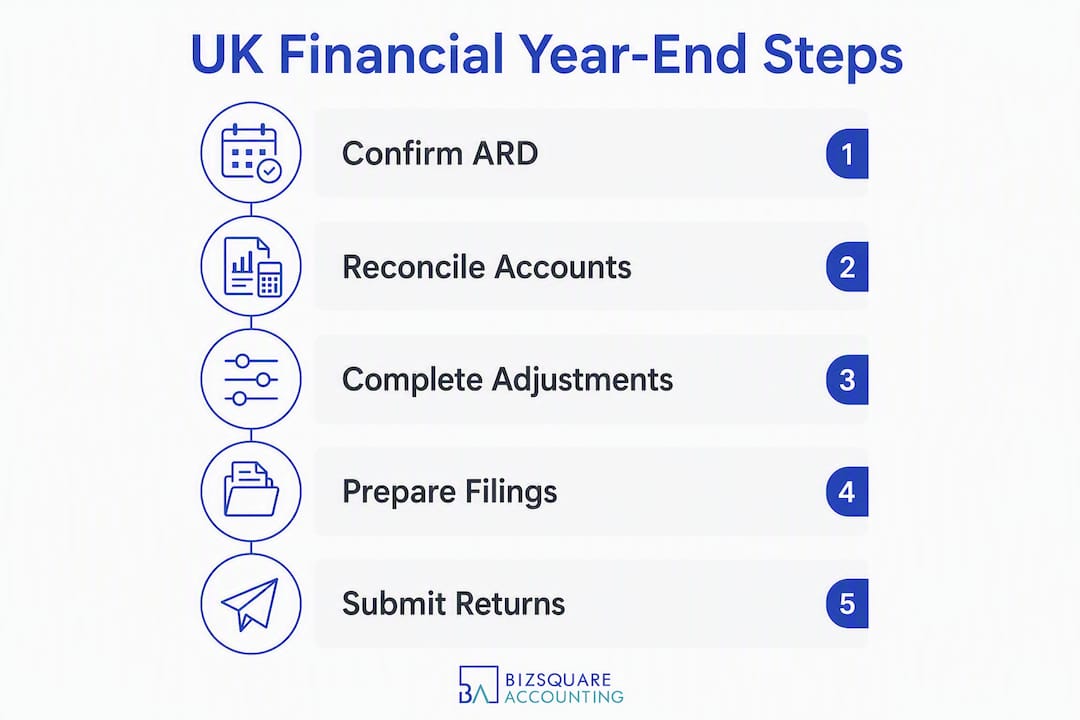
Corporation Tax filing and payment deadlines are tied to the company’s accounting period end date, not the April-to-April personal tax year. Directors must track both cycles separately.
Practical timeline: what to do and when
60–30 days before year end
- Confirm your ARD and calculate the corresponding filing deadlines for Companies House and HMRC
- Chase outstanding invoices and clear aged creditors where possible
- Finalise payroll, including year-end payroll submissions and P11D benefits reporting
- Review VAT returns to confirm they align with the accounting period
Final week before year end
- Freeze the nominal ledger for the period and post any outstanding accruals or prepayments
- Complete a preliminary bank reconciliation
- Confirm stock counts and inventory valuations are complete
First four weeks after year end
- Complete all balance sheet reconciliations before posting adjustments
- Post depreciation, bad debt provisions and any other year-end journals
- Produce draft year-end financial statements for director review and approval
- Submit accounts to Companies House and file the CT600 with HMRC within the statutory windows
Key reminder: Companies House treats the legal filing date as the date accounts are physically delivered, not the date they were posted or sent. Always allow extra time for delivery confirmation.
How does the personal tax year differ from a company’s financial year?
This is one of the most common points of confusion for business owners, particularly directors who also file personal self-assessment returns. The two cycles are entirely separate, and each carries its own obligations.
The UK personal tax year runs from 6 April to 5 April. Every individual who earns income outside PAYE, including sole traders, landlords, and company directors receiving dividends, must report that income to HMRC through a self-assessment return. The online filing deadline is 31 January following the end of the tax year.
A company’s accounting period, by contrast, runs from the ARD set at incorporation and does not have to align with the April-to-April personal tax year. HMRC links the Corporation Tax return deadline to the company’s accounting period end, not to 5 April. A company with a 31 December year end, for example, files its CT600 by 31 December the following year and pays Corporation Tax by 1 October of that same year.
The practical implications differ by business structure:
- Sole traders follow the personal tax year for income tax purposes. Their trading profits are reported on the self-assessment return for the tax year in which the accounting period ends.
- Partnerships also report through self-assessment, with each partner declaring their share of profits for the relevant tax year.
- Limited companies operate entirely on the company accounting period. Directors must track the company ARD and the personal tax year as two distinct obligations, particularly when extracting salary and dividends.
Misaligning bookkeeping cut-offs with the relevant reporting period is one of the most common causes of late filing. A director who closes the company books on 31 March but forgets to reconcile personal dividend income to 5 April will find the self-assessment return incomplete. Keeping a simple calendar with both cycles marked clearly prevents this.
How is a company’s year end set and how do you change it?
What the accounting reference date is
Companies House uses the accounting reference date to determine when a company’s annual accounts are due. For most companies, the ARD defaults to the last day of the month in which the company was incorporated. A company incorporated on 14 March will have an ARD of 31 March, and its first accounts will cover the period from incorporation to that date.
How to change your accounting reference date
Companies House allows directors to change the ARD by filing form AA01 online or by post. The rules are as follows:
- Shortening the year: you can shorten the accounting period by at least one day. There is no limit on how often you can shorten.
- Lengthening the year: you can lengthen the accounting period to a maximum of 18 months. You may only do this once every five years, with limited exceptions.
- Effect on filing deadlines: changing the ARD normally changes the deadline for filing accounts, unless you are lengthening a company’s first financial year.
- HMRC notification: treat a change to the ARD as both an accounting and a compliance change. Always update HMRC with the new accounting period dates after filing with Companies House.
Steps directors must take when changing the year end
- Decide the new ARD and confirm it does not breach the 18-month maximum.
- File form AA01 with Companies House before the current accounts filing deadline.
- Recalculate the new accounts filing deadline based on the revised ARD.
- Notify HMRC of the new accounting period dates in writing or through the HMRC online portal.
- Check whether any previously available filing extension has been removed by the change.
- Update internal bookkeeping systems to reflect the new period end.
Pro Tip: Changing your ARD can remove a filing extension you were relying on. Always check your new deadline before submitting form AA01, and never assume the old deadline still applies.

How to prepare for your financial year end
A well-managed year-end close does not happen in a single busy week. The financial year end process works best when preparation begins at least 60 days before the ARD. The close process finalises the general ledger for the fiscal year and produces approved financial statements, so every reconciliation and adjustment must be complete before the final reports are produced.
Pre-close actions (60–30 days before year end)
- Confirm the ARD and recalculate filing deadlines for both Companies House and HMRC
- Chase unpaid invoices and resolve disputed creditor balances
- Finalise payroll submissions, including any outstanding P11D or benefits-in-kind returns
- Complete and reconcile all VAT returns for the period
- Review fixed asset registers and confirm depreciation rates are correct
Balance sheet reconciliations to prioritise
A clean year-end close starts with reconciling the balance sheet first, then posting adjustments, and finally producing the approved reports. The reconciliations to complete first are:
- Bank reconciliation: match every transaction on the bank statement to the nominal ledger
- Accounts receivable (AR): confirm all outstanding invoices are correctly aged and provisions for bad debts are adequate
- Accounts payable (AP): confirm all supplier invoices are posted and accruals cover any unposted liabilities
- Payroll control accounts: reconcile PAYE, National Insurance, and pension contributions to HMRC records
- VAT control account: confirm the balance matches the last submitted VAT return
Common year-end accounting adjustments
| Adjustment | What it does | Why it matters |
|---|---|---|
| Accruals | Records expenses incurred but not yet invoiced | Matches costs to the correct period |
| Prepayments | Defers income or expenses paid in advance | Prevents overstating costs in the current year |
| Depreciation | Spreads the cost of fixed assets over their useful life | Reflects the true value of assets on the balance sheet |
| Bad debt provisions | Reduces the value of receivables unlikely to be collected | Gives a realistic picture of debtors |
| Inventory valuation | Values stock at cost or net realisable value, whichever is lower | Complies with UK GAAP and FRS 102 |
Post-close tasks
After all reconciliations and adjustments are complete, the following steps close the year formally:
- Produce draft year-end financial statements, including the profit and loss account, balance sheet, and cash flow statement
- Obtain director approval and signatures on the accounts
- Lock the accounting period in your bookkeeping software to prevent further entries
- Archive all reconciliations, journal entries, and approval sign-offs in a single, clearly labelled folder
- Submit accounts to Companies House and file the CT600 with HMRC within the statutory deadlines
Keeping a consistent close package with evidence for every reconciliation and journal entry speeds up any subsequent HMRC enquiry or statutory audit considerably.
What happens if you miss a filing or payment deadline?
Missing a deadline with Companies House or HMRC is not simply an administrative inconvenience. Penalties accumulate quickly, and repeated late filing escalates the consequences.
Companies House late filing penalties
Companies House imposes fixed penalties based on how late the accounts arrive. For private companies, the penalty starts at £150 for accounts filed up to one month late and rises to £1,500 for accounts filed more than six months late. Public companies face higher penalties. Critically, Companies House treats the legal filing date as the date accounts are delivered, not the date they were posted. A package sent on the deadline date but delivered the following day is late.
Penalty escalation: Companies House doubles the fixed penalty for any company that files late in two consecutive years. A private company filing six months late for the second year running faces a £3,000 penalty rather than £1,500. Filing on time in every period is the only way to avoid this doubling.
HMRC Corporation Tax penalties and interest
For Corporation Tax, the return filing deadline is 12 months after the end of the accounting period. Missing this date triggers an automatic £100 penalty. A return filed more than three months late attracts a further £100 penalty. If the return is more than six months late, HMRC may issue a tax-geared penalty based on its estimate of the tax due.
Interest on unpaid Corporation Tax begins to accrue from the payment due date, which for most smaller companies falls nine months and one day after the accounting period ends. This means tax can be overdue and accruing interest before the return filing deadline even arrives.
Immediate steps if you have missed a deadline
- File the outstanding accounts or return as soon as possible to stop further penalties accruing.
- Notify HMRC if there is a reasonable excuse for the delay, as this may reduce or remove penalties.
- Pay any outstanding tax immediately to stop interest charges growing.
- Keep evidence of any extenuating circumstances in writing.
- Seek professional advice if penalties are significant or if HMRC has opened an enquiry.
Good cash flow management ahead of payment deadlines reduces the risk of missing a tax payment date.
Common questions about the year-end close and financial statements
How does the year-end close work in practice?
The year-end close is a structured sequence of steps. First, all transactions for the period are posted and reconciled. Next, adjusting entries such as accruals, prepayments, and depreciation are posted. Finally, the approved financial statements are produced and the period is locked. The key documents produced are the profit and loss account, the balance sheet, and the cash flow statement.
What is a year-end financial summary?
A year-end financial summary is a set of approved financial statements covering the full accounting period. It typically includes the profit and loss account, which shows income and expenditure, the balance sheet, which shows assets, liabilities, and equity at the period end, and the cash flow statement, which shows how cash moved through the business.

How do you read a year-end balance sheet quickly?
Start with total assets, then subtract total liabilities to arrive at net equity. Assets are split between current assets (cash, debtors, stock) and fixed assets (property, equipment). Liabilities are split between current liabilities (creditors due within one year) and long-term liabilities. A positive net equity figure means the company owns more than it owes.
What happens when accounts are audited?
For companies above the statutory audit threshold under the Companies Act 2006, an independent auditor reviews the financial statements and issues an audit opinion. The auditor checks that the accounts give a true and fair view and comply with applicable accounting standards such as FRS 102 or IFRS. Most small companies qualify for the audit exemption if they meet at least two of the three size criteria: turnover below £10.2 million, balance sheet total below £5.1 million, and fewer than 50 employees.
What do sole traders and partnerships need to report?
Sole traders and most partnerships do not file accounts with Companies House. They report trading profits through the HMRC self-assessment system for the relevant personal tax year. The records required are simpler than those for a limited company, but the obligation to keep accurate records for at least five years after the 31 January filing deadline remains.
Key takeaways
The most important action for any UK business owner is to confirm the accounting reference date, calculate all corresponding filing deadlines, and begin reconciliations at least 60 days before year end.
| Point | Details |
|---|---|
| Confirm your ARD first | Check your accounting reference date with Companies House before calculating any filing deadline. |
| Reconcile balance sheet before adjustments | Complete bank, AR, AP, and payroll reconciliations before posting accruals or depreciation. |
| Track two separate cycles | Company accounting periods and the personal tax year run independently; directors must manage both. |
| Notify HMRC when changing year end | A change to the ARD is both an accounting and a compliance change; always update HMRC promptly. |
| File on time to avoid doubled penalties | Companies House doubles fixed penalties for companies that file late in two consecutive years. |
Why treating year end as a year-round habit saves money
Most small business owners treat the financial year end as a single, stressful event. In practice, the businesses that spend the least on accountants and face the fewest HMRC queries are the ones that close their books monthly, not annually.
Monthly bank reconciliations take 30 minutes when the records are current. They take three days when the last reconciliation was 11 months ago. The difference in professional fees is significant. An accountant working from clean, reconciled records can produce year-end accounts in a fraction of the time compared to one who must first reconstruct a year of unreconciled transactions. That time difference translates directly into cost.
There is also the question of HMRC enquiries. A company with a well-documented close package, with signed reconciliations, approved journals, and a clear audit trail, can respond to an HMRC information request within days. A company without that documentation may spend weeks reconstructing records, often at considerable cost. The archive does not need to be elaborate. A clearly labelled folder per accounting period, containing the final trial balance, all reconciliations, and director-approved accounts, is sufficient.
The same logic applies to changing the accounting reference date. Directors sometimes change the ARD to align the company year with a quieter trading period, which is a sensible operational decision. The compliance risk arises when the change removes a filing extension that was already being relied upon. Checking the new deadline before filing form AA01 costs nothing. Discovering the new deadline has already passed costs considerably more.
For business owners who find the year-end close genuinely burdensome, the practical answer is not to work harder in the final week but to build a monthly close habit throughout the year. A consistent bookkeeping accuracy routine reduces the year-end workload to a final review rather than a full reconstruction.
How Bizsquare can support your year-end compliance

Year-end compliance involves multiple moving parts: reconciliations, adjustments, director approvals, Companies House filings, and HMRC submissions. Bizsquare provides professional accounting and bookkeeping services designed to take that burden off business owners and directors. From maintaining accurate records throughout the year to producing compliant year-end financial statements and filing on time, Bizsquare’s consultants handle the process with precision.
For companies considering a change to their accounting reference date, or for those who need structured support with their annual close, Bizsquare offers advisory services tailored to each business’s specific compliance position. Speak to the Bizsquare team today to confirm your filing deadlines and put a year-end plan in place before the pressure builds.
Useful sources
The following official sources underpin the guidance in this article. Each link leads directly to the relevant GOV.UK or HMRC page.
- Preparing and filing Companies House accounts (GOV.UK): the primary reference for how Companies House defines the ARD, the legal filing date, and accounts delivery rules.
- Change your company’s year end (GOV.UK): the official page for filing form AA01, understanding the limits on lengthening and shortening, and the compliance consequences of changing the ARD.
- Company Tax Return obligations (GOV.UK): HMRC’s guidance on CT600 filing deadlines, payment timing, and how the accounting period end date drives both obligations.
- HM Revenue & Customs (GOV.UK): the HMRC landing page for all tax-related guidance, payment portals, and self-assessment information.
- Self-assessment tax returns: who must send a return (GOV.UK): confirms which individuals, including sole traders and company directors, must file a personal self-assessment return.
- Paying HMRC (GOV.UK): the official portal for making Corporation Tax, self-assessment, and VAT payments to HMRC.
FAQ
What is a financial year end in the UK?
A financial year end is the closing date of a 12-month accounting period. For companies, it is the accounting reference date set with Companies House; for individuals, it follows the fixed personal tax year ending 5 April.
How does the end of a financial year work?
The year-end close involves posting all outstanding transactions, completing balance sheet reconciliations, making adjusting entries such as accruals and depreciation, and producing approved financial statements before submitting them to Companies House and HMRC.
What is the UK personal tax year?
The UK personal tax year runs from 6 April to 5 April each year. Individuals report income and expenses for this period through an HMRC self-assessment tax return.
When must a private company file its accounts with Companies House?
A private company must deliver its annual accounts to Companies House within nine months of its accounting reference date. The legal filing date is the date of delivery, not the date of posting.
When is Corporation Tax due for a UK company?
For most smaller companies, Corporation Tax is due nine months and one day after the end of the accounting period. The CT600 return must be filed within 12 months of the accounting period end.
What is an accounting reference date?
The accounting reference date (ARD) is the last day of a company’s financial year. Companies House uses it to calculate when annual accounts must be delivered.
How do you change a company’s accounting reference date?
File form AA01 with Companies House online or by post. You can shorten the period by at least one day as often as needed, but you can only lengthen it to a maximum of 18 months, and only once every five years in most cases.
Does changing the year end affect filing deadlines?
Yes. Changing the ARD normally changes the deadline for filing accounts with Companies House and may affect the Corporation Tax accounting period. Always recalculate deadlines and notify HMRC after any change.
What happens if company accounts are filed late with Companies House?
Companies House imposes fixed penalties starting at £150 for accounts up to one month late, rising to £1,500 for accounts more than six months late for private companies. The penalty doubles if the company files late in two consecutive years.
What documents does a year-end financial summary include?
A year-end financial summary typically includes the profit and loss account, the balance sheet, and the cash flow statement, all covering the full accounting period and approved by the directors.
How do you read a year-end balance sheet?
Subtract total liabilities from total assets to find net equity. Current assets include cash, debtors, and stock; fixed assets include property and equipment. A positive net equity figure means the company’s assets exceed its liabilities.
Do sole traders need to file accounts with Companies House?
No. Sole traders report trading profits through HMRC self-assessment and are not required to file accounts with Companies House. They must, however, keep business records for at least five years after the 31 January filing deadline.
What are accruals and why do they matter at year end?
Accruals are entries that record expenses incurred but not yet invoiced by the year-end date. They match costs to the correct accounting period and prevent the profit and loss account from understating expenses.
What is the audit exemption for small UK companies?
Most small companies qualify for the audit exemption if they meet at least two of three criteria: turnover below £10.2 million, balance sheet total below £5.1 million, and fewer than 50 employees. Companies that qualify do not need an independent statutory audit.
How far back must UK businesses keep financial records?
Limited companies must keep accounting records for at least six years from the end of the financial year they relate to. Sole traders must keep records for at least five years after the 31 January self-assessment filing deadline for the relevant tax year.