


TL;DR:
– Singapore law requires appointing a company secretary within six months of incorporation.
– The secretary is responsible for maintaining statutory registers, filing returns, and ensuring compliance.
– Choosing a professional, transparent service helps prevent legal penalties and supports company growth.
Company Secretary Services in Singapore: Compliance Guide
Missing a single deadline can cost a Singapore company director up to S$1,000 in fines, yet many entrepreneurs only discover this after the fact. The 6-month appointment window for a company secretary is one of the most overlooked obligations in Singapore’s corporate compliance framework. Beyond the fine itself, a vacant secretary position signals governance gaps that can complicate banking relationships, investor due diligence, and regulatory standing. This guide breaks down the legal requirements for appointing a company secretary, clarifies what professional service providers actually do, explains how to evaluate and select the right partner, and outlines the ongoing compliance practices that protect your business long after incorporation.
Table of Contents
- Understanding the legal requirements for appointing a company secretary in Singapore
- Core responsibilities of a company secretary: Beyond basic paperwork
- How to choose reliable company secretary services in Singapore
- Maintaining compliance: Key processes and recurring controls
- What most entrepreneurs miss about company secretary services
- Streamline your compliance with expert company secretary services
- Frequently asked questions
Key Takeaways
| Point | Details |
|---|---|
| Comply with appointment deadlines | Appoint a qualified company secretary within 6 months to avoid fines and compliance issues. |
| Understand ongoing responsibilities | Professional secretaries handle more than paperwork—they manage key registers, filings, and legal deadlines. |
| Choose services carefully | Evaluate providers based on process reliability, transparency, and official registration—not reviews alone. |
| Maintain robust compliance processes | Strong documentation and recurring communication prevent costly compliance lapses. |
Understanding the legal requirements for appointing a company secretary in Singapore
Now that you know what’s at stake, it’s important to break down what Singapore’s laws actually require. The Companies Act is the governing statute, and it is unambiguous on this point: every company must appoint a company secretary within 6 months of incorporation. This is not a best practice or a recommendation. It is a legal obligation enforced by the Accounting and Corporate Regulatory Authority (ACRA).
The company secretary requirements go beyond simply filling a position. The individual appointed must satisfy specific eligibility criteria that are designed to ensure genuine accountability and local oversight.
Key eligibility requirements include:
- The company secretary must be a natural person, meaning a corporate entity cannot hold this role.
- The secretary must be ordinarily resident in Singapore, which typically means a Singapore citizen, permanent resident, or an EntrePass or Employment Pass holder with a local residential address.
- The sole director of a company cannot simultaneously serve as the company secretary. This rule prevents a single individual from self-approving compliance without any independent check.
- If a company has only one director, that director must appoint a separate, qualified individual as secretary.
These restrictions exist for good reason. The company secretary functions as an independent compliance checkpoint within the corporate structure. Allowing the sole director to fill both roles would eliminate that check entirely.
“Directors may be fined up to S$1,000 if the company secretary position is left vacant for more than 6 months.” This is not a theoretical risk. ACRA monitors corporate records and can act on non-compliance.
Beyond the appointment itself, the secretary carries responsibility for maintaining the accuracy of ACRA’s records. This includes updating the company’s registered particulars, ensuring the register of members reflects current shareholding, and confirming that any changes to directors or officers are filed promptly. These are key legal obligations that affect how your company appears to regulators, banks, and potential investors.
Pro Tip: When incorporating a new company in Singapore, arrange your company secretary appointment at the same time as your director appointments. Waiting until the fifth or sixth month introduces unnecessary risk, especially if you are evaluating multiple service providers.
One aspect that surprises many founders is that the company secretary role is not passive. The secretary is not simply a record-keeper who files documents once a year. They are an active participant in corporate governance, responsible for flagging deadlines, coordinating board meetings, and ensuring that resolutions are properly documented. Treating the role as a formality is precisely the mindset that leads to compliance failures.
For foreign entrepreneurs establishing a Singapore entity, the residency requirement for the secretary is particularly important to plan around. If your founding team is entirely based overseas, you will need to engage a professional corporate secretary service from day one. This is standard practice and widely available, but it must be factored into your setup timeline and budget.
Core responsibilities of a company secretary: Beyond basic paperwork
With the legal must-haves in mind, let’s look at what a company secretary actually does for your business. The scope of the role is broader than most entrepreneurs initially expect, and understanding it fully helps you appreciate why the quality of your secretary service matters.

ACRA outlines that the company secretary is responsible for maintaining company information and registers, organizing meetings, taking notes, reminding directors of annual deadlines, and updating the company about new regulatory rules. Each of these functions carries real operational weight.
The core responsibilities of a company secretary include:
- Maintaining statutory registers. This includes the register of members, register of directors, register of charges, and register of substantial shareholders. These documents must be current and available for inspection.
- Filing annual returns with ACRA. Every Singapore company must file an annual return, and the secretary coordinates this process, ensuring it is submitted within the required timeframe.
- Organizing and documenting board meetings. This means preparing meeting notices, circulating agendas, attending meetings, and producing accurate minutes that reflect resolutions passed.
- Managing share transfers and allotments. When ownership changes hands or new shares are issued, the secretary handles the documentation and updates the relevant registers accordingly.
- Monitoring regulatory changes. Singapore’s corporate governance landscape evolves, and the secretary’s job includes tracking amendments to the Companies Act and advising directors on how changes affect the company.
- Coordinating with ACRA and other authorities. The secretary acts as the primary liaison for regulatory correspondence, ensuring responses are timely and accurate.
To help you avoid legal pitfalls, consider how professional services compare to managing this in-house or attempting a do-it-yourself approach.
| Factor | Professional service | In-house or DIY |
|---|---|---|
| Regulatory expertise | Dedicated specialists, current knowledge | Depends on individual’s background |
| Deadline management | Systematic reminders and tracking | Risk of oversight, especially during busy periods |
| Cost | Predictable annual fee | Hidden costs: time, training, errors |
| Scalability | Easily adjusts as company grows | Requires additional hiring or training |
| Compliance assurance | Documented processes and accountability | Variable, often undocumented |
The outsourcing secretary benefits are particularly compelling for SMEs and startups that do not yet have the internal resources to dedicate a full-time hire to compliance administration. A professional service brings institutional knowledge, established workflows, and a clear paper trail, all of which become invaluable during audits, financing rounds, or corporate restructuring.
How to choose reliable company secretary services in Singapore
Once you know what your secretary should do, the next challenge is finding a trustworthy provider. The market in Singapore includes dozens of firms ranging from large corporate service companies to boutique consultancies, and the variation in quality, pricing, and service depth is significant.
What to look for when evaluating providers:
- Verified registration and credentials. Confirm the firm is registered with ACRA and that the individuals handling your account meet the residency and qualification requirements.
- Transparent pricing structure. Reputable providers offer clear, written fee schedules. Be cautious of providers who quote very low base fees without disclosing what is and is not included.
- Documented workflow and communication standards. Ask how they notify you of upcoming deadlines, how they handle urgent filings, and what their turnaround time is for standard requests.
- Proof of compliance delivery. A professional firm should be able to show you copies of filed documents, ACRA confirmation receipts, and updated registers as a matter of course.
- Responsiveness and accessibility. Test their response time before you sign. A secretary service that takes days to respond to a basic inquiry will not serve you well when a time-sensitive filing arises.
When researching providers, online reviews can offer useful signals about real-world service quality. However, they require careful interpretation. Company secretary provider reviews reveal a pattern common across the industry: some providers attract both strong praise for efficiency and complaints about unexpected fees or questions around compliance documentation. This pattern tells you something important. It is not just about whether a provider has good reviews, but whether the reviews indicate consistent process transparency.
Pro Tip: When reading reviews, pay attention to how providers respond to negative feedback. A firm that acknowledges concerns professionally and explains its processes is demonstrating the kind of accountability you want managing your compliance.
For finding affordable services without sacrificing quality, focus on value rather than price alone. A provider charging S$300 per year who misses your annual return filing will cost you far more in penalties and remediation than one charging S$600 with a flawless track record.
| Selection criterion | Why it matters | How to verify |
|---|---|---|
| ACRA registration | Legal requirement for the role | Check ACRA’s public register |
| Pricing transparency | Prevents surprise charges | Request written fee schedule |
| Filing documentation | Proves compliance was executed | Ask for sample confirmation receipts |
| Client communication | Ensures you stay informed | Test response time before engaging |
| Regulatory updates | Keeps your company current | Ask how they communicate law changes |
Understanding the company secretary appointment steps before you engage a provider also helps you ask better questions and set clearer expectations from the outset.
Maintaining compliance: Key processes and recurring controls
Choosing the right provider is step one. Next, you’ll need to sustain compliance with robust processes. Many business owners assume that once a secretary is appointed, compliance runs on autopilot. In practice, maintaining a clean compliance record requires active coordination between the company’s directors and the secretary throughout the year.
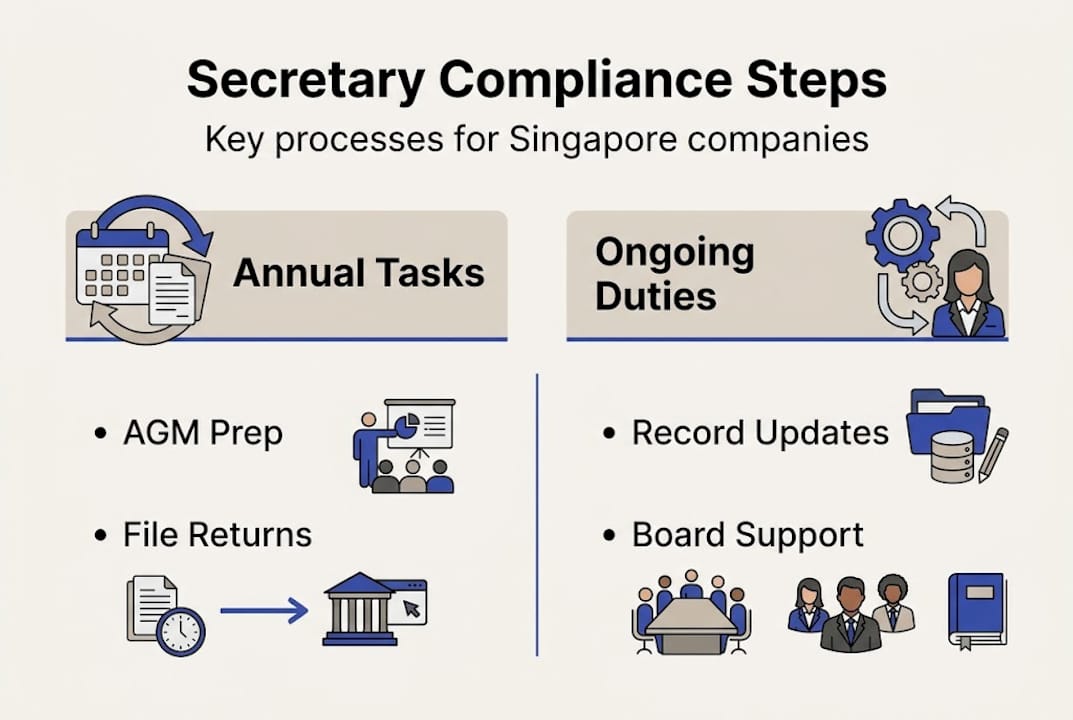
Company secretaries must maintain statutory registers, handle meeting minutes, and systematically remind directors about annual filings. This ongoing responsibility means that compliance is a continuous process, not an annual event.
A structured compliance calendar typically includes:
- Annual General Meeting (AGM) coordination. Private companies in Singapore are exempt from holding AGMs but must still pass resolutions and circulate financial statements within prescribed timeframes.
- Annual return filing with ACRA. This must be filed within 5 months of the financial year end for listed companies and 7 months for non-listed companies. Missing this deadline triggers late fees and potential enforcement action.
- Register updates after any corporate changes. Director appointments or resignations, share transfers, changes to the registered address, and amendments to the company constitution all require timely updates.
- Board resolution documentation. Any significant business decision, including opening bank accounts, entering major contracts, or approving financial statements, should be supported by a properly recorded board resolution.
- Ongoing monitoring of regulatory changes. Singapore’s regulatory environment is active, and your secretary should be proactively alerting you to changes that affect your obligations.
Compliance gaps rarely appear suddenly. They accumulate gradually through small oversights: a register not updated after a share transfer, minutes not circulated after a board meeting, a deadline reminder missed during a busy quarter.
For ensuring ongoing compliance, establish a simple internal protocol where directors confirm receipt of all compliance communications from the secretary and flag any corporate changes promptly. This two-way communication habit prevents the most common compliance failures.
Pro Tip: Ask your secretary service to provide a compliance calendar at the start of each financial year. A documented schedule of all key deadlines gives directors visibility and creates shared accountability for meeting them.
For early-stage companies, secretary services for startups are specifically designed to handle the higher volume of corporate changes that typically occur in the first two years: adding co-founders, issuing new shares, onboarding investors, and amending the constitution. These events each trigger compliance obligations that a well-organized secretary service will manage systematically.
What most entrepreneurs miss about company secretary services
Understanding recurring compliance brings us to the bigger lesson many founders overlook. The most common mistake is treating the company secretary role as a commodity purchase, something to acquire at the lowest possible price and then forget about. This mindset is understandable, especially for early-stage founders managing tight budgets, but it consistently produces the same outcome: avoidable compliance failures at the worst possible moments.
The strategic value of a quality secretary service becomes most visible during critical business events. When you are raising a funding round, investors will conduct due diligence on your corporate records. When you are applying for a bank loan, the bank will review your statutory registers. When you are onboarding a new director or shareholder, every step must be documented correctly. In each of these situations, a clean and complete compliance record is a genuine business asset.
The comprehensive secretary guide that Bizsquare Accounting has developed reflects a core belief: governance quality is a growth enabler, not just a regulatory burden. Companies that invest in professional, well-documented compliance from the start spend less time on remediation, attract better partners, and move faster when opportunities arise.
The biggest compliance risks are rarely technical. They come from neglecting continual record-keeping and communication. A secretary who proactively communicates, documents everything, and keeps directors informed is not just managing paperwork. They are protecting the company’s reputation and operational continuity. That is worth far more than the annual fee.
Streamline your compliance with expert company secretary services
Ready to transform your compliance approach from chore to strength? Here’s how you can get started.
At Bizsquare Accounting, we provide professional company secretary services built specifically for Singapore entrepreneurs, SMEs, and growing businesses. Our approach combines transparent pricing, systematic deadline management, and clear communication so you always know your compliance status without having to chase for updates.
Our full guide to secretary services walks you through every aspect of corporate secretarial compliance, from initial appointment to ongoing governance. If you want to understand precisely how a professional secretary keeps your company protected, our resource on keeping your company compliant covers the processes in detail. When you are ready to engage trusted secretary services that prioritize your business’s long-term standing, our team is available to discuss your specific situation and provide a clear, written proposal.
Frequently asked questions
What are the legal requirements for appointing a company secretary in Singapore?
All companies must appoint a secretary within 6 months of incorporation, and the individual must be a natural person ordinarily resident in Singapore who is not the sole director of the company.
What are the main responsibilities of a company secretary?
The company secretary’s duties include maintaining statutory registers, organizing and minuting board meetings, filing annual returns, managing share transfers, and keeping directors informed of regulatory changes and upcoming deadlines.
How can I check if a company secretary service provider is trustworthy?
Review platforms offer useful process signals, but you should always verify the provider’s ACRA registration and request documented evidence of past filings. Review platforms are a starting point for research, not a substitute for direct verification with official bodies.
What happens if I don’t appoint a company secretary on time?
If the company secretary position remains vacant for more than 6 months after incorporation, directors may be fined up to S$1,000, and the company’s compliance standing with ACRA will be at risk, potentially affecting banking and investor relationships.