

Company Incorporation in Vietnam: 2026 Guide for Singapore Entrepreneurs
Overview
Company incorporation in Vietnam allows foreign entrepreneurs to establish legal business entities under the 2026 reforms. The process involves obtaining the ERC before the IRC, with the LLC being the most popular legal structure for Singapore investors. Ongoing compliance includes capital contribution, tax reporting, and social insurance registration, all while navigating new streamlined procedures introduced in 2026.
Company incorporation in Vietnam is the legal process through which foreign entrepreneurs establish a registered business entity, gaining market access under Vietnam’s 2026 regulatory framework. The process operates under two parallel laws: the Law on Enterprises, which governs company formation, and the Law on Investment, which regulates foreign capital entry. Singapore entrepreneurs expanding into Vietnam must navigate both laws to obtain two key certificates: the Enterprise Registration Certificate (ERC) and the Investment Registration Certificate (IRC). The 2026 reforms have simplified this process significantly, including a reversed licensing sequence that lets foreign investors obtain the ERC before the IRC, enabling faster operational setup.
What are the main types of legal entities for company incorporation in Vietnam?
Foreign investors have four primary structures to choose from when setting up a business in Vietnam. Each structure carries different compliance obligations, ownership rules, and operational flexibility.
The four main options are:
- Limited Liability Company (LLC): The most common choice for foreign investors. An LLC can have one or multiple members, offers limited liability protection, and has a simpler governance structure than a joint stock company.
- Joint Stock Company (JSC): Required for businesses planning to list on a stock exchange or raise capital from the public. A JSC has shareholders rather than members and requires a board of directors.
- Branch Office: An extension of a foreign parent company. A branch can conduct commercial activities but carries the full legal liability of the parent entity.
- Representative Office (RO): Permitted only for market research and liaison activities. An RO cannot generate revenue or sign commercial contracts directly.
For most Singapore entrepreneurs entering Vietnam, the LLC is the preferred structure. It combines legal protection with manageable compliance requirements and suits a wide range of business activities.
Foreign ownership rules allow 100% foreign ownership in most sectors. However, sensitive industries such as media and telecommunications require joint-venture structures or carry ownership caps. Misunderstanding these restrictions is one of the most common reasons for application rejections.
Pro Tip: Before selecting a structure, confirm your target business activity against Vietnam’s conditional business list. Entering a restricted sector with the wrong entity type will cause delays that are difficult to reverse.
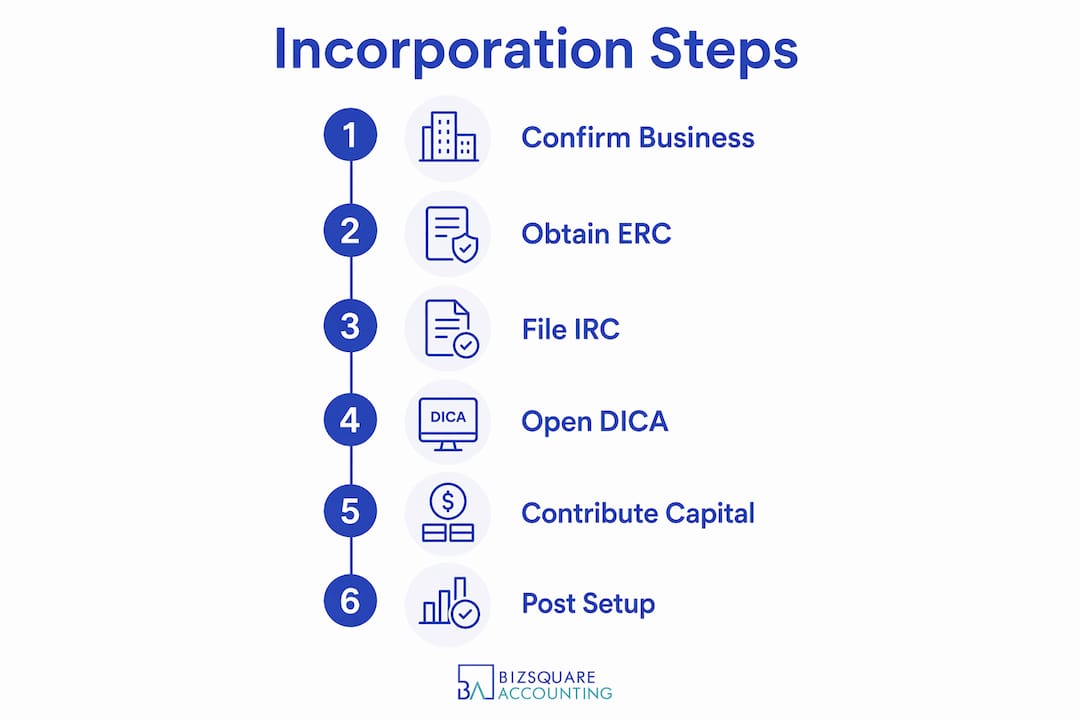
How to legally register a company in Vietnam: step-by-step
The business registration process in Vietnam follows a clear sequence under the 2026 framework. Standard non-conditional projects take 4–6 weeks from start to finish. Conditional sector projects take 8–12 weeks due to additional licensing requirements.
Step 1: Confirm your business lines and company name
Start by identifying your business activities using Vietnam Standard Industrial Classification (VSIC) codes. Incorrect VSIC codes can cause irreversible licensing issues, so this step requires careful attention. Check your chosen name against the National Business Registration Portal to confirm it is available and compliant with naming rules.

Step 2: Obtain the Enterprise Registration Certificate (ERC)
Under the 2026 reforms, foreign investors can obtain the ERC before the IRC for many project types. The ERC establishes your company as a legal entity and assigns a tax identification number. This certificate is issued by the Department of Planning and Investment (DPI) in the province where your company is registered.
The ERC does not authorize operations in conditional sectors on its own. Companies in conditional sectors need additional sub-licenses before they can legally operate.
Step 3: File for the Investment Registration Certificate (IRC)
The IRC is required for all foreign-invested enterprises. Statutory processing times are 15 days for standard projects and 35 days for conditional projects. In practice, real-world IRC processing takes 20–30 days in 2026. Submit your IRC application to the DPI with documents including a proposed investment project outline, financial capacity proof, and a lease agreement or letter of intent for office premises.
Step 4: Open a Direct Investment Capital Account
After the ERC is issued, open a Direct Investment Capital Account (DICA) at a licensed bank in Vietnam. This account receives charter capital contributions from foreign investors. It is also used to repatriate profits and dividends back to Singapore.
Step 5: Contribute charter capital within 90 days
Charter capital must be fully contributed within 90 days of ERC issuance. Failure to meet this deadline triggers administrative scrutiny and potential penalties. Transfer the agreed capital amount into the DICA before the deadline and retain bank transfer records as evidence.
Step 6: Complete post-licensing setup
After both certificates are in hand, complete the following:
- Register for value-added tax (VAT) and corporate income tax with the General Department of Taxation
- Apply for e-invoicing authorization, which is mandatory for all businesses in Vietnam
- Register employees for social insurance with the Vietnam Social Security agency
- Obtain sector-specific sub-licenses if your business operates in a conditional industry
Pro Tip: Open your DICA immediately after ERC issuance. The 90-day capital contribution clock starts from the ERC date, not the IRC date. Delays in opening the bank account eat directly into that window.
Timeline summary
| Stage | Statutory time | Real-world time (2026) |
|---|---|---|
| ERC issuance | 3–5 business days | 5–7 business days |
| IRC (standard project) | 15 days | 20–30 days |
| IRC (conditional project) | 35 days | 35–45 days |
| Full setup (non-conditional) | N/A | 4–6 weeks |
| Full setup (conditional) | N/A | 8–12 weeks |
What are the post-incorporation compliance obligations in Vietnam?
Compliance does not end at registration. Companies incorporated in Vietnam carry ongoing legal and tax obligations that must be met to maintain good standing.
Key post-incorporation obligations include:
- Charter capital contribution: The full amount declared in the ERC must be deposited within 90 days. This is one of the most strictly enforced rules in Vietnam’s company law.
- Tax registration and filing: Corporate income tax (CIT) is filed annually. VAT returns are filed monthly or quarterly depending on revenue size. Late filings attract penalties.
- E-invoicing: All businesses must use government-approved e-invoicing software. Paper invoices are no longer accepted for most transactions.
- Social insurance: Employers must register all Vietnamese employees with Vietnam Social Security and contribute monthly premiums covering health, social, and unemployment insurance.
- Annual financial statements: Companies must prepare and submit audited financial statements annually. Foreign-invested enterprises are subject to mandatory audit requirements.
One significant change effective january 1, 2026, is that Vietnam abolished the annual business license tax. This removes a recurring administrative cost that previously applied to all registered businesses. The saving is modest in absolute terms, but the elimination reduces one compliance obligation from the annual calendar.
Pro Tip: Set a compliance calendar on the day you receive your ERC. Mark the 90-day capital contribution deadline, your first VAT filing date, and your social insurance registration deadline. Missing any of these in the first year creates a compliance record that affects future license renewals.
How does the 2026 Law on Investment change the incorporation process?
The 2026 revised Law on Investment introduced several changes that directly affect how foreign investors set up companies in Vietnam. The most significant change is the reversed licensing sequence.
Reversed licensing sequence
Previously, foreign investors had to obtain the IRC before the ERC. The 2026 framework allows many project types to get the ERC first, which enables earlier legal operations. With an ERC in hand, a company can open a bank account, sign a lease, and begin hiring staff before the IRC is fully approved. This is a practical advantage for Singapore entrepreneurs who want to establish a physical presence quickly.
Digitalized submissions
The 2026 reforms expanded the use of the National Business Registration Portal for online submissions. Entrepreneurs can now submit ERC applications, track processing status, and receive digital certificates without visiting government offices in person. This reduces travel requirements and speeds up document handling.
Abolition of the business license tax
As noted, Vietnam abolished the business license tax from january 1, 2026. This removes a fixed annual fee that all companies previously paid regardless of revenue.
Conditional business line changes
The 2026 reforms removed several business activities from the conditional business list. This means some sectors that previously required special sub-licenses now operate under standard registration. Entrepreneurs should verify the current conditional business list before filing, as the list changes with each legislative cycle.
Key comparison: pre-2026 vs. 2026 process
| Feature | Pre-2026 process | 2026 process |
|---|---|---|
| Licensing sequence | IRC before ERC | ERC before IRC (most projects) |
| Submission method | Largely paper-based | Digital portal available |
| Business license tax | Annual fee required | Abolished from january 1, 2026 |
| Conditional business lines | Broader list | Reduced list |
| Bank account timing | After IRC approval | After ERC issuance |
Pro Tip: The reversed sequence is only available for projects that do not fall under restricted or conditional categories. Confirm your VSIC codes against the current conditional business list before assuming you qualify for ERC-first processing.
Key Takeaways
Successful company incorporation in Vietnam requires selecting the right entity type, following the 2026 ERC-first sequence, contributing charter capital within 90 days, and maintaining ongoing tax and compliance obligations from day one.
| Point | Details |
|---|---|
| Choose the right entity | An LLC suits most foreign investors due to limited liability and simpler compliance requirements. |
| Follow the 2026 sequence | Obtain the ERC before the IRC to open a bank account and begin operations earlier. |
| Meet the 90-day capital rule | Contribute full charter capital within 90 days of ERC issuance to avoid penalties. |
| Verify VSIC codes early | Incorrect business classification codes can cause irreversible licensing problems. |
| Track ongoing compliance | Tax filing, e-invoicing, and social insurance registration are mandatory from the start of operations. |
Vietnam incorporation: what Singapore entrepreneurs often get wrong
The most common mistake Singapore entrepreneurs make is treating Vietnam incorporation as a paperwork exercise rather than a strategic decision. The choice of VSIC codes, entity type, and charter capital amount all have long-term consequences that are difficult to reverse after registration.
The reversed ERC-IRC sequence introduced in 2026 is genuinely useful, but it is not a universal shortcut. Entrepreneurs in conditional sectors, including food and beverage, education, and healthcare, still face the full 8–12 week timeline and additional sub-licensing requirements. Assuming the faster timeline applies to every business type leads to missed launch dates and cash flow problems.
Capital contribution is another area where entrepreneurs underestimate the urgency. The 90-day window sounds generous, but setting up a DICA, arranging international transfers from Singapore, and clearing bank compliance checks takes time. Starting this process on day one of ERC issuance is the only reliable approach.
The abolition of the business license tax in 2026 is a welcome simplification, but it does not reduce the overall compliance burden significantly. VAT, CIT, social insurance, and e-invoicing obligations remain in full force. Entrepreneurs who assume that fewer taxes means less compliance work tend to fall behind on filings in the first year.
Professional advisory support is not a luxury for Vietnam incorporation. The combination of dual-law requirements, VSIC classification rules, and sector-specific licensing creates a process where small errors have large consequences. Engaging a qualified consultant before filing, not after a rejection, is the most cost-effective approach.
How Bizsquare supports your Vietnam expansion
Singapore entrepreneurs expanding into Vietnam face a complex registration process that spans two legal frameworks, multiple government agencies, and strict post-incorporation deadlines.

Bizsquare provides end-to-end support for company incorporation in Vietnam, covering entity selection, ERC and IRC filing, tax registration, and ongoing compliance management. The same team also handles company incorporation in Singapore, making Bizsquare a single point of contact for entrepreneurs managing entities in both markets. For businesses that need ongoing financial oversight, Bizsquare’s corporate advisory services provide structured support across accounting, tax filing, and outsourced CFO functions. Reach out to Bizsquare to get your Vietnam setup done correctly from the start.
FAQ
1.) What is the difference between the ERC and the IRC in Vietnam?
The Enterprise Registration Certificate (ERC) establishes your company as a legal entity and assigns a tax code. The Investment Registration Certificate (IRC) authorizes foreign capital investment and is required for all foreign-invested enterprises.
2.) How long does company incorporation in Vietnam take in 2026?
Standard non-conditional projects take 4–6 weeks from start to finish. Conditional sector projects take 8–12 weeks due to additional sub-licensing requirements.
3.) Can a Singapore entrepreneur own 100% of a Vietnam company?
Yes, 100% foreign ownership is permitted in most sectors. Restricted industries such as media and telecommunications require joint-venture structures or carry ownership caps.
4.) What happens if charter capital is not contributed within 90 days?
Failure to contribute the full charter capital within 90 days of ERC issuance triggers administrative scrutiny and potential penalties under Vietnam’s enterprise law.
5.) Is the annual business license tax still required in Vietnam?
No. Vietnam abolished the annual business license tax effective january 1, 2026, removing this recurring fee for all registered businesses.
6.) What is a Direct Investment Capital Account and why is it needed?
A Direct Investment Capital Account (DICA) is a bank account opened in Vietnam to receive charter capital from foreign investors. It is required to complete the capital contribution within the 90-day deadline.
7.) Do Singapore companies need a local partner to set up in Vietnam?
A local partner is not required in most sectors. However, conditional and restricted industries may require a Vietnamese joint-venture partner or impose foreign ownership limits.
8.) What are VSIC codes and why do they matter?
Vietnam Standard Industrial Classification (VSIC) codes define the business activities a company is authorized to conduct. Incorrect codes can cause irreversible licensing problems and must be confirmed before filing.
9.) What taxes does a foreign-invested company pay in Vietnam?
Foreign-invested companies pay corporate income tax, value-added tax, and social insurance contributions for employees. The standard corporate income tax rate is 20% for most businesses.
10.) Can a foreign company open a bank account in Vietnam before receiving the IRC?
Yes. Under the 2026 ERC-first sequence, a company can open a Direct Investment Capital Account after ERC issuance, before the IRC is approved. This allows charter capital to be transferred within the 90-day window.
11.) What is the minimum charter capital required for a Vietnam LLC?
Vietnam does not set a universal minimum charter capital for most industries. However, certain regulated sectors such as banking, insurance, and real estate have statutory minimum capital requirements set by sector-specific laws.
12.) Does a Vietnam company need to be audited every year?
Foreign-invested enterprises are subject to mandatory annual audit requirements. Financial statements must be prepared and submitted to the relevant tax authority each year.
13.) What is the role of the Department of Planning and Investment in Vietnam incorporation?
The Department of Planning and Investment (DPI) is the government body responsible for issuing both the ERC and the IRC. All incorporation applications are submitted to and processed by the DPI in the relevant province.