


Advisory Services in Singapore: 44% SME Revenue Growth
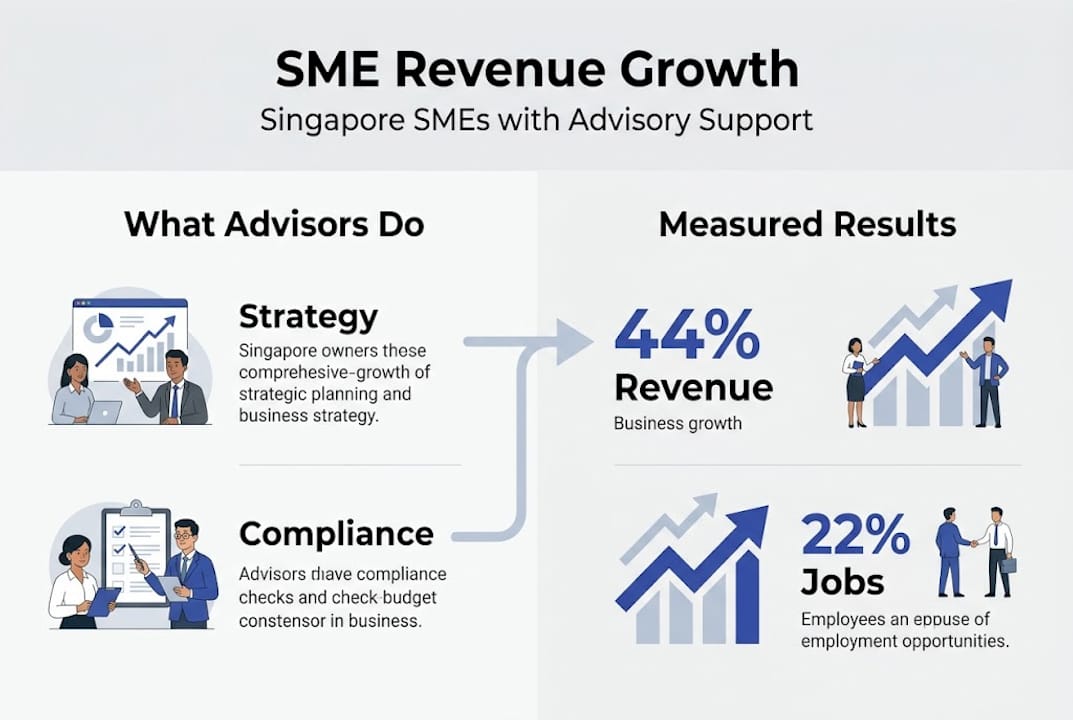
Many business owners in Singapore assume advisory services are a luxury reserved for large corporations with deep pockets and dedicated strategy teams. That assumption is costing them real growth. Advisory-linked interventions have produced 44.3% higher revenue and 21.9% higher employment for participating SMEs, according to Singapore’s T-Up program data. Whether you run a startup, an established SME, or a growing regional business, expert advisory support can reshape your operations, sharpen your compliance posture, and accelerate financial health. This article covers what advisory services actually involve, how they deliver measurable results, and how to choose the right model for your business.
Table of Contents
- What are advisory services and why do Singapore businesses need them?
- Methodologies and approaches: How advisory services deliver value
- The impact of advisory services: Evidence and outcomes
- Challenges, nuances, and alternatives: Navigating the Singapore advisory landscape
- Editorial perspective: Why hybrid advisory is often the smartest move for Singapore SMEs
- Connecting with trusted advisory services in Singapore
- Frequently asked questions
Key Takeaways
| Point | Details |
|---|---|
| Advisory boosts growth | Leveraging expert advisory translates into measurable revenue, efficiency, and compliance gains for Singapore businesses. |
| Methodologies matter | Choosing structured advisory approaches ensures strategic planning, accurate financial forecasting, and operational excellence. |
| Hybrid models work best | Combining external and internal expertise balances insight, continuity, and cost-efficiency for SMEs. |
| Evidence-backed outcomes | Singapore case studies confirm substantial improvements in R&D, admin savings, and operational costs through advisory support. |
What are advisory services and why do Singapore businesses need them?
Advisory services refer to expert guidance provided to businesses across strategic, financial, operational, and compliance dimensions. Unlike standard accounting or legal work, advisory engagements are forward-looking. They help business owners make informed decisions, not just record what has already happened.
In Singapore’s business environment, the regulatory landscape adds a layer of complexity that makes advisory support particularly valuable. Companies must navigate requirements from the Accounting and Corporate Regulatory Authority (ACRA) and the Inland Revenue Authority of Singapore (IRAS), while also managing financial performance and growth targets. Advisory services for Singapore businesses focus on optimizing operations, ensuring regulatory compliance with ACRA and IRAS, improving financial planning including tax optimization and cash flow management, and supporting strategic growth such as funding, expansion, and risk mitigation.
The core areas where advisory services bring the most value include:
- Regulatory compliance: Staying current with ACRA rules for 2026 and IRAS filing obligations
- Tax planning: Structuring transactions and entities to minimize tax exposure legally
- Financial management: Budgeting, forecasting, and cash flow optimization
- Operational efficiency: Identifying process bottlenecks and reducing overhead
- Strategic growth: Market entry, funding strategy, and business model refinement
- Risk management: Identifying financial and operational vulnerabilities before they escalate
For SMEs specifically, the value of advisory services extends beyond problem-solving. A skilled advisor acts as a sounding board, helping owners pressure-test decisions before committing resources. This is especially relevant when managing IRAS tax compliance obligations, where errors carry penalties that can disrupt cash flow significantly.
SMEs that engaged advisory support through Singapore’s T-Up program recorded 65.4% higher R&D spend, 44.3% higher revenue, and 21.9% higher employment compared to non-participants.
The scope of advisory work can be narrow and project-specific, such as preparing for a funding round, or broad and ongoing, covering everything from monthly financial reviews to annual compliance planning. Businesses that rely on trusted accounting services often find that the advisory layer on top of core accounting work is where the most strategic value is created.
Methodologies and approaches: How advisory services deliver value
Now that we’ve defined advisory services, let’s explore how experts in Singapore actually deliver value. The quality of an advisory engagement depends heavily on the methodology used. Generic advice rarely moves the needle. What works is a structured, evidence-based process tailored to the specific business context.
Advisory methodologies include strategic planning (goal setting, roadmaps), financial analysis (forecasting, budgeting, DCF valuation), operational reviews (process audits, efficiency optimization), data-driven decision-making (KPIs, benchmarking), compliance diagnostics (gap analysis, control assessments), and tailored consulting models such as project-based, retainer, or hybrid arrangements.
Here is how these methodologies typically unfold in practice:
- Discovery and diagnostic: The advisor conducts an initial assessment of the business, reviewing financials, operations, compliance status, and strategic goals.
- Gap analysis: Current performance is benchmarked against industry standards and regulatory requirements, identifying priority areas for improvement.
- Roadmap development: A structured action plan is created, with clear milestones, responsibilities, and timelines.
- Implementation support: The advisor works alongside the business team to execute changes, whether that involves restructuring financial reporting, optimizing tax positions, or redesigning workflows.
- Monitoring and iteration: KPIs are tracked regularly, and the plan is adjusted based on actual results and changing conditions.
The financial analysis component deserves particular attention. Discounted cash flow (DCF) valuation, for example, is a method that estimates the present value of future cash flows, which is critical for businesses evaluating acquisitions, investments, or exit strategies. Budgeting and forecasting tools help management anticipate cash shortfalls before they become crises.
| Advisory methodology | Primary use case | Key output |
|---|---|---|
| Strategic planning | Growth and expansion | Roadmap with milestones |
| Financial analysis (DCF) | Valuation and investment | Business valuation report |
| Operational review | Efficiency improvement | Process optimization plan |
| Compliance diagnostics | Regulatory risk reduction | Gap analysis report |
| KPI benchmarking | Performance management | Dashboard and targets |
Pro Tip: Before engaging an advisor, review your year-end compliance checklist to identify existing gaps. This gives your advisor a head start and reduces the time spent on discovery, lowering your overall engagement cost.
The consulting model you choose also matters. Project-based engagements work well for defined tasks like a company incorporation guide or a one-time restructuring. Retainer models suit businesses that need ongoing advisory support across compliance, finance, and strategy. Hybrid models combine both, offering flexibility as business needs evolve.
The impact of advisory services: Evidence and outcomes
With clear methodologies laid out, let’s connect these advisory approaches to tangible outcomes for Singapore businesses. The evidence is compelling, and it extends well beyond anecdotal success stories.
Singapore SME data shows that advisory-linked interventions produce measurable gains: the T-Up program produced 65.4% higher R&D spend, 44.3% higher revenue, and 21.9% higher employment; AI adoption supported by advisory tripled to 14.5 to 15% between 2023 and 2024, with 85% of adopters reporting efficiency gains; case studies document a 52% reduction in tender costs, 40 hours per week in administrative savings, and a 20% decrease in operational costs.
| Outcome metric | Measured result |
|---|---|
| Revenue growth (T-Up SMEs) | 44.3% higher than non-participants |
| Employment growth (T-Up SMEs) | 21.9% higher than non-participants |
| R&D spend increase | 65.4% higher |
| AI adoption rate (2024) | 14.5 to 15% of SMEs |
| Efficiency gains from AI advisory | 85% of adopters reported gains |
| Tender cost reduction (case study) | 52% |
| Admin time saved (case study) | 40 hours per week |
| Operational cost reduction | 20% |
These numbers reflect what structured advisory engagement can produce when applied consistently. The benefits realized by businesses that commit to advisory support include:
- Significant reductions in compliance costs through proactive corporate tax advisory and planning
- Administrative time savings that free up management bandwidth for higher-value work
- Lower operational costs through process redesign and vendor renegotiation
- Accelerated revenue growth through better strategic positioning and funding access
- Stronger governance frameworks that reduce audit risk and regulatory exposure
The 52% tender cost reduction case study is particularly instructive. It came from a business that engaged an advisor to review its procurement and bidding processes. The advisor identified redundant steps, renegotiated supplier terms, and restructured the bid preparation workflow. The result was not just cost savings but a faster, more competitive tendering capability.

Challenges, nuances, and alternatives: Navigating the Singapore advisory landscape
Understanding impact is essential, but making the right advisory choices means recognizing challenges and weighing alternatives. Not every advisory engagement delivers the expected return, and knowing why helps businesses make smarter decisions upfront.
Key nuances in Singapore advisory include: SMEs with resource constraints benefit from fractional CFO or advisory models without full-time hires; high costs and limited internal operational knowledge are common challenges for consultants; startups often lack sufficient historical data for income-based valuations and should favor asset or market-based methods instead; financial institutions require customized compliance diagnostics given ongoing Monetary Authority of Singapore (MAS) regulatory changes; and hybrid consulting plus in-house arrangements balance the strengths of both approaches.
| Model | Strengths | Limitations |
|—|—|
| External advisory | Unbiased perspective, specialized expertise, speed | Higher cost, potential knowledge gaps on internal ops |
| In-house strategy team | Deep operational knowledge, continuity, lower long-term cost | Risk of internal bias, limited specialization |
| Hybrid model | Balances expertise with internal context | Requires clear role definition to avoid overlap |
For growing SMEs, the fractional CFO model is worth understanding. A fractional CFO provides senior financial leadership on a part-time or project basis, giving businesses access to strategic financial guidance without the cost of a full-time executive. This is particularly relevant for companies managing foreign-owned company compliance obligations, where financial and regulatory complexity often exceeds what a standard bookkeeper can handle.
- Clarify scope before signing: Vague engagement terms lead to scope creep and unexpected costs.
- Assess advisor specialization: A generalist may not have the depth needed for MAS compliance or cross-border tax structuring.
- Set measurable outcomes: Define success metrics at the outset so progress can be tracked objectively.
- Plan for knowledge transfer: Ensure the advisory work builds internal capability, not just dependency.
Pro Tip: When evaluating advisory firms, ask for case studies from businesses in your industry and at your growth stage. An advisor who has solved similar problems before will reach solutions faster and with fewer missteps.
Editorial perspective: Why hybrid advisory is often the smartest move for Singapore SMEs
The debate between external advisory and in-house strategy teams often misses the point. Most Singapore SMEs do not have the budget for a full internal strategy function, and most external engagements are too short to build lasting institutional knowledge. The real question is not which model is better in theory. It is which combination works for your specific stage and constraints.
External advisory excels at delivering unbiased insights, specialized expertise, and speed, particularly for one-off crises or expansion projects. In-house teams offer deeper operational continuity and lower long-term costs. Consulting engagements tend to be project-based and short-term, while advisory relationships are ongoing partnerships.
The hybrid model, pairing an external advisor with a capable internal lead, often delivers the best outcomes for Singapore SMEs. The external advisor brings market perspective and technical depth. The internal lead ensures recommendations are grounded in operational reality and actually get implemented. Without that internal anchor, even the best advisory work can stall at the execution stage. Businesses that invest in corporate secretary solutions alongside advisory support tend to build stronger governance foundations that sustain growth over time.
Connecting with trusted advisory services in Singapore
The evidence is clear: structured advisory support produces real, measurable results for Singapore businesses at every stage of growth. Whether you are navigating incorporation, managing compliance obligations, or planning your next expansion, having the right advisory partner changes the quality of decisions you make.
Bizsquare Accounting provides tailored advisory services across company incorporation, corporate secretarial, accounting, and tax functions. Start with our incorporation checklist to assess your setup, review our tax filing guide to strengthen your compliance posture, or explore what appointing a secretary means for your governance obligations. Our consultants are ready to build a plan that fits your business, not a generic template.
Frequently asked questions
What core areas do advisory services cover for Singapore businesses?
Advisory services in Singapore cover financial planning, regulatory compliance with ACRA and IRAS, operational efficiency, strategic growth, and risk management. The scope can be tailored to a specific challenge or structured as an ongoing engagement.
How do advisory services improve compliance with ACRA and IRAS?
Advisors conduct compliance diagnostics, including gap analysis and control assessments, to identify where a business falls short of regulatory requirements. They then implement corrective measures and monitoring systems to maintain ongoing accuracy.
What measurable results can advisory services deliver for SMEs?
SMEs participating in advisory-supported programs have recorded 44.3% higher revenue and 21.9% higher employment, along with documented reductions in operational costs and administrative time.
When should a business choose hybrid advisory over outsourcing or in-house models?
Hybrid advisory is most effective when a business needs both the unbiased expertise of an external advisor and the operational continuity of an internal team, particularly in fast-changing environments or when resources are constrained.


1 Comment
The Role of a Business Consultant for Singapore SMEs
October 13, 2026, at 10:51 am[…] operations director, and strategy lead on its payroll. Consultants fill these gaps on demand. The advisory services available to Singapore SMEs cover exactly these organizational capacity […]