

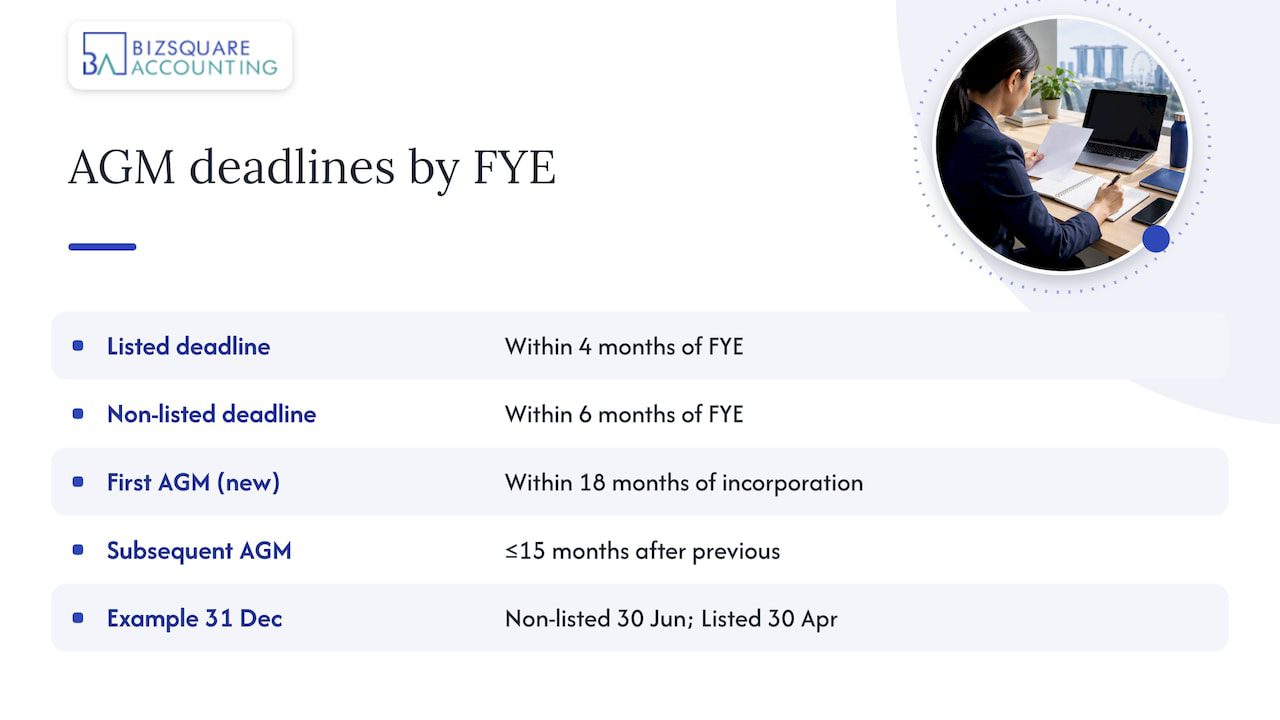
Your AGM due date depends on your financial year end and your company type. Listed companies must hold their AGM within four months of FYE, non-listed companies within six months, a first AGM is due within 18 months of incorporation, and subsequent AGMs follow a 15-month cycle. Check your FYE now, confirm your accounts are on track, and apply for an extension of time early if your audit will run late.
TL;DR:
- Companies must hold their AGM within four months of the FYE if listed, and within six months if non-listed, with the first AGM due within 18 months of incorporation.
- Auditors typically need six to eight weeks to complete financial statements, so early planning and internal deadlines are crucial to meet statutory dates.
- Application for an extension of up to 60 days can be made with a $200 fee if accounts or audits are delayed, but late filings lead to fines ranging from $300 to $600.
- Virtual or hybrid AGMs are now permitted if the company constitution or member resolution allows, requiring secure voting and proper minutes.
- Accurate scheduling relies on understanding the 15-month rule after the first AGM and factoring in audit and preparation times, with corporate secretarial support to avoid delays.
Table of Contents
- Statutory deadlines and how your financial year end sets your AGM date
- A step-by-step reverse timeline for planning your AGM
- Documents, audit timing and XBRL steps that decide your real deadline
- Applying for an extension of time on Bizfile
- Virtual and hybrid AGMs under the 2023 amendments
- Filing the annual return and what happens if you file late
- Worked examples: mapping your FYE to real dates
- Where AGM timelines usually go wrong
- Get your AGM timeline sorted with expert support
- Sources
- FAQ
Statutory deadlines and how your financial year end sets your AGM date
The Companies Act ties every AGM deadline to your company’s financial year end. Listed companies must hold their AGM within four months of the financial year end, while non-listed companies have six months. Many private companies in Singapore choose a financial year ending 31 December, 31 March, 30 June or 30 September, and each date produces a different compliance calendar.
A newly incorporated company gets more breathing room for its first AGM. It must be held within 18 months of incorporation, regardless of when the financial year actually ends. After that first meeting, the ongoing rule tightens: subsequent AGMs must be held no later than 15 months after the previous one, in addition to meeting the FYE-linked deadline.
This interaction matters in practice. A company with an FYE of 31 December must hold its AGM by 30 June the following year if it is non-listed, or by 30 April if listed. Shift the FYE to 30 June and the entire schedule moves with it, along with every internal task before the meeting. Choosing an FYE is not a paperwork formality, it is a decision that shapes your entire compliance calendar for years.
A step-by-step reverse timeline for planning your AGM
Working backwards from your due date gives directors a realistic view of what needs to happen and when. Below is a practical timetable that fits most non-listed companies.
- Six months before the deadline: close your accounts for the financial year and confirm the auditor’s engagement, if one is required.
- Four to five months before: finalise draft financial statements and resolve outstanding audit queries with your accountant.
- Six to eight weeks before: circulate near-final accounts to directors for review and sign-off.
- Three to four weeks before: fix the AGM date, venue or virtual platform, and prepare the notice of meeting.
- Fourteen days before (minimum notice period): issue the notice of AGM to all members, together with the financial statements.
- One to two weeks before: prepare proxy forms, confirm quorum arrangements, and finalise resolutions for the agenda.
- On the AGM date: obtain board and shareholder approval of the accounts and pass any resolutions.
- Within seven days after the AGM: file the annual return on Bizfile and keep signed minutes in your statutory records.
Pro Tip: Set your internal accounts cut-off six to eight weeks before the planned board approval date, so audit queries do not eat into your notice period.
Documents, audit timing and XBRL steps that decide your real deadline
The legal deadline is only half the story. The practical deadline is set by how quickly your financial statements and audit can be completed. Directors preparing for an AGM typically need the following ready before a meeting can proceed.
- Financial statements: profit and loss, balance sheet, and statement of changes in equity for the financial year.
- Directors’ statement and auditor’s report, where the company is not exempt from audit.
- Supporting schedules: fixed asset registers, debtor and creditor listings, and bank reconciliations.
- XBRL financial data, prepared and validated for upload through BizFinx before the annual return is filed.
Audit sequencing causes most delays. A new auditor unfamiliar with prior-year figures often needs extra time for opening balance checks, and unresolved queries can push sign-off back by weeks. Building in a buffer for handover issues, and assigning a single internal owner to chase outstanding documents, keeps the timeline on track.
Applying for an extension of time on Bizfile
When the audit or accounts will not be ready in time, an extension of time is the correct route rather than missing the deadline outright.
- An EOT can extend the AGM deadline, the annual return deadline, or both, by up to 60 days.
- Applications must be submitted at least 14 working days before the due date, because Bizfile will not accept a late application after the deadline passes.
The fee is $200, non-refundable, regardless of whether the application is approved. The outcome appears in the company’s Bizfile inbox, so directors should check the portal rather than wait for a separate notification. A strong application states the audit status clearly and proposes a realistic new meeting date. If an EOT is refused, the company remains liable for the original deadline, and late filing exposes it to composition sums and possible enforcement action.
Virtual and hybrid AGMs under the 2023 amendments
Companies can now hold AGMs virtually or in a hybrid format. The Companies, Business Trusts and Other Bodies (Miscellaneous Amendments) Act 2023 enabled this from 1 July 2023, subject to the company’s constitution or a member resolution permitting it.
- Confirm your constitution allows virtual or hybrid meetings, or pass a resolution first.
- Set up secure voting and identity authentication for remote members.
- Keep accurate minutes covering attendance, questions raised, and voting outcomes.
- Seek advice from your corporate secretary or auditor for complex shareholder structures before going virtual.
Filing the annual return and what happens if you file late
Filing the annual return on Bizfile is where the AGM finally becomes a matter of public record. You must declare your AGM date, or confirm an exemption or dispensation, when filing the annual return, whether the meeting was held, exempted, or dispensed with by resolution.
- Select and upload XBRL financial statements where your company is not exempt.
- Declare the AGM date, or the relevant exemption, in the annual return form.
- File within the statutory window that follows your AGM.
Missing this step carries real cost. Late annual return filings attract composition sums ranging from $300 to $600, depending on how late the filing is, and our guide to avoiding ACRA late filing penalties covers the enforcement pathway in more detail.
Worked examples: mapping your FYE to real dates
Seeing the rule applied to real dates makes it easier to plan around.
- FYE 31 December (non-listed): AGM due by 30 June, annual return due within seven days after. Draft accounts should be ready by April to leave a comfortable margin.
- FYE 30 June (non-listed): AGM due by 31 December, giving companies with a mid-year close a natural break over the December holiday period to finish paperwork early.
- First-year company incorporated in March 2026: first AGM due by September 2027, within 18 months. Every AGM after that must follow within 15 months of the previous one, alongside the standard FYE-linked deadline.
Our financial year end compliance checklist works through further combinations for companies weighing up a change of FYE.
Where AGM timelines usually go wrong
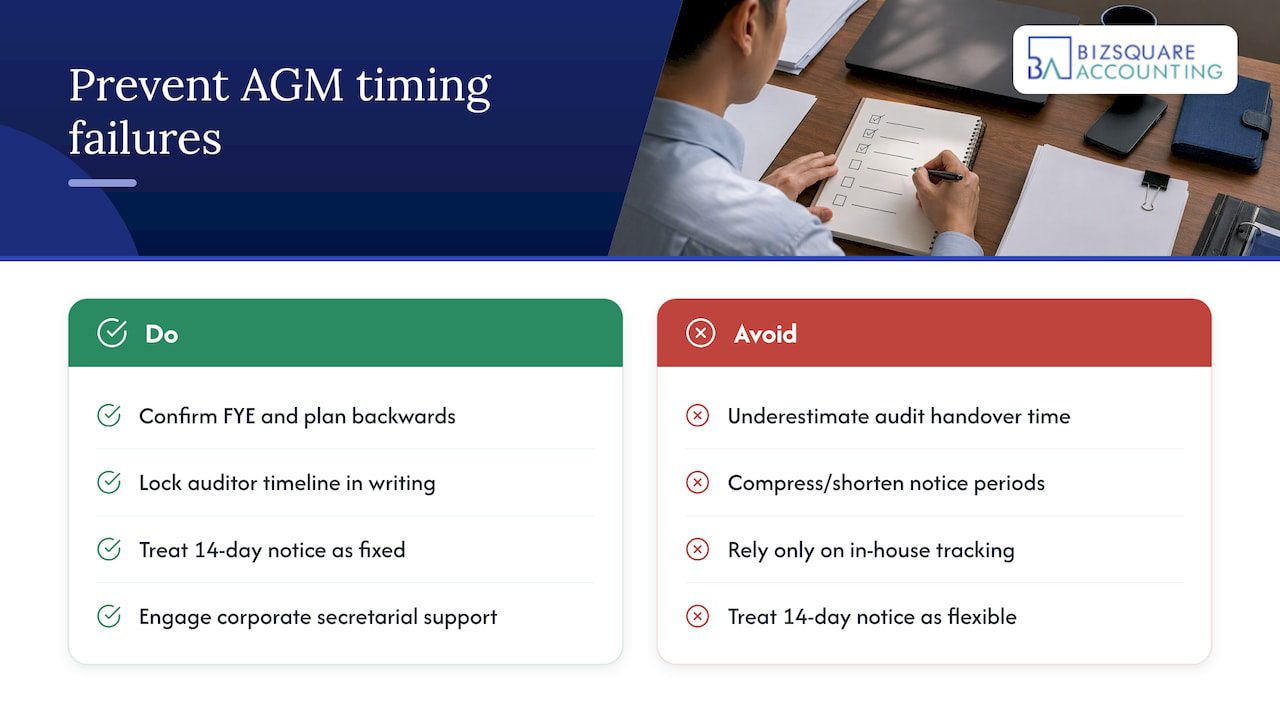
Most late AGMs are not caused by a lack of awareness of the rule, they are caused by accounts that were never going to be ready in time. Directors frequently underestimate how long an audit handover takes when switching accountants mid-year, and notice periods get compressed as a result.
A short checklist prevents most of this: confirm your FYE and count backwards from the deadline, lock in your auditor’s timeline in writing, and treat the 14-day notice period as fixed rather than flexible. Corporate secretarial support catches these gaps earlier than most in-house teams manage alone, because tracking statutory deadlines across multiple entities is what the role exists to do.
— Vandro
Get your AGM timeline sorted with expert support
Meeting a Singapore AGM deadline is far easier when someone is tracking the calendar alongside your accounts. Bizsquare’s corporate secretarial services handle notice preparation, minute-taking, and Bizfile filings, while our accounting and bookkeeping team keeps your financial statements audit-ready ahead of schedule.

If you are incorporating a new company, our company incorporation service sets your statutory records and FYE correctly from day one, avoiding the confusion that often causes first-year AGM delays. For a broader look at financial calendar planning alongside your AGM cycle, Sol Social Media’s financial planning resources are a useful companion. Speak with our team today for an AGM readiness review, or hand your filings over to us entirely so nothing slips past the deadline.
Sources
- Due dates & requirements for annual general meetings (AGMs) | ACRA
- Companies Act 1967 – Singapore Statutes Online
FAQ
What is the schedule for the upcoming AGM in 2026?
There is no single fixed date, each company’s AGM schedule depends on its own financial year end. A non-listed company with an FYE of 31 December must hold its AGM by 30 June, while a listed company on the same FYE must hold it by 30 April.
When must an AGM be held in Singapore?
An AGM must be held within six months of financial year end for non-listed companies, and within four months for listed companies. A company’s first AGM has a longer window of 18 months from incorporation.
What is the ACRA AGM deadline in Singapore?
The deadline is set by financial year end and company type, with non-listed companies given six months and listed companies four months. Companies that miss the deadline can apply for an extension of time of up to 60 days, for a $200 fee.
What is the time period of an AGM?
An AGM itself does not have a fixed duration, it runs as long as needed to complete the agenda and resolutions. The relevant time period directors must track is the statutory deadline for holding it, which follows the four or six month rule after financial year end.
How do I apply for an extension of time for my AGM?
You apply through Bizfile at least 14 working days before your AGM due date, stating the reason and a realistic new date. The application carries a non-refundable $200 fee and can cover the AGM, the annual return, or both.
What happens if I file my annual return late?
Late annual return filings attract composition sums ranging from $300 to $600, depending on how late the filing is. Repeated late filings can also draw closer regulatory attention, particularly for listed issuers.
Can a private company skip holding an AGM entirely?
A private company can dispense with AGMs by resolution, but it must still send financial statements to members within the statutory period. A member can still require an AGM up to 14 days before the statutory deadline, even after such a resolution is passed.
Are virtual AGMs legal in Singapore?
Yes, virtual and hybrid AGMs have been permitted since 1 July 2023 under amendments to the Companies Act. The company’s constitution must allow it, or members must pass a resolution permitting the format.
Does the AGM deadline change if I change my financial year end?
Yes, changing your FYE shifts every deadline linked to it, including your AGM and annual return dates. ACRA’s guidance on choosing a financial year end sets out how common FYE dates map to compliance calendars.
What documents do I need ready before an AGM?
You need finalised financial statements, the directors’ statement, and the auditor’s report if your company is not exempt from audit. XBRL data must also be prepared for upload through BizFinx before the annual return is filed.
Do listed companies face stricter AGM rules than private companies?
Yes, listed companies have a shorter four month deadline after financial year end, compared with six months for non-listed companies. SGX RegCo also expects listed issuers to meet these timelines consistently, and repeated extension requests can raise governance concerns.
What is the 15-month rule for AGMs?
After a company’s first AGM, every subsequent AGM must be held no later than 15 months after the previous one. This applies alongside, not instead of, the standard four or six month deadline linked to financial year end.