

Singapore companies can end a directorship three ways: shareholders pass an ordinary resolution under Section 152, the director resigns under Section 145, or the director becomes disqualified by law. Whichever route applies, your first job is the same, gather the meeting notice or resignation letter as evidence, then lodge the change on BizFile+ within 14 days. Watch the resident director rule closely, since it can block an otherwise valid resignation.
TL;DR:
- Shareholder-initiated removal requires giving special notice at least 28 days before the meeting and passing an ordinary resolution by majority vote.
- Resigning a director is invalid if it results in no remaining resident director; an appointment or government direction is needed before resignation takes effect.
- Disqualification causes include bankruptcy or court orders, requiring immediate notification to ACRA within 14 days to avoid fines.
- Filing changes on BizFile+ must be done within 14 days with supporting documents, or fines up to $5,000 may apply for late submission.
- Appointing a successor resident director before resignation minimizes operational disruptions and ensures compliance with local regulations.
Table of Contents
- Removing a director by shareholders, step by step
- How a director resigns: valid resignation and the resident-director rule
- Disqualification: grounds, consequences and notification duties
- How to notify ACRA and file on BizFile+: forms, timeline and common pitfalls
- Appointing a replacement when the resident-director rule blocks resignation
- Ready-to-use checklist and documents to prepare, file and retain
- Potential legal challenges and remedies if a director contests removal
- Implications of removing a director on company operations and governance
- Removal by shareholders versus removal by the board
- Role and protections of independent directors in the removal process
- What company owners consistently get wrong
- How Bizsquare handles your director change and ACRA filings
- Sources
- FAQ
Removing a director by shareholders, step by step
Shareholders hold the power to remove a director even mid term, without needing to prove misconduct. Section 152 of the Companies Act gives members of a private company this right through an ordinary resolution, meaning a simple majority vote at a general meeting.
The process starts with special notice. A member intending to move the resolution must give the company at least 28 days’ notice before the meeting. The company must then notify the director concerned, who has the right to make representations and speak at the meeting, even if they cannot attend in person. Public companies face slightly stricter procedural expectations, and some private company constitutions add their own layers, so checking your constitution first is not optional.
Practical steps look like this:
- Review the company constitution for any clauses that vary the standard removal process.
- Serve special notice on the company at least 28 days before the intended meeting.
- Have the company notify the affected director and circulate the resolution to members.
- Hold the general meeting, put the resolution to a vote, and record the outcome in signed minutes.
- Confirm the resolution passed by ordinary majority before treating the removal as effective.
Removal takes legal effect the moment the resolution is validly passed, not when it is later filed with the Accounting and Corporate Regulatory Authority. Until BizFile+ reflects the change, however, third parties dealing with the company may still rely on the public register, so speed matters here as much as accuracy.
How a director resigns: valid resignation and the resident-director rule
Resignation looks simple on paper, a signed letter and a board acknowledgement, but Singapore law adds a trap many company owners miss. Section 145 of the Companies Act states a resignation is not effective if it would leave the company without any director ordinarily resident in Singapore.
Follow these steps to resign correctly:
- Check the company constitution for any notice period or procedural requirement for resigning directors.
- Confirm whether at least one other director remains ordinarily resident in Singapore after your departure.
- Submit a written resignation letter to the board, stating the effective date clearly.
- Obtain written board acknowledgement confirming receipt and acceptance of the resignation.
- Retain a signed copy of the resignation letter and acknowledgement for your own records.
If you are the sole resident director, your resignation simply will not take effect in law, regardless of what you write in the letter. Many directors discover this only after ACRA rejects the filing, leaving the company in limbo. Keeping the acknowledgement and proof of submission protects you from liability if the company delays reporting your departure later.
Disqualification: grounds, consequences and notification duties
Directors can lose office automatically through disqualification, without any vote or resignation letter involved. Common grounds include personal bankruptcy, a court disqualification order, or conviction for certain offences under the Companies Act.
The notification chain has two sides, and both matter:
- The disqualified director must inform the company in writing as soon as the disqualifying event occurs.
- The company must then lodge the withdrawal on BizFile+ within 14 days of becoming aware of the disqualification.
- ACRA does not proactively track or notify companies when a director becomes disqualified, so the burden sits squarely with the company and the individual.
- Missing the 14 day window can trigger fines of up to $5,000 for the company and each officer in default, according to ACRA’s own guidance.
A disqualified director loses legal capacity to act on the company’s behalf immediately, even before the register is updated; if you face issues like this, check out Loan Rejected? What to Do Next for practical financial guidance related to director disqualification and company credit problems. If that person was the sole local director, the company must move fast to appoint a replacement, since operating without one breaches the resident director requirement and exposes the company to further compliance risk.
How to notify ACRA and file on BizFile+: forms, timeline and common pitfalls
Once the meeting or resignation is settled, the filing itself is a fairly mechanical process, provided you follow the right sequence.
- Log into BizFile+ using CorpPass and select the notice of cessation or change in officer particulars transaction.
- Attach supporting evidence, the signed resolution and minutes for removals, or the resignation letter and board acknowledgement for resignations.
- Submit the filing within 14 days of the effective date, well before ACRA’s statutory deadline.
- Check the officer’s status updates on the public register once processing completes, typically within one to three working days.
If the company drags its feet, an outgoing director is not stuck waiting. ACRA allows the departing director to file the notice of cessation directly, removing their name from the public record without needing the company’s cooperation.
The most common mistakes are surprisingly avoidable, missing attachments, filing before the resolution is properly signed, or neglecting to verify compliance with the resident director requirement after the change.
Pro Tip: Always screenshot or save a PDF confirmation of your BizFile+ submission the moment you file it, that timestamp is your proof if ACRA later queries the 14 day deadline.
Appointing a replacement when the resident-director rule blocks resignation
Section 145(5) is unforgiving, a resignation that leaves zero directors ordinarily resident in Singapore simply does not take legal effect, no matter how clearly it is written. This single rule causes more stuck resignations than any other issue Bizsquare sees in practice.
Your practical options, roughly in order of speed:
- Appoint a new resident director before the outgoing director’s resignation date, so the gap never actually opens.
- Use a temporary arrangement, such as a willing existing shareholder who qualifies as ordinarily resident, to bridge the transition.
- If no suitable local candidate exists, apply to the Registrar for a direction requiring members to appoint a resident director, though this route is slower and involves added cost.
- Vet any incoming appointee’s eligibility carefully, including immigration status if the candidate is a foreigner newly relocating to Singapore.
Appointing a replacement typically takes a few working days once you have identified an eligible candidate, but visa related delays for foreign appointees can stretch this considerably.
Ready-to-use checklist and documents to prepare, file and retain
Before doing anything else, pull the company constitution and confirm which removal or resignation route actually applies to your situation.
- Check the constitution for notice periods, special clauses, or voting thresholds that vary the standard rules.
- Draft the resolution or resignation letter, and set a clear effective date.
- Serve any required notice period, then hold the meeting or collect the signed resignation.
- Record signed minutes or obtain written board acknowledgement as your evidentiary trail.
- Lodge the change on BizFile+ within 14 days, attaching all supporting documents.
- Update internal statutory registers to reflect the new officer position.
| Document | Who prepares it | Retention purpose |
|---|---|---|
| Signed resolution and minutes | Company secretary or board | Evidence of valid shareholder removal |
| Resignation letter | Outgoing director | Proof of resignation date and terms |
| Board acknowledgement | Company secretary | Protects director from late filing disputes |
| BizFile+ filing confirmation | Company or outgoing director | Proof of statutory compliance |
Keep these records for at least five years, since disputes over historical directorships can resurface long after the change itself feels settled.
Potential legal challenges and remedies if a director contests removal
A removed director cannot block the resolution simply by disagreeing with it, but they retain real legal protections. Under Section 152, the director has the right to receive the special notice, circulate written representations to members, and speak at the meeting itself, even where the company disputes their conduct.
If a company fails to give proper notice, skips the representation rights, or the constitution’s own procedure is not followed, the removed director can challenge the resolution’s validity in court. Courts in Singapore generally will not second guess the commercial wisdom behind a removal, provided the procedure was followed correctly, but a procedural defect can unwind the entire decision.
Separately, a director removed without proper grounds may still pursue a wrongful dismissal claim if they also held an employment contract with the company, since a directorship and an employment relationship are legally distinct. Losing board status does not automatically end salary or severance entitlements under a separate service agreement.
The practical lesson is straightforward, follow the notice period, document every step, and keep signed minutes. Companies that shortcut these formalities to remove a difficult director quickly often find themselves back at the negotiating table months later, facing a far more expensive dispute than the one they tried to avoid.
Implications of removing a director on company operations and governance
Removing a director rarely stays a paperwork exercise, it reshapes decision making almost immediately. Bank mandates, contracts requiring board approval, and even day to day signing authority can all hinge on who currently holds office, so operational continuity needs planning before the resolution is passed, not after.
Governance balance shifts too. Losing a director changes board composition, voting dynamics, and sometimes quorum requirements for future meetings. A company with only two directors that removes one, for instance, may struggle to meet quorum until a replacement joins, effectively freezing certain decisions.
There is also a reputational dimension worth weighing. Frequent director turnover, particularly disputed removals, can raise questions among banks, auditors, and potential investors during due diligence. None of this means removal should be avoided when genuinely warranted, but it does mean the board should line up a transition plan, updated registers, briefed signatories, a clear communication line to key stakeholders, before the departure takes effect rather than scrambling afterwards.
Removal by shareholders versus removal by the board
Singapore’s default legal position gives shareholders, not the board, the statutory power to remove a director under Section 152. Fellow directors generally cannot vote a colleague off the board through an internal board resolution alone, since the Companies Act reserves that power for the general meeting.
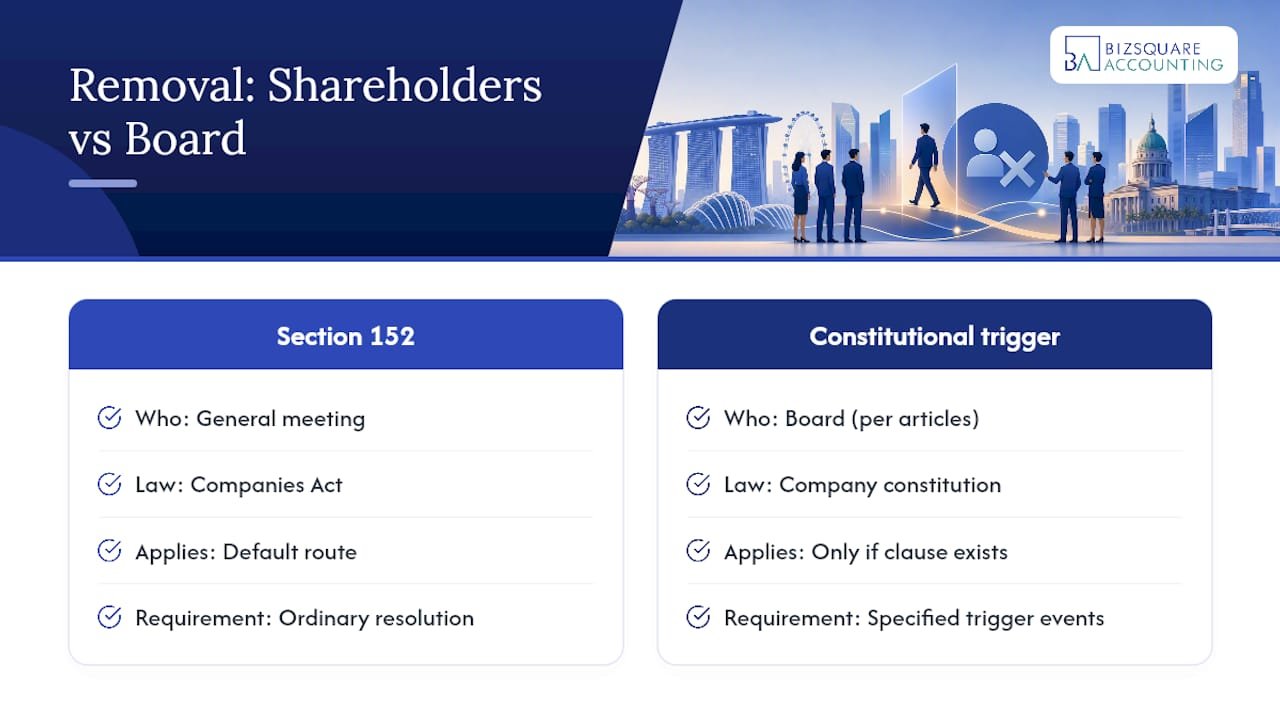
That said, many company constitutions build in board level mechanisms that operate alongside the statutory route. A constitution might allow the board to declare a director’s office vacant automatically upon events like prolonged absence from meetings, mental incapacity, or specific breaches spelled out in the articles. These are constitutional triggers rather than a true “board removal” in the Section 152 sense, and they only work if the constitution actually contains such a clause.
For most private companies without unusual constitutional provisions, the practical reality is this, if directors disagree among themselves and want a colleague gone, they need shareholder support to make it legally binding. Checking your own constitution early avoids wasted effort chasing a removal route your company’s governing document simply does not permit.
Role and protections of independent directors in the removal process
Independent directors, common on boards of larger private companies and listed entities, face the same statutory removal mechanics as any other director under Section 152. Singapore law does not create a separate, higher bar for removing someone specifically because they hold independent status.
Where independence matters most is procedural fairness. Corporate governance codes generally expect boards to handle an independent director’s removal with particular care, since these appointments often exist precisely to provide impartial oversight of management and controlling shareholders. Removing one abruptly, especially without clear grounds, can raise legitimate governance concerns among minority shareholders and external auditors reviewing board conduct.
Independent directors retain the same representation rights as any other director facing removal, the right to receive notice, respond in writing, and address the meeting directly. Companies that sideline these rights, even for directors seen as difficult, expose themselves to exactly the kind of procedural challenge discussed earlier. Good governance practice suggests documenting the specific reasons behind removing an independent director more thoroughly than usual, partly to protect the company’s own credibility with stakeholders watching how the board treats its checks and balances.
What company owners consistently get wrong
Most directorship disputes Bizsquare encounters trace back to the same handful of errors, missed notice periods, resignations that quietly breach the resident director rule, or filings submitted without the underlying resolution properly signed first. Companies also frequently underestimate how quickly the 14 day BizFile+ clock runs once a departure date is fixed.
Bizsquare’s corporate secretarial team handles the parts most owners find tedious or risky, drafting compliant resolutions and minutes, checking constitutional requirements before anyone signs anything, and submitting BizFile+ filings correctly the first time. That groundwork is what keeps a director change from becoming a governance headache months later.
— Vandro
How Bizsquare handles your director change and ACRA filings
Getting a director removal or resignation right on paper is one thing, filing it correctly on BizFile+ within the 14 day window is another matter entirely, and it is where most delays and fines actually happen.

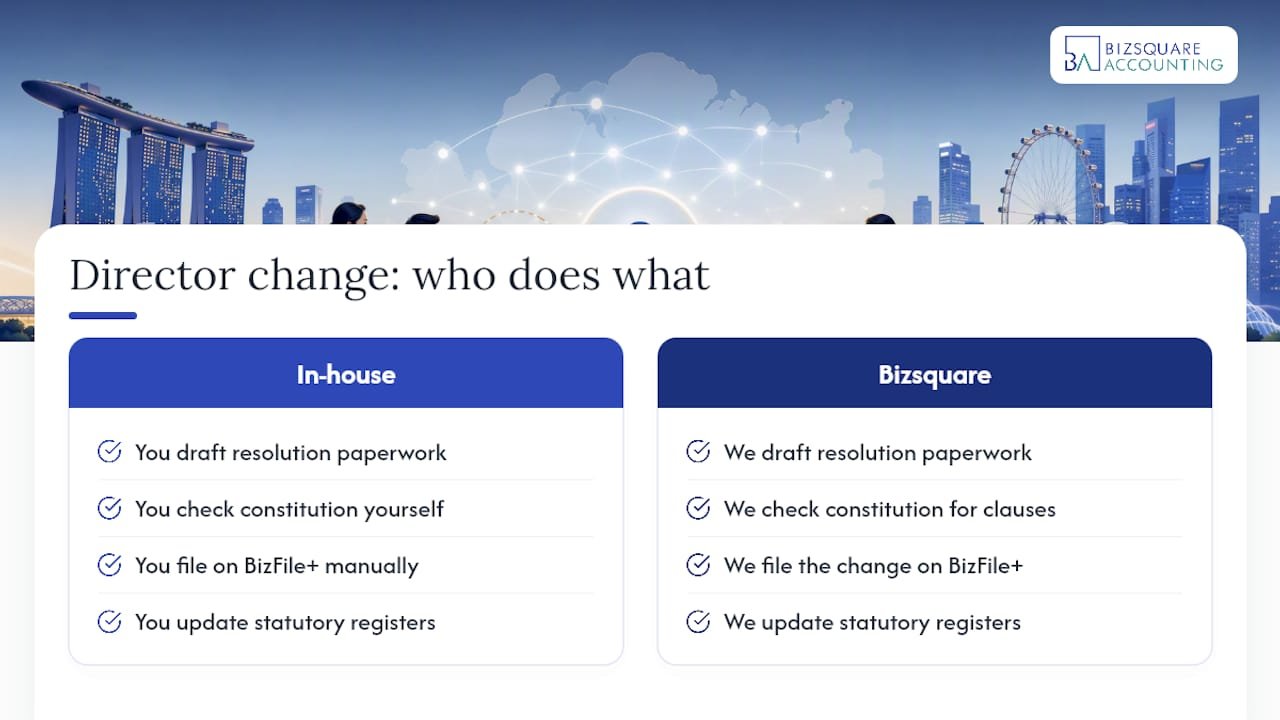
Bizsquare is the practical alternative to handling this in house without a company secretary on hand. Our corporate secretarial team drafts the resolution or resignation paperwork, checks your constitution for hidden clauses, files the change on BizFile+, and updates your statutory registers, all without you needing to decode the Companies Act yourself. We also support the AGM and annual filing obligations that follow any board change, so nothing slips through afterwards.
Choosing a dedicated corporate secretary lowers your exposure to the $5,000 penalty risk that comes with late notification, and avoids the invalid filing traps that catch companies acting without professional guidance. If your company needs a director change handled properly, or you are incorporating a new entity and want your secretarial obligations set up correctly from day one, visit our company incorporation services page to get started, or explore our corporate secretary services for ongoing compliance support.
This article is general information, not a substitute for advice from a qualified lawyer. Consult a qualified legal professional about your own circumstances before acting on anything here.
Sources
- When a director can or must leave office | Accounting and Corporate Regulatory Authority
- Companies Act 1967 – Singapore Statutes Online
- BizFile+
FAQ
Can you remove a director without their knowledge?
No. Section 152 requires the company to notify the director of the special notice and give them the chance to make representations before the meeting.
On what grounds can a director be removed?
Shareholders can remove a director by ordinary resolution without proving specific misconduct, while disqualification grounds include bankruptcy and court orders under the Companies Act.
What is the process for removing a director?
Serve special notice at least 28 days before the meeting, hold the vote, pass the ordinary resolution, then lodge the change on BizFile+ within 14 days.
How can I remove myself as a director?
Submit a written resignation to the board, but check first that another director remains ordinarily resident in Singapore, otherwise the resignation may be invalid.
What happens if a resignation leaves no resident director?
Under Section 145, the resignation does not take legal effect until a replacement resident director is appointed or the Registrar directs one.
How long does ACRA take to process a director change?
Filings on BizFile+ are typically processed within one to three working days, though complex cases may take longer.
What penalty applies for late BizFile+ notification?
Companies and officers in default risk fines of up to $5,000 for failing to notify ACRA within the 14 day statutory window.
Can an outgoing director file their own resignation with ACRA?
Yes. If the company fails to act, the outgoing director can file a notice of cessation directly through BizFile+.
Does ACRA automatically know when a director is disqualified?
No. ACRA does not proactively track disqualification events, so the company and director must notify ACRA themselves.
Can a board remove a director without shareholder approval?
Generally no, unless the company constitution contains a specific clause allowing automatic vacancy in defined circumstances.
Do independent directors get extra protection during removal?
Not legally, but governance best practice expects boards to document reasons carefully when removing an independent director.
Can a removed director challenge the decision in court?
Yes, if proper notice or representation rights were not followed, though courts rarely question a procedurally sound removal decision.
What documents should be kept after a director change?
Retain signed resolutions, minutes, resignation letters, board acknowledgements, and BizFile+ filing confirmations for at least five years.
How can Bizsquare help with a director resignation or removal?
Bizsquare drafts compliant resolutions, checks constitutional requirements, and files the change on BizFile+ within the statutory deadline.