

Annual return filing in Singapore: your compliance checklist
Every company incorporated in Singapore must file an annual return with the Accounting and Corporate Regulatory Authority (ACRA) each year. Most non-listed companies must submit within several months of their financial year end. Filing happens through BizFile, ACRA’s online portal, where you declare company details and attach financial statements or XBRL data as required.
Miss the deadline and the consequences bite quickly.
- All Singapore-incorporated companies on ACRA’s register must file, with no exceptions for dormant or small entities.
- The deadline depends on your company type and financial year end (FYE).
- You file online through BizFile, using either XBRL format or a PDF attachment.
Late filing can trigger penalties of up to S$600, plus further enforcement action against company officers.
Key Takeaways
Meeting your annual return deadline depends on knowing your company type, preparing financial statements correctly, and filing through BizFile without last-minute errors.
| Point | Details |
|---|---|
| Know your deadline | Non-listed companies file within 7 months of FYE; listed companies within 5 months. |
| Prepare documents early | Confirm officer details, XBRL files, and AGM information before logging in to BizFile. |
| Watch for penalties | Late filing risks fines of up to S$600 and possible director enforcement action. |
| Use extensions wisely | An EOT gives up to 60 extra days for a S$200 fee if you cannot meet the deadline. |
| Get professional support | Bizsquare’s secretarial team prepares and files annual returns accurately on your behalf. |
Your pre-filing checklist before you log in to BizFile
Gather everything before you open BizFile. It saves time and avoids rejected submissions.
- Confirm your registered office address, officer details, share capital figures, and business activity codes are current.
- Decide whether you need to file full financial statements or simply make an online declaration.
- Prepare your XBRL file if required, or check your PDF attachment meets ACRA’s filename rules.
- Collect your AGM date, director signatures, and any changes to company registers.
Pro Tip: Print your last annual return before you start. Comparing it against current records catches most mismatches in minutes.
Who must file, and what are the exact deadlines?
Every “live” company registered with ACRA must submit annual returns, regardless of turnover or trading activity. Dormant companies are not exempt from this obligation.
The deadline depends on whether your company is listed and whether it has share capital with an overseas branch register. ACRA sets out the official deadline matrix as follows:
- Listed companies: within 5 months after financial year end.
- Listed companies with share capital and an overseas branch register: within 6 months.
- Non-listed companies: within 7 months.
- Non-listed companies with share capital and an overseas branch register: within 8 months.
Take a practical example. A non-listed company with a financial year ending on 31 December must file its annual return by 31 July the following year. A listed company with the same FYE would need to file by 31 May instead.
One detail catches many directors out. You cannot change your financial year end after the filing deadline has passed, so plan any FYE adjustments well ahead of the cut-off date.

Financial statements, XBRL, and audit requirements explained
Not every company files the same paperwork. Your obligations depend on size, structure, and whether you qualify for exemptions.
Audited financial statements are generally required unless your company qualifies as a small company under the Companies Act, which involves criteria related to revenue, assets, and employee count.
- Most companies must file financial statements in a structured format, typically XBRL, following ACRA’s data taxonomy.
- Certain companies, such as those in insurance, banking, or those preparing statements under standards other than Singapore Financial Reporting Standards, may attach a PDF copy instead of full XBRL. ACRA’s guidance sets out exactly which category applies to your company.
- Attachments must follow strict filename conventions, and XBRL files go through automatic validation checks before submission is accepted.
- Solvent exempt private companies may qualify to file simplified financial statements or, in limited cases, none at all.
How do you file an annual return through BizFile?
Filing itself is a fairly linear process once your documents are ready. Follow these steps in order.
- Log in to BizFile using your SingPass credentials, then open the “File Annual Return” eService.
- Review the pre-filled company information carefully. BizFile pulls details from your last filing, and any changes must be updated first.
- Complete the declaration sections specific to your company type, including AGM details and financial year confirmation.
- Upload your XBRL file, or attach your PDF financial statements if XBRL is not required.
- Confirm director signatures are recorded correctly, then review every field once more before submitting.
Once submitted, ACRA updates your company record almost immediately. The standard filing fee is commonly S$60, payable at the point of submission.
What AGM details must you include in the annual return?
Your annual return must reflect the correct AGM position, and getting this wrong is one of the more common filing errors.
- Enter the date your AGM was held, or state clearly if the AGM is exempt or has been dispensed with under current rules.
- For companies with a single director, that director signs the directors’ statement alone. Companies with multiple directors need at least two signatures, or as specified in the constitution.
- Your AGM treatment directly affects which financial statements you must attach, so confirm this before completing the declaration.
Extensions, late penalties, and what happens if you fall behind
Sometimes you genuinely cannot meet the deadline. ACRA allows an extension of time (EOT) application, giving you up to 60 additional days to file, for a fee of S$200 per application.
Miss the deadline without an EOT and enforcement follows. Officers face fines, ACRA may issue composition offers, and repeated non-compliance can lead to director disqualification.
- Filing late risks fines of up to S$600 per breach, alongside possible prosecution for officers.
- Persistent non-filers risk having their company struck off the register, which ends its legal standing entirely.
- If several years are overdue, file the oldest outstanding return first, then work forward systematically rather than skipping to the most recent year.
Common filing errors and how to avoid them
Most rejections come down to small, avoidable mistakes rather than complex legal issues.
- Officer or company details that no longer match ACRA’s records.
- Filenames containing spaces, symbols, or characters BizFile does not accept.
- Missing director signatures on the statement, or an incomplete AGM declaration.
- XBRL files that fail automatic validation checks during upload.
Run through this list before you submit, not after. If your submission still fails, BizFile’s help centre provides troubleshooting guidance for specific error codes.
Pro Tip: Save a copy of your validation report immediately after upload. It tells you exactly which field caused the failure, rather than leaving you to guess.
Bizsquare’s perspective: the common pitfalls we see in filings
Most gaps we encounter come from outdated officer records or missed AGM declarations, not complicated legal disputes. Directors often assume last year’s filing simply carries forward unchanged, which is rarely true.
Proper secretarial support catches these mismatches before submission, not after rejection. For companies juggling tax filing deadlines alongside ACRA obligations, that overlap deserves careful attention each year.
How Bizsquare handles annual return filing for you
Bizsquare Accounting is the practical alternative to handling annual return filing alone, particularly for directors juggling operations alongside compliance deadlines. Rather than cross-checking XBRL rules and AGM declarations yourself each year, our corporate secretarial team prepares filings, validates attachments, and submits through BizFile on your behalf.

We prepare XBRL-ready financial statements, confirm AGM treatment correctly, and track your deadline well ahead of the cut-off date, so nothing slips through unnoticed. This matters most for growing companies where officer changes, share capital adjustments, or overseas branch registers add complexity to what should be a routine submission.
If you are incorporating a new company, our company incorporation service sets up your statutory records correctly from day one, which makes every future annual return simpler to file. Existing companies can speak with our team about ongoing secretarial support to keep filings on schedule every year.
Authoritative resources to complete your filing
- ACRA deadline and requirements page
- BizFile filing instructions
- GoBusiness annual returns checklist
- SingPass login portal
Sources
- Deadline & requirements for annual returns | Accounting and Corporate Regulatory Authority
- Steps to file an annual return | Accounting and Corporate Regulatory Authority
- Annual returns | GoBusiness
FAQ
1.) What is the deadline for filing an annual return in Singapore?
Non-listed companies must file within 7 months after their financial year end, while listed companies must file within 5 months.
2.) Who is required to file an annual return with ACRA?
Every company incorporated in Singapore and registered with ACRA must file, including dormant companies with no trading activity.
3.) Can I file an annual return myself?
Yes, directors can file directly through BizFile using SingPass, though many choose secretarial support like Bizsquare to reduce errors.
4.) What is the deadline for submitting tax returns in Singapore?
Corporate tax filing with IRAS follows separate deadlines from ACRA’s annual return, with dates that vary depending on filing method and company type.
5.) What happens if I file my annual return late?
You risk fines of up to S$600, and persistent non-filing can lead to your company being struck off ACRA’s register.
6.) Do I need an accountant to file my annual return?
It is not legally required, but preparing accurate financial statements and XBRL data is easier with professional bookkeeping support.
7.) What is XBRL and why does it matter for filing?
XBRL is a structured data format ACRA uses for financial statements, and most companies must submit their accounts in this format.
8.) Can dormant companies skip filing an annual return?
No, dormant companies must still file annual returns, though some qualify for simplified financial statement exemptions.
9.) How do I apply for an extension of time?
You submit an EOT application through BizFile before your deadline, paying a S$200 fee for up to 60 additional days.
10.) What is the difference between an annual return and an AGM?
An AGM is a shareholder meeting, while the annual return is the separate document filed with ACRA declaring company information.
11.) Can I amend an annual return after submitting it?
Yes, contact ACRA directly to request a correction, since BizFile does not allow self-service amendments after submission.
12.) What documents do I need before filing on BizFile?
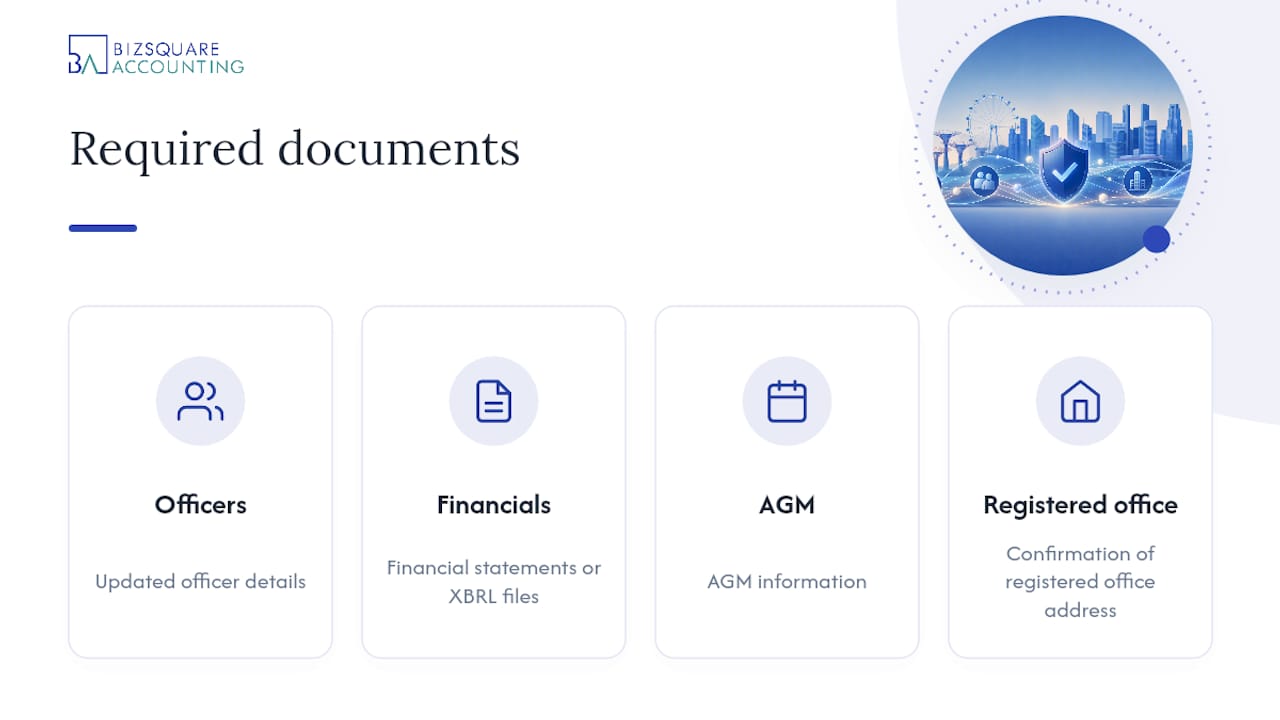
You need updated officer details, financial statements or XBRL files, AGM information, and confirmation of your registered office address.
Does every company need audited financial statements?
No, companies meeting small company criteria under the Companies Act may qualify for audit exemption, subject to specific revenue and asset thresholds.