


Company constitution Singapore: your incorporation guide
A company constitution in Singapore is the written rulebook that governs how your company operates. It covers voting rights, director powers, and share transfers. Under the Companies Act, you must submit one to the Accounting and Corporate Regulatory Authority (ACRA) when you incorporate, or declare that you are adopting the Model Constitution instead.
Here’s the immediate action point. During registration through Bizfile, ACRA’s online filing portal, you either upload a customised constitution or tick the box to adopt the Model Constitution set out under the Companies (Model Constitutions) Regulations 2015. There is no third option. One of these two paths must be completed before your company gets its Unique Entity Number.
Whichever path you choose, your constitution must cover certain mandatory items. These include:
- The company’s name and registered office address
- A statement of members’ liability (limited or unlimited)
- Details of share capital, if the company is limited by shares
- Rules on how shares may be transferred
- Basic provisions on directors’ powers and general meetings
Get these fundamentals sorted early, and the rest of the incorporation process moves far more smoothly.
Key Takeaways
A company constitution is a binding legal document required at incorporation, and choosing between the Model Constitution and a custom draft depends on your shareholder complexity and growth plans.
| Point | Details |
|---|---|
| File through Bizfile | Submit your custom constitution or select a Model Constitution adoption method during Bizfile incorporation. |
| Cover mandatory items | Include company name, liability statement, registered office, and share capital under section 22 of the Companies Act. |
| Store the signed copy | Keep the constitution signed by all subscribers at your registered office for audits and due diligence. |
| Amend through special resolution | Follow notice periods and ACRA filing deadlines whenever governance clauses change. |
| Get professional support | Bizsquare drafts, reviews, and files constitutions alongside its wider corporate secretary services. |
What does a company constitution actually do in Singapore?
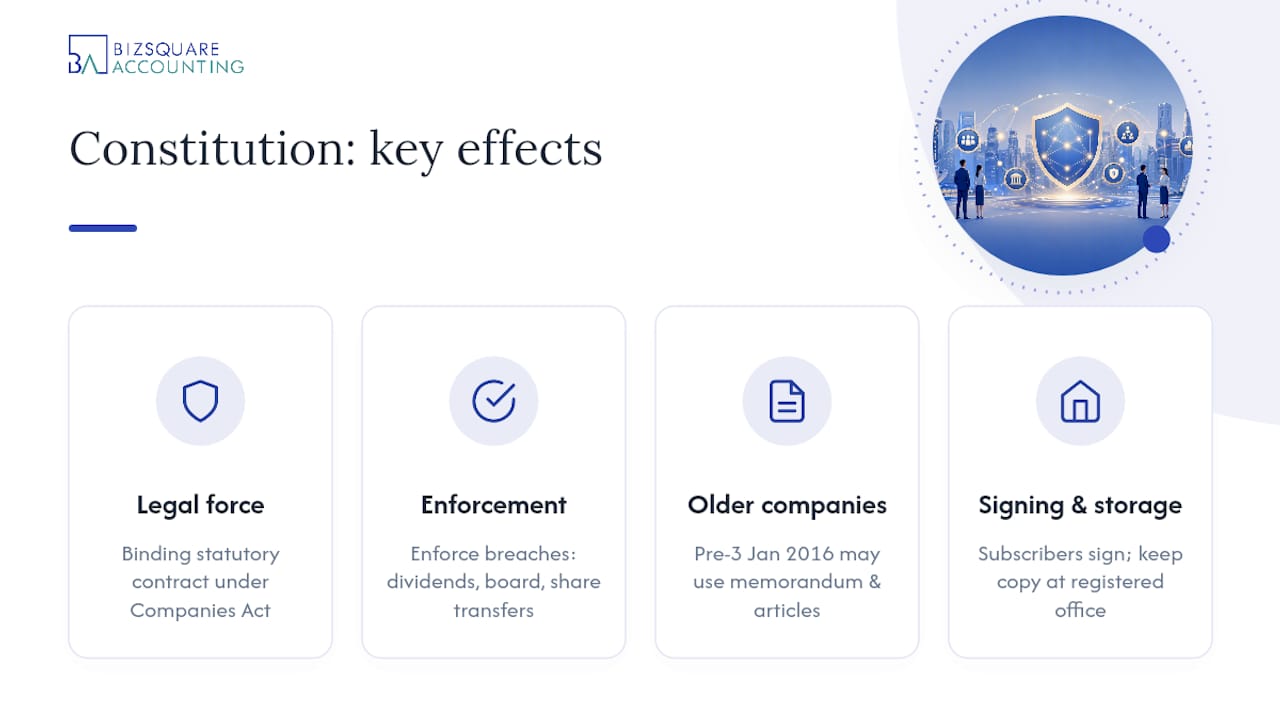
A company constitution has direct legal force under the Companies Act. It is not a formality you file and forget. Once registered, it operates as a binding statutory contract between the company and each of its members, and between the members themselves, according to how SingaporeLegalAdvice explains section 22 of the Companies Act.
That contractual effect matters more than most first time founders realise. If a shareholder breaches a rule set out in the constitution, other shareholders or the company itself can enforce it. Disputes over dividend policy, board appointments, or share transfers often come down to what the constitution actually says, not what anyone assumed at the time.
Older companies may still be working from a memorandum and articles of association, the two-document structure that predated the current system. Companies incorporated before 3 January 2016 were allowed to keep operating under their existing memorandum and articles, treating them as their constitution under transitional rules set out in the Companies Act on Singapore Statutes Online. Any company incorporated from that date onward must use a single consolidated constitution document. If your company predates 2016 and has never updated its founding documents, it is worth checking whether an update would simplify future amendments.
Signing requirements are straightforward but easy to overlook. Every subscriber, meaning the founding shareholders named in the incorporation application, must sign a copy of the constitution. That signed copy then needs to be kept at the company’s registered office, according to ACRA’s guidance on preparing or adopting a company constitution. Auditors and potential investors will ask for it during due diligence, so losing track of that signed copy creates avoidable headaches later.
What must a company constitution include under the Companies Act?
Section 22 of the Companies Act sets a firm baseline for what must appear in every company constitution, regardless of size or industry. Skipping any of these items risks a rejected filing or a defective constitution that fails to protect your interests later.
| Mandatory item | Why it matters |
|---|---|
| Company name | Must match exactly what is reserved and approved through Bizfile. |
| Registered office address | Establishes where statutory records and the signed constitution are kept. |
| Liability statement | Confirms whether members’ liability is limited by shares, by guarantee, or unlimited. |
| Share capital details | Sets out the number and class of shares for companies limited by shares. |
| Objects clause (if included) | Defines the scope of business activities, though most modern constitutions state unrestricted objects. |
Beyond the table, a few practical notes are worth flagging:
- Company type changes what applies. A company limited by shares must detail share capital and share classes, while a company limited by guarantee (common for non-profits and clubs) instead states the guaranteed contribution each member commits to on winding up.
- Unlimited companies face fewer mandatory clauses around liability but still need the core structural items.
- The liability statement is not optional. Even a single sentence stating “the liability of members is limited” satisfies the requirement, but omitting it entirely is a common drafting error according to SingaporeLegalAdvice.
Getting these mandatory items right the first time saves you from a resubmission cycle with ACRA, which can add days to your incorporation timeline.
Should you use the Model Constitution or draft a custom one?
For most private companies limited by shares, the Model Constitution is genuinely sufficient, as explained in this overview of companieshouse.sg alternatives. That is the direct answer, and it surprises many first-time founders who assume every company needs a bespoke legal document from day one.
The Model Constitution is prescribed under the Companies (Model Constitutions) Regulations 2015, which came into operation on 3 January 2016. It sets out standard governance provisions covering directors’ powers, share transfers, and meeting procedures, drafted to work for typical private companies without further customisation.
When you adopt the Model Constitution through Bizfile, you choose between two adoption methods. The first, “in force from time to time,” means your company automatically follows the Model Constitution as ACRA updates it in future. The second, “in force at a point in time,” fixes the version current at your incorporation date, so later regulatory amendments do not apply automatically. Each method suits different risk appetites, and ACRA’s guidance explains both options during the Bizfile filing step.
So when does a custom constitution make more sense? Here is how the two options compare:
| Consideration | Model Constitution | Custom constitution |
|---|---|---|
| Setup speed | Immediate, no drafting needed | Requires drafting time before filing |
| Cost | No drafting fees | Legal or advisory fees typically apply |
| Flexibility | Standard provisions only | Tailored clauses for specific needs |
| Best suited for | Straightforward private companies, sole founders, simple shareholder groups | Companies with multiple investors, complex share structures, joint ventures |
| Amendment ease | Simple, follows standard process | Same process, but bespoke clauses may need specialist review |
Founders with multiple co-founders, external investors, or plans to raise venture capital often need bespoke clauses. Common examples include drag-along and tag-along rights, weighted voting for certain shareholder classes, or restrictions on share transfers to competitors. If your company fits any of those categories, a custom constitution is worth the additional drafting cost from the outset.
How do you adopt or submit a constitution when incorporating?
Filing your constitution correctly during incorporation follows a set sequence through Bizfile. Missing a step here is one of the more common causes of delayed registration.
- Reserve your company name first. This must be approved before you can proceed to the full incorporation application on Bizfile.
- Decide between Model Constitution and custom document. Make this decision before you reach the constitution section of the application, since switching later means restarting parts of the form.
- Select your adoption method if using the Model Constitution. Choose “in force from time to time” or “in force at a point in time” as explained earlier.
- Upload your custom constitution as a PDF if drafting your own. ACRA also provides a downloadable Model Constitution template you can adapt as a starting point.
- Ensure every subscriber signs the physical or digital copy. All founding shareholders named in the application must sign before or shortly after incorporation.
- Store the signed copy at your registered office. This is a legal requirement, not just good practice, and it gets checked during audits or investor due diligence.
- File amendments through Bizfile when governance needs change. Most amendments require a special resolution passed by shareholders, and SingaporeLegalAdvice notes that specified notice periods apply before the resolution meeting, followed by a filing deadline with ACRA once the resolution passes.
A company secretary typically manages the amendment filing process, since missing the ACRA filing deadline after a special resolution can create compliance gaps. If you already have one, this workflow becomes far less stressful. Corporate secretarial services exist specifically to keep this timeline on track for growing companies.
Which clauses matter most for governance and disputes?
Certain clauses drive far more disputes than others, and getting the wording right at drafting stage prevents expensive disagreements down the line.
Share transfer and pre-emption rights
This clause governs what happens when a shareholder wants to sell their stake. A pre-emption right forces the selling shareholder to offer shares to existing members first, at a price set by an agreed formula, before selling to an outsider. Founders often word this loosely, leaving out a clear timeline for other shareholders to respond. A stronger approach specifies an exact number of days, commonly 30, within which existing shareholders must exercise or waive their right.

Directors’ powers and quorum rules
The constitution should state clearly what decisions directors can make alone and which require full board or shareholder approval. Quorum rules, meaning the minimum number of directors or shareholders needed to hold a valid meeting, are frequently left too low. A two-person board with a quorum of one director defeats the purpose of having a board at all.
Dispute resolution and deadlock mechanisms
Joint ventures and companies with two equal shareholders benefit enormously from a deadlock clause. This sets out what happens if the two sides cannot agree on a major decision, commonly a mediation step followed by a buyout mechanism or, in rarer cases, a forced sale of the entire company. Without this clause, a genuine deadlock can freeze the company indefinitely.
Confidential information clauses
These restrict what departing directors or shareholders can disclose about the company’s operations, clients, or financial position after they leave. Wording this too broadly can make the clause unenforceable, while wording it too narrowly leaves genuine trade secrets exposed.
Pro Tip: Vague quorum or deadlock wording is one of the most common causes of boardroom disputes years after incorporation. Ask your adviser to run through a worst case scenario for each clause before you finalise the document, not just the best case.
What mistakes should you avoid before filing?
A handful of recurring errors cause rejected filings or, worse, constitutions that fail to protect shareholders when a dispute eventually arises.
- Uploading a constitution with the wrong company name or an outdated registered office address.
- Forgetting to include the liability statement required under section 22 of the Companies Act.
- Choosing “in force from time to time” for the Model Constitution without understanding that future regulatory changes will apply automatically.
- Leaving quorum requirements unrealistically low for boards with more than two directors.
- Failing to have every subscriber sign the constitution before storing it.
- Losing track of the signed copy, so it cannot be produced during an audit or investor review.
- Missing the ACRA filing deadline after passing a special resolution to amend the constitution.
Before you file, run through this short checklist. Confirm the company name and address match your Bizfile application exactly. Confirm every mandatory item under section 22 is present. Confirm the adoption method for the Model Constitution matches your intention. Confirm all subscribers have signed, and confirm the signed copy has a clear home at your registered office.
If any of these feel uncertain, ACRA’s own forms and templates page is the fastest place to check the current Model Constitution wording against your draft.
Why a clear constitution matters as your company grows
A well-drafted constitution does more than satisfy ACRA at incorporation. It becomes the reference document investors examine during fundraising rounds, and the document lawyers consult during an exit or acquisition. Vague or outdated clauses discovered during due diligence can slow a deal or force last-minute amendments under time pressure.
Corporate governance in Singapore increasingly rewards companies that treat their constitution as a living document rather than a one-time filing task. Reviewing it whenever your shareholder base changes, or before a funding round, tends to catch problems while they are still cheap to fix. Bizsquare works with founders at exactly these turning points, helping translate governance decisions into properly drafted constitutional clauses that stand up to later scrutiny.
How Bizsquare helps with your constitution and incorporation
Drafting a constitution that genuinely fits your business, rather than defaulting to a template out of convenience, takes a mix of legal familiarity and practical judgement. Bizsquare’s incorporation team handles this from the first conversation through to filing.

The process runs in a few clear stages. First, Bizsquare reviews your shareholder structure and business plans to determine whether the Model Constitution suits your company or whether bespoke clauses are worth the investment. Second, if a custom document is needed, Bizsquare drafts the clauses covering share transfers, director powers, and dispute mechanisms in plain language you can actually review. Third, the team manages the entire Bizfile submission, including signature collection and storage of your signed copy.
Beyond the initial filing, Bizsquare’s corporate secretary services keep your statutory records current and handle special resolution filings whenever your constitution needs amending. That includes tracking notice periods and ACRA deadlines, so nothing slips through during a busy growth phase.
If you are still deciding between the Model Constitution and a custom document, or you simply want someone to handle the Bizfile filing correctly the first time, get in touch through Bizsquare’s company incorporation service to start the conversation.
Sources
- Step 4.5: Preparing or adopting a company constitution | ACRA
- The constitution of a company – SingaporeLegalAdvice
- Registering a local company in Singapore: Forms & templates | ACRA
Keep copies of all signed documents at your registered office, since these are the versions ACRA and auditors will expect to see during any future review.
FAQ
1.) How do you buy a company constitution from ACRA?
ACRA does not sell a constitution. You either adopt the free Model Constitution through Bizfile or draft and upload a custom constitution during incorporation.
2.) How do you draft a constitution for a company?
Start from the Model Constitution template and add bespoke clauses for share transfers, director powers, or dispute resolution as needed, then have a corporate secretary or adviser review the final draft.
3.) What is the role of a company constitution?
It sets the binding rules for how a company is governed, covering shareholder rights, director powers, and share transfer procedures under the Companies Act.
4.) Is a company’s constitution a contract?
Yes, it operates as a statutory contract between the company and its members, and between members themselves, once registered with ACRA.
5.) Do I need a custom constitution if I am a sole founder?
Usually not. The Model Constitution is generally sufficient for straightforward single founder companies without complex shareholder arrangements.
6.) What happens if I do not submit a constitution at all?
You cannot complete incorporation without either adopting the Model Constitution or uploading a custom one, since Bizfile requires this step to issue your company registration.
7.) Can I change my constitution after incorporation?
Yes, most amendments require a special resolution passed by shareholders, followed by a filing with ACRA within the specified deadline.
8.) What is the difference between the two Model Constitution adoption methods?
“In force from time to time” follows future regulatory updates automatically, while “in force at a point in time” fixes the version current at your incorporation date.
9.) Where do I store the signed constitution?
At your company’s registered office, since ACRA and auditors will expect to inspect the signed copy there.
10.) Does every shareholder need to sign the constitution?
Yes, all subscribers named in the incorporation application must sign the constitution at or shortly after incorporation.
11.) What are the mandatory contents of a Singapore company constitution?
Company name, registered office address, liability statement, and share capital details are mandatory under section 22 of the Companies Act.
12.) Can Bizsquare help draft a custom constitution?
Yes, Bizsquare drafts bespoke clauses and manages the full Bizfile filing process alongside its corporate secretary services.
13.) What is a deadlock clause and do I need one?
A deadlock clause sets out how disputes between equal shareholders get resolved, and it is particularly useful for joint ventures or two-founder companies.


1 Comment
5 Steps to Align Shareholders' Agreement and Constitution in Singapore
October 09, 2026, at 8:32 am[…] company constitution guide walks through the filing choices available at incorporation, including whether the constitution […]