

A company constitution is the mandatory public rulebook that binds a Singapore company and every member under the Companies Act. A shareholders agreement is a private, voluntary contract that binds only the parties who sign it. Getting the two documents to work together, rather than against each other, is what keeps a company’s governance enforceable.
TL;DR:
- The ACRA model constitution usually omits investor director nomination rights, founder vetoes over major asset sales, and share issuance controls that prevent dilution without consent.
- Shareholders agreements can set transfer rights, deadlock procedures, and founder leaver terms, but Singapore courts enforce noncompetes only when scope, duration, and geography are reasonable.
- Put director appointment rights and voting thresholds in the constitution when they must bind future shareholders; keep confidential valuation formulas and exit prices in the private agreement.
- Changing the constitution generally requires a 75% special resolution and ACRA filing; private agreements set their own amendment thresholds, often requiring unanimous consent.
- A member may seek court relief under Section 216 if company affairs unfairly disregard their interests, and remedies can include a forced buyout.
Table of Contents
- Key facts at a glance: statutory anchors and quick practical consequences
- Why the model constitution is often not enough for founders and investors
- Common shareholders’ agreement clauses explained
- How the constitution and shareholders agreement interact, and which terms must be in the constitution
- Amendment mechanics and enforceability, including section 216 oppression risk
- Practical drafting checklist: how to draft both documents together
- Author’s perspective: priorities for founders in Singapore
- How Bizsquare supports constitution and shareholders agreement alignment
- FAQ
- Sources
Key facts at a glance: statutory anchors and quick practical consequences
Every Singapore company needs a constitution. Section 17 of the Companies Act defines it, and it must be filed with the Accounting and Corporate Regulatory Authority (ACRA) at incorporation. Section 39 then gives it legal teeth: once registered, the constitution binds the company and every member as if each had personally signed it.
A shareholders agreement sits outside this public framework entirely. It is private, confidential, and never lodged with ACRA. Founders often use it to record commercial terms that the constitution simply was not built to hold.
- A constitution typically covers share structure, director powers, and meeting procedures.
- A shareholders agreement usually covers exit terms, funding rounds, and founder obligations.
- The constitution is public record. The shareholders agreement stays private between signatories.
- Both documents can exist together, but only one binds non-signatories by statute.
Section 39 of the Companies Act makes the registered constitution binding on the company and its members by operation of law. That statutory force is the key difference between the two documents, and it shapes everything else in this guide.
Why the model constitution is often not enough for founders and investors
ACRA’s Model Constitution is a sound starting point, but it is generic by design. It was written to suit thousands of companies at once, not the specific deal a founder struck with an investor last month.

Many founders adopt the model constitution during Bizfile registration and assume it covers everything. It usually does not. Reserved matters, investor veto rights, and bespoke exit terms rarely appear in the standard template, and the omission creates real friction later.
Consider three common gaps:
- Investors often expect a formal nomination right to appoint a director, a term the model constitution does not include.
- Founders frequently need veto protection over major asset disposals, which the generic template leaves silent.
- Share issuance controls that prevent dilution without consent are a frequent point of dispute when left unaddressed.
These gaps tend to surface only once a disagreement has already started. A founder who assumed a verbal understanding was enough may discover there is no governance mechanism to enforce it. The result is often a stalled exit, a frustrated investor, or months of uncertainty over who actually controls a decision.
Pro Tip: Read the model constitution clause by clause before incorporation and mark every gap your investors or co-founders will care about.
Our company constitution guide walks through the filing choices available at incorporation, including whether the constitution updates automatically with future amendments to the model text.
Common shareholders’ agreement clauses explained
A shareholders agreement earns its value through the clauses the constitution leaves out. These are the ones founders negotiate most often in Singapore.
- Reserved matters and vetoes. Decisions such as raising new capital, changing the business’s core activity, or taking on significant debt often require unanimous or supermajority shareholder consent.
- Share transfer controls. Pre-emption rights give existing shareholders first refusal before shares go to an outsider. Drag-along clauses let a majority force a sale on minority holders, while tag-along clauses let minority holders join that sale on the same terms.
- Deadlock resolution. When shareholders split evenly on a key vote, a simple framework such as a casting vote, a cooling-off period, or a buy-sell mechanism prevents the company from stalling indefinitely.
- Leaver provisions and vesting. These set out what happens to a founder’s shares if they leave early, often distinguishing between a “good leaver” and a “bad leaver” with different payout terms.
- Non-compete clauses. Singapore courts will enforce a non-compete only if it is reasonable in scope, duration, and geography, so vague or sweeping restrictions tend to fail.
Each of these terms binds only the people who sign the agreement. That is both the strength and the limit of a shareholders agreement, and it is the reason the next section matters so much.
How the constitution and shareholders agreement interact, and which terms must be in the constitution
The two documents are meant to complement each other, not compete. Under Section 39, the constitution binds the company itself, its directors, and every member automatically, including anyone who buys shares in future. A shareholders agreement binds only its original signatories, so a new investor joining later is not automatically bound by its terms unless they separately agree to it.
- Governance mechanics that must apply to every future shareholder, such as voting thresholds or director appointment rights, belong in the board ready ESG committee charter in the constitution.
- Commercial terms meant to stay confidential, such as valuation formulas or specific exit pricing, belong in the shareholders agreement.
- A term written only into the shareholders agreement creates contractual rights between its parties but has no corporate effect on the company structure itself.
- Practitioners commonly advise mirroring key governance protections in both documents to close the enforcement gap between them, as MLC Law notes.
A simple rule of thumb helps here: if a protection needs to bind someone who has not yet signed anything, such as a future shareholder, it needs to sit in the constitution.
Amendment mechanics and enforceability, including section 216 oppression risk
Changing a constitution is not a quiet process. It requires a special resolution, which generally means a 75% majority vote, and the amendment must then be filed with ACRA to take legal effect.
A shareholders agreement works differently. Most agreements set their own amendment threshold, often requiring unanimous consent or agreement from parties holding a specified percentage of shares, rather than following the statutory 75% rule.
- Constitutional amendments need a special resolution passed at a general meeting, then filing with ACRA.
- Some constitutions include entrenched provisions, requiring an even higher threshold than 75% for specific clauses.
- Shareholders agreements typically set their own consent threshold, agreed privately between the parties.
- Minority shareholders sometimes prefer rights placed in the shareholders agreement precisely because changing the constitution needs a special resolution.
Section 216 of the Companies Act allows a member to apply to court where a company’s affairs are conducted oppressively or unfairly disregard their interests. The court can order remedies including a forced buy-out, which makes oppression risk a real early-warning sign founders should watch for, particularly where a majority shareholder repeatedly bypasses minority consent rights.
Practical drafting checklist: how to draft both documents together
Founders get the best results when they treat the constitution and shareholders agreement as one connected project, not two separate chores.
- Draft both documents side by side. Cross-reference key clauses so the shareholders agreement points to the relevant constitution article, and vice versa.
- Decide what must bind everyone. List governance mechanics that need statutory force, such as director appointment rights, and place those in the constitution.
- Set clear amendment and dispute paths. Specify the exact consent threshold for changing each document and name a deadlock resolution process before a dispute arises.
- Store the documents correctly. Keep signed copies of the constitution at the registered office as required, and keep the shareholders agreement confidential among its signatories.
- Bring in professional support early. A corporate secretary can manage the ACRA filing and Bizfile submission, while a lawyer should review any clause meant to override statutory default rules, as Allen & Gledhill advises on enforceability limits.
Pro Tip: Ask your corporate secretary to flag any shareholders agreement clause that tries to change a statutory default, such as voting thresholds, before you sign.
Our corporate secretarial services handle the filing, minute keeping, and document storage that this checklist calls for, so nothing slips through during a busy incorporation.
Author’s perspective: priorities for founders in Singapore
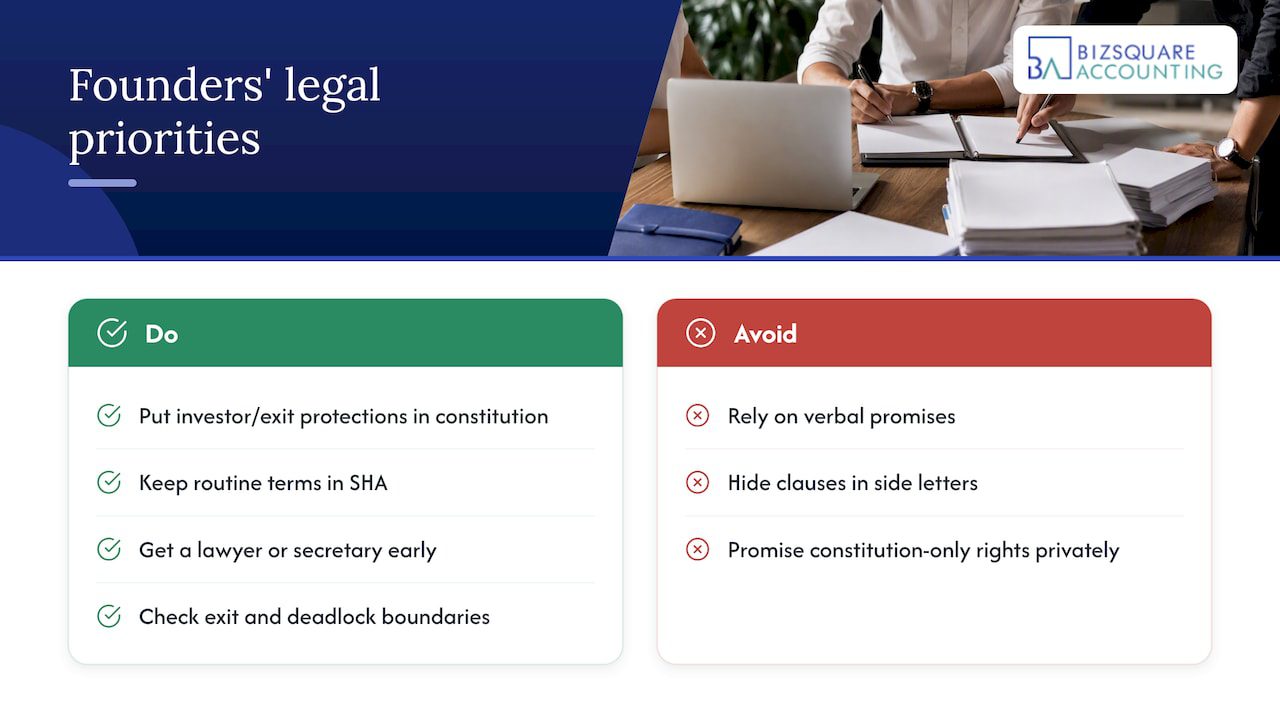
The founders who run into trouble are rarely the ones who skipped legal advice. They are the ones who assumed a verbal promise, or a clause buried in a side letter, would hold up against a determined co-founder or investor. Clarity beats cleverness every time a dispute actually lands in front of a court.
Our strongest recommendation is simple: never let a private agreement promise something only the constitution can deliver. If a protection needs to survive a shareholder exit or bind a future investor, write it into the constitution and file it. Everything else can stay in the shareholders agreement, but get a lawyer or corporate secretary to check the boundary early, particularly around exit and deadlock terms, where the cost of getting it wrong is highest.
— Vandro
How Bizsquare supports constitution and shareholders agreement alignment
Professional consultants can help Singapore founders turn this checklist into a finished set of documents, without the back-and-forth of managing ACRA filings alone.

Our company incorporation service prepares and files the constitution correctly from day one, including the choice between the model text and a customised version. Once a company is running, our corporate secretarial services keep statutory records current, manage annual filings, and store signed copies as required by law.
- A constitution can be prepared and filed tailored to governance needs, not just the generic model.
- Advice is given on which protections belong in the constitution versus a private shareholders agreement.
- Ongoing compliance maintenance ensures amendments are filed correctly when the company grows.
Get in touch through our company incorporation page to start the process, or reach out via our main site if you are not sure which service fits first.
This article is general information, not a substitute for advice from a qualified lawyer. Consult a qualified legal professional about your own circumstances before acting on anything here.
FAQ
What is a company constitution in Singapore?
A company constitution is a mandatory document, defined under Section 17 of the Companies Act, that sets out a company’s internal governance rules. It must be filed with ACRA at incorporation and binds the company and every member by statute.
What is a shareholders agreement?
A shareholders agreement is a private, voluntary contract between shareholders that records commercial arrangements not covered by the constitution. It is confidential and never filed with ACRA, and it binds only the people who sign it.
What is the main difference between a constitution and a shareholders agreement?
The constitution binds the company and all members automatically under Section 39, including future shareholders. A shareholders agreement binds only its original signatories and has no automatic effect on anyone who joins later.
How do I draft a constitution for a company in Singapore?
You can adopt the ACRA model constitution during Bizfile registration, or upload a customised version if your governance needs are more specific. Many founders start with the model and then amend it once investor or founder terms are finalised.
Is it better to be a shareholder or a director in a Singapore company?
The two roles carry different rights and risks, so the answer depends on your goals rather than one being universally better. Shareholders hold ownership and voting rights, while directors carry management duties and personal legal responsibilities under the Companies Act.
What is the difference between a constitution and a shareholders agreement for new investors?
A new investor is automatically bound by the constitution once they hold shares, because Section 39 applies to all members. They are not bound by an existing shareholders agreement unless they separately agree to join it.
Can a shareholders agreement override the company constitution?
No. Courts will not allow a private contractual term to override a mandatory statutory provision, as Allen & Gledhill notes. Any term meant to have corporate effect must be properly written into the constitution and filed where required.
How do I amend a company constitution in Singapore?
Amending a constitution requires a special resolution, generally a 75% majority vote, followed by filing with ACRA. Some constitutions set an even higher threshold for specific entrenched clauses.
What happens if a company’s affairs are run unfairly against a shareholder?
A shareholder can apply to court under Section 216 of the Companies Act if the company’s affairs are conducted oppressively or unfairly against their interests. The court can order remedies, including a forced buy-out of their shares.
Do I need both a constitution and a shareholders agreement?
Most founders with co-founders or outside investors benefit from both, since each document covers different ground. The constitution handles mandatory governance, while the shareholders agreement captures private commercial terms the model constitution does not address.
What clauses are commonly included in a shareholders agreement but not the constitution?
Reserved matters, drag-along and tag-along rights, deadlock resolution, and leaver provisions are typically found in a shareholders agreement rather than the standard model constitution. These clauses tend to involve sensitive commercial terms that founders prefer to keep confidential.
Does a shareholders agreement need to be filed with ACRA?
No, a shareholders agreement is private and is never filed with ACRA. Only the company constitution and its amendments need to be lodged with the regulator.
What is the memorandum of incorporation in relation to a shareholders agreement?
Singapore companies no longer use a separate memorandum, since the constitution now combines what used to be the memorandum and articles of association. A shareholders agreement remains a separate, private document that supplements the constitution rather than replacing it.
Sources
- Companies Act 1967 – Singapore Statutes Online
- Preparing or adopting a company constitution — ACRA
- Shareholders agreement commentary — MLC Law