


Indonesia Business Registration: 2026 Guide for Singapore Entrepreneurs
Overview
Indonesia business registration involves a two-step process: establishing a legal entity with the Ministry of Law and Human Rights, then obtaining operating licenses through the OSS-RBA platform. Correct KBLI classification determines the licensing complexity, and timely document preparation is essential for a smooth start. Foreign entrepreneurs should plan for notarized Power of Attorney and accurate translations to avoid delays.
Indonesia business registration is defined as a two-stage process: incorporating a legal entity through the Ministry of Law and Human Rights, then obtaining operating licenses through the government’s OSS-RBA platform. For Singapore entrepreneurs expanding into Southeast Asia’s largest economy, understanding this split is the foundation of a compliant market entry. The most common vehicle for foreign investors is the PT PMA (Penanaman Modal Asing), Indonesia’s designated foreign-invested company structure. Three terms govern the entire process: OSS-RBA (Online Single Submission Risk-Based Approach), KBLI (the national business classification code), and NIB (Business Identification Number). Getting all three right, in the correct sequence, determines how fast your business can legally operate.
What is the company registration process for a PT PMA in Indonesia?
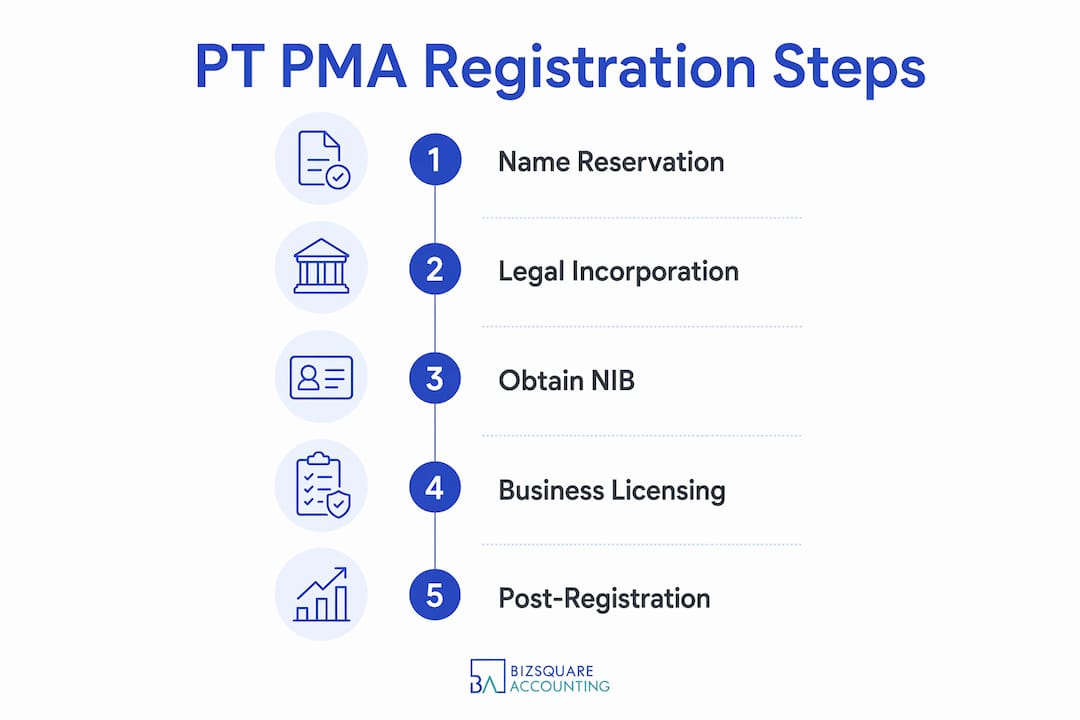
PT PMA incorporation follows a structured sequence that begins with a name reservation and ends with a government-issued legal entity decree. Each step feeds directly into the next, so a mistake at any stage delays the entire timeline.
Step-by-step: from name reservation to legal entity status
- Reserve the company name on AHU Online. The AHU Online portal, managed by the Ministry of Law and Human Rights (Kemenkumham), is where all Indonesian company names are checked for availability and reserved. The name must comply with Indonesian naming rules and cannot duplicate an existing registered entity.
- Engage a licensed notary to draft the Deed of Establishment. The Deed of Establishment must be written in Bahasa Indonesia. This document contains the company’s Articles of Association, shareholder details, director and commissioner appointments, and the authorized share capital structure.
- Notarize and submit electronically to Kemenkumham. The notary authenticates the deed and submits it electronically through AHU Online. This digital submission is mandatory. Physical delivery alone does not satisfy the legal requirement.
- Receive the SK Kemenkumham. The Ministry issues a legal entity decree called the SK Kemenkumham. This document confirms the PT PMA has official legal entity status. Without it, the company cannot proceed to the OSS-RBA licensing stage.
Statutory requirements for a PT PMA
A PT PMA requires a minimum of two shareholders, at least one director, and at least one commissioner. The company must also have a valid local registered address in Indonesia. This address appears on all official filings and must be a physical, verifiable location, not a virtual office in most regulated sectors.
Foreign founders who cannot travel to Indonesia to sign documents have a practical solution. A notarized Power of Attorney allows an authorized representative to sign the Deed of Establishment and handle related filings on the founder’s behalf. The Power of Attorney itself must be apostilled and notarized in the founder’s home country before it is accepted in Indonesia.
Pro Tip: Prepare all shareholder and director identity documents in advance, including certified translations into Bahasa Indonesia. Document language consistency is one of the most significant factors affecting approval speed, and incomplete translations are among the most common causes of early-stage delays.
How does Indonesia’s OSS-RBA licensing system work for business operations?
Company registration and business licensing are two distinct processes in Indonesia. Incorporation through Kemenkumham grants legal entity status. The OSS-RBA system at oss.go.id grants permission to actually conduct business activities. A company that completes incorporation but skips OSS-RBA licensing cannot legally operate.

How KBLI codes determine your license type
The KBLI is Indonesia’s standard business classification system. Every business activity a company intends to conduct maps to a specific KBLI code. The OSS-RBA platform reads those codes and assigns a risk level to each activity. That risk level then determines what licensing instruments the government issues alongside the NIB.
The three outcomes under the OSS-RBA risk framework are:
- Low-risk activities: The company receives only the NIB. No additional permits are required before operations begin.
- Medium-risk activities: The company receives the NIB plus a standard certificate. Operations may begin, but the company must meet ongoing compliance conditions.
- High-risk activities: The company receives the NIB but must obtain a full operating permit before any business activities can legally commence.
What the NIB actually covers
The NIB is a 13-digit number issued through oss.go.id. It serves as the company’s primary operational identity across multiple government systems, covering licensing, tax registration, customs access, and social security enrollment. The NIB replaced multiple older permits that previously required separate applications. This consolidation is one of the genuine efficiency gains the OSS-RBA system introduced.
KBLI accuracy is the single biggest factor influencing whether licensing is fast and straightforward or requires additional certifications and permits. Selecting the wrong KBLI code can push a low-risk activity into a medium or high-risk classification, triggering additional compliance requirements that add weeks to the timeline.
For medium-high and high-risk businesses, sector-specific approvals such as environment permits, building approvals, and land use compliance documents must be submitted alongside the OSS-RBA application, not after it. Submitting these documents late delays license issuance and delays the legal start of operations.
OSS-RBA also integrates periodic investment activity reporting through the LKPM (Investment Activity Report). Timely LKPM submissions are mandatory under 2026 regulations. Missing reports can result in license suspension or revocation.
What are the pre- and post-registration requirements for smooth Indonesia company formation?
Preparation before filing significantly reduces the risk of rejection or delay. The typical incorporation sequence runs from name reservation through notarial deed preparation, local address registration, tax enrollment, and then NIB application via OSS. Each step depends on the one before it.
Pre-registration vs. post-registration requirements
| Stage | Requirement | Purpose |
|---|---|---|
| Pre-registration | Valid local registered address in Indonesia | Required for all official filings and government correspondence |
| Pre-registration | Shareholder and director identity documents | Needed for notarial deed and AHU Online submission |
| Pre-registration | Draft Articles of Association | Defines company structure, share capital, and governance |
| Post-registration | NPWP (Taxpayer Identification Number) | Mandatory for tax compliance and banking |
| Post-registration | Social security registration (BPJS) | Required for companies with employees |
| Post-registration | VAT registration (PKP) | Required if annual turnover meets the threshold |
| Post-registration | KKPR and IMB documents | Land use and building compliance for certain sectors |
How notary filings affect government records
Notary online filings determine when entity changes propagate across Indonesian government databases. Delays in notary filings for shareholding or director changes cause data mismatches across government systems, which then affects licensing approvals and banking relationships. A clear filing sequence, planned with the notary before any changes are made, reduces these risks significantly.
The NPWP, Indonesia’s Taxpayer Identification Number, must be obtained from the local tax office after incorporation. Tax registration is a prerequisite for opening a corporate bank account and for completing the OSS-RBA application. Companies in certain sectors must also register for VAT (known locally as PKP status) once they meet the revenue threshold.
Pro Tip: Coordinate your notary, tax registration, and OSS-RBA applications as a single project timeline, not as separate tasks. Treating them as sequential and independent tasks is the most common reason Singapore entrepreneurs experience multi-week delays during the setup phase.
What are the common challenges for Singapore entrepreneurs registering a business in Indonesia?
Setting up a business in Indonesia as a foreign investor involves navigating a regulatory environment that differs substantially from Singapore’s ACRA-based system. The challenges are manageable, but they require preparation and local expertise.
The most frequent issues Singapore entrepreneurs encounter include:
- Incorrect KBLI code selection. Choosing the wrong code is the most common and most costly mistake. It can reclassify a business activity into a higher-risk category, triggering additional permit requirements and delaying operations.
- Document translation lapses. All incorporation documents must be in Bahasa Indonesia. Incomplete or uncertified translations are rejected at the notarial stage, restarting the process.
- Delayed notary filings. When directors or shareholders change after incorporation, data mismatches across government systems occur if the notary does not file updates promptly. These mismatches block licensing renewals and banking transactions.
- Failure to prepare sector-specific permits in parallel. Medium-high and high-risk businesses must submit environment permits, building approvals, and land use documents alongside the OSS-RBA application. Preparing these after the fact causes significant delays.
- Underestimating the Power of Attorney process. Foreign investors who cannot sign documents in Indonesia must arrange an apostilled and notarized Power of Attorney in Singapore before the notary can proceed. This step takes time and must be factored into the project timeline.
Practical tips for a faster, cleaner registration
Research your KBLI codes before engaging a notary. Cross-reference your intended business activities against the official KBLI list and confirm the risk classification with a local advisor. Use the OSS-RBA digital platform at oss.go.id to check classifications before filing. Engage a licensed Indonesian notary with PT PMA experience, not a general practice firm. Verify that your registered address meets the requirements for your specific sector, as virtual offices are not accepted in all industries. For Singapore entrepreneurs who want a comparison of PT PMA vs. local PT structures, reviewing the differences before committing to a structure saves time and restructuring costs later.
Key takeaways
Indonesia business registration requires completing two separate legal processes: company incorporation through the Ministry of Law and business licensing through OSS-RBA, with KBLI code accuracy determining the speed and complexity of the entire licensing stage.
| Point | Details |
|---|---|
| Two-stage process | Incorporation via AHU Online and licensing via OSS-RBA are separate and both mandatory. |
| KBLI code accuracy | Correct KBLI classification determines whether you need only an NIB or full operating permits. |
| Power of Attorney | Singapore founders who cannot sign in Indonesia must arrange an apostilled Power of Attorney in advance. |
| Post-registration compliance | NPWP, BPJS, and LKPM reporting are mandatory after incorporation and affect licensing continuity. |
| Notary filing sequence | Delays in notary updates cause data mismatches across government systems, blocking banking and licensing. |
Indonesia registration from a Singapore perspective: what the process actually demands
The most important thing Singapore entrepreneurs get wrong about Indonesia business registration is treating it as a single process. It is not. Incorporation and licensing are two separate legal milestones, governed by different agencies, different platforms, and different timelines. Conflating them is the root cause of most delays I see when advising on cross-border expansion.
The OSS-RBA and AHU Online platforms have genuinely improved the process. Both are digital, both are accessible remotely, and both have reduced the paper-based bottlenecks that plagued Indonesia’s registration system a decade ago. That said, digital access does not mean simple. The KBLI classification system alone requires careful research. A single misclassified code can push a straightforward business into a permit-heavy category that adds months to the timeline.
My strongest recommendation for Singapore entrepreneurs is to invest in KBLI research before anything else. Confirm your business activities, map them to the correct codes, and verify the risk classification with a qualified Indonesian advisor. Do this before engaging a notary, before reserving a company name, and before signing any documents. The 2026 regulatory environment under PP 28/2025 and Peraturan BKPM 5/2025 has tightened compliance monitoring and increased sanctions for missed LKPM reports. The system rewards preparation and penalizes shortcuts.
Finally, plan your Power of Attorney early. If you cannot travel to Indonesia to sign the Deed of Establishment, the apostilled POA process in Singapore takes time. Build it into your project plan from day one, not as an afterthought.
How Bizsquare helps Singapore businesses register in Indonesia
Singapore entrepreneurs expanding into Indonesia face a registration process that spans two government platforms, multiple document requirements, and strict language compliance rules. Bizsquare provides end-to-end support for Indonesia business registration, covering PT PMA incorporation, notarial coordination, certified document translation, and OSS-RBA licensing applications.

Bizsquare’s consultants manage the full filing sequence, from AHU Online name reservation through NPWP registration and NIB issuance, so Singapore entrepreneurs avoid the data mismatches and compliance gaps that delay operations. For businesses that need broader regional support, Bizsquare also offers company incorporation services to help structure your Singapore entity before expanding into Indonesia. Reach out to Bizsquare to discuss your Indonesia expansion plan and get a clear timeline for your registration.
FAQ
1.) What is a PT PMA in Indonesia?
A PT PMA (Penanaman Modal Asing) is Indonesia’s designated company structure for foreign investment. It requires at least two shareholders, one director, and one commissioner, and must be incorporated through a licensed notary and registered with the Ministry of Law and Human Rights.
2.) What is the NIB and why does every business need it?
The NIB is a 13-digit Business Identification Number issued through oss.go.id. It serves as the company’s primary identity for licensing, tax, customs, and social security, and replaces multiple older permits that previously required separate applications.
3.) How long does Indonesia business registration take?
The timeline varies by business activity and risk classification. Low-risk businesses with correct KBLI codes and complete documents can complete both incorporation and NIB issuance in a few weeks. High-risk businesses requiring full operating permits take longer, particularly if sector-specific approvals are needed.
4.) Can a Singapore entrepreneur register a PT PMA without traveling to Indonesia?
Yes. Foreign founders who cannot sign documents in Indonesia can use an apostilled and notarized Power of Attorney to authorize a local representative to sign the Deed of Establishment and handle related filings on their behalf.
5.) What happens if a company misses its LKPM investment activity report?
Under 2026 regulations, missing LKPM reports can result in license suspension or revocation. OSS-RBA integrates compliance monitoring across agencies, and timely reporting is a mandatory ongoing obligation, not a one-time requirement.
6.) What is the difference between OSS-RBA and AHU Online?
AHU Online is the Ministry of Law and Human Rights portal used for company incorporation and legal entity registration. OSS-RBA is the government’s integrated licensing platform used to obtain operating permits and the NIB after incorporation is complete.
7.) What is a KBLI code and how does it affect my business license?
A KBLI code is Indonesia’s standard business classification code that identifies your specific business activity. The OSS-RBA system reads your KBLI codes to assign a risk level, which then determines whether you receive only an NIB, a standard certificate, or a full operating permit.
8.) Do I need a physical office address to register a PT PMA?
Yes. A valid local registered address in Indonesia is required for all official filings. Virtual offices are not accepted in all sectors, particularly regulated industries, so entrepreneurs should verify address requirements for their specific business activity before committing to a location.
9.) What documents are required to incorporate a PT PMA?
Required documents include shareholder and director identity documents, a draft Articles of Association, proof of a local registered address, and, for foreign founders, an apostilled and notarized Power of Attorney if they cannot sign in person. All documents submitted to the notary must be in Bahasa Indonesia or accompanied by certified translations.
10.) What taxes must a PT PMA register for after incorporation?
A PT PMA must obtain an NPWP (Taxpayer Identification Number) from the local tax office after incorporation. Companies with employees must also register for BPJS social security. Companies that meet the annual revenue threshold must register for VAT (PKP status).
11.) Is KBLI classification something I can determine on my own?
The KBLI list is publicly available, but accurately mapping your business activities to the correct codes requires careful analysis. An incorrect classification can trigger higher-risk permit requirements. Consulting a qualified Indonesian advisor before filing is the most reliable way to get the classification right the first time.