


How to Set Up Business in Vietnam: 2026 Guide
Overview
Vietnam’s 2026 Law on Investment allows foreign investors to register a company first with an ERC, followed later by an IRC. This reform enables earlier incorporation and preparatory activities, but the IRC remains mandatory, requiring timely application after ERC issuance. Proper document legalization, understanding sector licenses, and meeting strict deadlines are crucial for a smooth, compliant setup process.
Setting up a business in Vietnam now follows a two-certificate framework under Vietnam’s Law on Investment No. 143/2025/QH15, effective March 1, 2026, which allows foreign investors to obtain an Enterprise Registration Certificate (ERC) before securing an Investment Registration Certificate (IRC). This ERC-first approach is a significant reform. It lets entrepreneurs incorporate earlier, begin preparatory activities such as leasing office space and hiring staff, and then complete the investment approval process. The formal industry term for this two-stage process is “company formation with deferred investment licensing.” Understanding both certificates, and the sequence between them, is the foundation of any successful Vietnam startup guide.
How do you set up a business in vietnam under the 2026 law?
The core rule under the 2026 regime is straightforward. Foreign investors apply for the ERC first through the National Business Registration Portal, then apply for the IRC at the Department of Planning and Investment (DPI). This sequence replaces the older requirement to obtain investment approval before incorporation. The practical benefit is real: entrepreneurs can establish a legal entity, open bank accounts, and sign preliminary contracts while the investment review is still in progress.

The distinction between the two certificates matters. The ERC is the company’s birth certificate. It records the company name, legal form, charter capital, and registered address. The IRC, by contrast, documents the investment project itself, including the business objectives, investment scale, and implementation schedule. Changes to investment project content require IRC adjustments, while changes to the enterprise itself, such as company name or address, require ERC updates. Some changes require concurrent adjustments to both documents.
Vietnam’s business registration in 2026 is more accessible than it was five years ago. The government’s push toward digital submission and faster processing reflects a deliberate effort to attract foreign capital. Still, the process has multiple stages, and each stage has its own document requirements and deadlines.
What business structures are available for foreign investors?
Foreign investors in Vietnam can choose from four main legal entity types. Each structure carries different implications for liability, ownership, capital requirements, and operational complexity.
| Entity Type | Liability | Foreign Ownership | Formation Complexity | Licensing Needs |
|---|---|---|---|---|
| Single-Member LLC | Limited to charter capital | Up to 100% | Moderate | ERC + IRC required |
| Multi-Member LLC | Limited to capital contribution | Up to 100% | Moderate | ERC + IRC required |
| Joint-Stock Company | Limited to shares held | Up to 100% (sector-dependent) | Higher | ERC + IRC required |
| Representative Office | Parent company liable | N/A (not a legal entity) | Lower | Separate license from Ministry of Industry and Trade |
| Branch Office | Parent company liable | N/A | Moderate | Separate license required |
The Limited Liability Company (LLC) is the most common choice for foreign entrepreneurs entering Vietnam. It offers full foreign ownership in most sectors, capped liability, and a relatively straightforward registration process. A single-member LLC suits solo founders or wholly foreign-owned ventures. A multi-member LLC works well for joint ventures with Vietnamese partners.
The Joint-Stock Company (JSC) is better suited for businesses planning to raise capital from multiple shareholders or eventually list on a stock exchange. JSCs require a minimum of three shareholders and have more complex governance requirements, including a board of directors and supervisory board.
Representative offices and branches do not require ERC or IRC. They operate under separate licensing from the Ministry of Industry and Trade. Representative offices cannot generate revenue directly. Branches can conduct business but carry full parent company liability. Both are useful for market research or limited commercial activity before committing to full incorporation.
What documents are needed for business registration in vietnam?
Document preparation is the most time-consuming part of the entire process. Document legalization is often the most time-consuming step due to investor country bureaucracy. Starting this process at least four to six weeks before your target registration date is strongly advisable.
For individual foreign investors, the standard document checklist includes:
- Notarized and consular-legalized copy of the investor’s passport
- Proof of financial capacity, such as a bank statement showing sufficient funds
- Investment proposal outlining the business objectives, capital amount, and implementation plan
- Draft company charter specifying governance structure and capital contributions
- Office lease agreement or a letter of commitment from the landlord as proof of registered address
- Proposed company name (checked against the National Business Registration Portal for conflicts)
- Vietnam Standard Industrial Classification (VSIC) codes for the intended business activities
For corporate foreign investors (a company investing in Vietnam), additional documents include:
- Certificate of incorporation of the parent company, notarized and consular-legalized
- Charter or articles of association of the parent company
- Audited financial statements or equivalent proof of financial capacity
- Resolution or decision authorizing the investment in Vietnam
- Passport copy of the authorized representative
Pro Tip: Get your documents consular-legalized in your home country before you arrive in Vietnam. Attempting to legalize documents after arrival adds weeks to your timeline and is a common reason for dossier rejection.
The office lease agreement deserves special attention. A compliant office lease or letter of commitment is mandatory early in the process for both investment and company registration dossiers. Without it, neither the ERC nor the IRC application can proceed. Securing the address before submitting any application removes one of the most common gating delays.
Step-by-step process to register a company in vietnam
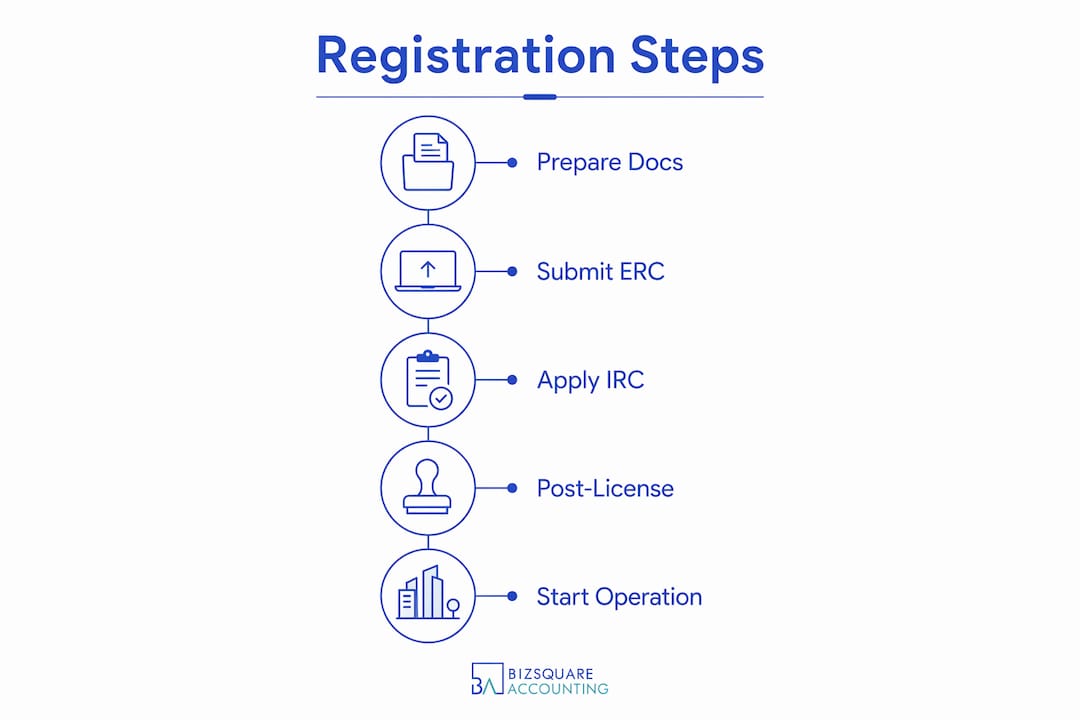
The full process from first document to operational status typically takes 15–60 days, depending on sector complexity and document readiness. The table below summarizes the key stages and timelines.
| Stage | Action | Responsible Party | Typical Timeline |
|---|---|---|---|
| 1 | Prepare and legalize all documents | Investor | 4–6 weeks (before submission) |
| 2 | Submit ERC application online | Investor via National Business Registration Portal | Day 1 |
| 3 | ERC issued | Business Registration Office | 3 working days |
| 4 | Submit IRC application | Investor at Department of Planning and Investment | After ERC |
| 5 | IRC issued | Department of Planning and Investment | 15 working days (statutory) |
| 6 | Carve company seal, obtain digital signature | Investor | 1–3 days after ERC |
| 7 | Open capital contribution bank account | Investor at licensed bank | 3–5 days |
| 8 | Contribute charter capital | Investor | Within 90 days of ERC |
| 9 | Apply for sector-specific operating licenses | Investor | Varies by sector |
Step 1: submit the ERC application
The ERC application goes through Vietnam’s National Business Registration Portal. Vietnam’s business registration offices issue the ERC within 3 working days after receiving a valid and complete dossier. An incomplete dossier results in a request for amendment, which restarts the processing clock upon resubmission. Accuracy and completeness at this stage directly determine how fast the company gets incorporated.
Step 2: apply for the IRC
After receiving the ERC, the investor submits the IRC application to the Department of Planning and Investment. The IRC application typically takes 15 working days under the revised Law on Investment framework, though real-world processing can extend to 20–30 days. Complex sectors, such as education, healthcare, or telecommunications, often take longer due to additional inter-agency consultation requirements.
Step 3: complete post-licensing formalities
Once both certificates are in hand, several post-licensing tasks must be completed promptly.
- Company seal: Order the official company seal, which is required for contracts and official documents.
- Digital signature: Register for a digital signature with a licensed provider for tax and government portal submissions.
- Bank account: Open a direct investment capital account at a licensed commercial bank in Vietnam.
- Charter capital contribution: Charter capital must be contributed within 90 days of ERC issuance. This deadline is strictly enforced. Missing it can result in administrative penalties and forced capital reduction.
- Tax registration: Register for a tax identification number with the local tax authority.
- Social insurance registration: Register with the local social insurance authority before hiring employees.
Pro Tip: Do not wait until day 89 to contribute charter capital. Banks require time to process international wire transfers, and public holidays can delay clearing. Start the transfer process at least two weeks before the deadline.
What licensing requirements apply to specific business activities?
Obtaining both the ERC and IRC does not automatically grant the right to operate in every sector. Vietnam requires two levels of licenses: incorporation licenses (ERC and IRC) and operational licenses for certain conditional business sectors. This distinction is the most misunderstood aspect of business registration in Vietnam.
Sectors that require additional operating licenses beyond ERC and IRC include:
- Banking and financial services: License from the State Bank of Vietnam
- Education and training: License from the Ministry of Education and Training
- Healthcare and pharmaceuticals: License from the Ministry of Health
- Telecommunications: License from the Ministry of Information and Communications
- Multi-level marketing: Specific permit from the Ministry of Industry and Trade
- Real estate trading: License from the Ministry of Construction
- Food and beverage manufacturing: Food safety certification from relevant authorities
- Tourism and hospitality: Business license from the Ministry of Culture, Sports, and Tourism
The Vietnam Investment Law categorizes these as “conditional business lines.” The government publishes an official list of conditional sectors, and investors should verify their VSIC codes against this list before submitting any application. Operating in a conditional sector without the required license carries penalties including fines, forced suspension, and in serious cases, revocation of the IRC.
Checking market access conditions early prevents costly surprises. Foreign investors in sectors with foreign ownership caps, such as certain media or logistics activities, must also verify that their ownership structure complies with Vietnam’s World Trade Organization commitments and bilateral investment treaties.
What practical tips should entrepreneurs know before starting?
The most common mistakes in Vietnam company formation are not legal errors. They are logistical ones. Entrepreneurs underestimate document preparation time, misread capital contribution deadlines, and confuse incorporation with the right to operate.
Key practical tips for a smoother process:
- Secure the office address first. The registered address is required for both the ERC and IRC applications. Virtual offices are accepted in many cases, but the lease or commitment letter must be from a compliant provider.
- Prepare legalized documents before traveling. Consular legalization in the investor’s home country takes time. Some countries require apostille certification, while others require full embassy legalization. Check requirements early.
- Do not confuse incorporation with an operating license. The ERC confirms the company exists. The IRC confirms the investment project. Neither document alone permits operations in conditional sectors.
- Budget realistically for the timeline. A straightforward LLC in a non-conditional sector can be ready in 15–20 working days. A company in education or healthcare may take 60–90 days or more.
- Understand the ERC-first sequencing rule. The IRC must still be obtained within statutory deadlines after the ERC is issued. Delaying the IRC application creates legal risk even if the company is already incorporated.
For entrepreneurs comparing Vietnam to other Southeast Asian markets, reviewing how to set up a company in Vietnam alongside Singapore’s framework offers useful context on regional regulatory differences. Entrepreneurs expanding across Southeast Asia may also find it useful to compare the business incorporation process in Portugal as a reference point for understanding how different jurisdictions handle foreign investor documentation and approval timelines.
Pro Tip: Hire a local legal or consulting firm to handle document legalization and government liaison. The cost is modest relative to the time saved, and local firms know which DPI officers handle which sectors.
Key takeaways
Setting up a business in Vietnam in 2026 requires completing the ERC first, then the IRC, with strict deadlines for capital contribution and sector-specific operating licenses.
| Point | Details |
|---|---|
| ERC comes before IRC | Obtain the Enterprise Registration Certificate first, then apply for the Investment Registration Certificate. |
| Document legalization is the longest step | Start consular legalization of investor documents at least four to six weeks before your target submission date. |
| Capital contribution has a hard deadline | Charter capital must be contributed within 90 days of ERC issuance, with no grace period in practice. |
| Incorporation does not equal permission to operate | Conditional sectors require additional operating licenses beyond the ERC and IRC. |
| Timeline varies by sector | Budget 15–20 days for simple structures and up to 60–90 days for conditional or complex sectors. |
Vietnam’s 2026 reforms reward preparation, not speed
The ERC-first rule introduced by Vietnam’s 2026 Law on Investment is genuinely useful for foreign entrepreneurs. It removes the old bottleneck of waiting for full investment approval before even forming a company. That is a real improvement. However, the reform creates a new risk that many founders overlook: the temptation to treat incorporation as the finish line.
The IRC is not optional. It must be obtained after the ERC within the statutory period. Founders who incorporate quickly and then delay the IRC application because they are busy with operations are creating a compliance gap that can result in penalties or forced restructuring. The ERC-first rule is a sequencing tool, not a shortcut.
Document readiness separates fast registrations from slow ones. Entrepreneurs who arrive in Vietnam with fully legalized documents, a signed office lease, and a clear VSIC code selection can complete the ERC in three working days and the IRC in 15. Those who arrive unprepared spend weeks chasing apostilles and embassy stamps. The process itself is not the obstacle. Preparation is.
The most overlooked step is sector licensing. Bizsquare consistently sees foreign investors who have a valid ERC and IRC but no operating license for their conditional sector. They are legally incorporated but cannot legally operate. Treating the process as a series of regulatory checkpoints, rather than a single incorporation event, is the mindset that produces clean, compliant market entry.
For entrepreneurs also considering Singapore as a regional base, reviewing Singapore company registration alongside Vietnam’s framework helps clarify which jurisdiction suits which business model. Both markets reward preparation and penalize shortcuts.
How Bizsquare can help you register a business in vietnam
Foreign entrepreneurs managing ERC and IRC applications, document legalization, and capital contribution deadlines simultaneously face a real administrative burden. Bizsquare provides structured support at every stage of the process.

Bizsquare’s consultants assist with ERC and IRC application preparation, VSIC code selection, and dossier review before submission. The team also supports post-licensing compliance, including charter capital contribution tracking, tax registration, and social insurance setup. For entrepreneurs expanding across Southeast Asia, Bizsquare’s company incorporation services cover Singapore and regional markets, giving founders a single point of contact for multi-jurisdiction compliance. Contact Bizsquare today to discuss your Vietnam market entry plan and get a clear timeline for your specific sector and structure.
FAQ
1.) What is the erc-first rule in vietnam’s 2026 investment law?
Vietnam’s Law on Investment No. 143/2025/QH15, effective March 1, 2026, allows foreign investors to obtain an Enterprise Registration Certificate before securing an Investment Registration Certificate. This lets entrepreneurs incorporate earlier and begin preparatory activities while investment approval is still in progress.
2.) How long does it take to register a company in vietnam?
The ERC is issued within 3 working days of a complete dossier submission. The IRC typically takes 15 working days, though complex or conditional sectors can extend this to 20–30 days or longer.
3.) What is the minimum charter capital required in vietnam?
Vietnam does not set a universal minimum charter capital for most sectors. The amount must be sufficient to cover the investment project’s costs and must be contributed within 90 days of ERC issuance.
3.) Do foreign investors need a local partner to set up a company in vietnam?
Most sectors allow 100% foreign ownership through a wholly foreign-owned LLC or joint-stock company. Certain conditional sectors, such as some media, logistics, and retail activities, impose foreign ownership caps that may require a Vietnamese partner.
4.) What is the difference between an ERC and an IRC in vietnam?
The ERC is the enterprise registration document that records the company’s legal identity, including its name, structure, and charter capital. The IRC documents the investment project itself, covering objectives, investment scale, and implementation schedule. Both are required for most foreign-invested companies.
5.) Can a foreign investor open a bank account before getting the IRC?
Yes. After receiving the ERC, a foreign investor can open a direct investment capital account at a licensed Vietnamese commercial bank. This account is used to receive the charter capital contribution from overseas.
6.) What happens if charter capital is not contributed within 90 days?
Failure to contribute charter capital within 90 days of ERC issuance can result in administrative penalties and a mandatory reduction of the registered charter capital. The deadline is strictly enforced by Vietnamese authorities.
7.) Which business sectors require additional operating licenses in vietnam?
Conditional sectors including banking, education, healthcare, telecommunications, multi-level marketing, real estate trading, and food manufacturing require operating licenses beyond the ERC and IRC. Investors should verify their VSIC codes against the official conditional business lines list before applying.
8.) Is a physical office required to register a company in vietnam?
Yes. A compliant office lease agreement or letter of commitment from a landlord is mandatory for both ERC and IRC applications. Virtual office addresses are accepted in many cases, provided the provider issues a valid lease or commitment letter.
9.) How does vietnam’s 2026 company registration compare to singapore’s?
Vietnam’s process involves two sequential certificates (ERC then IRC) and takes 15–60 days depending on sector. Singapore’s company registration is typically completed within one to three working days through ACRA. Both markets allow 100% foreign ownership in most sectors, but Vietnam has more conditional business lines requiring additional licenses.
10.) Can entrepreneurs start operations immediately after getting the ERC?
No. The ERC confirms the company’s legal existence but does not authorize operations in conditional sectors. The IRC must be obtained, and sector-specific operating licenses must be secured before commencing regulated business activities.
11.) What is the role of VSIC codes in vietnam business registration?
Vietnam Standard Industrial Classification (VSIC) codes define the business activities a company is authorized to conduct. Selecting the correct VSIC codes at the ERC stage determines which additional licenses are required and whether the investment falls under conditional sector restrictions.
12.) Should foreign investors hire a local consultant for vietnam company setup?
Hiring a local legal or consulting firm is strongly advisable. Local consultants know current DPI requirements, can manage document legalization, and reduce the risk of dossier rejection that restarts processing timelines.