


How to Set Up Company in Vietnam (2026)
Overview
Setting up a company in Vietnam requires obtaining both the ERC and IRC, completing post-licensing steps, and meeting capital contribution deadlines. The 2026 reforms introduced an ERC-first approach, enabling earlier lease signing and bank account setup, which accelerates company formation. Investors must carefully choose legal structures, prepare legalized documents, appoint Vietnamese-resident legal representatives, and comply promptly with registrations to avoid penalties.
Setting up a company in Vietnam is defined as the process of obtaining two core licenses, the Enterprise Registration Certificate (ERC) and the Investment Registration Certificate (IRC), completing post-licensing compliance, and meeting capital contribution requirements under the 2026 Investment Law. The typical setup timeline ranges from 4 to 12 weeks, depending on whether the business operates in a standard or conditional sector. Vietnam’s 2026 regulatory framework introduces an ERC-first approach, allowing foreign investors to sign leases and open bank accounts before investment approval is finalized. This shift makes Vietnam company formation faster and more accessible than at any prior point. Appointing a qualified legal representative and contributing charter capital within 90 days of ERC issuance are non-negotiable requirements that every investor must plan for from day one.
How to set up a company in Vietnam: legal structures explained
Choosing the right legal structure is the first and most consequential decision in the Vietnam company formation process. The structure determines ownership rights, compliance obligations, and long-term scalability. Choosing the right structure at the outset is critical for investor flexibility and cost efficiency.
The four main entity types available to foreign investors are as follows:
- Limited Liability Company (LLC): The most common choice for foreign investors. An LLC allows full foreign ownership in most sectors, requires a minimum of one member, and carries simpler compliance obligations than a joint-stock company.
- Joint-Stock Company (JSC): Suited for businesses planning an IPO or large capital raises. A JSC requires a minimum of three shareholders and allows the issuance of shares to the public.
- Representative Office: Not a legal entity for conducting business. A representative office can only perform market research, liaison, and promotional activities. It cannot generate revenue or sign commercial contracts.
- Branch Office: A branch can conduct business and generate revenue, but it carries the full legal liability of the parent company. Branches face sector-specific restrictions and are not permitted in all industries.
The table below summarizes the key differences between the two most common structures for foreign investors:
| Feature | LLC | JSC |
|---|---|---|
| Minimum shareholders/members | 1 | 3 |
| Foreign ownership | Up to 100% in most sectors | Up to 100% in most sectors |
| Share issuance | Not permitted | Permitted |
| Compliance complexity | Lower | Higher |
| Best suited for | SMEs, wholly foreign-owned firms | Large-scale or publicly listed firms |
Beyond structure, investors must also select the correct Vietnam Standard Industrial Classification (VSIC) business activity codes. These codes define what the company is legally permitted to do. Selecting the wrong codes at registration forces costly amendments later. Certain sectors, such as education, healthcare, and financial services, carry ownership caps or require additional sub-licenses beyond the ERC and IRC.
Pro Tip: Select VSIC codes that cover not only your current activities but also any adjacent services you may offer within the next two to three years. Amending business activity codes after registration requires a formal application and processing time.
What documents and prerequisites are needed before registering?
Preparation is the stage where most foreign investors lose time. Incomplete or improperly legalized documents are the leading cause of application rejections and delays in the business setup in Vietnam process.
The following steps outline the preparation sequence every investor should complete before submitting any application:
- Define compliant business activities. Confirm that the intended business activities are permitted for foreign ownership under Vietnamese law. Cross-reference the VSIC code list and verify sector-specific ownership caps with a qualified legal advisor.
- Secure a registered office address. The address must be a commercial or industrial property. Residential addresses are not accepted. The lease agreement must be valid for at least the duration of the initial license period. Virtual office addresses are accepted in many provinces, but investors should verify local rules.
- Appoint a legal representative. The legal representative must reside in Vietnam. Under 2026 regulations, the legal representative must hold a personal VNeID (Vietnam electronic identification) for corporate e-ID registration. This requirement creates a practical bottleneck for foreign nationals without Vietnamese residency.
- Prepare and legalize foreign documents. All foreign corporate documents, such as certificates of incorporation, articles of association, and identity documents, must be consular legalized, authenticated by Vietnam’s Ministry of Foreign Affairs (MOFA), and then translated and notarized into Vietnamese. Document legalization adds 15 to 30 days before IRC submission.
- Draft a power of attorney. If a third party or law firm is handling the registration, a notarized power of attorney is required. This document authorizes the representative to act on behalf of the investor during the registration process.
- Prepare corporate documentation. This includes the company charter, member or shareholder list, capital contribution schedule, and the proposed business plan for IRC submission.
Pro Tip: Start document legalization at least six weeks before your target registration date. Consular appointments and MOFA authentication can take longer than expected, especially during Vietnamese public holidays.
What is the step-by-step registration process for a foreign company in Vietnam?
The 2026 registration process follows a specific sequence. Skipping or reversing steps causes delays and, in some cases, requires restarting the application. The process below reflects the ERC-first approach introduced under the 2026 Investment Law.
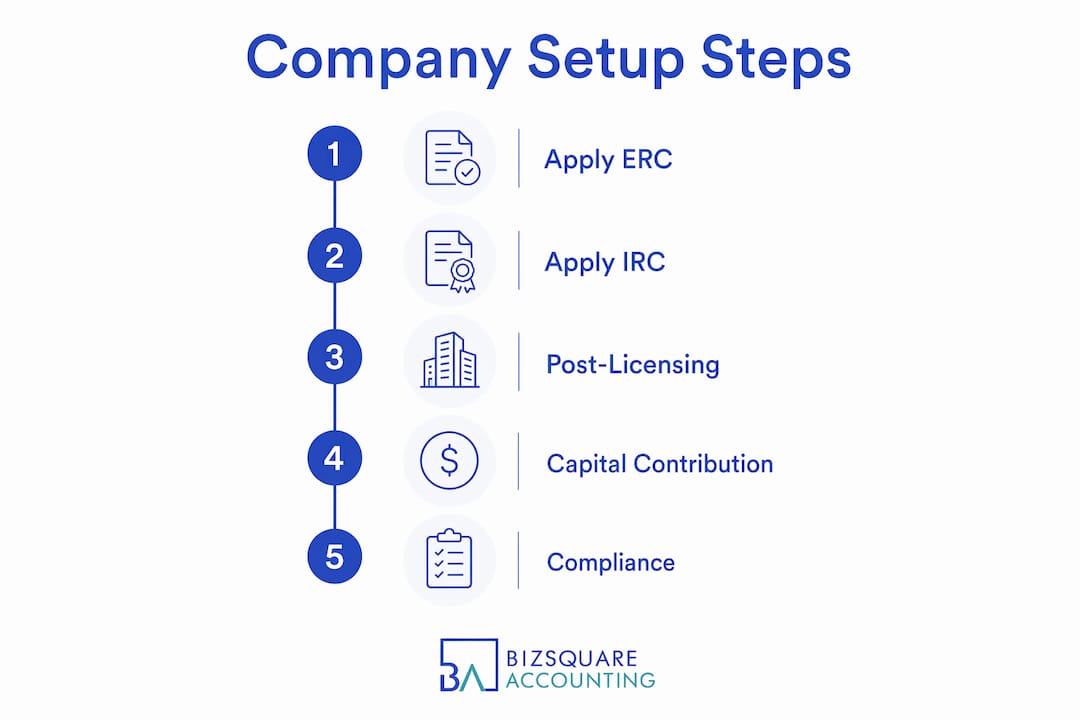
Step 1: Apply for the Enterprise Registration Certificate (ERC)
Submit the ERC application to the Department of Planning and Investment (DPI) in the province where the company will be registered. The application is submitted online through the National Business Registration Portal. The ERC statutory timeline is 3 working days, though practical processing typically takes 3 to 7 days. The ERC confirms the company’s legal existence, name, charter capital, and legal representative.

Step 2: Apply for the Investment Registration Certificate (IRC)
For foreign-invested enterprises, the IRC is required to confirm the investment project’s legal status. The IRC application is submitted to the DPI or the Management Board of the relevant industrial zone, depending on the company’s location. The IRC statutory timeline is 15 days, but practical processing takes 20 to 30 days in most provinces. The IRC specifies the investment project scope, capital amount, and investor details.
Under the ERC-first model, investors can obtain the ERC before the IRC is finalized. This allows the company to sign lease agreements and open a Direct Investment Capital Account (DICA) at a licensed bank before investment approval is complete.
Step 3: Complete post-licensing registrations
After both certificates are issued, the following steps must be completed promptly:
- Company seal: Order and register the company seal with the DPI. The seal is required for official documents and contracts.
- DICA bank account: Open the Direct Investment Capital Account at a licensed commercial bank. All capital injections and profit repatriations must flow through this account. Personal accounts are not permitted for company funds.
- Tax registration: Register with the local Tax Department to obtain a tax identification number (TIN) and activate value-added tax (VAT) obligations.
- Social insurance registration: Register employees with the Vietnam Social Insurance agency. Missing this registration triggers fines.
- E-invoice registration: Register for the e-invoicing system with the General Department of Taxation. Vietnam mandates e-invoices for all business transactions.
- Corporate e-ID registration: Register the company’s digital identity through the national e-ID portal. This step requires the legal representative’s VNeID.
Post-licensing registrations like tax, social insurance, and e-invoices must be completed promptly to avoid penalties.
Step 4: Contribute charter capital
Charter capital must be contributed within 90 days of ERC issuance. All capital must be transferred through the DICA. Failure to contribute the full amount on time results in administrative fines and may trigger a mandatory reduction of the registered charter capital.
Pro Tip: Open the DICA account immediately after ERC issuance. Banks have their own due diligence requirements, and account opening can take one to two weeks. Starting early prevents a last-minute capital contribution rush.
What operational challenges and compliance pitfalls should new businesses watch out for?
Starting a business in Vietnam comes with a set of post-registration compliance obligations that many investors underestimate. The 2026 reforms reduced barriers to entry, but they also introduced stricter post-establishment audits.
The key compliance pitfalls to monitor are outlined below:
- Corporate e-ID bottleneck. The legal representative must hold a VNeID to complete corporate e-ID registration. Foreign nationals without Vietnamese residency face a circular dependency: they need residency to get a VNeID, but they need the VNeID to complete registration. The practical solution is to appoint a local Vietnamese resident as the initial legal representative.
- Provincial variation in approval speed. Approval timelines vary significantly by province. Ho Chi Minh City and Hanoi have well-resourced DPI offices but high application volumes. Smaller provinces may process applications faster but have less experience with complex foreign investment structures.
- DICA compliance. All capital injections and foreign loans must flow through the DICA. Charter capital must be paid within 90 days of ERC issuance. Using personal accounts or non-DICA channels for company funds is a direct violation of foreign exchange regulations.
- Non-cash payment threshold. Transactions above 5 million VND must be conducted through non-cash payment methods. Cash payments above this threshold are not deductible for corporate income tax purposes and may trigger audit flags.
- Timely post-licensing compliance. Tax registration, social insurance enrollment, and e-invoice activation each carry independent deadlines. Missing any one of them results in administrative fines that accumulate quickly.
The 2026 reforms removed 38 conditional business lines, simplifying market entry for many sectors. However, firms now face rigorous post-establishment audits and strict digital compliance requirements in exchange for faster licensing.
How do location and sector choices affect setup speed and business environment?
Location is not just a logistical decision. It directly affects how fast the company can be registered, what incentives are available, and how smoothly day-to-day operations run.
The table below compares key locations for foreign business setup in Vietnam:
| Location | Setup Speed | Key Advantage | Best For |
|---|---|---|---|
| Ho Chi Minh City | Moderate | Largest commercial market | Retail, tech, services |
| Hanoi | Moderate | Government proximity | Finance, consulting, trade |
| Bac Ninh | Fast | Industrial zone incentives | Manufacturing, electronics |
| Binh Duong | Fast | Established industrial zones | Light manufacturing, logistics |
| Da Nang | Moderate to fast | Tourism and tech hub | Hospitality, IT services |
Provinces like Bac Ninh and Binh Duong offer faster licensing and incentives compared to Hanoi or Ho Chi Minh City. Industrial zone management boards in these provinces have streamlined approval processes specifically designed to attract foreign manufacturing investment.
Sector selection also carries strategic weight. The 2026 reforms removed 38 conditional business lines, meaning investors in those sectors no longer need sub-licenses before commencing operations. However, sectors like education, healthcare, real estate, and financial services still carry ownership restrictions and require additional approvals beyond the standard ERC and IRC.
Selecting the wrong VSIC codes at registration is one of the most common and costly mistakes in the Vietnam startup guide process. Amendments require a formal application, DPI review, and additional processing time. Investors should map out their full business model before selecting codes, not just their immediate activities.
Pro Tip: If the business will operate across multiple provinces, consider registering in the province with the most favorable incentives and establishing branch offices elsewhere. This approach can reduce the initial licensing burden while preserving geographic flexibility.
For investors comparing Vietnam with other Southeast Asian markets, the foreign investment process in Indonesia offers a useful reference point for understanding regional regulatory patterns.
Key takeaways
Successfully registering a company in Vietnam requires obtaining both the ERC and IRC, appointing a Vietnam-resident legal representative, and completing all post-licensing compliance steps within statutory deadlines.
| Point | Details |
|---|---|
| ERC-first model speeds up setup | Investors can sign leases and open bank accounts before IRC approval is finalized. |
| LLC is the preferred structure | Most foreign investors benefit from the LLC’s simpler compliance and full ownership rights. |
| Document legalization takes time | Foreign documents require consular legalization and MOFA authentication, adding 15 to 30 days. |
| DICA is mandatory for capital | All charter capital and foreign loans must flow through the Direct Investment Capital Account. |
| Post-licensing compliance is strict | Tax, social insurance, and e-invoice registrations carry independent deadlines with fines for late filing. |
Vietnam company setup: what the process actually demands
The ERC-first model introduced in 2026 is a genuine improvement. It removes the frustrating wait that previously forced investors to hold off on lease agreements and bank account openings until investment approval was complete. For investors who have worked through the old sequential process, this change alone saves weeks of operational dead time.
That said, the legal representative requirement remains the single most underestimated obstacle in the entire process. The VNeID dependency is not a minor administrative detail. It is a hard technical requirement that blocks corporate e-ID registration for any company whose legal representative lacks Vietnamese residency. Appointing a local Vietnamese resident as the initial legal representative is not a workaround. It is the correct approach, and investors who plan for it from the start avoid significant delays.
Location selection also deserves more strategic attention than most investors give it. Bac Ninh and Binh Duong are not just faster. They offer tax incentives, infrastructure support, and industrial zone management boards with direct experience handling foreign investment applications. For manufacturing and logistics businesses, the operational advantages compound over time.
The compliance environment after registration is where many newly established companies stumble. The 2026 reforms simplified entry, but post-establishment audits have increased in frequency and rigor. Tax registration, social insurance enrollment, and e-invoice activation are not optional or deferrable. Treating them as secondary priorities after the company is “up and running” is a reliable path to administrative fines.
The investors who establish companies in Vietnam most efficiently are those who treat documentation, legal structure selection, and post-licensing compliance as equally important as the business plan itself.
How Bizsquare can support your Vietnam company setup
Setting up a foreign-invested enterprise in Vietnam involves multiple agencies, strict deadlines, and documentation requirements that vary by province and sector. Bizsquare provides end-to-end support for entrepreneurs and business owners who want to establish their presence in Vietnam without navigating the process alone.

Bizsquare’s consultants bring deep expertise in foreign investment regulatory frameworks across Southeast Asia. From legal structure selection and document preparation to post-licensing compliance and ongoing corporate secretarial support, Bizsquare covers every stage of the process. The same expertise that supports company incorporation for clients in Singapore applies directly to the regulatory and compliance challenges foreign investors face in Vietnam. Contact Bizsquare today for a consultation and get your Vietnam company formation started on the right foundation.
FAQ
1.) What are the two main licenses required to set up a company in Vietnam?
Foreign investors must obtain the Enterprise Registration Certificate (ERC) and the Investment Registration Certificate (IRC). The ERC confirms the company’s legal existence, while the IRC approves the investment project.
2.) How long does it take to register a company in Vietnam?
The standard setup timeline is 4 to 6 weeks for non-conditional sectors and 8 to 12 weeks for conditional sectors. Document legalization adds an additional 15 to 30 days before the process begins.
3.) Can a foreigner be the legal representative of a Vietnam company?
A foreigner can serve as legal representative, but they must reside in Vietnam and hold a VNeID for corporate e-ID registration. Investors without Vietnamese residency should appoint a local resident as the initial legal representative.
4.) What is the capital contribution deadline after ERC issuance?
Charter capital must be contributed within 90 days of ERC issuance. All capital must be transferred through the Direct Investment Capital Account (DICA) at a licensed commercial bank.
5.) What is the best legal structure for foreign investors in Vietnam?
The Limited Liability Company (LLC) is the recommended structure for most foreign investors. It allows full foreign ownership in most sectors, requires only one member, and carries simpler compliance obligations than a Joint-Stock Company.
6.) What happens if post-licensing registrations are not completed on time?
Missing tax registration, social insurance enrollment, or e-invoice activation deadlines triggers administrative fines. These fines accumulate independently for each missed obligation.
7.) Can a foreign company use a virtual office address for registration in Vietnam?
Virtual office addresses are accepted in many provinces for ERC registration. Investors should verify local rules, as acceptance varies by province and business activity type.
8.) What is the DICA and why is it required?
The Direct Investment Capital Account (DICA) is a dedicated bank account required for all capital injections and profit repatriations. Personal accounts are not permitted for company funds under Vietnamese foreign exchange regulations.
9.) Which provinces offer the fastest company registration in Vietnam?
Bac Ninh and Binh Duong are known for faster licensing and investment incentives compared to Hanoi and Ho Chi Minh City. Industrial zone management boards in these provinces have streamlined processes for foreign investors.
10.) What did the 2026 Investment Law change for foreign investors?
The 2026 reforms removed 38 conditional business lines and introduced the ERC-first approach. Investors can now obtain the ERC before IRC approval, allowing earlier lease signing and bank account opening.
11.) What is the non-cash payment threshold in Vietnam?
Transactions above 5 million VND must be conducted through non-cash payment methods. Cash payments above this threshold are not deductible for corporate income tax purposes.
12.) How do I choose the right VSIC business activity codes?
Select codes that cover both current and planned future activities. Amending VSIC codes after registration requires a formal DPI application and additional processing time, so thorough planning at the outset saves significant cost and delay.