


How to Set Up Business in Indonesia: 2026 Guide
Overview
Setting up a business in Indonesia involves legally incorporating a company, obtaining an NIB, and meeting capital requirements. Foreign investors typically establish a PT PMA for commercial activities, with registration managed through the OSS portal, where risk level and licenses are determined by KBLI codes. Proper planning of entity type, capital, and compliance steps ensures smooth registration and ongoing business operations.
Setting up a business in Indonesia is defined as the formal process of incorporating a legal entity, securing a Nomor Induk Berusaha (NIB), and meeting capital requirements under Indonesian investment law. Foreign entrepreneurs typically establish a PT PMA (Penanaman Modal Asing), the standard foreign-owned limited liability company, to conduct commercial activities legally. The entire registration process runs through Indonesia’s Online Single Submission (OSS) portal at oss.go.id, which classifies business activities by risk level and determines what licenses apply. Understanding entity types, capital thresholds, and KBLI business classification codes upfront saves significant time and prevents costly amendments later.
How to set up a business in indonesia: entity types explained
The first decision when setting up a company in Indonesia is selecting the right legal structure. Each entity type carries distinct ownership rules, capital obligations, and permitted activities.
PT PMA: the standard foreign investment vehicle
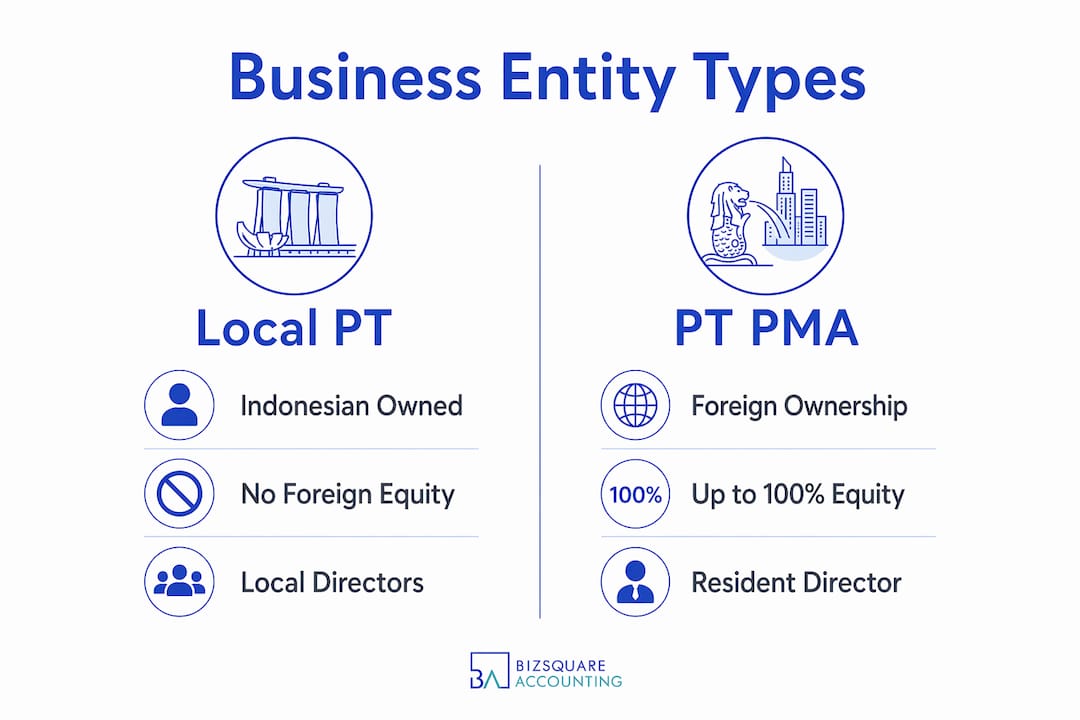
A PT PMA is the primary vehicle for foreign investors seeking commercial operations in Indonesia. Foreign ownership through a PT PMA is governed by the Negative Investment List, which restricts or limits foreign equity in certain sectors. Outside restricted sectors, foreign investors can hold up to 100% equity. The PT PMA requires a minimum paid-up capital and a formal investment plan submitted to BKPM (the Investment Coordinating Board).

Local PT vs. PT PMA: key differences
| Feature | Local PT | PT PMA |
|---|---|---|
| Foreign ownership | Not permitted | Permitted (up to 100% in open sectors) |
| Minimum paid-up capital | IDR 50 million | IDR 2.5 billion (2026 rules) |
| Investment value plan | No minimum | Generally above IDR 10 billion |
| Eligible business activities | All domestic sectors | Subject to Negative Investment List |
| Regulatory body | Ministry of Law | BKPM and Ministry of Law |
A local PT (Perseroan Terbatas) suits Indonesian nationals or businesses with local partners holding majority equity. Foreign entrepreneurs cannot use a local PT as the primary holding structure for foreign-owned operations.
Representative offices: a non-commercial entry point
Representative offices like KPPA (Kantor Perwakilan Perusahaan Asing) allow foreign companies to establish a presence in Indonesia for liaison and market research only. They cannot generate revenue or sign commercial contracts. If commercial activities begin, transitioning to a PT PMA is required. This structure suits companies testing the Indonesian market before committing to full incorporation.
Key considerations for each entity type:
- PT PMA: Full commercial rights, subject to capital and investment plan requirements
- Local PT: Indonesian-owned, lower capital threshold, no foreign equity
- KPPA/KP3A: Non-commercial only, no revenue generation, simpler setup
What are the financial requirements to start a business in indonesia?
Capital requirements for business registration in Indonesia follow BKPM Regulation 5 of 2025, which took effect in 2026. Understanding these figures before filing prevents rejection and rework.
Paid-up capital and investment value
The paid-up capital requirement for a PT PMA has been lowered to IDR 2.5 billion in 2026. This reduction makes entry more accessible for mid-sized foreign investors. However, the total investment value plan submitted to BKPM generally remains above IDR 10 billion. That gap between paid-up capital and investment value reflects Indonesia’s expectation that companies will deploy significant capital over time, not just at incorporation.
Paid-up capital must be deposited into an Indonesian bank account. Capital lock-up rules require those funds to remain in the company’s account for at least 12 months unless spent on productive business activities. This directly affects cash flow planning for the first year of operations.
KBLI codes and risk classification
Indonesia uses KBLI codes (Klasifikasi Baku Lapangan Usaha Indonesia) to classify every business activity and assign a risk level for licensing. The 2026 enforcement framework follows the KBLI 2025 classification system. Mismatches between declared KBLI codes and actual business activities cause licensing delays and can trigger a higher risk classification.
Key financial and regulatory requirements include:
- Paid-up capital: Minimum IDR 2.5 billion for PT PMA (2026)
- Investment value plan: Generally above IDR 10 billion
- Capital lock-up: Minimum 12 months in Indonesian bank account
- KBLI selection: Must match actual business activities precisely
- Domicile address: Must comply with local zoning regulations
- Notary deed: Must reflect accurate company data before OSS filing
Pro Tip: Validate your KBLI codes against the OSS portal before finalizing the notary deed. Changing KBLI codes after deed execution requires a formal amendment, which adds weeks to the timeline.
How does the OSS risk-based licensing system work?
The OSS (Online Single Submission) system at oss.go.id is Indonesia’s centralized business licensing portal. Obtaining an NIB (Nomor Induk Berusaha) through OSS is mandatory for legal operation and serves as the company’s primary business identification number.
Risk levels and licensing outcomes
OSS classifies every business activity into four risk categories based on the declared KBLI codes. Each category carries different licensing requirements:
- Low risk: NIB issuance is the only requirement. Approval is near-instant after data submission.
- Medium-low risk: NIB plus a Standard Certificate (Sertifikat Standar) that is self-declared by the business.
- Medium-high risk: NIB plus a Standard Certificate that requires government verification before it becomes active.
- High risk: NIB plus a full Business License (Izin Usaha) requiring detailed government review. High-risk approvals can take months depending on the sector.
This risk-based approach centralizes licensing under one portal but creates very different timelines depending on the business sector. A low-risk retail business may receive its NIB within hours. A high-risk financial services company may wait several months for full permit issuance.
Quarterly LKPM reporting
After obtaining the NIB, PT PMA companies must submit quarterly LKPM (Laporan Kegiatan Penanaman Modal) investment activity reports through OSS. These reports track capital realization against the investment plan submitted at registration. Failure to file LKPM reports on time can result in sanctions and complications with license renewal.
Pro Tip: Set calendar reminders for LKPM submission deadlines at the start of each quarter. Late filings are one of the most common compliance failures for newly registered PT PMA companies.
What are the practical steps to register a company in indonesia?
The step-by-step process for company incorporation in Indonesia follows a clear sequence. Skipping or rushing any step creates downstream problems that are expensive to fix.
Step-by-step registration process
- Select and validate KBLI codes. Identify the business activities the company will conduct. Cross-reference each activity with the OSS KBLI database to confirm the correct code and risk classification.
- Secure a compliant domicile address. The company address must comply with local zoning regulations. Virtual offices are accepted in many Indonesian cities, but the address must be registered and verifiable.
- Prepare the Deed of Establishment. Engage a licensed Indonesian notary to draft the Deed of Establishment (Akta Pendirian). The deed must include shareholder details, share capital structure, directors, commissioners, and KBLI-aligned business purpose.
- Obtain Ministry of Law approval. The notary submits the deed to the Ministry of Law and Human Rights for legal entity status. This step formalizes the PT PMA as a legal entity under Indonesian law.
- Register on OSS and obtain the NIB. Log in to oss.go.id, input company data, select KBLI codes, and submit. The NIB is issued based on the risk classification of the declared activities.
- Inject paid-up capital. Transfer the minimum IDR 2.5 billion paid-up capital into the company’s Indonesian bank account. The 12-month capital lock-up period begins from the date of injection.
- Obtain additional permits if required. Based on the OSS risk classification, secure Standard Certificates or Business Licenses before commencing operations.
- Register for tax. Obtain a Tax Identification Number (NPWP) from the Directorate General of Taxes. This is required for all commercial transactions and employee payroll.
Common pitfalls and how to avoid them
| Pitfall | Impact | Prevention |
|---|---|---|
| KBLI mismatch between deed and OSS | Licensing delays, amendment costs | Validate KBLI before notary engagement |
| Domicile address not zoning-compliant | Registration rejection | Confirm zoning status with local authority |
| Capital injected after OSS filing | Compliance breach | Inject capital before or immediately after NIB issuance |
| LKPM reports not filed quarterly | Sanctions, license complications | Set automated reminders for each quarter |
| Deed data inconsistency with OSS | Formal amendment required | Cross-check all deed data against OSS inputs |
Document alignment between the Deed of Establishment and OSS registration is non-negotiable. Discrepancies in company name, address, shareholder details, or KBLI codes require formal amendments through the notary and Ministry of Law, adding weeks or months to the timeline.
How to manage compliance after setting up in indonesia?
Starting a business in Indonesia is only the beginning. Ongoing compliance obligations are significant and require structured management from day one.
Capital lock-up and treasury planning
The 12-month capital lock-up rule directly affects how founders plan operational spending. Funds deposited as paid-up capital can only be released for productive business expenditures, such as equipment purchases, staff salaries, or office leases. Founders must plan operational cash flow carefully to avoid liquidity issues during the first year.
Key ongoing compliance obligations include:
- Quarterly LKPM reports: Submit investment activity reports through OSS every quarter
- Annual financial statements: PT PMA companies must prepare audited financial statements annually
- Tax filings: Monthly VAT returns and annual corporate income tax filings are mandatory
- KBLI amendments: If business activities change, update KBLI codes through a formal deed amendment and OSS update
- Director and commissioner compliance: Maintain at least one resident director and one commissioner as required by Indonesian company law
Transitioning from representative office to PT PMA
Representative offices offer a simplified introduction to Indonesia’s business environment, but require strategic planning if commercial activity is desired. The transition from KPPA to PT PMA is not automatic. It requires a full PT PMA incorporation process, including a new notary deed, OSS registration, and capital injection. Companies that begin commercial activities through a representative office without transitioning face significant legal and tax exposure.
Pro Tip: If the long-term plan involves revenue generation in Indonesia, incorporate a PT PMA from the start. The cost of transitioning from a representative office later exceeds the cost of direct PT PMA incorporation.
Key takeaways
Successfully setting up a business in Indonesia requires selecting the right entity, meeting capital requirements, and navigating OSS risk-based licensing with precise KBLI classification.
| Point | Details |
|---|---|
| Choose the right entity | PT PMA suits foreign investors; local PT suits Indonesian nationals; KPPA is for non-commercial presence only. |
| Meet capital requirements | PT PMA paid-up capital is IDR 2.5 billion in 2026, with investment plans generally above IDR 10 billion. |
| Validate KBLI codes early | Correct KBLI selection controls risk classification and determines licensing speed and complexity. |
| Use OSS for NIB and licensing | All business registration in Indonesia runs through oss.go.id; risk level determines additional permit requirements. |
| Plan for ongoing compliance | Quarterly LKPM reports, annual audits, and capital lock-up rules require structured financial management from day one. |
Indonesia business setup: what most guides get wrong
Most articles on setting up a company in Indonesia focus on the steps. Few focus on the sequencing. After working through dozens of PT PMA registrations across Southeast Asia, the single most common and costly mistake is treating KBLI selection as an afterthought.
Founders often finalize the notary deed first, then discover their KBLI codes trigger a high-risk classification that requires a full Business License. That means months of additional processing, not days. The fix is straightforward: validate KBLI codes against the OSS portal before the notary engagement, not after.
The second issue is capital planning. The KBLI classification impact on licensing is well-documented, but the 12-month capital lock-up catches founders off guard. Many assume paid-up capital is freely available for operations. It is not, unless spent on productive expenditures. Founders who treat the IDR 2.5 billion as working capital find themselves in a compliance breach within the first quarter.
The third insight is entity selection. Representative offices are genuinely useful for market research and relationship building. But the moment a commercial transaction occurs, the legal exposure is real. The PT PMA vs. local PT decision should be made based on a five-year business plan, not the lowest-cost entry point today.
Indonesia’s regulatory environment in 2026 is more accessible than it was five years ago. The OSS portal has reduced processing times significantly for low-risk businesses. The paid-up capital threshold has come down. These are genuine improvements. The entrepreneurs who succeed here are the ones who invest in precise compliance upfront rather than trying to fix problems after the NIB is issued.
How Bizsquare can support your indonesia business setup
Setting up a PT PMA in Indonesia involves notary coordination, KBLI validation, OSS registration, capital compliance, and ongoing reporting. Each step carries compliance risk if handled without expert guidance.

Bizsquare provides end-to-end support for company incorporation in Indonesia, covering entity selection, KBLI code validation, OSS registration, and post-incorporation compliance. Bizsquare’s consultants guide foreign entrepreneurs through capital injection requirements, LKPM reporting, and corporate secretary obligations, so the business launches on solid legal footing. For entrepreneurs already operating in Singapore who want to expand into Indonesia, Bizsquare offers integrated regional advisory across both markets. Reach out to Bizsquare to start the process with confidence.
FAQ
1.) What is a PT PMA in indonesia?
A PT PMA (Penanaman Modal Asing) is a foreign-owned limited liability company in Indonesia. It is the standard legal entity for foreign investors seeking to conduct commercial activities in the country.
2.) What is the minimum capital to set up a PT PMA in 2026?
The minimum paid-up capital for a PT PMA is IDR 2.5 billion under BKPM Regulation 5 of 2025. The total investment value plan submitted to BKPM generally remains above IDR 10 billion.
3.) What is an NIB and why is it required?
An NIB (Nomor Induk Berusaha) is a business identification number issued through the OSS portal at oss.go.id. It is mandatory for legal operation and determines what additional licenses the business must obtain.
4.) What are KBLI codes and why do they matter?
KBLI codes classify every business activity in Indonesia and determine the risk level assigned by OSS. The risk level directly controls whether a business needs only an NIB or must obtain additional Standard Certificates or Business Licenses.
5.) Can a foreign investor use a representative office for commercial activities?
No. A representative office like KPPA is limited to non-commercial activities such as liaison and market research. Any commercial activity requires transitioning to a PT PMA, which involves a full incorporation process.
6.) How long does business registration in indonesia take?
Low-risk businesses can receive their NIB within hours of OSS submission. High-risk businesses requiring a full Business License may wait several months for government verification and permit issuance.
7.) What is the capital lock-up rule for PT PMA?
Paid-up capital must remain in the company’s Indonesian bank account for at least 12 months. The funds can only be released for productive business expenditures such as equipment, salaries, or office costs.
8.) What is LKPM reporting?
LKPM (Laporan Kegiatan Penanaman Modal) is a quarterly investment activity report that PT PMA companies must submit through OSS. It tracks capital realization against the investment plan filed at registration.
9.) Can a PT PMA be 100% foreign-owned?
Yes, in sectors not restricted by Indonesia’s Negative Investment List. In restricted sectors, foreign equity may be capped or prohibited, requiring a local partner structure.
10.) What happens if KBLI codes are wrong in the deed of establishment?
A mismatch between the deed and OSS registration requires a formal amendment through a licensed notary and Ministry of Law approval. This adds significant time and cost to the registration process.
11.) Do foreign investors need a local director for a PT PMA?
Indonesian company law requires at least one resident director and one commissioner. The resident director does not need to be an Indonesian citizen but must be a legal resident of Indonesia.
12.) Is a virtual office address acceptable for PT PMA registration?
Virtual offices are accepted in many Indonesian cities for domicile registration. The address must comply with local zoning regulations and be verifiable by the relevant authority.
13.) What taxes apply to a PT PMA in indonesia?
A PT PMA is subject to corporate income tax at 22%, monthly VAT filings, and employee income tax withholding. Annual audited financial statements are required for tax compliance purposes.