

Why Keep Business Records: A Guide for Singapore SMEs
Overview
Maintaining proper business records provides Singapore companies with legal compliance, financial visibility, and strategic growth advantages. Organized documentation supports accurate financial management, simplifies audits, and enhances credibility with investors and lenders. Implementing a structured retention and storage system ensures ongoing compliance and readiness for critical business moments.
Most business owners in Singapore set up their record keeping with tax season in mind and think little more about it. That framing undersells the function by a wide margin. Understanding why keep business records matters requires looking past compliance checkboxes and toward the full picture: financial visibility, audit readiness, investor confidence, and growth planning. This article covers the legal obligations under ACRA and IRAS, the financial management benefits, practical organization strategies, common pitfalls to avoid, and how well-maintained records become one of the most useful strategic tools a Singapore business owner can hold.
Table of Contents
- Key takeaways
- Why keep business records: legal and regulatory obligations
- Financial management benefits of accurate records
- How to organize business records effectively
- Common pitfalls in business record keeping
- Leveraging records for strategic growth
- My perspective: records as a competitive advantage
- How Bizsquareaccounting supports Singapore businesses with record keeping
- FAQ
Key takeaways
| Point | Details |
|---|---|
| Legal compliance is non-negotiable | Singapore companies must maintain accounting records and statutory documents under the Companies Act to avoid penalties. |
| Records power financial decisions | Organized records produce the financial statements you need to understand cash flow, profitability, and growth trends. |
| Retention periods vary by document | Different record types require retention of 1, 3, 7 years or longer. A written policy prevents costly gaps. |
| Poor records create compounding problems | Missing or inconsistent records complicate audits, slow financing applications, and expose businesses to regulatory risk. |
| Records are a strategic growth asset | Investors, lenders, and acquirers all rely on clean records to assess business value and make funding decisions. |
Why keep business records: legal and regulatory obligations
Singapore operates one of the most structured and transparent regulatory environments in Asia. For incorporated companies, record keeping is not optional. It is a statutory requirement enforced through the Companies Act and overseen by both the Accounting and Corporate Regulatory Authority (ACRA) and the Inland Revenue Authority of Singapore (IRAS).
Under the Companies Act, every Singapore company must maintain proper accounting records that give a true and fair view of its financial position. This includes general ledgers, invoices, bank statements, receipts, and supporting schedules for every transaction. Directors must maintain these documents and keep them updated alongside officer change records and annual filing submissions.
The specific documents Singapore businesses are required to maintain include:
- Accounting records: General ledgers, cash books, journals, and subsidiary records
- Source documents: Invoices issued and received, receipts, purchase orders, and delivery orders
- Bank records: Statements, reconciliation records, and transaction confirmations
- Payroll records: Salary schedules, CPF contribution records, and employee contracts
- Statutory registers: Register of directors, shareholders, and share transfers
- Tax records: Corporate tax returns, GST submissions, and supporting computations
The standard retention period for most accounting and tax records in Singapore is five years from the relevant financial year end. IRAS requires GST-registered businesses to retain records for at least five years from the end of the accounting period in which the records were created. For non-GST businesses, the same five-year rule applies to income tax documentation.
What happens when records fall short? Penalties are imposed for failure to keep adequate records, and the consequences compound quickly when an audit or IRAS query arises without proper documentation to support the figures filed. ACRA inspections that find record keeping deficiencies can result in fines against both the company and its directors personally.
The practical benefit of maintaining complete records is substantial. A complete set of records speeds up any tax examination or compliance response, reducing the time and professional fees a business spends managing an audit. Clean records mean answers are retrievable, not reconstructed.
Financial management benefits of accurate records
Beyond regulatory compliance, the importance of business records becomes most visible in day-to-day financial management. Businesses that maintain organized records can see exactly where money is coming in, where it is going, and whether the numbers trend in a favorable direction.

Consider a Singapore-based professional services firm with ten employees. Without organized records, the owner cannot reliably answer basic questions: Which clients generate the most revenue? Which service lines carry the healthiest margins? Are quarterly collections keeping pace with monthly outgoings? Accurate records make these questions answerable in an afternoon rather than a week-long forensic exercise.
The practical financial benefits follow a logical progression:
- Track income and expenses in real time. When every transaction is recorded promptly and categorized correctly, business owners can spot cash flow gaps weeks before they become crises rather than days after.
- Prepare meaningful financial statements. Good records help prepare accurate profit and loss statements and balance sheets, the two documents that matter most when assessing business health or presenting financials to a bank.
- Identify customer and product profitability. Disaggregated records by client, project, or product line reveal which parts of the business deserve investment and which are quietly draining resources.
- Plan budgets with real data. Forecasting next year’s expenses without historical records is guesswork. With organized records spanning multiple years, budget projections carry genuine analytical weight.
- Manage GST obligations accurately. For GST-registered businesses, precise input and output tax records are not just useful. They are the only way to file correctly and reclaim what the business is entitled to.
Organized records allow businesses to see earnings, manage cash flow, and plan across business cycles with clarity. This is the benefit of record keeping that most business owners discover late. They start keeping records for compliance and realize they have built a management information system.
Pro Tip: Set aside thirty minutes at the end of every week to reconcile transactions in your accounting software. Weekly reconciliation catches errors while the context is still fresh and prevents month-end bottlenecks that lead to rushed and inaccurate records.
How to organize business records effectively
Knowing why you need records is only part of the picture. Knowing how to organize business records determines whether those records are actually usable when you need them. Poor organization defeats the purpose even when every document exists somewhere in the filing system.
The starting point is a clear categorization framework. Every record a Singapore business generates falls into one of a few functional categories: financial records, statutory records, employee records, contracts and legal agreements, and correspondence. Each category deserves its own folder structure, whether in a physical cabinet or a cloud-based document management system.
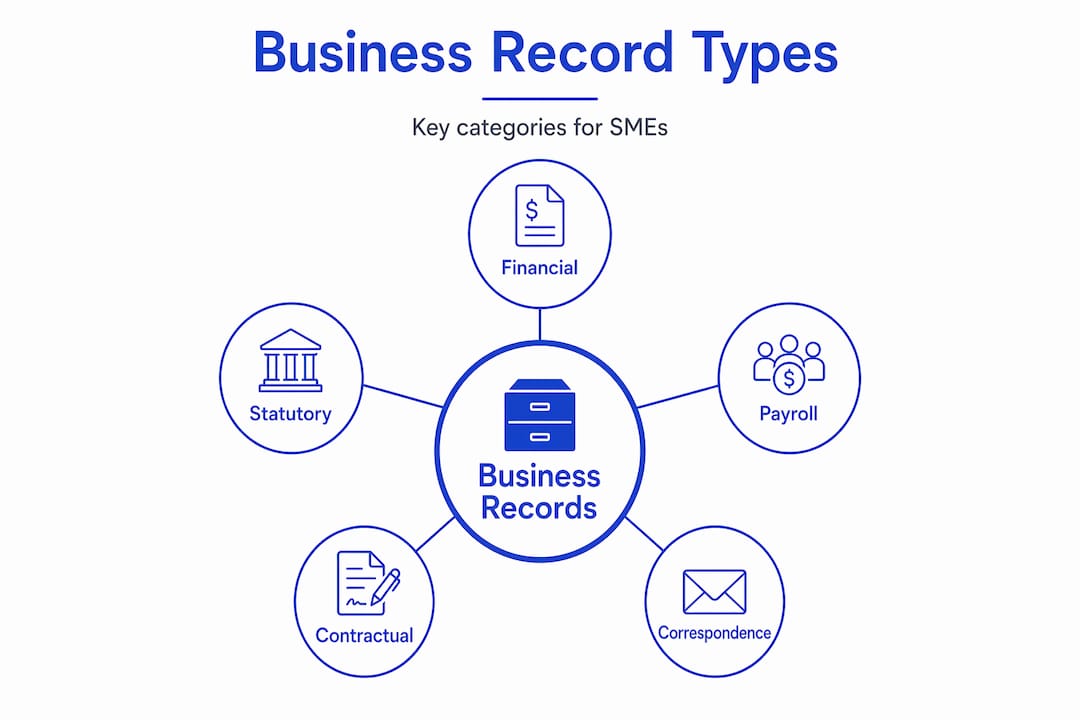
The following table shows recommended retention periods by document type, which should anchor any formal business record retention policy:
| Document type | Recommended retention period | Notes |
|---|---|---|
| Accounting ledgers and journals | 5 years | IRAS minimum for tax purposes |
| GST records and tax invoices | 5 years | From end of relevant accounting period |
| Employment and payroll records | 5 years after employee leaves | Includes CPF and salary records |
| Contracts and legal agreements | 7 years after contract ends | Allows for dispute resolution window |
| Incorporation documents | Indefinitely | MOA, AOA, share certificates |
| Bank statements and reconciliations | 5 years | Align with accounting record cycle |
| Insurance policies | Duration plus 3 years | Match to claims limitation period |
Retention periods vary by document type, commonly organized around the 1, 3, 5, and 7-year marks, with some records held indefinitely. A written business record retention policy removes any ambiguity about what to keep and for how long.
On the question of physical versus digital storage, most Singapore businesses benefit from a hybrid approach. Organizations should balance digital and paper methods and maintain backups for security. Digital records should be stored in a cloud system with access controls, version history, and automatic backup. Physical records should be organized chronologically within each category, with a clear destruction schedule once the retention period has passed.
Accounting software such as Xero, QuickBooks, or MYOB is widely used by Singapore SMEs and integrates with local bank feeds to reduce manual data entry. These platforms also produce the financial reports that directors need for ACRA filings and corporate tax submissions, which makes them genuinely worth the subscription cost. For guidance on accounting practices for Singapore SMEs, the investment in proper software infrastructure pays dividends at every subsequent compliance milestone.
Pro Tip: Create a “year-end records checklist” that lists every document type, its retention period, and the responsible team member. Review it quarterly rather than waiting for the financial year end to discover gaps in the filing system.
Common pitfalls in business record keeping
Understanding the reasons to maintain records is one thing. Sustaining the discipline of record keeping through a busy operating year is another. Several patterns recur consistently among Singapore businesses that find themselves underprepared at audit time or during a financing application.
The most damaging pitfalls include:
- Mixing personal and business finances. When a business owner uses a personal bank account for company transactions, even occasionally, it creates a documentation problem that is expensive to untangle. Every transaction becomes a question rather than a fact. A dedicated business account is the first rule of clean record keeping.
- Inconsistent transaction recording. Records that are updated monthly or quarterly rather than weekly or in real time accumulate errors. A receipt misplaced two months ago cannot be reconstructed with confidence. The further from the transaction date, the more unreliable the records become.
- No version control on financial documents. When spreadsheets replace proper accounting software, multiple versions of the same document begin to circulate, and no one can establish with certainty which figures are final. This creates genuine compliance risk.
- Ignoring statutory record updates. Beyond accounting records, Singapore companies must update their statutory registers when directors change, shares are transferred, or the registered address changes. Delays in these updates constitute a Companies Act violation, regardless of how clean the financial records are.
- Failing to document business decisions. Board resolutions, shareholder approvals for significant transactions, and related-party agreements all require documentation. A business that cannot produce these records during a restructuring, sale, or audit faces serious procedural complications.
Routine internal audits of the record-keeping system prevent these problems from accumulating. A quarterly review of whether all categories are current, all retention schedules are being followed, and all statutory registers reflect the current state of the company takes a few hours and saves considerably more. Explore the bookkeeping essentials for Singapore businesses to build a compliance-first culture from the ground up.
Leveraging records for strategic growth
The final reason why keep business records matters at an elevated level is strategic. Records are raw material for every significant business decision a Singapore company will make as it scales. When they are accurate and well-organized, they enable the kind of analysis that separates reactive management from deliberate growth strategy.
The strategic applications follow a clear sequence:
- Assess business health with precision. A multi-year profit and loss record reveals whether revenue growth is outpacing cost growth, whether gross margins are stable, and whether the business is building or consuming working capital. Records show whether a business is improving and what operational changes are needed to sustain or accelerate that trajectory.
- Support financing applications. Banks and alternative lenders in Singapore require at least two to three years of audited or reviewed financial statements before approving business loans. Private investors and private equity firms request the same. Without complete records, financing options narrow significantly regardless of how well the underlying business performs.
- Enable tax planning engagements. Effective corporate tax advisory depends entirely on accurate historical records. A tax advisor who can see three years of income, expenses, capital allowances, and related-party transactions can identify legitimate tax planning opportunities that a business with incomplete records simply cannot access.
- Facilitate business valuations. Whether the business is preparing for an acquisition, bringing in a new equity partner, or restructuring internally, the valuation process starts with the records. Clean, auditable records command a credibility premium that translates directly into better terms.
- Strengthen shareholder and board reporting. For companies with multiple shareholders or an advisory board, regular financial reporting built on reliable records builds governance credibility. Business management systems that incorporate disciplined record keeping create the transparency that sophisticated stakeholders expect.
Records should be viewed not only as legal necessities but as vital tools for managing and growing a business. A Singapore company that treats its records as a strategic asset from day one is better positioned at every subsequent inflection point, from the first bank loan to an eventual exit.
How Bizsquare supports Singapore businesses with record keeping
For Singapore business owners who recognize the importance of business records but find the day-to-day maintenance difficult to sustain alongside running operations, professional support changes the equation entirely.
Bizsquare provides professional accounting and bookkeeping services designed specifically for Singapore SMEs, startups, and growing companies. The firm’s bookkeeping team manages transaction recording, bank reconciliation, GST filing preparation, and monthly management accounts, so business owners receive accurate, current financial information without carrying the administrative burden themselves.
Beyond bookkeeping, Bizsquare offers corporate secretary services to maintain statutory registers and handle ACRA compliance filings, corporate tax advisory to plan and file accurately, and an Outsourced CFO service for companies that need senior financial oversight without a full-time hire. For businesses at the formation stage, company incorporation in Singapore through our sets up the record-keeping framework correctly from day one, avoiding the costly corrections that come from starting without proper structure. Contact us to discuss how professional record management can support your compliance and growth objectives.
FAQ
What records must Singapore companies legally maintain?
Singapore companies are required under the Companies Act to maintain accounting records, source documents such as invoices and receipts, bank statements, payroll records, and statutory registers including the register of directors and shareholders. Most records must be retained for a minimum of five years.
Why keep business records beyond tax compliance?
Records help monitor progress and support better business decisions, not just tax filings. Accurate records enable cash flow management, financial planning, financing applications, and business valuations that are independent of tax season requirements.
How long should a Singapore business keep its financial records?
The IRAS standard retention period for accounting and tax records is five years from the end of the relevant accounting period. Contracts and legal agreements are typically retained for seven years after expiry, and incorporation documents should be kept indefinitely.
What are the consequences of poor record keeping in Singapore?
Penalties can be imposed for failure to maintain adequate records, and directors may face personal liability for Companies Act violations. Poor records also complicate tax audits, slow financing applications, and reduce the accuracy of business valuations.
How should a small business organize its records?
A practical approach involves categorizing records into financial, statutory, payroll, contractual, and correspondence types, storing digital copies in a cloud system with access controls and automatic backup, maintaining a written retention policy, and conducting quarterly reviews to confirm all categories are current and complete.