



Withholding tax Singapore: what finance teams must do
If your company pays a non-resident for services, interest, royalties or director’s fees, Singapore withholding tax almost certainly applies. The payer, not the payee, must withhold the correct amount and remit it to IRAS. Miss this and your business faces penalties, not the overseas vendor.
Here is the quick version. Every one of these payments must be filed and paid to IRAS) by the 15th day of the second month after the payment date.
Before you send that next invoice payment overseas, do three things:
- Check whether the recipient is a non-resident individual or company.
- Classify the payment correctly, since the rate depends entirely on payment type.
- Prepare your filing through myTax well before the deadline, so you avoid late penalties.
Pro Tip: Even payments exempted under a tax treaty still need to be filed with IRAS. A zero rate does not mean zero paperwork.
Key Takeaways
Singapore withholding tax obligations fall entirely on the payer, who must withhold the correct rate by payment type and remit it to IRAS by the 15th day of the second month after payment.
| Point | Details |
|---|---|
| Payer carries the obligation | The Singapore company paying a non-resident must withhold and remit tax, not the recipient. |
| Rates follow payment type | Interest and rent sit at 15%, royalties at 10%, director’s fees at 24%. |
| Services are not final tax | Fees for work performed in Singapore are taxed at the prevailing corporate rate, with refunds possible. |
| Deadlines are strict | Filing and payment are due on the 15th day of the second month after payment. |
| Treaty relief needs documents | A Certificate of Residence must be submitted on time to claim reduced DTA rates. |
| Bizsquare supports compliance | Bizsquare Accounting handles vendor checks, WHT filings, and COR submissions for Singapore businesses. |
Table of Contents
- What is withholding tax in Singapore and who must pay it
- Which payments attract withholding tax and at what rates
- How do you claim DTA relief and get a Certificate of Residence
- Filing and paying withholding tax through myTax
- What mistakes trigger IRAS penalties and how to avoid them
- Three worked examples of withholding tax calculations
- A quick compliance checklist before you pay a non-resident
- When should you bring in a tax adviser for withholding tax
- A note from Bizsquare on getting withholding tax right
- How Bizsquare Accounting takes withholding tax off your plate
- Sources
- FAQ
What is withholding tax in Singapore and who must pay it
Withholding tax is a tax deducted at source. When your company makes certain payments to a non-resident, you hold back a portion of that payment and send it to IRAS on the recipient’s behalf. It exists because IRAS has limited reach over overseas taxpayers, so it puts the compliance burden on the local payer instead.
The payer bears full legal responsibility. IRAS is explicit that the party making the payment, not the non-resident receiving it, must withhold and remit the tax. If your finance team sends $50,000 to an overseas consultant and forgets to withhold, IRAS will come after your company for the shortfall, plus penalties.
So who counts as a non-resident? For individuals, it comes down to physical presence. Someone who stays in Singapore for fewer than 183 days in a calendar year is generally treated as a non-resident for tax purposes. For companies, residency depends on where control and management of the business is exercised, not where it is incorporated. A company registered in Singapore but run entirely from an overseas head office may still be classed as non-resident.
Permanent establishment status also matters when a tax treaty is in play. If a foreign company has a fixed place of business or an active presence in Singapore, this can shift how a double tax agreement treats certain income, sometimes reducing or removing the withholding obligation altogether.
| Point | Details |
|---|---|
| Who withholds | The Singapore payer, never the non-resident recipient. |
| Non-resident individual test | Fewer than 183 days physically present in Singapore during the year. |
| Non-resident company test | Control and management exercised outside Singapore. |
| Legal basis | Set out under the Income Tax Act 1947. |
Which payments attract withholding tax and at what rates
Not every cross-border payment triggers withholding tax, but many common ones do. IRAS publishes a clear schedule of rates by payment type, and getting the classification wrong is one of the most frequent payer mistakes.
| Payment type | Standard withholding rate | Final tax? |
|---|---|---|
| Interest, commission, fees on loans | 15% | Often final |
| Royalties | 10% | Often final |
| Rent on movable property | 15% | Final |
| Management fees and technical services | Prevailing corporate income tax rate | Not final |
| Non-resident director’s fees | 24% | Final |
| Time, voyage and bareboat charter fees for ships | Exempt | Not applicable |
| Interest on deposits with approved banks | Exempt | Not applicable |
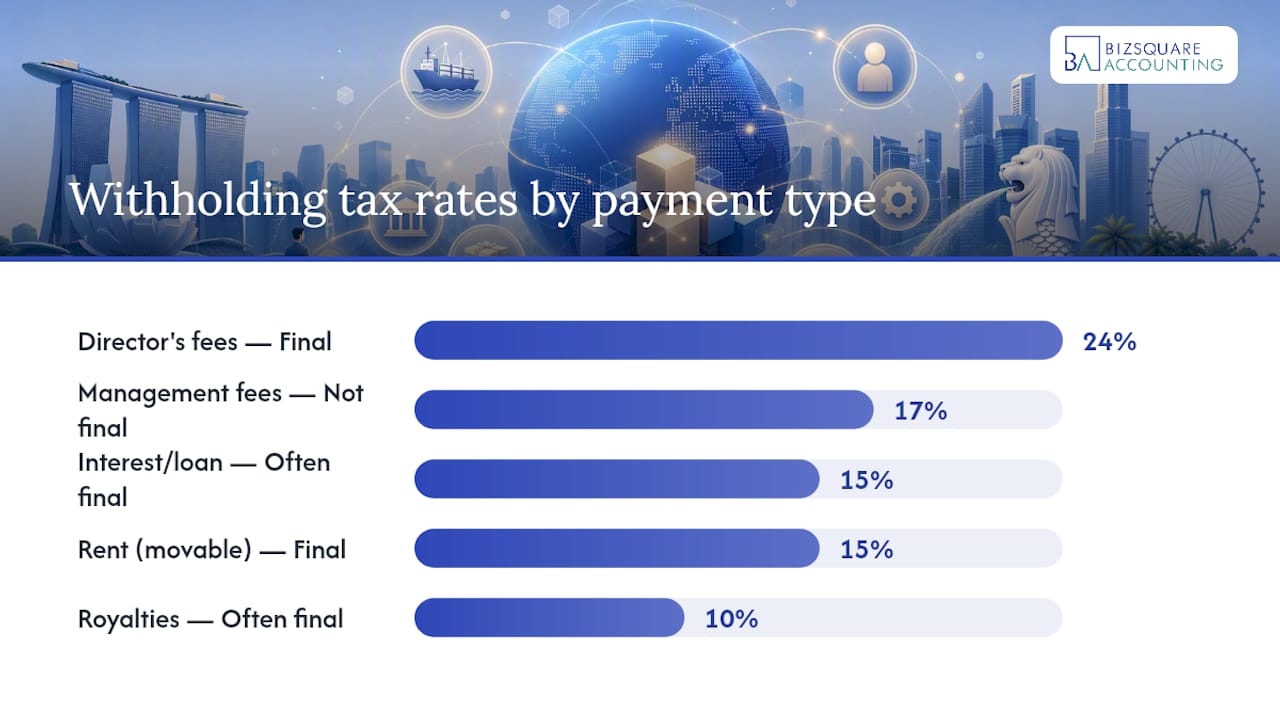
The distinction between final and non-final tax matters enormously for how your vendor gets treated afterwards. Interest and royalties are often treated as a final settlement of the non-resident’s Singapore tax liability, so no further filing is expected from them. Service fees work differently.
When a non-resident company sends staff to perform services physically in Singapore, IRAS taxes the gross fee at the prevailing corporate income tax rate, currently 17%. This is not the final tax. The non-resident company can later submit certified accounts and a tax computation to claim deductions for actual expenses, and reclaim any tax overwithheld on the gross figure.
A handful of payments carry a nil rate. Charter fees for ships operating on time, voyage or bareboat arrangements are exempt, as is interest paid on deposits with banks approved by the Monetary Authority of Singapore. Incorrect classification remains a leading cause of errors, since the rate follows the payment type, not who the vendor happens to be.
How do you claim DTA relief and get a Certificate of Residence
Singapore has signed tax treaties, known as Double Tax Agreements, with dozens of countries. But relief is not automatic. Your vendor has to prove tax residency in their home country first.
- Ask the non-resident vendor for a scanned Certificate of Residence, issued by their home tax authority, covering the year the payment falls under.
- Confirm the treaty article that applies to the specific payment type, since royalties, interest and services are usually addressed in separate clauses.
- Tick the relevant DTA relief box when filing the WHT return through myTax.
- Upload the Certificate of Residence within the timeframe IRAS sets for that filing year. For example, a COR covering 2025 payments generally needs to reach IRAS by 31 March 2026.
- Keep a copy of the COR and the filing confirmation on record for at least five years.
Pro Tip: Request the Certificate of Residence from your vendor the moment a contract is signed, not the week before filing is due. Overseas tax authorities can take weeks to issue one, and a missed deadline means paying the full standard rate with no easy way back.
Timing matters more than most payers realise. Practical COR deadlines are tied to the filing year, not the payment month, so a payment made in December still needs supporting documents lodged early the following year. Miss the window and IRAS will process the filing at the standard, non-treaty rate, leaving your vendor to chase a refund later, if one is even possible.
Filing and paying withholding tax through myTax
Every withholding tax filing follows the same rhythm, regardless of payment type. Payment date, then filing deadline, then GIRO deduction if you have that arrangement set up.

Consider a payment made on 10 January. The filing and payment deadline falls on the 15th day of the second month after that, which is 15 March. If you pay via GIRO, IRAS will typically deduct the amount from your linked bank account around the 25th of that same month, giving you a short buffer after the filing deadline itself.
Filing itself happens through the myTax Portal. The process generally runs like this:
- Log in to myTax.iras.gov.sg using your CorpPass credentials.
- Select the S45 form corresponding to the payment type made.
- Enter the payment details, including the gross amount, payment date and recipient information.
- Indicate whether DTA relief applies and attach the Certificate of Residence if claiming a reduced rate.
- Submit the filing and settle payment before the due date, either via GIRO, internet banking or cheque.
Some payments qualify for a lighter touch. Records that are fully exempt under a DTA or the Approved Royalties Incentive can be consolidated and filed twice a year, on 15 June and 15 December, rather than filed individually every time a payment goes out. This saves administrative time for businesses with regular, low-risk cross-border payments.
Mistakes happen even in well-run finance teams. If you spot an error after submission, IRAS allows amendments through the S45 view or amend function in myTax, and this generally covers records filed within the last two years. Refunds, where IRAS agrees one is due, are usually processed within around 30 days.
| Filing scenario | Deadline or timing |
|---|---|
| Standard WHT filing | 15th day of second month after payment |
| GIRO deduction | Typically around 25th of the filing month |
| Consolidated exempt filings | 15 June and 15 December |
| Amendment window | Up to two years from original filing |
| Typical refund processing | Around 30 days once approved |
What mistakes trigger IRAS penalties and how to avoid them
Most withholding tax problems trace back to a handful of recurring errors. Recognising them early saves your finance team from unnecessary correspondence with IRAS.
- Classifying a payment incorrectly, such as treating a technical service fee as a royalty, which changes the applicable rate entirely.
- Forgetting that a DTA exemption still requires a filing, not just silence because no tax is due.
- Missing the Certificate of Residence deadline and losing the reduced treaty rate as a result.
- Failing to withhold any tax at all, often because the payment was processed by a department unaware of the rule.
- Paying late, even by a few days, which triggers automatic penalties and interest charges.
- Overlooking non-resident director’s fees, which IRAS treats as taxable regardless of whether the director physically attended board meetings in Singapore.
Late payment penalties typically start at a percentage of the unpaid tax and can escalate the longer the amount remains outstanding. For non-resident director’s fees specifically, IRAS often issues a Confirmation of Payment letter once the tax is settled, and companies should keep this on file as proof of compliance.
Pro Tip: Build a simple vendor onboarding checklist that flags non-resident status before any invoice reaches accounts payable. Catching this at the contract stage is far cheaper than untangling a missed withholding after the money has already left the country.
Three worked examples of withholding tax calculations
Numbers make this clearer than any explanation. Here are three common scenarios finance teams encounter.
Example 1: Royalty payment to a non-resident licensor
With a valid Certificate of Residence submitted on time, withholding drops to $8,000. The company files the S45 form, ticks the DTA relief box, attaches the COR, and remits $8,000 by the 15th of the second month.
Example 2: Service fees for work performed in Singapore
A non-resident consulting firm sends two consultants to Singapore for a three-week project, billing $80,000 gross. This is not the final tax. The consulting firm can later file certified accounts showing actual project costs and claim a refund on any tax overwithheld against its real profit margin.
Example 3: Non-resident director’s fee
A Singapore company pays a non-resident board director $40,000 for the year. The company files and remits by the deadline, then requests a Confirmation of Payment letter for its records.
Before filing any of these, confirm the vendor’s residency status, gather the Certificate of Residence if relief is being claimed, and check the deadline against your payment date.
A quick compliance checklist before you pay a non-resident
Print this out, or paste it into your accounts payable workflow. Every cross-border payment should pass through these steps before the money leaves your account.
- Confirm whether the recipient is a non-resident individual or company under Singapore’s tests.
- Classify the payment type correctly, since the rate depends on this alone.
- Request a Certificate of Residence early if you plan to claim DTA relief.
- Calculate the correct withholding amount using the current rate table.
- File through myTax and remit payment by the 15th of the second month after payment.
- Retain the COR, filing confirmation, and any Confirmation of Payment letters for at least five years.
- Log any refund claims and follow up if the 30-day processing window has passed without a response.
When should you bring in a tax adviser for withholding tax
Some situations call for more than a checklist. If a payment classification genuinely sits between categories, such as a hybrid licensing and services contract, getting professional input avoids an expensive misstep. Large one-off payments, complex treaty questions involving multiple jurisdictions, or intra-group allocations across regional entities all raise the stakes considerably.
Permanent establishment exposure is another trigger. If your overseas vendor has staff working from a Singapore office for an extended period, this can shift their tax position entirely, sometimes overriding the treaty benefit you were expecting to apply. A comparison of branch versus subsidiary structures illustrates how differently tax authorities treat a fixed presence compared with a standalone local entity, a principle that carries across borders.
Before meeting an adviser, gather your invoices, the underlying contracts, evidence of where the service was actually performed, and copies of prior WHT filings for the same vendor relationship. This saves time and lets the adviser focus on the actual grey area rather than reconstructing the paper trail from scratch. Outsourcing withholding tax administration tends to pay for itself once a company handles more than a handful of cross-border payments a year, purely through avoided penalties and recovered treaty relief.
A note from Bizsquare on getting withholding tax right
Withholding tax compliance rewards preparation, not panic. Companies that build vendor checks into their payment process from day one rarely face penalty letters from IRAS. Those that treat it as an afterthought usually learn the hard way, often through a late payment penalty on a payment they did not even realise qualified.
Bizsquare Accounting works with Singapore businesses across incorporation, bookkeeping, corporate tax filing, and cross-border tax advisory, including withholding tax classification and Certificate of Residence submissions. For a broader view of how withholding tax interacts with your annual filings, our complete guide to filing corporate tax in Singapore covers the full compliance calendar most companies need to track.
How Bizsquare Accounting takes withholding tax off your plate
Chasing down vendor residency status, tracking treaty rates, and hitting IRAS deadlines every month pulls finance teams away from work that actually grows the business. Bizsquare Accounting exists to carry that load for you, so cross-border payments stop being a source of dread every time an overseas invoice lands in your inbox.

Our team validates vendor status before payment goes out, classifies each transaction against the correct rate, prepares and files the S45 return through myTax, and manages Certificate of Residence collection so treaty relief never slips through the cracks. This sits alongside our broader accounting and bookkeeping services, corporate tax filing and advisory, and outsourced CFO support for businesses managing regular cross-border activity. If your company is newly incorporated and still setting up its finance processes, our company incorporation service can build compliance in from the very start, rather than retrofitting it later.
If withholding tax deadlines have been slipping through the cracks, get in touch with Bizsquare Accounting today to book a consultation and put a proper system in place before your next cross-border payment goes out.
Sources
For readers who want to verify these rules directly, the following IRAS pages and statutory references cover the details discussed above.
This article offers general information on Singapore withholding tax rules and does not replace tailored professional advice. Confirm current rates and deadlines with IRAS or a qualified tax adviser before making cross-border payments.
This article is general information, not a substitute for advice from a qualified financial advisor. Consult a qualified financial professional about your own circumstances before acting on anything here.
FAQ
How do you avoid the 24% withholding tax on non-resident director’s fees?
The rate is fixed by residency status and payment type, not negotiable through structuring.
What is withholding tax and who actually pays it?
Withholding tax is a portion of a payment deducted at source when a Singapore payer sends money to a non-resident. The Singapore payer withholds and pays it to IRAS, not the non-resident recipient.
How much withholding tax will I need to pay?
The rate depends entirely on payment type.
Who is subject to withholding tax in Singapore?
Non-resident individuals and companies receiving specified payments from a Singapore payer are subject to withholding tax. Residency depends on physical presence for individuals and control and management location for companies.
What happens if I miss the withholding tax filing deadline?
IRAS charges late payment penalties and interest on the outstanding amount. Filing and payment are due on the 15th day of the second month after the payment date.
Do I still need to file if the payment is exempt under a tax treaty?
Yes. IRAS requires a filing even when a Double Tax Agreement or the Approved Royalties Incentive reduces the rate to zero.
How do I claim a reduced withholding tax rate under a DTA?
Tick the DTA relief option when filing through myTax and submit a scanned Certificate of Residence from the recipient’s home tax authority within the deadline for that filing year.
Is withholding tax on service fees the final tax?
No. Withholding on service fees performed in Singapore is calculated on gross fees but is not final. The non-resident company can later submit certified accounts to claim deductions and any refund due.
Can I amend a withholding tax filing after submission?
Yes, through the S45 view or amend function in myTax, generally for records filed within the last two years.
How long does an IRAS withholding tax refund take?
Refunds are typically processed within around 30 days once IRAS agrees that an overpayment has occurred.
What documents do I need to claim DTA relief?
You need a scanned Certificate of Residence covering the relevant payment year, plus supporting contract or invoice details showing the nature of the payment.
Are any payments to non-residents exempt from withholding tax?
Yes. Time, voyage and bareboat charter fees for ships, and interest on deposits with approved banks, are exempt from withholding tax.
Can Bizsquare Accounting help with withholding tax filings?
Yes. Bizsquare Accounting validates vendor residency status, classifies payments correctly, prepares S45 filings through myTax, and manages Certificate of Residence collection for Singapore businesses.


1 Comment
5 Step Board Checklist for Dividends in Singapore: Section 403 and Tax
September 28, 2026, at 8:40 am[…] generally not subject to Singapore withholding tax, a point worth understanding alongside broader withholding tax obligations that can apply to other cross-border […]