

Why prepare a cash flow statement for your business
Prepare a cash flow statement to know exactly how much cash enters and leaves your business in any given period. This single document answers the question your profit and loss report cannot: does your business actually have the money to pay its bills today?
Three immediate benefits make it worth the effort:
- Avoid cash shortfalls. Spot gaps before they become crises, giving you time to act.
- Assess financing needs. Know precisely when and how much external funding you require.
- Strengthen stakeholder credibility. Lenders and investors trust businesses that present clear cash data.
The rest of this guide shows you how to prepare, read, and use the statement to manage your business with confidence.
Key takeaways
A cash flow statement is the most direct tool a business owner has for understanding liquidity, and preparing it consistently is what separates reactive cash management from proactive financial control.
| Point | Details |
|---|---|
| Cash flow vs profit | Profit does not equal cash; the statement shows what is actually available to spend. |
| Three sections | Operating, investing, and financing activities each reveal a different dimension of cash health. |
| Indirect method | Most SMEs use the indirect method, starting from net profit and adjusting for non-cash items. |
| Quality of earnings | A large gap between net profit and operating cash flow signals earnings not yet backed by cash. |
| Bizsquare support | Bizsquare’s accounting, bookkeeping, and outsourced CFO services help businesses prepare accurate statements and act on them. |
Why prepare a cash flow statement? The core reason
The primary purpose of a cash flow statement is to provide relevant information about cash receipts and payments during a period. That information tells you whether the business generates enough cash to meet its obligations and fund daily operations, which is the foundation of avoiding insolvency.
Profit figures can be misleading. A business can report a healthy net profit while simultaneously running short of cash, because accrual accounting records revenue when it is earned, not when it is collected. The cash flow statement cuts through that ambiguity. It shows the real position: cash in, cash out, and what remains.
What is a cash flow statement, and how does it differ from profit and the balance sheet?
A cash flow statement is a financial report that tracks all cash receipts and payments over a specific period, typically a month, a quarter, or a financial year.
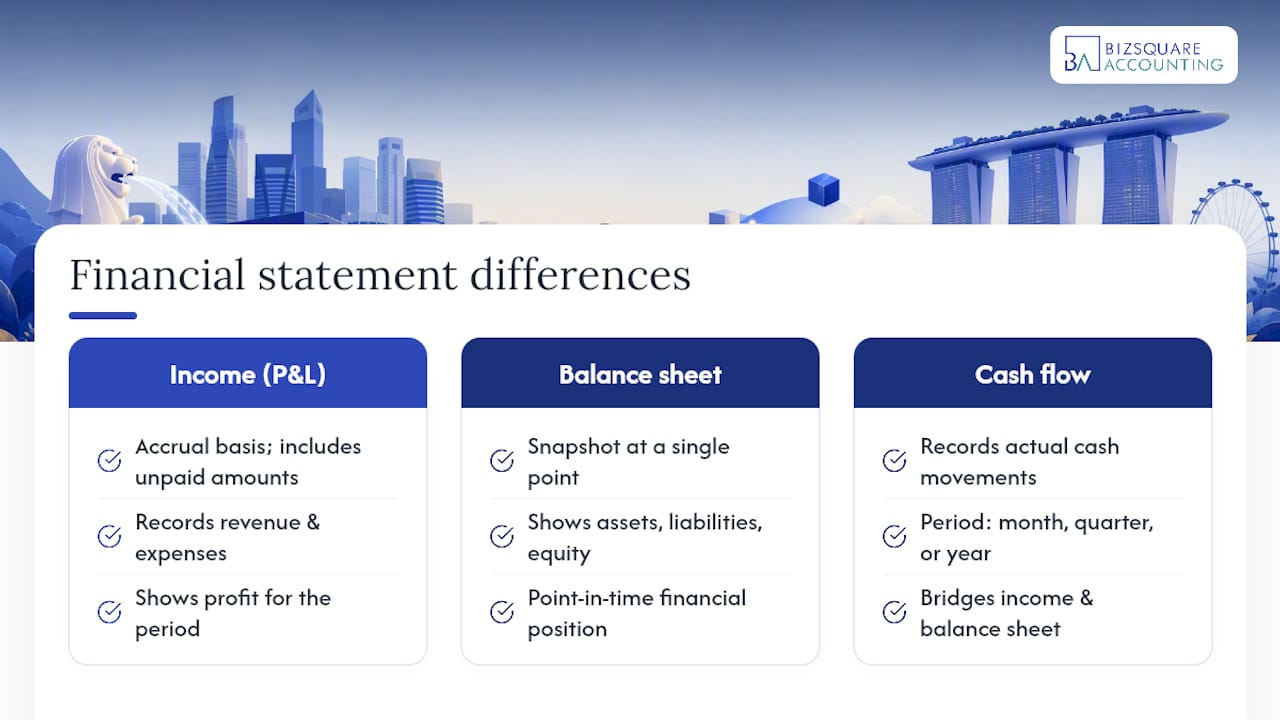
The profit and loss (income) statement records revenue and expenses on an accrual basis, including amounts not yet received or paid. The cash flow statement records only actual cash movements. The balance sheet shows assets, liabilities, and equity at a single point in time. The cash flow statement serves as the bridge between the income statement and the balance sheet, explaining how the opening cash balance became the closing cash balance.
That distinction matters for everyday decisions. A business owner who reads only the profit figure may approve a large purchase, unaware that £80,000 of that profit sits in unpaid invoices. The cash flow statement makes that gap visible immediately.
What are the core purposes and benefits of cash flow statements?
Cash flow is often more important than profit for short-term survival, because it funds day-to-day operations and debt servicing. Regular cash flow reporting delivers several concrete advantages:
- Liquidity monitoring. Track whether the business holds enough cash to cover payroll, rent, and supplier payments each month.
- Forecasting. A cash flow forecast tells you how much cash you will need in future periods, helping to plan hires, purchases, and investments.
- Investing and financing decisions. Identify surplus cash available for capital expenditure, or recurring shortfalls that signal a need for a credit facility.
- Quality of earnings assessment. Reconciling net income to cash reveals whether profits are backed by real cash or by non-cash items such as accrued revenue.
- Stakeholder reporting. Lenders, investors, and board members rely on cash flow data to assess liquidity and repayment capacity before committing funds.
Key insight: Operating cash flow is the critical short-term metric. Profits matter for long-term success, but cash keeps operations running. A business with strong profits and weak operating cash flow is a business at risk.
Business owners use the statement to calculate cash runway, the number of months the business can operate without new revenue. Finance managers use it to model debt servicing capacity before approaching lenders. For more on managing cash effectively, see Bizsquare’s guide on the importance of cash flow management for small businesses.
How is a cash flow statement structured?
Cash flow reporting covers three sections: operating, investing, and financing activities, plus an opening and closing cash balance.
- Operating activities. Cash generated or used by the core business: collections from customers, payments to suppliers, wages, rent, and taxes.
- Investing activities. Cash spent on or received from long-term assets: buying equipment, selling property, or making investments.
- Financing activities. Cash from or returned to funders: loan drawdowns, repayments, share issuances, and dividend payments.
- Opening cash balance. The cash position at the start of the period, taken directly from the prior period’s closing balance.
- Closing cash balance. Opening cash plus or minus the net movement across all three sections.
Direct method vs indirect method
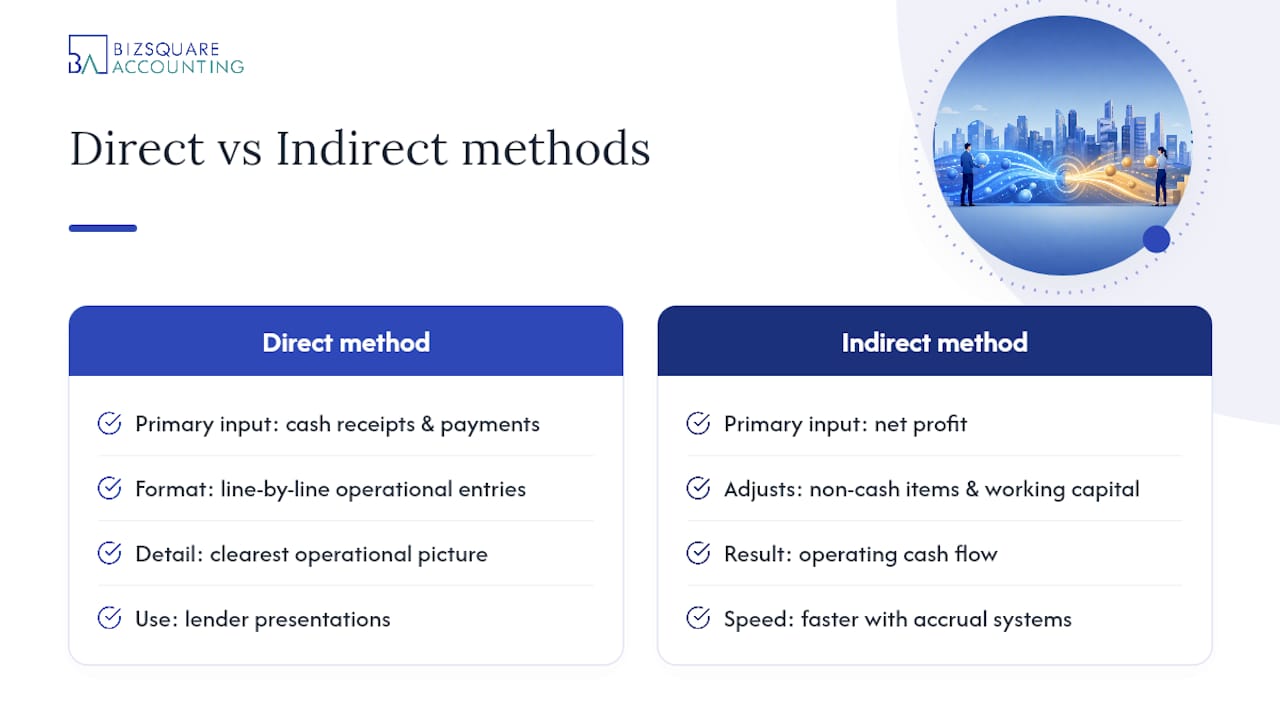
The direct method lists actual cash receipts and payments line by line, giving the clearest operational picture. The indirect method starts with net profit and adjusts for non-cash items and working capital changes to arrive at operating cash flow. The indirect method is faster for most accrual accounting systems, while the direct method gives clearer operational detail. Most small and medium-sized businesses use the indirect method because it draws directly from existing accounting records.
Pro Tip: If your accounting software uses accrual-basis records, start with the indirect method. You can always produce a direct-method supplementary schedule later for lender presentations.
How do you prepare a cash flow statement, step by step?
The preparation process follows a repeatable sequence: establish opening cash, calculate operating cash, record investing and financing flows, compute closing cash, and reconcile.
- Find the opening cash balance. Take the closing cash figure from the previous period’s statement or bank reconciliation.
- Choose your method. Select the indirect method (net profit adjusted for non-cash items) or the direct method (actual receipts and payments listed).
- Calculate operating cash flow (indirect method). Start with net profit. Add back depreciation and amortisation. Adjust for changes in working capital: subtract increases in trade receivables, add increases in trade payables, subtract increases in inventory.
- Record investing activities. List cash paid for equipment, property, or investments, and cash received from asset disposals.
- Record financing activities. List loan proceeds received, loan repayments made, share capital raised, and dividends paid.
- Compute the closing cash balance. Add operating, investing, and financing net cash flows to the opening balance.
- Reconcile to the bank statement. Confirm the closing cash balance matches the bank statement and petty cash on hand.
Pro Tip: Tag every non-cash transaction in your accounting records, such as depreciation, amortisation, and unrealised gains, so they are easy to identify and adjust during preparation.
Review checklist before finalising
- All non-cash items removed from operating cash flow
- Investing and financing flows classified correctly
- Closing balance reconciles to the bank statement
- Prior period opening balance matches last period’s closing balance
- No transactions counted twice across sections
A worked example you can reproduce in a spreadsheet
The table below shows a compact example for a small trading company, Greenfield Supplies Ltd, for the month of March 2026.
Each row maps directly to a step in the preparation process above. The closing balance of £15,200 must match the bank statement for March. If it does not, revisit the reconciliation before publishing the statement.
For a ready-to-use layout, copy this structure into Excel with one column for labels and one for amounts. Add a third column for the prior period to enable month-on-month comparison. Bizsquare’s guide on how to prepare financial statements provides a complementary template and step-by-step reference.
How do you use the cash flow statement to control cash and make decisions?
Effective cash flow management and forecasting improve liquidity and resilience, and the statement is the starting point for both. Once prepared, it drives a range of practical decisions:
- Budgeting. Compare actual cash flows against the budget to identify variances early.
- Working capital moves. Shorten payment terms for slow-paying customers or negotiate extended terms with suppliers.
- Capex timing. Delay or accelerate equipment purchases based on projected cash availability.
- Dividend policy. Confirm free cash flow is sufficient before declaring a dividend.
- Financing discussions. Present operating cash flow trends to lenders when applying for a credit facility or term loan.
KPIs to track from the statement
- Operating cash flow ratio. Operating cash flow divided by current liabilities. A ratio above 1.0 indicates the business can cover short-term obligations from operations.
- Free cash flow. Operating cash flow minus capital expenditure. This is the cash available for growth, debt repayment, or distribution.
- Days sales outstanding (DSO). Average trade receivables divided by daily revenue. A rising DSO signals slower collections and a future cash squeeze.
- Cash conversion cycle. Days inventory outstanding plus DSO minus days payable outstanding. A shorter cycle means cash returns to the business faster.
Pro Tip: Review these KPIs monthly alongside the statement. A single month of weak operating cash flow is a data point; two or three consecutive months is a trend that requires action.
Cash flow statements can reveal surplus cash for investment or recurring shortfalls that require action, such as improving collections. When shortfalls appear consistently, that is the signal to approach a lender or financial adviser, with at least three months of cash flow statements prepared and ready to present.
What are the most common cash flow statement mistakes?
Errors in cash flow statements usually fall into a small number of categories. Recognising them in advance saves significant rework.
Common errors:
- Forgetting to add back depreciation and other non-cash charges in the indirect method
- Misclassifying a financing payment as an operating expense, or vice versa
- Failing to reconcile the closing balance to the bank statement
- Double-counting a loan repayment in both operating and financing sections
- Omitting seasonal cash movements, such as a large VAT payment in January or a pre-Christmas stock build
Quick reconciliation checklist:
- Confirm opening balance matches the prior period’s closing balance.
- Verify all depreciation and amortisation figures are added back.
- Check that changes in receivables, payables, and inventory are correctly signed (an increase in receivables is a cash outflow).
- Confirm each investing and financing item appears in only one section.
- Reconcile the closing balance to the bank statement line by line.
Seasonal cash effects deserve a brief note in the statement or accompanying commentary. A retail business that builds inventory in October and November will show a large investing or operating outflow in those months. Presenting that movement without context can alarm a reader who does not know the business cycle. A one-line note, such as “October inventory build ahead of peak trading season,” removes the ambiguity.
Who should prepare the statement, and how often?
The right owner and cadence for cash flow reporting depends on the business type and its current stage.
- Startups and retail businesses benefit from weekly cash flow tracking, given their sensitivity to daily cash movements and the speed at which a shortfall can become critical. For more on this, see Bizsquare’s resource on why startups need accounting for sustainable growth.
- SMEs typically prepare a formal cash flow statement monthly, which balances detail with the time available to management.
- Established businesses with longer operating cycles may find quarterly statements sufficient for strategic planning, supplemented by monthly bank reconciliations.
Roles and responsibilities:
- Bookkeeper. Maintains the transaction records that feed the statement. Accuracy at this level determines the quality of the output.
- Accountant. Prepares or reviews the statement, applies the correct method, and ensures compliance with applicable standards.
- Finance manager or CFO. Interprets the statement, tracks KPIs, and presents findings to the board or lenders.
- Outsourced CFO. Provides the same analytical function as an in-house CFO for businesses that do not yet justify a full-time hire.
Upgrade the frequency of reporting when the business is growing rapidly, when a financing round is approaching, or when cash has been tight for two or more consecutive months. At that point, involving an external adviser, such as an outsourced CFO, adds significant value. Bizsquare’s accounting and bookkeeping services support businesses at each of these stages.
The case for making cash flow reporting a discipline, not an afterthought
Most businesses that encounter a cash crisis do not lack profit. They lack visibility. The cash flow statement is the instrument that provides that visibility, and the businesses that prepare it consistently tend to negotiate better credit terms, make more confident investment decisions, and face fewer unpleasant surprises at month-end.
The practical priorities are straightforward: establish a monthly reporting routine, automate collections where possible, monitor the four KPIs outlined above, and build a cash reserve equivalent to at least two months of operating expenses. When the business reaches a point where the finance function demands more time than the owner can give, outsourcing to a qualified accountant or CFO is the logical next step, not a sign of weakness.
Bizsquare helps you build a clear cash flow picture

Bizsquare offers a direct alternative to managing cash flow reporting alone. The team handles accounting and bookkeeping with the precision that accurate cash flow statements require, and the outsourced CFO and corporate advisory service takes that further, providing forecasting, KPI tracking, and financing support tailored to your business stage. For businesses that need clean records as the foundation, Bizsquare’s bookkeeping service ensures every transaction is correctly classified before the statement is prepared. The result is a cash flow statement you can present to a lender or board with confidence, prepared on a schedule that keeps your decision-making current. Contact Bizsquare to arrange a financial review or to get started with a cash flow template and setup guidance.
Sources
- Cash flow management and reporting guide for businesses | JPMorgan
- Cash flow statement explained | NetSuite
- What is cash flow in business? | LivePlan
- Business
- How to prepare a cash flow statement | Harvard Business School Online
- Purpose of the cash flow statement – FMX | Fiscal Management
This article is general information, not a substitute for advice from a qualified financial advisor. Consult a qualified financial professional about your own circumstances before acting on anything here.
FAQ
1.) Why is it important to prepare a cash flow statement?
A cash flow statement shows whether a business can meet its obligations and fund operations, which profit figures alone cannot confirm. It is the primary tool for avoiding insolvency and planning financing needs.
2.) What is the primary purpose of a cash flow statement?
The primary purpose is to provide relevant information about cash receipts and payments during a period, enabling owners, lenders, and investors to assess liquidity and financial health.
3.) What are three key benefits of having a cash flow statement?
The three main benefits are: identifying cash shortfalls before they become critical, supporting financing decisions with concrete data, and demonstrating financial credibility to lenders and investors.
4.) Is it mandatory to prepare a cash flow statement in the UK?
Large and medium-sized companies under FRS 102 or IFRS, and listed companies under IAS 7, are generally required to include a cash flow statement. Small companies and micro-entities may be exempt; confirm your obligation with a qualified accountant each year.
5.) How often should a business prepare a cash flow statement?
Startups and retail businesses benefit from weekly tracking, SMEs typically prepare a formal statement monthly, and established businesses with longer operating cycles may find quarterly preparation sufficient for strategic planning.
6.) What is the difference between the direct and indirect method?
The direct method lists actual cash receipts and payments line by line, while the indirect method starts with net profit and adjusts for non-cash items and working capital changes. Most SMEs use the indirect method because it draws directly from existing accounting records.
7.) What does reconciling net income to cash flow reveal?
The reconciliation reveals the quality of earnings. A large gap between net profit and operating cash flow indicates that profits are tied up in receivables or non-cash items rather than available as spendable cash.
8.) What are the most common mistakes when preparing a cash flow statement?
The most common errors include forgetting to add back depreciation, misclassifying financing payments as operating expenses, and failing to reconcile the closing balance to the bank statement.
9.) When should a business seek professional help with cash flow reporting?
A business should involve a qualified accountant or outsourced CFO when cash has been tight for two or more consecutive months, when a financing round is approaching, or when the finance function demands more time than the owner can manage.
10.) How does a cash flow statement help when applying for a loan?
Lenders use the operating cash flow trend and the cash conversion cycle to assess repayment capacity. Presenting at least three months of prepared statements significantly strengthens a financing application.


1 Comment
Stop Cash Surprises: 13-Week Cash Flow Finance Teams Can Run Weekly
September 10, 2026, at 9:02 am[…] Why prepare a cash flow statement for your business […]