


Why Business Advisory Matters for Singapore Growth
Overview
Business advisory is an ongoing strategic partnership that connects financial insights with organizational growth, reducing decision risk. It differs from consulting by fostering deep familiarity and forward-looking guidance that evolves over time, enhancing capabilities for growth and transitions. Building networks of specialized advisors amplifies outcomes, making advisory essential for Singapore SMEs facing complex regulatory and market challenges.
Business owners in Singapore often reach a critical juncture where their instincts, experience, and existing team are no longer sufficient to navigate the complexity ahead. Why business advisory matters becomes sharply relevant at exactly that point. Many leaders assume advisory is simply a formalized version of accounting or a one-time consulting engagement. It is neither. Business advisory is a sustained, strategic partnership that connects financial data with organizational direction, reduces decision risk, and prepares companies to grow with confidence rather than guesswork.
Table of Contents
- Key takeaways
- Defining business advisory and how it differs
- Key benefits of business advisory for Singapore businesses
- How advisory supports strategic growth and transitions
- The psychological side of effective advisory
- My perspective on advisory as a critical investment
- How Bizsquareaccounting supports your advisory needs
- FAQ
Key takeaways
| Point | Details |
|---|---|
| Advisory is not consulting | Business advisory is an ongoing partnership, not a fixed-term project, and compounds value over time. |
| Risk identification is central | Advisors close the gap between internal blind spots and external threats before those threats become costly. |
| Psychological trust drives results | Technical expertise alone does not produce implementation success; emotional intelligence in advisory relationships is critical. |
| Growth requires preparation | Advisory supports scaling, restructuring, and exit planning, not just daily operations. |
| Networks amplify outcomes | Sophisticated owners build teams of four to seven specialized advisors rather than relying on a single generalist. |
Defining business advisory and how it differs
The confusion is understandable. Accountants prepare financial statements. Consultants arrive with a scoped deliverable, complete a project, and exit. A business advisor occupies a fundamentally different role. As ongoing advisory research confirms, advisory is a continuing relationship where deep familiarity with a business allows the advisor to catch second-order decision effects before they materialize. That kind of foresight is impossible in a six-week engagement.
The distinction matters practically. A consultant might redesign a company’s sales process and hand over a report. An advisor would ask why the sales process broke down, whether the leadership team is incentivized correctly, what the downstream cash flow implications are, and whether the planned fix creates a compliance or capacity problem twelve months later. Consultants solve defined problems. Advisors help leaders define which problems are actually worth solving.
Here is how the three roles compare at a functional level:
- Accountant: Prepares financial records, manages statutory compliance, files tax returns, and reports historical performance.
- Consultant: Engages on a fixed-scope project, delivers a specific output (process redesign, market entry plan, technology audit), and concludes the engagement.
- Business advisor: Maintains an ongoing relationship, provides forward-looking strategic guidance, challenges assumptions, and evolves recommendations as the business changes.
The critical variable is time. Advisors provide more value over time because they accumulate nuanced knowledge of a business and its ecosystem. A consultant hired twice a year will never understand a company the way an embedded advisor does after eighteen months.
Pro Tip: Before engaging any external professional, diagnose the actual need. If the problem is execution with a clear scope, a consultant or advisor is the right choice. If the need is ongoing strategic judgment and a thinking partner for leadership, an advisory relationship will serve the business far better.
Leaders must diagnose their needs correctly to avoid wasting resources on the wrong type of external support.
Key benefits of business advisory for Singapore businesses
The practical case for business advisory in Singapore is grounded in specific, measurable outcomes. Singapore’s regulatory environment, competitive intensity, and the pace of regional economic shifts create conditions where internal management teams frequently face challenges that exceed their existing expertise. Advisory fills that gap in ways that produce tangible results.
- Risk identification and management. Most business leaders manage risks they already know about. The dangerous ones are the risks they have not yet recognized. Most business leaders face unmanaged or poorly understood risks internally, a gap that external advisors systematically close by bringing disciplined risk identification methods and an outside perspective unclouded by internal politics or familiarity bias.
- Operational structure and process improvement. Advisors evaluate how a business operates against how it should operate at the next stage of growth. This includes organizational design, resource allocation, vendor relationships, and technology infrastructure. The result is a business that runs more efficiently at scale rather than one that simply adds headcount to handle more volume.
- Revenue growth through financial clarity. Sustainable revenue growth is rarely a sales problem alone. It is typically connected to pricing strategy, margin management, customer segmentation, and cash flow forecasting. Advisors bring the financial modeling and strategic frameworks to identify where revenue growth is real and where it is masking a profitability problem. Singapore SMEs that engaged advisory services experienced up to 44% revenue growth over defined periods.
- Cost reduction and margin improvement. One of the less discussed but highly practical benefits of business advisory is cost optimization. Companies using advisory roles save between 25% and 50% compared to full-time senior executive costs while still accessing mature expertise. That cost efficiency extends to the advice itself, where targeted guidance prevents expensive mistakes.
- Access to external networks. Advisors bring contacts and connections that accelerate specific outcomes. External advisory networks provide access to capital sources, strategic partners, and deal opportunities that would otherwise take years to cultivate independently. In Singapore’s relationship-driven business culture, this network value is frequently decisive.
The importance of business advisory is particularly pronounced for SMEs, where leadership teams are lean and the cost of a major strategic error is disproportionately high. Having a qualified advisor in the room when significant decisions are made is not a luxury. It is a form of risk management with a clear return.
How advisory supports strategic growth and transitions
Business advisory is not exclusively about fixing what is broken. Its forward-looking function, helping a company prepare for future growth stages and major transitions, may be its most valuable application. Advisory services systematically prepare businesses for future growth stages rather than simply responding to current problems.
Consider the difference between a business that grows reactively and one that grows with preparation. The reactive business hires when overwhelmed, invests when cash happens to be available, and restructures after a crisis forces it to. The prepared business maps its growth trajectory, stress-tests its financial model, and builds the systems and leadership capacity before they are urgently needed. An advisor makes the second scenario achievable.
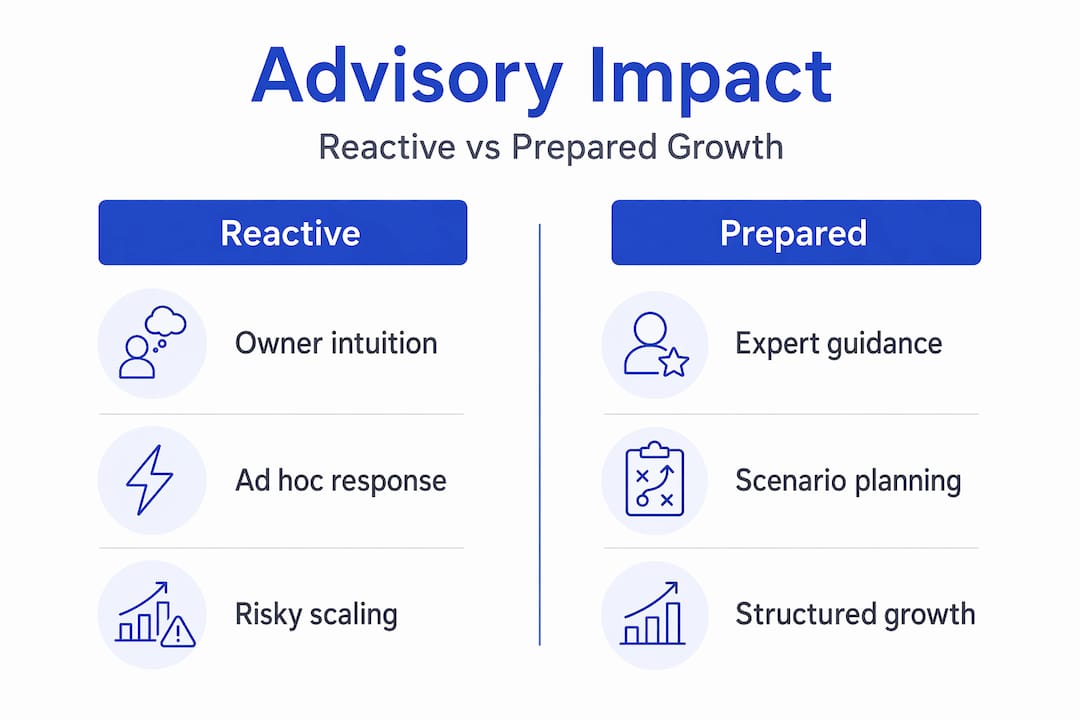
The table below illustrates how advisory support changes across key business stages:
| Business stage | Without advisory | With advisory |
|---|---|---|
| Early growth | Scaling based on owner intuition, unmanaged cash flow risk | Structured financial model, clear hiring plan, risk-adjusted forecasts |
| Market expansion | Reactive entry based on opportunity | Scenario-tested market entry plan, compliance preparation, capital readiness |
| Operational plateau | Owner-level bottleneck, unclear diagnosis | Structural redesign, delegation frameworks, leadership development priorities |
| Exit or succession | Valuation uncertainty, unprepared handover | Months or years of pre-exit preparation, clean financial records, buyer-ready documentation |
Strategic advisory also helps build credible, investor-grade business plans. Stress-tested, scenario-based planning enforced by advisors improves both business resilience and attractiveness to investors and lenders. A bank or private equity firm reviewing a business plan can immediately identify whether it has been rigorously challenged or simply drafted optimistically. An advisor’s involvement signals and creates that rigor.

Pro Tip: If a business is planning to raise capital, pursue an acquisition, or transition ownership within three years, the time to engage an advisor is now. Pre-exit preparation compressed into a few months rarely produces the valuation or outcome that two or three years of deliberate advisory work can create.
For Singapore businesses considering cross-border expansion, advisory provides the structured preparation that reduces regulatory and financial risk. The role of tax advisory in cross-border planning, for instance, is a distinct and critical layer that generalist advisors often refer to specialized partners.
The psychological side of effective advisory
Technical expertise is the entry price for any advisory relationship. What separates a good advisor from a transformational one is the ability to understand how a business owner actually thinks and makes decisions. This is not a soft consideration. It has a direct bearing on whether good advice is ever implemented.
Financial decisions are filtered through emotion before logic, a reality that advisors must manage actively if their strategic recommendations are to produce real-world results. An owner who intellectually accepts a restructuring recommendation but emotionally resists it will delay, dilute, or quietly abandon the implementation. A technically correct plan that fails to account for this dynamic delivers no value.
The most effective advisory relationships are built on the following foundations:
- Trust established over time. Owners share information they would never share publicly when they trust the advisor’s discretion and judgment.
- Emotional attunement. Advisors recognize when resistance is financial, psychological, or relational, and they address the actual barrier rather than repeating the technical argument.
- Accountability without judgment. The advisor’s role includes holding the owner responsible for commitments, which requires a relationship secure enough to sustain that honest pressure.
- Adapting communication style. Some owners process information analytically. Others need narrative context. Effective advisors match the format to the client, not the other way around.
“Transforming the advisor’s role from a technician to a trusted partner improves implementation success.” — Thomson Reuters Advisory Research
The practical implication is that when evaluating advisory relationships, business owners should assess not only credentials and sector experience, but also how well the advisor listens, challenges assumptions diplomatically, and communicates during disagreement. The advisor who only tells owners what they want to hear may be technically capable but is functionally useless when it matters most.
How Bizsquare supports your advisory needs
For Singapore business owners who recognize the importance of advisory but are uncertain where to begin, Bizsquare offers a practical starting point grounded in local expertise and genuine strategic depth.
Bizsquare corporate advisory and outsourced CFO services are designed for SMEs and growing companies that need experienced strategic guidance without the cost of full-time executive hiring. From financial modeling and business planning to compliance structuring and decision support, the team brings advisory engagement that evolves with the business. For companies at earlier stages, Bizsquare also provides company incorporation in Singapore alongside bookkeeping and accounting services that build the financial foundation advisory relationships depend on.
FAQ
What is business advisory, and how does it differ from consulting?
Business advisory is an ongoing strategic partnership where an advisor provides continuous guidance aligned with a company’s growth and decisions. Consulting, by contrast, is project-based with a fixed scope and a defined end date.
Why does business advisory matter specifically for Singapore SMEs?
Singapore SMEs operate in a high-compliance, competitive environment where strategic errors carry significant financial consequences. Advisory closes the gap between internal expertise and the complexity of scaling, regulatory management, and market transitions.
How do business advisors help with risk management?
Advisors apply structured, external risk identification methods to surface vulnerabilities that internal teams often overlook, as most leaders manage poorly understood risks without outside perspective.
When is the right time to hire a business advisor?
The right time is before a major transition, not during one. Businesses planning to scale, raise capital, expand regionally, or prepare for succession benefit most when advisory engagement begins well in advance of those events.
How many advisors should a business owner work with?
Research on advisory networks indicates that sophisticated owners engage four to seven specialized advisors rather than one generalist, which reduces single-point failure risk and improves decision quality across all domains.