

What Is Tax Planning for Singapore Business Owners
TL;DR:
- Tax planning is a proactive process that manages financialdecisions throughout the year to minimize legal tax liabilities. It involves timing income and expenses, choosing appropriate business structures, and utilizing available deductions effectively. Engaging in regular reviews helps entrepreneurs reduce taxes and enhance cash flow while maintaining compliance in Singapore.
Tax planning is the proactive, year-round process of legally organizing financial activities to minimize tax liabilities and preserve after-tax wealth. It differs from tax preparation, which is a reactive filing exercise done once a year. For Singapore business owners and entrepreneurs, understanding what tax planning involves is the difference between paying what the law requires and paying more than necessary. The Inland Revenue Authority of Singapore (IRAS) provides a framework of deductions, exemptions, and incentives that reward businesses who plan ahead. This article explains the core strategies, timing, and benefits of tax planning so entrepreneurs can make better financial decisions throughout the year.
What is tax planning and why does it matter in Singapore?
Tax planning is defined as the analysis of a financial situation to pay the lowest legally permissible tax using available statutes, deductions, and credits. That definition carries a critical word: legally. Tax planning operates entirely within the law. It is not tax evasion, which involves concealing income or falsifying records. Tax planning is the deliberate use of rules that already exist.
For Singapore entrepreneurs, this distinction matters because Singapore’s tax environment is genuinely favorable. The corporate tax rate is capped at 17%, and the Start-Up Tax Exemption scheme allows qualifying new companies to exempt a significant portion of their chargeable income for the first three years. These benefits do not apply automatically. A business must structure its affairs correctly to claim them.
Tax planning also differs from tax compliance. Compliance means filing returns accurately and on time, which is a baseline legal obligation. Planning goes further. It asks: given the income expected this year, what decisions made today will reduce the tax bill legally? That forward-looking question is what separates businesses that manage tax costs from those that simply react to them.
What are the core tax planning strategies for Singapore business owners?
Effective tax planning focuses on four primary levers: timing, income character, account location, and business entity structure. Applying these levers consistently, with clean records, produces durable after-tax savings over time.

Timing income and expenses
Timing is the most accessible strategy for most business owners. Accelerating deductible expenses into the current year and deferring income to the next year reduces taxable income in the period when the tax rate is highest. A Singapore SME expecting a strong revenue year, for example, might prepay certain operating costs or bring forward capital expenditure claims before the financial year closes.
The reverse also applies. A business in a low-revenue year may choose to accelerate income recognition to fill a lower tax bracket before rates climb in the following period. This approach requires forecasting, not guesswork.
Choosing the right business entity and compensation structure
The legal structure of a business directly affects its tax treatment. A sole proprietorship in Singapore is taxed at personal income tax rates, which can reach 24% for higher earners. A private limited company pays corporate tax at a maximum of 17%, with partial exemptions available. For profitable businesses, incorporation often produces a measurable tax advantage.
Compensation structure also matters. Business owners who pay themselves a salary, a director’s fee, or a combination of both face different tax outcomes. Salary is deductible for the company but taxable for the individual. Dividends paid from after-tax profits are exempt from further tax in Singapore under the one-tier tax system. Structuring the mix of salary and dividends correctly can reduce the combined tax burden on both the company and the owner.
Using available deductions and tax incentives
Singapore’s tax framework includes deductions for qualifying business expenses, capital allowances on fixed assets, and industry-specific incentives administered by the Economic Development Board (EDB). Entrepreneurs who document expenses accurately and claim every eligible deduction reduce their chargeable income without any aggressive maneuvering.
Key deductions available to Singapore companies include:
- Qualifying business expenses such as staff costs, rent, and professional fees
- Capital allowances on plant, machinery, and equipment under Section 19 and 19A of the Income Tax Act
- Startup tax exemptions for new companies in their first three years of assessment
- Productivity and Innovation Credit schemes for qualifying research and development activities
- Double tax deductions for qualifying international business development expenses
Pro Tip: Keep a running log of all business expenses in a cloud-based accounting system throughout the year. Expenses forgotten at year-end cannot be claimed retroactively, and the IRAS does not accept estimates.
Quarterly reviews and mid-year checkups
Tax planning is not a once-a-year task. Quarterly financial reviews allow business owners to monitor income against projections, adjust estimated tax payments, and catch problems before they become penalties. A mid-year review in the may to july window is particularly valuable, as it leaves enough time to implement changes before the financial year closes.
How does proactive tax planning differ from tax preparation?
Conflating tax compliance with tax planning limits a business’s ability to reduce liabilities proactively. The distinction is worth understanding precisely.
Tax preparation is the process of compiling financial records and filing a tax return after the financial year ends. It is backward-looking. The numbers are fixed, and the only task is reporting them accurately to the IRAS.
Tax planning is forward-looking. It happens before transactions occur, before income is received, and before expenses are committed. A business that plans taxes asks: “What is the tax consequence of this decision before we make it?” A business that only prepares taxes asks: “What do we owe based on what already happened?”
Tax compliance sits between the two. Compliance means meeting all filing deadlines, paying estimated taxes on time, and maintaining records that satisfy IRAS audit requirements. Compliance is mandatory. Planning is optional, but the businesses that skip it consistently pay more tax than necessary.
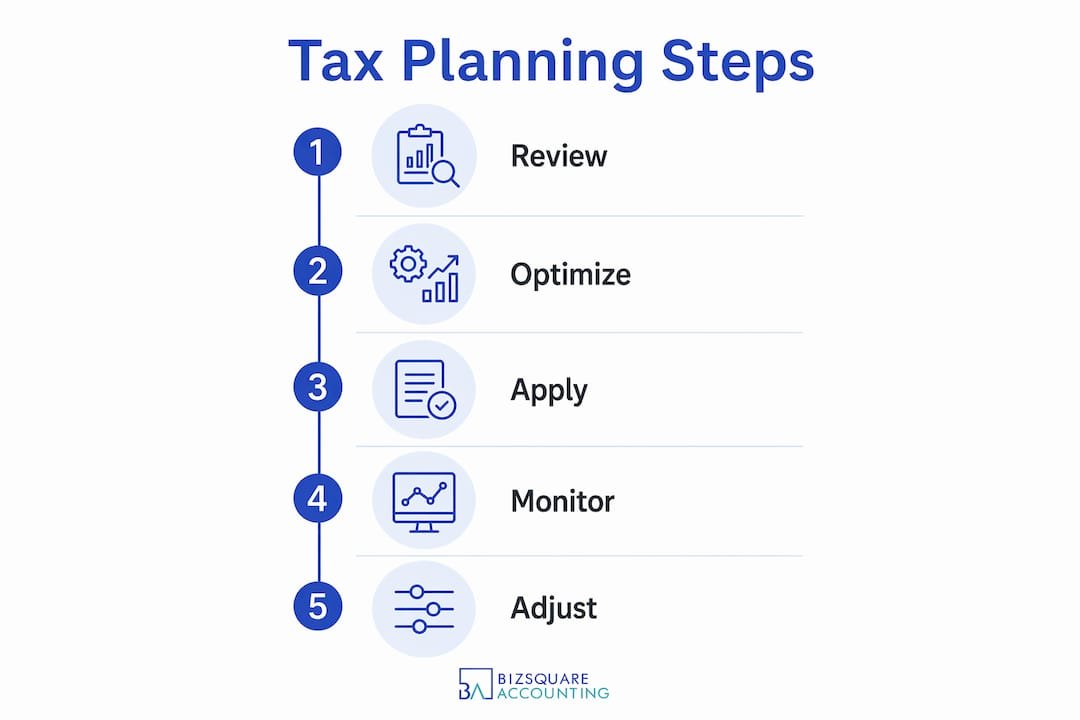
The practical steps that separate planning from preparation include:
- Set annual tax targets. At the start of each financial year, estimate the expected tax liability based on projected revenue and expenses.
- Review entity structure annually. Business growth often changes the optimal legal structure. A sole proprietor crossing a certain profit threshold may benefit from incorporating.
- Document everything in real time. Organized digital tax records reduce filing errors and administrative burden at year-end. Use accounting software to categorize transactions as they occur.
- Engage a tax advisor before major transactions. Selling an asset, acquiring a subsidiary, or restructuring equity all carry tax consequences. Advice sought after the transaction is often too late to change the outcome.
- Integrate tax planning with financial planning. Tax decisions affect cash flow, investment returns, and business valuation. A tax strategy that ignores the broader financial picture produces suboptimal results.
Pro Tip: Schedule a formal tax review meeting with your accountant every quarter, not just before the filing deadline. Treat it as a board agenda item, not an afterthought.
The role of a qualified tax advisor is to connect these steps into a coherent annual cycle. Entrepreneurs who work with advisors year-round, rather than only at filing time, consistently identify more savings and face fewer surprises. Bizsquare’s tax advisory services are structured around this year-round model.
When and how should Singapore entrepreneurs conduct tax planning reviews?
Mid-year tax checkups between may and july are essential. End-of-year planning is often too late to implement key strategies. By the time december arrives, most income has already been earned and most expenses are already committed. The window for meaningful action is narrow.
A structured annual tax planning cycle for Singapore businesses looks like this:
| Period | Key Actions |
|---|---|
| January to March | Review prior year results, confirm deductions claimed, assess entity structure |
| April to June | Project current year income, adjust estimated tax payments, review capital expenditure plans |
| July to September | Mid-year checkup, assess whether income timing adjustments are needed, review payroll structure |
| October to December | Year-end planning, accelerate deductible expenses, confirm all documentation is complete |
This cycle keeps tax planning active throughout the year rather than compressed into a frantic filing period.
For businesses with variable income, quarterly reviews are especially important. A strong quarter may push annual income into a higher bracket, requiring an adjustment to estimated payments. A weak quarter may create an opportunity to accelerate income recognition at a lower rate.
Practical actions for each review include:
- Compare actual revenue and expenses against the annual forecast
- Verify that all receipts and invoices are captured in the accounting system
- Check whether any new IRAS incentives or deductions apply to the business
- Review the corporate tax checklist for Singapore businesses to confirm compliance milestones
- Assess whether major planned transactions carry tax implications that require advance structuring
Adjusting withholding and estimated payments before year-end mitigates underpayment penalties. Businesses that wait until filing season to calculate their liability often discover they owe more than expected, with no time left to reduce it. The IRS Tax Withholding Estimator is a useful reference tool for businesses with cross-border income exposure, though Singapore-based entrepreneurs should work with a local advisor familiar with IRAS guidelines.
For a detailed walkthrough of how Singapore companies calculate their tax obligations, the business tax computation guide provides step-by-step technical guidance.
What are the benefits and misconceptions of tax planning for business owners?
Tax planning is often misunderstood as a seasonal task. Taxes touch payroll, legacy planning, and investments simultaneously. Treating tax planning as an annual filing exercise means missing savings opportunities that only exist during the year.
The benefits of proactive tax planning extend well beyond reducing a single year’s tax bill:
- Improved cash flow. Businesses that plan tax payments avoid large, unexpected liabilities that disrupt operations.
- Better compliance. Year-round documentation reduces the risk of errors, omissions, and IRAS audit findings.
- Informed business decisions. Tax consequences factor into hiring, capital investment, and expansion decisions when planning is integrated into management.
- Wealth preservation. Tax planning manages liabilities sustainably to promote business growth, not just reduce a single year’s bill.
- Reduced stress. Entrepreneurs who know their tax position throughout the year face filing season with confidence, not anxiety.
A common misconception is that tax planning is only relevant for large corporations with complex structures. Singapore SMEs and sole proprietors face the same tax obligations and have access to the same deductions. The scale differs; the need does not.
Another misconception is that aggressive tax minimization and tax planning are the same thing. They are not. Aggressive schemes that exploit loopholes or misrepresent transactions carry legal and reputational risk. Sound tax planning uses only clearly permitted deductions and structures.
“Tax planning is not about eliminating taxes. It is about managing liabilities in a way that supports long-term business growth and aligns with broader financial goals.”
Entrepreneurs who integrate tax strategy into their regular financial management, rather than treating it as a separate compliance exercise, build businesses that are more financially resilient. For practical guidance on reducing tax liability within Singapore’s regulatory framework, a structured approach is always more effective than reactive adjustments.
For a broader view of how income and payroll tax obligations interact with business tax planning, the 2026 business tax guide from JurisLedger provides useful context for small business owners navigating multiple tax categories.
Key Takeaways
Effective tax planning is the year-round, proactive management of income, expenses, and business structure to legally minimize tax liabilities and support sustainable business growth in Singapore.
| Point | Details |
|---|---|
| Tax planning is proactive | It happens before transactions occur, not after the financial year closes. |
| Timing is the primary lever | Accelerating expenses and deferring income reduces taxable income in high-revenue years. |
| Mid-year reviews are critical | Conduct a formal tax checkup between may and july to adjust payments and strategies. |
| Planning differs from compliance | Compliance meets legal minimums; planning actively reduces what is legally owed. |
| Integration drives results | Tax strategy embedded in daily business decisions produces better outcomes than seasonal filing. |
Tax planning is a year-round discipline, not a filing deadline
Most entrepreneurs treat tax planning as something that happens in the weeks before a filing deadline. That timing is too late for most meaningful strategies. By the time a business owner sits down with their accountant in march or april, the income has been earned, the expenses are fixed, and the only task left is reporting accurately.
The businesses that consistently pay less tax are not doing anything aggressive or complicated. They are simply making decisions with tax consequences in mind throughout the year. They choose the right entity structure before they grow into the wrong one. They document expenses as they occur, not in a frantic catch-up exercise at year-end. They review their position quarterly and adjust before problems compound.
The other pattern worth noting is the cost of poor documentation. Entrepreneurs who cannot substantiate their deductions lose them. The IRAS does not accept reconstructed records or verbal explanations. A business that runs clean books throughout the year never faces this problem. Bookkeeping and tax planning are not separate functions. They are the same discipline viewed from different angles.
The practical recommendation is straightforward: treat tax planning as a standing agenda item in your business management calendar, not a task you delegate entirely to an accountant once a year. Engage your advisor early, review your position regularly, and make decisions with the tax outcome already factored in. That habit, sustained over years, produces compounding financial benefits that no last-minute strategy can replicate.
— Vandro
How Bizsquare supports Singapore businesses with tax planning
Singapore’s tax framework rewards businesses that plan ahead, but navigating IRAS requirements, exemption schemes, and filing deadlines takes time and expertise that most entrepreneurs cannot spare.

Bizsquare provides corporate tax filing and advisory services designed for Singapore SMEs and growing companies. The approach covers year-round tax planning, not just annual filing. Bizsquare’s advisors work with business owners to identify applicable deductions, structure compensation correctly, and conduct mid-year reviews that keep tax positions on track. For entrepreneurs who want expert guidance without building an in-house finance team, Bizsquare offers the depth of a full advisory practice with the accessibility of a dedicated consultant.
FAQ
What is tax planning in simple terms?
Tax planning is the process of organizing your financial affairs to pay the lowest legally permissible tax. It uses available deductions, exemptions, and timing strategies within the law.
How is tax planning different from tax preparation?
Tax preparation is backward-looking: it records what already happened and files a return. Tax planning is forward-looking: it shapes decisions before they occur to reduce future tax liabilities.
Is tax planning legal in Singapore?
Tax planning is fully legal. It uses deductions, exemptions, and structures permitted by IRAS and the Income Tax Act. It is distinct from tax evasion, which involves concealing income or falsifying records.
When should a Singapore business start tax planning?
Tax planning starts at the beginning of the financial year, not at filing time. A mid-year review between may and july is the most critical checkpoint for adjusting strategies before the year closes.
What are the main benefits of tax planning for entrepreneurs?
The main benefits include improved cash flow, better compliance, reduced year-end surprises, and alignment of tax decisions with broader business and financial goals.
Does tax planning apply to small businesses and sole proprietors?
Tax planning applies to businesses of all sizes. Singapore SMEs and sole proprietors have access to the same deductions and exemptions as larger companies, and the financial impact of planning is proportionally significant.
What documents are needed for effective tax planning?
Effective tax planning requires organized records of all income, expenses, invoices, receipts, payroll records, and asset purchases. Digital records maintained throughout the year reduce errors and support IRAS audit readiness.
Can tax planning reduce my corporate tax rate in Singapore?
Tax planning cannot reduce the statutory corporate tax rate of 17%, but it reduces the chargeable income that rate applies to. Exemptions, deductions, and incentives lower the effective tax paid.
How often should a business review its tax plan?
A business should review its tax plan quarterly, with a formal mid-year checkup between may and july and a year-end review before the financial year closes.
What is the difference between tax planning and tax avoidance?
Tax planning uses clearly permitted deductions and structures within the law. Tax avoidance exploits loopholes in ways that may be technically legal but carry regulatory and reputational risk. IRAS actively scrutinizes arrangements that lack commercial substance.
Do I need a tax advisor for tax planning in Singapore?
A qualified tax advisor is not legally required, but the complexity of IRAS rules, exemption schemes, and filing requirements makes professional guidance valuable for most business owners. Advisors identify savings that owners often miss.
How does bookkeeping support tax planning?
Accurate, real-time bookkeeping provides the financial data that tax planning depends on. Businesses with clean books can make informed decisions about timing, deductions, and entity structure throughout the year.
What happens if a business skips tax planning?
Businesses that skip tax planning typically pay more tax than legally required, face cash flow disruptions from unexpected liabilities, and risk penalties for underpayment or filing errors.