

Reverse charge GST in Singapore: a guide for businesses
If your Singapore business is GST-registered and cannot claim full input tax, you must self-account for GST on imported services and specified low-value goods by way of reverse charge. Act on these two checks first:
- Check your annual totals. Add up all imported services and low-value goods (LVG) purchased in the past 12 months. If the value is significant, reverse charge obligations almost certainly apply.
- Verify your GST registration status. Reverse charge applies to GST-registered recipients. If your registration is pending or lapsed, resolve that before filing your next return.
The Inland Revenue Authority of Singapore (IRAS)/gst-and-digital-economy/local-businesses) is the official reference point for all reverse charge GST rules in Singapore. Start there for primary guidance.
Key takeaways
| Point | Details |
|---|---|
| Who accounts for reverse charge | GST-registered Singapore recipients of imported services and LVG valued at S$400 or below. |
| Current GST rate to apply | Self-account at 9% on the Singapore dollar value of the qualifying supply. |
| Where to report on returns | Enter output tax in Box 6 and claimable input tax in Box 7 of the GST F5 return via MyTax Portal. |
| Key compliance control | Reconcile imported service invoices and LVG totals monthly; retain supporting documents for five years. |
| Bizsquare support | Bizsquare handles GST return preparation, reverse charge accounting, and input tax recovery analysis for Singapore businesses. |
What is the reverse charge mechanism in Singapore?
The reverse charge mechanism shifts the responsibility for accounting for GST from the overseas supplier to the Singapore-based recipient. Under normal GST rules, a supplier charges and remits tax. Under reverse charge, the recipient self-accounts as if they were the supplier, then reports that amount on their own GST return.
IRAS confirms that the GST-registered recipient accounts for GST on imported services and low-value goods as if the recipient were the supplier, and may claim that amount as input tax subject to the normal input tax recovery rules.
Why does Singapore use this approach? The reverse charge mechanism exists to level the playing field between local and foreign service providers. It ensures GST is paid on consumption in Singapore regardless of where the supplier is located. Without it, a Singapore business could buy the same legal or software service from an overseas firm tax-free, while a local firm would charge 9% GST, creating an unfair cost advantage for foreign suppliers.
The policy rationale is straightforward. Singapore introduced reverse charge on B2B imported services from 1 January 2020, then extended it to low-value goods from 1 January 2023, as confirmed by BDO’s guidance on GST and imported services.
A simple illustration:
- A Singapore law firm (GST-registered, partially exempt) pays S$10,000 to an overseas software vendor for a subscription.
- The overseas vendor does not charge GST.
- The law firm self-accounts for GST at 9%, recording S$900 as output tax on its GST return.
- It then assesses how much of that S$900 it can reclaim as input tax, based on its partial exemption ratio.
Bizsquare Accounting advises clients to treat this self-accounting step as a standing monthly control, not a year-end adjustment. Finance teams that leave it to the annual close routinely miss tax points and face late-accounting penalties. The MyTax Portal is where GST returns are filed and reverse charge amounts are reported.
Which businesses and supplies does reverse charge cover?
Reverse charge in Singapore targets a specific set of supplies and a specific category of recipient. It does not apply to all imports.
Supplies in scope
- Imported services: Any service supplied by an overseas person to a Singapore recipient, where the place of supply is Singapore. This includes professional services, IT services, management fees, royalties, and digital services used for business purposes.
- Low-value goods (LVG): Goods valued at a low value per consignment, imported into Singapore by a GST-registered business that does not have full input tax entitlement.
Who must account for reverse charge GST?
IRAS guidance is clear: reverse charge applies to GST-registered recipients who do not have full input tax entitlement. This typically means businesses that make both taxable and exempt supplies, such as financial institutions, insurance companies, and property developers.
PwC’s Singapore tax summary notes that reverse charge affects businesses restricted in input tax recovery, particularly those making exempt supplies or carrying on exempt activities.
Businesses with full input tax entitlement still account for reverse charge, but typically reclaim the full amount immediately.
Registration triggers
IRAS stresses that businesses must consider the annual value of imported services and LVG when deciding whether to register for GST. Reverse charge liabilities can create a registration obligation even when taxable turnover is below the standard threshold. Consult the Bizsquare guide to GST registration in Singapore for a full breakdown of registration triggers.
Who accounts for GST: a quick reference
| Scenario | Who accounts for GST? |
|---|---|
| GST-registered B2B recipient, imported services | Recipient (reverse charge) |
| GST-registered B2B recipient, LVG (S$400 or below) | Recipient (reverse charge) |
| B2C consumer, digital services from overseas vendor | Overseas vendor (OVR regime) |
| Electronic marketplace, B2C LVG | Marketplace operator (OVR regime) |
| Non-GST-registered business, imported services | No GST currently due, but registration may be triggered |
Notable exclusions
- Imported goods above S$400 per consignment are subject to normal import GST at the border, not reverse charge.
- Services that are zero-rated or out of scope are excluded.
- Consumer purchases are handled under the Overseas Vendor Registration (OVR) regime, not reverse charge.
Practical note on supplier GST numbers: If a GST-registered business provides its GST registration number to an overseas vendor, IRAS guidance confirms the vendor should not charge GST on that supply. This prevents double charging and simplifies accounting. Always share your GST registration number with overseas suppliers at the point of purchase.
How do you account for and report reverse charge GST?
The accounting process follows a clear sequence. Finance teams that map it step by step avoid the most common errors.
Step-by-step accounting process
- Receive the invoice from the overseas supplier. Confirm the supply is an imported service or qualifying LVG. Note the invoice date, as this determines the tax point.
- Calculate the GST amount. Apply the prevailing GST rate to the value of the supply in Singapore dollars. Convert foreign currency amounts using the exchange rate on the tax point date.
- Record the reverse charge output tax. Post the GST amount as output tax in your accounts. This is the amount you owe IRAS.
- Assess input tax recovery. Determine how much of the output tax you can reclaim as input tax. A fully taxable business reclaims 100%. A partially exempt business applies its recovery ratio.
- Post the input tax entry (where claimable). This offsets the output tax in your accounts.
- Report on the GST return. Enter the reverse charge output tax in Box 6 (output tax) and the claimable input tax in Box 7 (input tax) of the GST F5 return on MyTax Portal.
Worked numerical example: imported service
A Singapore marketing agency (fully taxable, GST-registered) pays S$5,000 to an overseas digital platform for advertising services.
| Step | Amount |
|---|---|
| Invoice value | S$5,000 |
| GST at 9% (reverse charge output tax) | S$450 |
| Input tax claimable (100% recovery) | S$450 |
| Net GST cost to business | S$0 |
The agency reports S$450 in Box 6 and S$450 in Box 7. The net position is nil, but the reporting obligation still exists.
Worked numerical example: partially exempt business
The institution reports S$1,800 in Box 6 and S$900 in Box 7. The net S$900 is a real cost, not recoverable.
Journal entry template: imported service (fully taxable)
Dr  Expense (e.g. Software Costs)          S$5,000
Dr  GST Input Tax Recoverable              S$450
    Cr  Accounts Payable (Overseas Vendor)     S$5,000
    Cr  GST Output Tax Payable (Reverse Charge) S$450
For LVG calculations and MyTax reporting steps, IRAS publishes a dedicated guide to accounting GST on low-value goods by way of reverse charge, which covers the specific fields to complete in MyTax.
GST rate reminder: The current GST rate in Singapore is the applicable rate set by IRAS. Apply this rate to all reverse charge calculations.
Timing controls
Finance teams should set a calendar reminder to reconcile all imported service invoices at the end of each GST accounting period. Late accounting, even by one period, can attract penalties. The tax point is not the payment date alone; it is the earlier of payment or invoice issuance.
How does OVR differ from reverse charge, and when does each apply?
The Overseas Vendor Registration (OVR) regime and the reverse charge mechanism both address GST on cross-border supplies, but they operate in different contexts and target different parties.
Key distinctions
- OVR applies to B2C supplies. When an overseas vendor sells digital services or LVG to a Singapore consumer (non-GST-registered buyer), the overseas vendor or marketplace operator must register under OVR and charge GST directly.
- Reverse charge applies to B2B supplies. When a GST-registered Singapore business buys imported services or LVG from an overseas supplier, the Singapore business self-accounts for GST by way of reverse charge.
- Marketplace operators as deemed suppliers. For LVG sold through electronic marketplaces, the marketplace operator is treated as the supplier for GST purposes. If the buyer is a GST-registered business, reverse charge may still apply at the recipient level.
Practical scenarios
Scenario A: A Singapore consumer buys software from an overseas vendor. No reverse charge applies.
Scenario B: A GST-registered Singapore company buys the same software for business use. The company provides its GST registration number to the vendor. The vendor does not charge GST. The company self-accounts by way of reverse charge.
Scenario C: A GST-registered Singapore retailer buys LVG through an overseas marketplace. The marketplace operator is the deemed supplier. The retailer checks whether the marketplace has charged GST. If not, the retailer applies reverse charge.
Avoiding double charging
Providing your GST registration number to overseas vendors prevents them from charging GST on B2B supplies, which simplifies accounting and reduces the need to apply reverse charge in some cases. This is a practical step that IRAS guidance explicitly recommends.
For the official OVR framework and LVG extension details, refer to the IRAS page on local businesses importing services and low-value goods.
What are the most common reverse charge GST errors?
Finance teams that understand the typical failure points can build controls to prevent them. These are the errors that appear most frequently in practice.
- Applying reverse charge to all imported goods. Reverse charge in Singapore strictly targets imported services and specified LVG, not general imported goods above S$400. Goods above that threshold are subject to import GST at the border.
- Missing the registration threshold. Businesses sometimes overlook that imported services and LVG values count towards the GST registration threshold. A business with low local turnover may still need to register because of high imported service spend.
- Using the wrong tax point. The tax point is the earlier of the invoice date or the payment date. Many finance teams default to the payment date, which can push the liability into the wrong GST period.
- Claiming input tax incorrectly. Partially exempt businesses must apply their recovery ratio. Claiming 100% input tax when the ratio is lower is a common audit finding.
- Poor documentation. IRAS requires documentary evidence to support input tax claims. Missing supplier details, no service description, or absent GST registration numbers on invoices can result in disallowed claims.
- Failing to account for foreign currency conversion. The GST amount must be calculated in Singapore dollars. Using the wrong exchange rate or the wrong date introduces errors.
Penalties for non-compliance
IRAS can impose penalties for late accounting, incorrect returns, and failure to register. The consequences range from financial penalties to prosecution in serious cases. Remediation steps include voluntary disclosure to IRAS, which generally results in more favourable treatment than errors discovered during audit.
Pro Tip: Set up a dedicated reverse charge ledger account in your accounting system. This makes it straightforward to reconcile output tax and input tax entries each period, and gives auditors a clear trail.
For a broader view of tax obligations for Singapore businesses, the Bizsquare resource library covers the full compliance picture.
A practical compliance checklist for finance teams
Use this checklist monthly and annually to keep reverse charge GST compliance on track.
Monthly actions
- Collect all invoices from overseas suppliers received during the period.
- Classify each invoice: imported service, LVG, or general import (above S$400).
- Confirm the tax point for each qualifying invoice (earlier of invoice date or payment date).
- Calculate GST at 9% on each qualifying supply.
- Post the reverse charge output tax entry to the GST output tax payable account.
- Apply the input tax recovery ratio and post the input tax entry where applicable.
- Reconcile the reverse charge ledger to the total of qualifying invoices for the period.
- Report Box 6 (output tax) and Box 7 (input tax) figures on the GST F5 return via MyTax Portal.
Annual actions
- Tally the total annual value of imported services and LVG to check against registration thresholds.
- Review the input tax recovery ratio and update it if the business’s exempt supply proportion has changed.
- Confirm that all overseas suppliers have your GST registration number on file.
- Retain all supporting invoices and documentation for at least five years, as required by IRAS.
AP invoice fields to capture
Every accounts payable invoice for an imported service or LVG should record:
- Supplier name and country of incorporation
- Service or goods description
- Invoice date and payment date
- Invoice value in original currency and Singapore dollar equivalent
- Exchange rate used and source
- Supplier’s GST registration number (if provided under OVR)
- Platform or marketplace operator name (for LVG purchases)
Template journal entry: LVG purchase (partially exempt, 50% recovery)
Dr  Inventory / Purchases                  S$400

    Cr  Accounts Payable (Overseas Vendor)     S$400
    Cr  GST Output Tax Payable (Reverse Charge) S$36
Net GST cost = S$18.
Pro Tip: Treat reverse charge review as a monthly control, not a year-end task. Reconcile imported service invoices and LVG totals to a central register each period. This detects registration triggers early and supports input tax claims with a clean audit trail, as recommended in the IRAS guide to accounting GST on low-value goods by way of reverse charge.
For bookkeeping accuracy tips that support GST compliance, the Bizsquare guide to bookkeeping for Singapore SMEs is a practical companion resource.
An expert perspective on reverse charge GST compliance
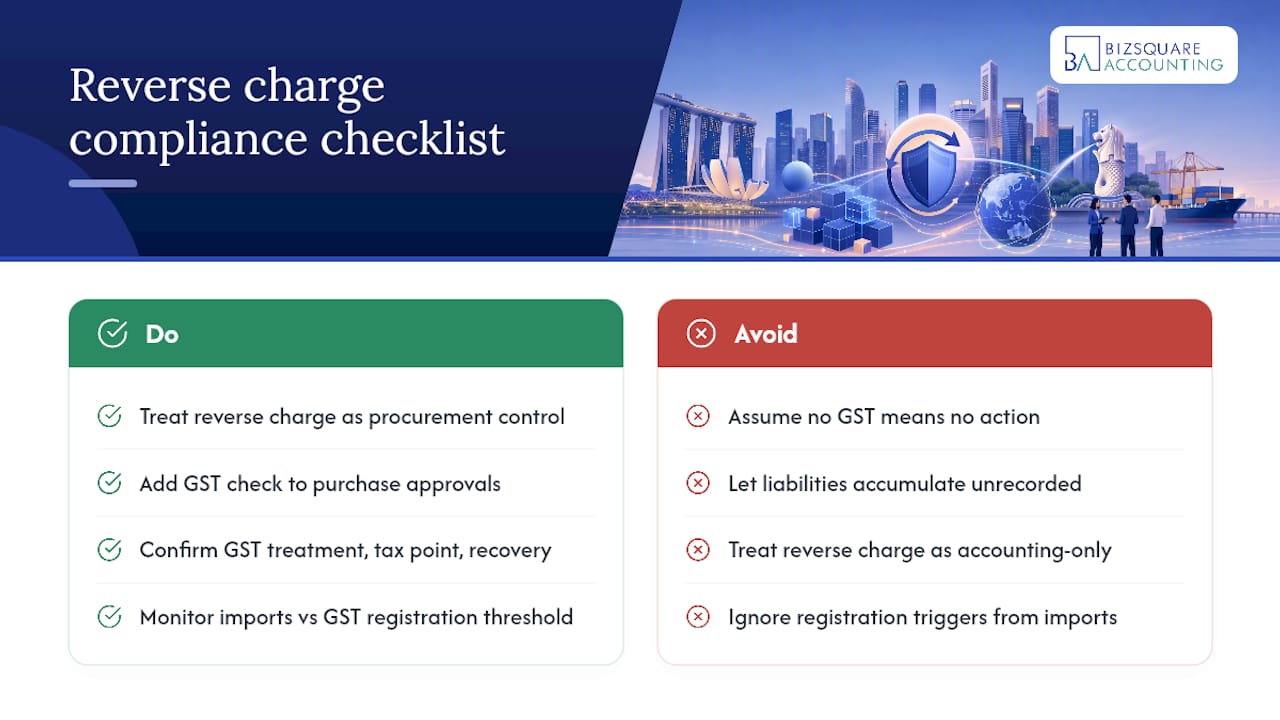
Most businesses that struggle with reverse charge GST do not struggle because the rules are complicated. They struggle because the rules are easy to overlook. Imported service invoices arrive without GST charged, so there is no visible prompt to self-account. The obligation sits entirely with the recipient, and if no one in the finance team is watching for it, months of liabilities can accumulate unrecorded.
The businesses that manage this well treat reverse charge as a procurement control, not just an accounting one. They build the check into the purchase approval process: before an overseas service contract is signed, someone confirms the GST treatment, the tax point rule, and the input tax recovery position. That upstream discipline prevents the downstream scramble.
Partially exempt businesses face the sharpest real cost. That is a material figure that belongs in budget planning, not just in the tax return.
The practical question Bizsquare hears most often is: “Do we need to register for GST just because of our imported service spend?” The answer is yes, if the annual value of those imports crosses the registration threshold. Reverse charge liabilities can trigger registration even when local taxable turnover is low. That is a compliance risk that catches businesses off guard, particularly fast-growing technology and professional services firms with heavy overseas software and consultancy spend.
How Bizsquare supports your reverse charge GST compliance
Reverse charge GST compliance requires consistent monthly controls, accurate journal entries, and correctly filed GST returns. For many finance teams, particularly in SMEs and growing businesses, that is a significant operational commitment on top of core business responsibilities.

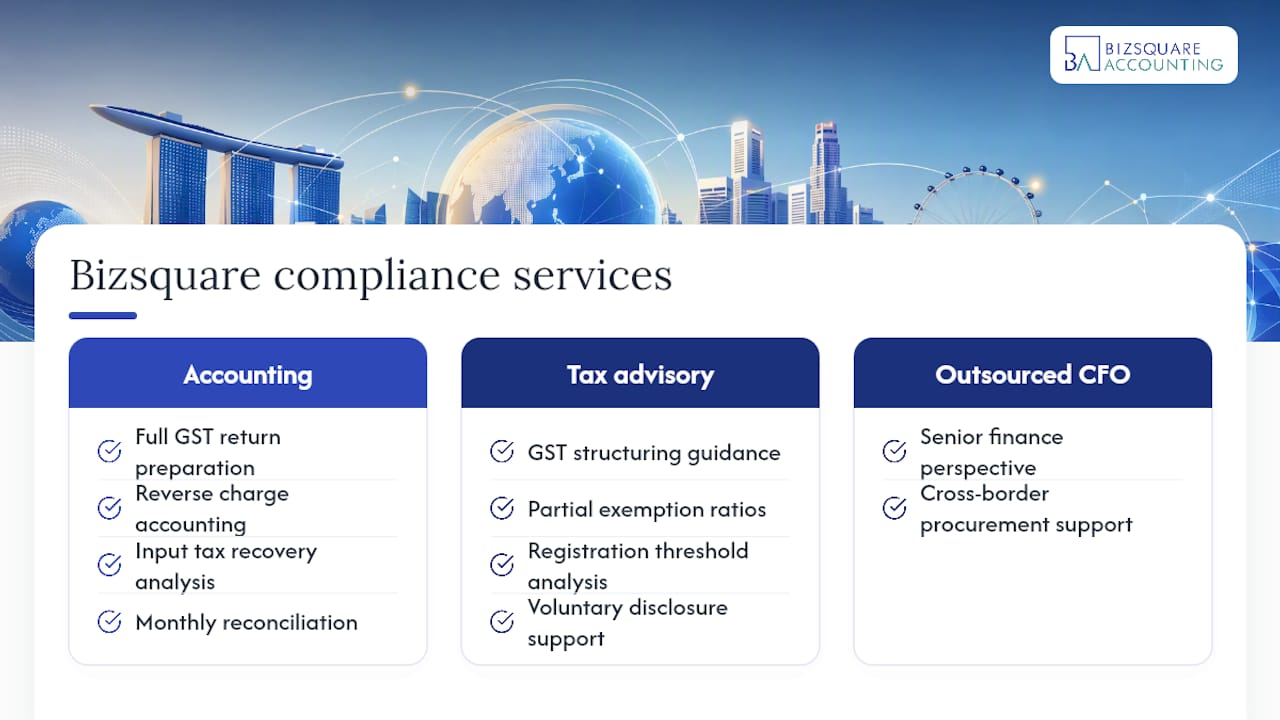
Bizsquare provides professional accounting and bookkeeping services that include full GST return preparation, reverse charge accounting, and input tax recovery analysis. The team handles the monthly reconciliation, the MyTax filing, and the documentation controls that IRAS expects to see during audit. For businesses that need strategic guidance on GST structuring, the tax advisory service covers partial exemption ratios, registration threshold analysis, and voluntary disclosure support. The outsourced CFO service adds a senior finance perspective for businesses navigating complex cross-border procurement. To get started, contact Bizsquare directly through Bizsquareaccounting for a consultation on your GST compliance position.
Sources
The following official and authoritative references provide primary guidance on reverse charge GST in Singapore.
This article is general information, not a substitute for advice from a qualified financial advisor. Consult a qualified financial professional about your own circumstances before acting on anything here.
FAQ
1.) What is reverse charge GST in Singapore?
Reverse charge GST is a mechanism where the Singapore GST-registered recipient, rather than the overseas supplier, accounts for GST on imported services and qualifying low-value goods. The recipient self-assesses the GST, reports it as output tax, and claims it as input tax subject to normal recovery rules.
2.) Who pays reverse charge GST?
The GST-registered Singapore business receiving the imported service or low-value goods pays the reverse charge. The overseas supplier does not charge GST on the invoice; instead, the recipient self-accounts for the amount directly with IRAS.
3.) What is an example of reverse charge GST in practice?
A Singapore company pays S$10,000 to an overseas IT consultant. The consultant does not charge GST. A fully taxable business has a net GST cost of nil; a partially exempt business bears the non-recoverable portion.
4.) How does reverse charge interact with the OVR regime?
OVR applies to B2C sales, where overseas vendors charge GST directly to Singapore consumers. Reverse charge applies to B2B sales, where GST-registered Singapore businesses self-account. Providing your GST registration number to an overseas vendor signals a B2B transaction and prevents the vendor from charging GST under OVR.
5.) When did reverse charge GST start in Singapore?
Reverse charge on B2B imported services began on 1 January 2020. The regime extended to low-value goods from 1 January 2023, as confirmed by IRAS and summarised in BDO’s advisory guidance.
6.) Where do you report reverse charge GST on the GST return?
Report the reverse charge output tax in Box 6 and the claimable input tax in Box 7 of the GST F5 return, filed through the MyTax Portal.
7.) Does reverse charge apply to all imported goods?
No. Reverse charge in Singapore applies only to imported services and low-value goods valued at S$400 or below per consignment. General imported goods above S$400 are subject to import GST collected at the border, not reverse charge.
8.) What documents must you keep for reverse charge GST?
Keep the overseas supplier’s invoice showing the service description, invoice date, value, and supplier details. Record the exchange rate used, the tax point date, and the supplier’s GST registration number if provided. IRAS requires these records for at least five years.
9.) Can a non-GST-registered business be affected by reverse charge?
A non-GST-registered business does not currently account for reverse charge, but high imported service or LVG spend can trigger a GST registration obligation. Once registered, reverse charge applies from the effective registration date.
10.) What is the current GST rate for reverse charge calculations?
Apply this rate to the Singapore dollar value of all qualifying imported services and low-value goods when calculating the reverse charge amount.
11.) What happens if a business misses a reverse charge obligation?
IRAS can impose penalties for late or incorrect accounting. Voluntary disclosure before an audit generally results in more favourable treatment. Bizsquare’s GST advisory and accounting services can help businesses identify and remediate past errors.
12.) How does partial exemption affect reverse charge GST?
A partially exempt business applies its input tax recovery ratio to the reverse charge amount. The non-recoverable portion is a real cost to the business.