

FRS 115 Revenue Recognition: Checklist and Singapore IRAS Notes
FRS 115 requires revenue to be recognised in a way that depicts the transfer of control of goods or services, using a five step model. The model runs from identifying a contract through to recognising revenue once each performance obligation is satisfied. The biggest judgement areas are measuring progress, variable consideration, contract modifications and contract costs. Where adoption affects taxable income, IRAS has published specific tax guidance that finance teams need to follow.
Overview:
Revenue recognition over time requires selecting between input and output methods, with costs excluding waste and inefficiencies reflecting actual progress.
Variable consideration estimates must be reassessed each period, with conservative approaches used for products or contracts with limited history.
Contract modifications are accounted for as new contracts, continuations, or cancellations, with careful tracking of added scope and consideration adjustments.
Costs to obtain and fulfill contracts are capitalized only if they are incremental, directly related, and recoverable, and are amortized based on revenue transfer.
Disclosures should include significant judgments, contract balances, and the impact of contract modifications, supported by detailed schedules for audit and IRAS review.
The five step model explained, with quick practical checks
Every contract subject to FRS 115 and IFRS 15 is worked through the same five steps, and each step carries its own test.
Step 1: identify the contract. Check that the contract is enforceable, that both parties are committed, and that collection of consideration is probable. A verbal agreement can qualify if local contract law makes it enforceable.
Step 2: identify performance obligations. A promised good or service is distinct when the customer can benefit from it on its own and it is separately identifiable from other promises in the contract. Bundled goods that are highly interrelated are usually treated as one obligation, not several.
Step 3: determine the transaction price. This includes fixed fees plus any variable elements, such as bonuses, discounts or penalties, adjusted for the time value of money where significant.
Step 4: allocate the transaction price. Allocate based on relative stand alone selling prices. Where a stand alone price is not observable, estimate it using an adjusted market assessment, expected cost plus margin, or a residual approach.
Step 5: recognise revenue. Recognise revenue at a point in time, or over time if one of the over time criteria in the standard is met.
A short checklist at contract inception helps keep this consistent:
- Confirm enforceability, commercial substance and collectability before booking anything.
- List every distinct performance obligation and its stand alone selling price.
- Flag any variable consideration and the method chosen to estimate it.
- Decide and document whether recognition is at a point in time or over time.
- File the checklist with the signed contract for audit purposes.
Measuring progress: input methods versus output methods
For contracts recognised over time, SB-FRS 115 paragraph 39 requires an appropriate input or output method to measure progress towards completion.
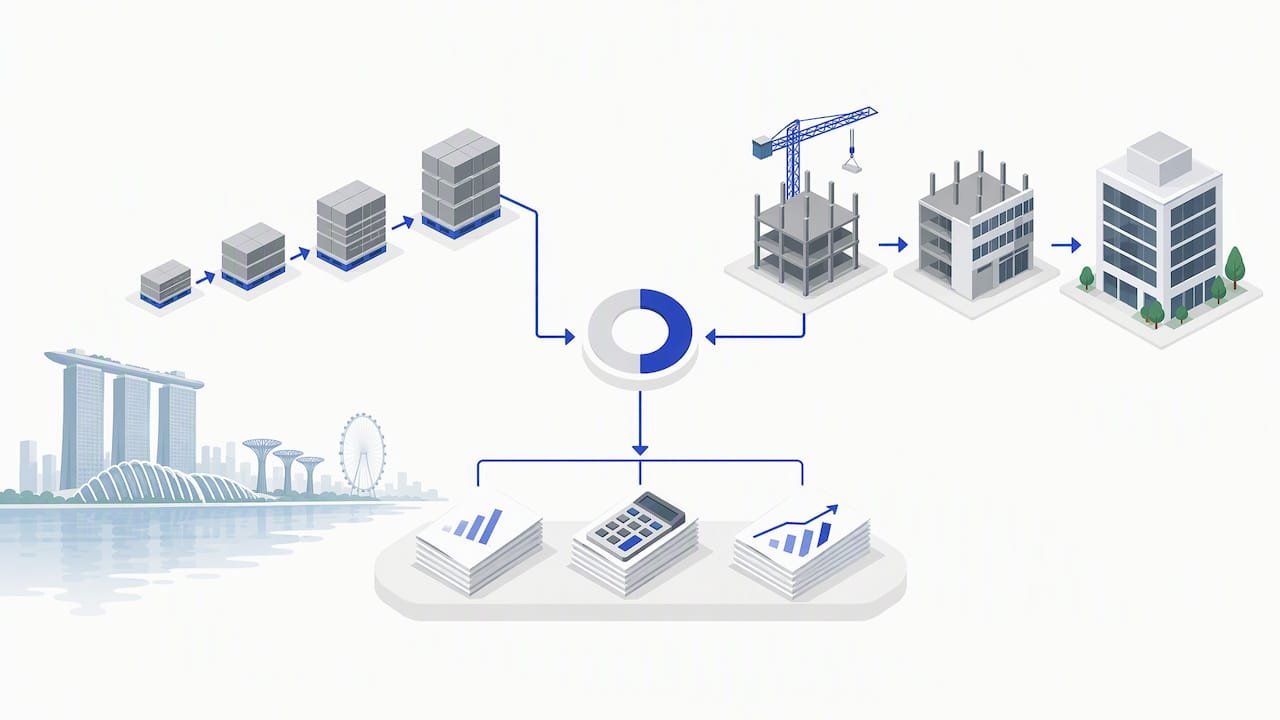
Input methods measure effort put into the contract, such as costs incurred relative to total expected costs, labour hours, or machine hours. Wasted material, rework and inefficiency costs should be excluded, because they do not reflect progress towards transferring control to the customer.
Output methods measure results directly, through milestones reached, units delivered, or surveys of work performed. These tend to represent transfer of control more faithfully when outputs are measurable and milestones are meaningful to the customer.
- Use cost-to-cost when costs are a reliable proxy for progress and tracked accurately.
- Use milestone or survey methods when physical completion is easier to verify than cost.
- Exclude abnormal costs, such as scrap or rework, from any input measure.
- Keep a documented rationale for the chosen method, updated whenever circumstances change.
Auditors and ISCA technical guidance) expect explicit evidence linking the chosen input measure to actual performance, not simply to cash spent.
Pro Tip: Keep a monthly reconciliation between budgeted costs, actual costs and recognised revenue, so any drift in your progress measure is caught early.
Variable consideration and the constraint on estimates
Variable consideration covers discounts, rebates, refunds, credits, performance bonuses, penalties and price concessions. Each of these needs an estimate before it can be included in the transaction price.
Two estimation methods are available under the standard. The expected value approach sums probability weighted outcomes, and suits contracts with a large number of similar items. The most likely amount approach picks the single most probable outcome, and suits contracts with only two possible results, such as achieving a bonus or not.
The constraint then limits how much variable consideration can be included. Amounts are only recognised to the extent it is highly probable that a significant reversal will not occur once the uncertainty resolves. IFRS Foundation materials confirm that estimates must be reassessed at the end of each reporting period, with any change allocated on the same basis as the original transaction price.
- New product lines with limited performance history often warrant a cautious estimate.
- Volume rebates tied to historical buying patterns can usually be estimated with more confidence.
- Penalty clauses with unclear enforcement history should generally be excluded until resolved.
Contract modifications: new contract or continuation
A contract modification changes the scope or price of an existing arrangement, and the accounting treatment depends on what changes.
- Treat as a separate new contract when the modification adds distinct goods or services and the added price reflects their stand alone selling price, adjusted for the specific contract’s circumstances.
- Treat as part of the original contract when the added goods or services are not distinct from those already delivered, requiring a cumulative catch up adjustment to revenue already recognised.
- Treat as a termination of the old contract and creation of a new one when the remaining goods or services are distinct from those already transferred, with the remaining consideration reallocated across the remaining obligations.
Where a modification increases the transaction price for previously promised items, illustrative examples in SB-FRS 115 show the increase is allocated on the same basis as at contract inception, with any catch up recognised once the related obligations have transferred.
Common commercial modifications include scope changes on construction contracts, added licence terms, and renegotiated service levels. A simple control that helps here is a dated change log, cross referenced to the original contract file and supported by a consulting agreement template to ensure every amendment can be traced through to its accounting entry.
Costs to obtain and to fulfil a contract
Not every cost linked to a contract gets expensed immediately. The standard draws a clear line between costs that qualify for capitalisation and those that do not.
- Costs to obtain a contract, such as sales commissions, are capitalised only when they are incremental, meaning they would not have been incurred without winning the contract, and recovery is expected.
- Costs to fulfil a contract are capitalised when they relate directly to the contract, generate or enhance resources used to satisfy future obligations, and are expected to be recovered.
- Capitalised costs are amortised on a basis consistent with the transfer of the related goods or services, not on an arbitrary straight line schedule.
- Impairment testing is required whenever the carrying amount of a capitalised asset exceeds the remaining expected consideration, less remaining costs to fulfil.
This approach prevents opportunistic deferral of costs that have no genuine future benefit, a concern the standard addresses directly in its basis for conclusions.
Disclosures and areas of significant judgement
Disclosure requirements under FRS 115 go well beyond a single revenue line in the income statement, and this is where auditors tend to focus their review.
- Disclose the significant judgements made in determining the timing of satisfaction of performance obligations.
- Disclose the methods, inputs and assumptions used to estimate variable consideration and the constraint applied.
- Provide a breakdown of contract balances, including contract assets, contract liabilities and any impairment recognised.
- Reconcile the opening and closing balances of remaining performance obligations, including expected timing of recognition.
Supporting schedules, built directly from contract files, make an IRAS or audit review considerably faster to complete.
Tax treatment and IRAS considerations when adopting FRS 115
Adopting FRS 115 can shift the timing of revenue recognised for accounting purposes without changing the underlying tax rules, which creates timing differences that need to be tracked carefully.
IRAS’s e-Tax guide.pdf?sfvrsn=8ad2455b_14), published 30 January 2026, sets out the expected tax adjustments when an entity adopts FRS 115 and explains the reconciliations IRAS looks for during review. The guide addresses situations where accounting revenue is recognised earlier or later than it would be under the previous standard, and clarifies how transitional adjustments should be treated for tax purposes.
- Identify every contract where the timing of accounting revenue has shifted under the new model.
- Prepare a reconciliation schedule showing accounting revenue, tax adjustments and resulting taxable income.
- Retain supporting workings for any transitional adjustment claimed in the year of adoption.
- Review GST treatment alongside income tax, since contract modifications can affect both.
Where timing differences are material, a documented reconciliation, updated each filing period, keeps both tax computations and statutory accounts defensible under review.
Practical worked examples and a short implementation checklist
Worked figures make the five step model easier to apply with confidence.
- Example A, allocation across obligations. Say a contract is worth $100,000 for equipment plus installation, with a possible $5,000 bonus for early completion treated as highly probable. Stand alone prices are $80,000 for equipment and $25,000 for installation, so the $105,000 total transaction price is allocated 76% to equipment ($79,800) and 24% to installation ($25,200).
- Example B, contract modification with catch up. Say 60% of a service contract is complete when the customer adds further hours at the same rate, treated as part of the original contract. The transaction price rises from $50,000 to $65,000, and because 60% was already complete, $9,000 of the added value is recognised immediately as a catch up adjustment.
- Example C, cost-to-cost with excluded costs. Say total expected costs are $200,000, actual costs incurred are $90,000, of which $10,000 is wasted material excluded from the measure. Progress is measured as $80,000 divided by $200,000, giving 40% completion rather than the 45% a raw cost ratio would suggest.
A documented and auditable revenue recognition policy, built around the five step model, is the clearest way to demonstrate FRS 115 compliance to both auditors and IRAS, as set out in IFRS 15’s core framework.
One page checklist for implementation:
- Immediate: map all active contracts against the five steps and flag any with variable consideration or embedded modifications.
- 30 days: finalise the progress measurement method for each over time contract and document the rationale.
- 90 days: complete the IRAS tax reconciliation schedule and update the disclosure note for the next reporting cycle.
Bizsquare perspective: helping finance teams apply FRS 115 consistently
We support finance teams through accounting and bookkeeping, outsourced CFO advisory and tax advisory and IRAS audit support as FRS 115 is implemented and maintained. A common pitfall seen is contracts booked without a documented performance obligation analysis, which can be corrected by building a standard contract checklist into onboarding processes. Another involves progress measures that include wasted costs, which can be adjusted and re-documented for audit purposes.
How Bizsquare can help with FRS 115 compliance
Getting the five step model right takes more than reading the standard once. Comprehensive accounting, tax and advisory expertise helps maintain consistent revenue policies, contract schedules and IRAS reconciliations over time.

Our accounting and bookkeeping services build the contract-level schedules FRS 115 demands, while our corporate tax filing and advisory team handles the IRAS reconciliations that follow adoption. If you would like a practical review of how your contracts are currently recognised, get in touch through our accounting and bookkeeping services page to arrange a conversation.
This article is general information, not a substitute for advice from a qualified financial advisor. Consult a qualified financial professional about your own circumstances before acting on anything here.
FAQ
1.) What are the five criteria for revenue recognition?
The five steps are identifying the contract, identifying performance obligations, determining the transaction price, allocating that price, and recognising revenue once obligations are satisfied. Each step carries its own documented judgement, drawn from the FRS 115 and IFRS 15 framework.
2.) Is FRS 115 the same as IFRS 15?
FRS 115, also referred to as SB-FRS 115, is based directly on IFRS 15 and uses the same five step model and core principles. Minor wording and transitional provisions may differ by jurisdiction, so the local standard remains the authoritative reference.
3.) What are the five steps of revenue recognition under the equivalent Indian standard?
The equivalent Indian standard, Ind AS 115, follows the same five step structure as FRS 115 and IFRS 15: identify the contract, identify performance obligations, determine the transaction price, allocate it, and recognise revenue. The underlying principles and judgement areas are consistent across these standards, since all are based on the same global framework.
4.) How do you recognise revenue under FRS 115?
Revenue is recognised either at a point in time or over time, depending on when control of the good or service transfers to the customer. For over time recognition, SB-FRS 115 paragraph 39 requires an appropriate input or output method to measure progress.
5.) Does adopting FRS 115 change my tax filing?
Adoption can shift when revenue is recognised for accounting purposes, creating timing differences from taxable income. IRAS’s e-Tax guide sets out the adjustments and reconciliations expected when these differences arise.
6.) Can sales commissions be capitalised under FRS 115?
Incremental commissions paid specifically to win a contract can be capitalised if recovery of those costs is expected. They are then amortised consistently with the transfer of the related goods or services, rather than expensed immediately.
7.) What happens when a contract is modified part way through?
The modification is treated as a new separate contract, a termination and replacement, or a continuation of the original contract, depending on whether the added goods or services are distinct. Continuations typically require a cumulative catch up adjustment to revenue already recognised.
8.) What is the constraint on variable consideration?
The constraint limits variable consideration to amounts that are highly probable not to result in a significant revenue reversal once the uncertainty is resolved. Estimates are reassessed at each reporting date and adjusted as new information becomes available.
9.) Why does the input versus output method choice matter so much?
The method chosen directly affects how much revenue is recognised in each period for over time contracts. Auditors expect the chosen method to genuinely reflect progress towards transferring control, with any wasted or abnormal costs excluded from input measures.