


One Month to File GST in Singapore: Avoid $200 Penalties, Check Corppass
In Singapore, your GST return and any tax due are due one month after the end of your accounting period. For a business on the standard quarterly cycle ending 31 March, that means submission and payment by 30 April, with GIRO deductions following on 15 May. Even if you had zero taxable transactions, you must still file a nil return by that date.
Overview:
Businesses with special accounting periods must still file their GST returns one month after their specific period ends, regardless of the calendar quarter.
Filing nil returns is mandatory even when no transactions occur, as failure to do so results in late filing penalties.
IRAS imposes a $200 composition penalty for late filing, with additional steep late payment penalties if tax remains unpaid beyond 60 days.
Extension requests are rarely granted and require supporting evidence, needing to be submitted at least five workdays before the deadline.
Ensuring the correct Corppass Approver role is assigned is critical, as only Approvers can submit GST returns and avoid unnecessary delays.
When is GST filing due? Standard quarterly deadlines explained
Most GST registered businesses in Singapore file on a quarterly cycle, and the Singapore GST return deadline/filing-gst/due-dates-and-requests-for-extension) always falls one month after the quarter closes. This rule almost never changes, so once you know your accounting period, you already know your due date.
Here are the four standard quarters and their corresponding filing dates.
| Accounting period | Filing and payment due date |
|---|---|
| January to March | 30 April |
| April to June | 31 July |
| July to September | 31 October |
| October to December | 31 January |
If you pay via GIRO, the actual deduction happens later than the filing deadline. For the March quarter, IRAS deducts payment on 15 May, roughly two weeks after the 30 April due date. This timing gap matters for cashflow planning, since your books need to show the liability before the money actually leaves your account.
A few points worth keeping in mind:
- GIRO deductions occur on the 15th of the month following the payment due date, not the filing due date itself.
- Non-GIRO payments must clear IRAS’s bank account by the original due date, so bank transfers need extra lead time.
- Your personalised due dates and payment status are always visible once you log in to myTax Portal, which is the authoritative source if your accounting period differs from the calendar quarter.
What happens with special accounting periods and nil returns?
Not every business runs on the standard January, April, July, October quarter start. Some companies register with IRAS using a special accounting period, often to align GST reporting with their financial year end. The one month after period end rule still applies, it just shifts depending on your registered cycle.
Consider a business with a special accounting period ending 15 February. Its GST return and payment would be due one month later, on 15 March. The calculation method never changes, only the reference date does. If you’re unsure which cycle applies to your company, myTax Portal displays your specific accounting periods and their matching due dates.
Nil returns catch out a surprising number of business owners. Even with no sales, no purchases, and no output or input tax to declare, you are still required to file. Skipping this step because “there’s nothing to report” still triggers the same late filing consequences as missing a return with genuine transactions.
Keep these points in mind for special periods and nil filings:
- The due date is always one month after your specific period end, calendar quarter or not.
- A nil GST return must be filed by the deadline, with all boxes on the F5 return showing zero.
- Newly registered businesses should confirm their first accounting period on myTax Portal, since it can be shorter or longer than a full quarter.
- Businesses considering deregistration still need to file a final return covering the period up to cancellation.
How much are the penalties for late GST filing and late payment?
Missing your GST filing deadline in Singapore triggers consequences almost immediately, and they escalate quickly the longer the return stays outstanding.
A late GST return attracts an immediate composition penalty, imposed as soon as you cross the due date, whether you owe tax or not. This penalty can also be levied for each additional month of continued non-filing, up to a set maximum, so a return left unfiled for several months becomes far more expensive than a single missed date suggests.
Late payment works on a separate, steeper scale.
Pro Tip: *Treat the 60-day mark as your real deadline for damage control.
Here is how the numbers actually stack up in a simple example:
- Return filed three months late with $5,000 tax owed: $200 late filing penalty, plus 5% ($250) late payment penalty from day one, plus 2% monthly increments once past 60 days.
- Continued non-filing can lead IRAS to issue an estimated Notice of Assessment based on prior filings, which is rarely in your favour.
- Persistent non-compliance can also trigger further recovery action, including legal proceedings in serious cases.
How do you request a GST filing extension in Singapore?
Extensions exist, but IRAS grants them sparingly and only for genuine, documented circumstances. Applying because you simply ran out of time will not succeed.
The acceptable reasons and their typical maximum extension periods are as follows.
- Newly registered business filing its first return can typically receive up to one additional month.
- System breakdown affecting your accounting or filing systems, usually capped at two weeks.
- Recent purchase of new accounting software that has not yet stabilised, generally up to two weeks.
- Key finance staff hospitalised or on extended medical leave, with supporting medical certificates required.
- Business restructuring, such as a merger or major system migration, assessed case by case.
- API or e-filing technical issues on IRAS’s own systems, documented with error screenshots or service reports.
A few practical points to remember before applying:
- Submit your extension request at least five working days before your original due date, never on the day itself.
- Attach supporting evidence, such as IT service reports, medical certificates, or software purchase invoices.
- Because extensions are genuinely rare, the safer strategy is building a buffer into your internal reconciliation timeline so you never need one.
Step-by-step checklist for filing your GST return on time
A reliable filing process removes most of the stress around Singapore GST submission dates. Work through these steps in order, ideally starting at least two weeks before your due date.
- Reconcile your accounts. Confirm all output tax, input tax, and adjustments match your bookkeeping records, and convert any foreign currency transactions using the correct exchange rate basis.
- Verify F5 return figures. Cross check boxes for standard rated supplies, zero rated supplies, exempt supplies, and total value of purchases against your general ledger.
- Check Corppass permissions. Confirm the person filing has an Approver role, not just a Preparer role, since only Approvers can submit the return.
- Log in to myTax Portal using Singpass or Corppass credentials and navigate to the GST e-filing section.
- Submit the return and save your digital acknowledgement immediately, as this is your proof of on-time filing.
- Pay or confirm GIRO status. If paying manually, ensure funds clear before the due date. If on GIRO, note that the actual deduction happens roughly two weeks later.
Pro Tip: Never assume filing on time means you’ve also paid on time. The GST filing deadline and the GIRO deduction date are two separate events, and confusing them is one of the most common cashflow mistakes among Singapore SMEs.
What are the most common GST filing mistakes and how do you fix them?
Most GST penalties trace back to a small handful of avoidable errors, and recognising them early saves both money and stress.
- Forgetting to file a nil return when there were genuinely no transactions in the period.
- Reporting foreign currency transactions using the wrong exchange rate or conversion date.
- Missing the distinction between the filing due date and the actual GIRO deduction date.
- Delegating filing to a Preparer without also assigning an Approver in Corppass.
- Assuming an estimated Notice of Assessment can simply be ignored, when it cannot.
If you spot an error after filing, IRAS allows corrections within one year of the original F5 deadline, and doing so promptly can avoid penalties in qualifying circumstances.
| Situation | What to do |
|---|---|
| Missed the filing deadline entirely | File immediately, even late, to stop further escalation |
| Received an estimated Notice of Assessment | File the actual return to revise it, then pay assessed tax plus penalties |
| Discovered an error after submission | Correct within one year of the original deadline where eligible |
Why outsourcing GST compliance reduces business risk
Filing responsibility sits with the business owner even when staff or an external agent prepares the return, which is why the systems behind your GST process matter as much as the filing itself. A professional adviser typically maintains automated bookkeeping records, manages Corppass roles so an Approver is always available, and runs scheduled reconciliations well ahead of each due date.
Bizsquare Accounting supports Singapore businesses with exactly this kind of structured compliance, drawing on services spanning accounting and bookkeeping, corporate tax filing, and GST advisory. Before appointing any adviser, ask how they track your GST filing requirements Singapore wide, who holds Corppass Approver access, and how they handle special accounting periods.
What the rules actually reward, and what they punish
The conventional advice on this topic focuses almost entirely on the calendar, memorise the quarter dates, mark them in your diary, done. That advice is not wrong, but it misses where businesses actually lose money. The real damage comes from confusing the filing deadline with the GIRO deduction date, and from treating nil returns as optional paperwork.
IRAS’s own penalty structure tells you where to focus. A $200 composition penalty for late filing is annoying but survivable. If you take one thing from this guide, prioritise your payment timeline over your filing timeline, because payment is where the real financial exposure sits.
Corppass permissions deserve more attention than they typically get too. A business can have its figures perfectly reconciled and still miss the deadline because nobody checked whether the right person had Approver access. That is a solvable, boring, entirely avoidable failure, and it happens constantly.
How Bizsquare Accounting keeps your GST filing on track
Bizsquare Accounting gives Singapore business owners a fixed point of contact for GST compliance, instead of scrambling every quarter to reconcile figures and chase Corppass access. Where many businesses juggle spreadsheets, external bookkeepers, and last-minute myTax logins separately, Bizsquare brings reconciliation, Corppass management, and return submission under one coordinated process.

Our accounting and bookkeeping services are built to keep your GST figures audit ready well before each due date, so filing becomes routine rather than a fire drill. We also support broader compliance needs through corporate tax filing and advisory, which pairs naturally with GST work since both rely on the same underlying financial records. If your team is stretched thin around quarter end, or you have missed a deadline and need to correct course quickly, consider engaging professional help to take GST compliance off your plate.
Useful IRAS resources for GST filing
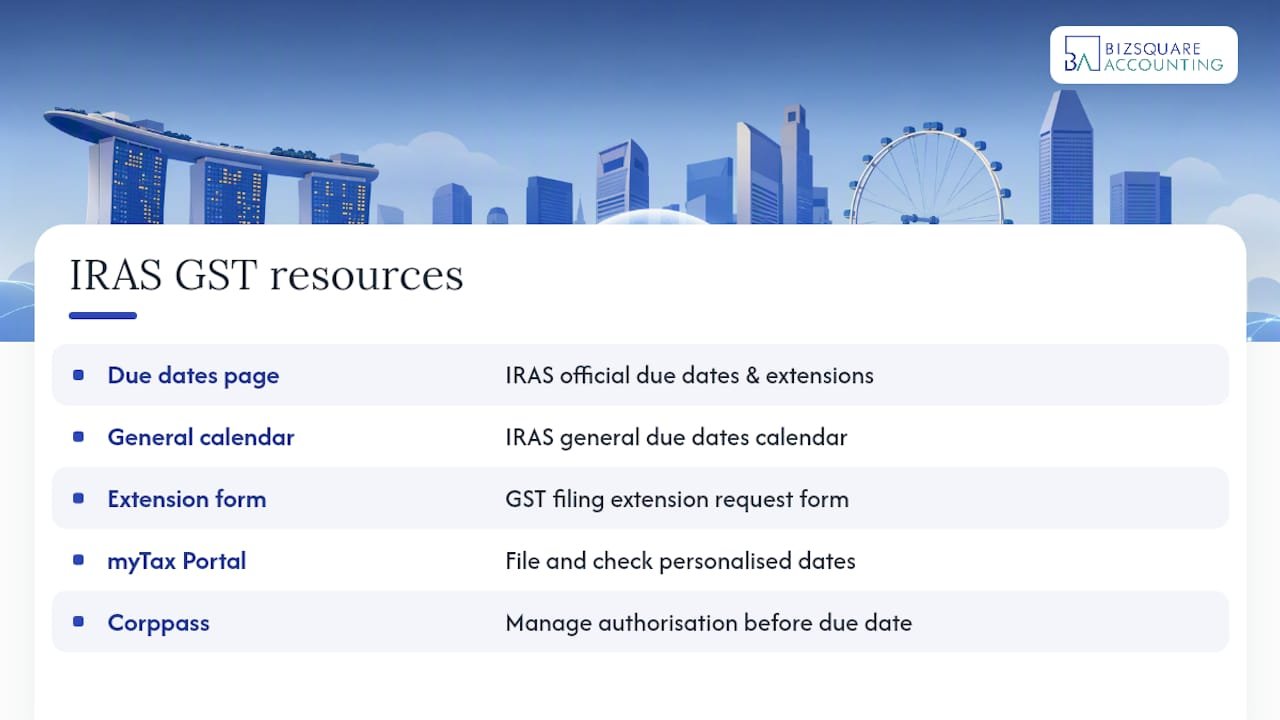
For direct access to official guidance, bookmark the IRAS due dates and extension page, the general due dates calendar, and the GST filing extension request form. File and check your personalised dates through myTax Portal, and manage authorisation through Corppass before your next due date arrives.
FAQ
1.) What is the due date for GST filing in Singapore?
Your GST return and any tax due must be filed and paid one month after your accounting period ends, such as 30 April for a March quarter.
2.) What is the deadline for GST if I use GIRO?
The filing and payment due date stays the same, but GIRO deductions typically occur on the 15th of the month after the payment due date, giving roughly two extra weeks before funds leave your account.
3.) Is the GST return date ever extended?
Extensions are possible but rare, granted only for specific reasons like system breakdowns, new software, or staff hospitalisation, and must be requested at least five working days before the original due date.
4.) Do I need to file a nil GST return?
Yes, a nil return is mandatory even with zero transactions in the period, and skipping it still results in late filing penalties.
5.) How do I check my specific GST filing due date?
Log in to myTax Portal using Singpass or Corppass, where your registered accounting periods and exact due dates are listed under your GST profile.
6.) What happens if I receive an estimated Notice of Assessment?
File your actual GST return immediately to revise the estimate, then pay the assessed tax along with any prescribed late payment penalties.
7.) Who can submit a GST return on myTax Portal?
Only a Corppass user with Approver rights can submit a return, so a Preparer alone cannot complete the filing.
8.) Can I correct a GST filing mistake after submission?
Yes, corrections made within one year of the original F5 deadline can avoid penalties in qualifying circumstances, though tax owed still needs settling.
9.) What documents do I need for a GST filing extension request?
Supporting evidence such as IT service reports, medical certificates, or software purchase invoices, submitted alongside your extension request at least five working days early.
10.) Does a special accounting period change my GST due date?
Yes, the one month after period end rule still applies, but the reference date shifts to match your registered special accounting period.
11.) Can outsourcing GST filing reduce the risk of missing deadlines?
Yes, a professional adviser like Bizsquare Accounting can manage Corppass roles, reconciliations, and filing schedules to reduce the risk of missed GST filing requirements Singapore wide.


1 Comment
Avoid $200 Fines: Singapore GST Filing Cycle, Deadlines and Bizsquare
September 29, 2026, at 9:01 am[…] One Month to File GST in Singapore: Avoid $200 Penalties, Check Corppass […]