

FRS 116: Avoid IRAS Tax Surprises for Singapore Finance Teams
SB-FRS 116 requires most lessees in Singapore to recognise a right-of-use asset and a lease liability on the balance sheet. The standard has applied since 1 January 2019 for SFRS and SFRS(I) reporters. The real complexity now sits elsewhere: reconciling that accounting treatment against IRAS tax rules, and handling index-linked rents correctly.
Overview:
- Most leases are now on the balance sheet, but companies must carefully reconcile these accounting treatments with Singapore’s IRAS tax rules to avoid discrepancies.
- Index-linked rent revisions, like JTC’s market-based adjustments, require remeasuring lease liabilities without changing the discount rate, impacting asset values but not profit immediately.
- Short-term leases under 12 months and low-value assets such as small IT equipment can be expensed directly, simplifying compliance for many SMEs.
- Proper documentation, including lease contracts, remeasurement records, and a detailed lease register, is essential for audit readiness and to avoid common errors.
- Regularly updating remeasurements and lease modifications throughout the lease term is crucial, as most errors stem from outdated calculations after initial recognition.
What is SB-FRS 116 and who must apply it in Singapore?
SB-FRS 116 is Singapore’s lease accounting standard, issued by the Accounting Standards Council and now maintained by the Accounting Standards Council Singapore (ASSB). It replaced FRS 17, the older standard that split leases into “operating” and “finance” categories for lessees and let most operating leases stay off the balance sheet entirely. That distinction is gone for lessees under the current standard.
The objective is straightforward, even if the mechanics take some getting used to. Almost every lease a company signs, whether for office space, machinery, vehicles, or warehouse racking, now creates an asset and a matching liability on the balance sheet. SB-FRS 116 requires a lessee to recognise a right-of-use asset and a lease liability at the commencement date for most leases, rather than simply expensing rent as it falls due.
The standard took effect for annual reporting periods beginning on or after 1 January 2019. It applies to entities reporting under SFRS and SFRS(I), which covers the vast majority of Singapore-incorporated companies, including SMEs that prepare full financial statements. If your company still reports rent as a straight-line operating expense with no lease liability on the balance sheet, that treatment is very likely outdated.
Scope exclusions matter just as much as the main rule. SB-FRS 116 does not apply to leases for exploring or using non-regenerative resources such as minerals, oil, and gas. It also excludes certain licences of intellectual property granted by a lessor, and rights held under specific licensing arrangements covered by other standards. These exclusions are set out explicitly in the standard itself, so a finance team dealing with resource concessions or IP licences should check the scope section carefully before applying the general lessee model.
For a wider view of how this standard sits alongside other reporting requirements, our guide to accounting standards in Singapore covers the broader framework companies need to follow.
How do you decide if a contract contains a lease?
Not every rental arrangement is a lease under SB-FRS 116, and not every service contract is free of one. The standard uses a control test, and getting this test wrong at the start creates problems that ripple through every later calculation.
A contract contains a lease when it conveys the right to control the use of an identified asset for a period, in exchange for consideration. Two conditions need to be satisfied together. First, there must be an identified asset, meaning a specific piece of property, plant, or equipment that is explicitly or implicitly named in the contract. Second, the customer must have the right to obtain substantially all the economic benefits from using that asset, and the right to direct how and for what purpose the asset is used throughout the period.
Substitution rights complicate this test often. If the supplier has a genuine, practical right to substitute the asset at any time and would benefit economically from doing so, the contract does not contain a lease, because the customer never really controls a specific asset. A data centre contract where the provider can freely move a client’s workload between servers usually fails the identified asset test. A dedicated fleet of delivery vans assigned to one client for two years usually passes it.
Once you have confirmed a lease exists, check whether the contract bundles lease and non-lease components together. A typical office lease might include base rent alongside maintenance services, cleaning, or security. SB-FRS 116 requires separating these unless a practical expedient is elected.
Key steps for isolating the lease component:
- Identify the stand-alone price of each component if observable in similar contracts.
- Allocate consideration based on relative stand-alone prices when observable prices are not directly stated.
- Consider the practical expedient allowing lessees to account for lease and non-lease components as a single lease component, applied consistently by asset class.
- Assess portfolios of similar leases together only when the outcome would not differ materially from applying the standard lease by lease.
Pro Tip: Review every service contract with an embedded equipment or premises element, not just obvious property leases. Practitioners often flag embedded leases in service contracts as the most frequently missed item during FRS 116 adoption, because finance teams tend to scan only rental agreements and skip logistics, IT, and outsourcing contracts.
Lessee accounting: measuring the lease liability and the right-of-use asset
Once you have confirmed a contract contains a lease, the lessee side of SB-FRS 116 follows a consistent measurement sequence. Get the inputs right at commencement, and the following years largely take care of themselves through mechanical amortisation and interest calculations.
Step 1: Calculate the present value of lease payments. The lease liability equals the present value of payments not yet paid at the commencement date. Included payments are fixed payments, variable payments that depend on an index or a rate, amounts expected under residual value guarantees, exercise prices of purchase options reasonably certain to be exercised, and termination penalties if the lease term reflects exercise of a termination option.
Step 2: Choose the discount rate. Use the interest rate implicit in the lease if it can be readily determined. In practice, most Singapore lessees cannot determine this rate, because it requires knowing the lessor’s fair value assumptions and residual value estimates. The fallback is the lessee’s incremental borrowing rate, meaning the rate the company would pay to borrow, over a similar term and with similar security, the funds needed to obtain an asset of similar value in a similar economic environment. Banks’ prevailing SME lending rates, adjusted for the specific lease term and security, are a common Singapore reference point.
Step 3: Recognise the right-of-use asset. At commencement, the right-of-use asset equals the initial lease liability, plus any lease payments made at or before commencement, plus initial direct costs, minus any lease incentives received, plus an estimate of restoration costs if applicable.
Step 4: Account for subsequent movements. The lease liability increases for interest expense and decreases for lease payments made. The right-of-use asset is depreciated, typically on a straight-line basis, over the shorter of the lease term and the asset’s useful life.
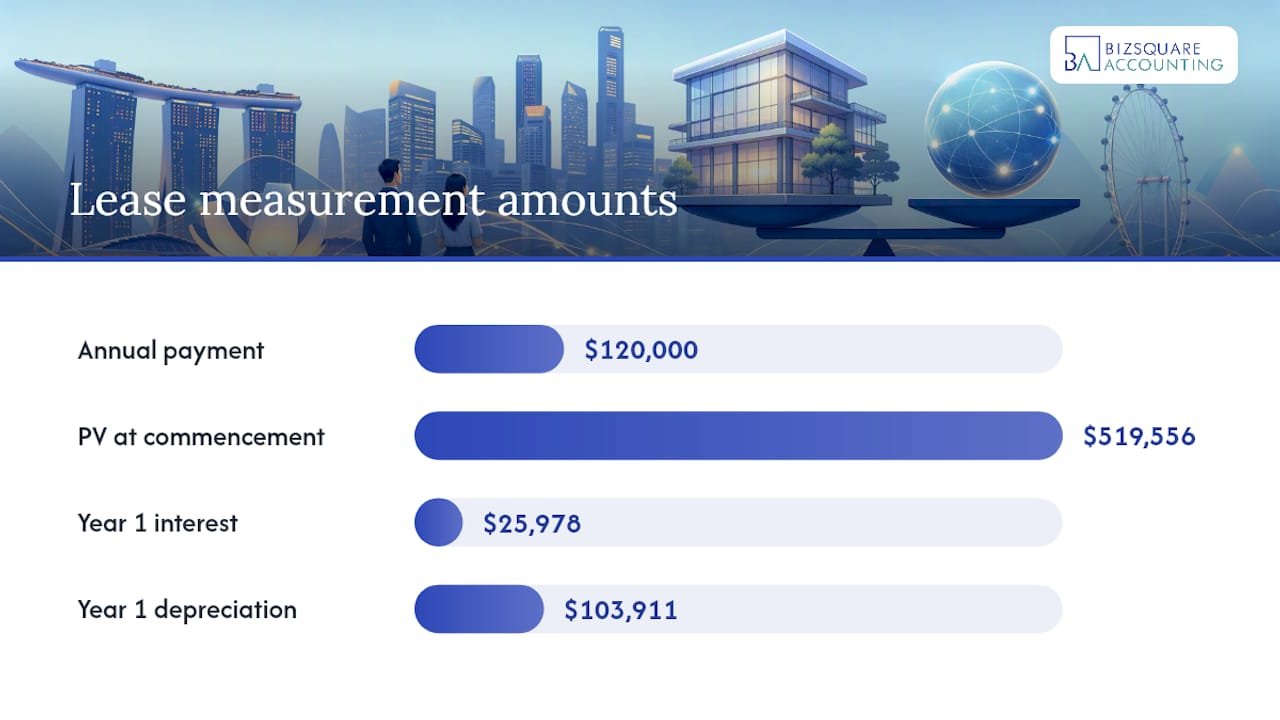
Here is a simplified worked example for a five-year office lease with annual payments of $120,000 payable in arrears, using an incremental borrowing rate of 5%.
| Item | Amount |
|---|---|
| Annual lease payment | $120,000 |
| Lease term | 5 years |
| Discount rate | 5% |
| Present value of lease liability at commencement | $519,556 |
| Initial right-of-use asset (no incentives or direct costs) | $519,556 |
| Year 1 interest expense (5% x $519,556) | $25,978 |
| Year 1 lease liability closing balance | $519,556 |
| Year 1 depreciation charge ($519,556 / 5 years) | $103,911 |
The journal entries follow directly from these figures. At commencement, debit right-of-use asset $519,556, credit lease liability $519,556. During year one, debit interest expense $25,978 and debit lease liability $94,022, credit cash $120,000. Separately, debit depreciation expense $103,911, credit accumulated depreciation on the right-of-use asset $103,911.
ASSB’s illustrative examples work through comparable computations in more detail, including cases with initial direct costs and lease incentives, which shift the opening right-of-use asset balance away from a simple match with the liability. If your finance team wants to stress-test a lease decision against buying the asset outright, a buy versus lease calculator can help model the cash flow trade-offs alongside the accounting entries.
Lessor accounting: finance leases against operating leases
Lessors under SB-FRS 116 still classify leases using the dual model that lessees no longer apply. A lease is a finance lease when it transfers substantially all the risks and rewards of ownership to the lessee. Everything else is an operating lease.
Indicators pointing towards a finance lease include a lease term covering most of the asset’s economic life, a purchase option the lessee is reasonably certain to exercise, and present value of lease payments approximating the asset’s fair value. None of these indicators is decisive alone, and judgement across the whole arrangement matters more than ticking a single box.
For a finance lease, the lessor derecognises the underlying asset and recognises a receivable equal to the net investment in the lease. Finance income is then recognised over the lease term using a pattern reflecting a constant periodic rate of return, similar in principle to how a bank recognises interest income on a loan.
For an operating lease, the lessor keeps the underlying asset on its own balance sheet and continues depreciating it in the usual way. Lease income is recognised, generally on a straight-line basis over the lease term, unless another systematic basis better represents the pattern in which benefit from the asset is diminished.
Disclosure obligations differ by lessor type too. Finance lessors must disclose a maturity analysis of lease receivables and reconciliation to the net investment in the lease. Operating lessors must disclose future minimum lease payments and a maturity analysis of lease payments to be received, alongside a general description of leasing arrangements. Property companies, equipment rental businesses, and industrial landlords in Singapore need to review their lease books against these tests regularly, since a portfolio can contain a mix of both types.
Short-term and low-value lease exemptions
SB-FRS 116 gives lessees two practical exemptions that avoid the full right-of-use accounting model, and many SMEs rely on both.
A short-term lease has a lease term of 12 months or less at the commencement date, and contains no purchase option. A low-value asset is one that is low in value when new, commonly illustrated in guidance using examples such as laptops, small office furniture, or tablets, assessed on an absolute basis rather than relative to the lessee’s size.
For leases meeting either exemption, the lessee may elect to recognise lease payments as an expense on a straight-line basis over the lease term, exactly as under the old FRS 17 approach, with no right-of-use asset or lease liability recorded at all.
- Short-term photocopier or printer rentals under 12-month contracts typically qualify.
- Low-value IT equipment, such as individual laptops or monitors, generally qualifies regardless of total fleet size.
- Month-to-month storage unit rentals with no automatic renewal into a longer term often qualify.
- Vehicles rarely qualify as low-value, even when individually inexpensive, because guidance treats vehicles as generally excluded from the low-value category.
The election must be made by class of underlying asset for low-value leases, and can be made lease by lease for short-term leases. Document the policy choice clearly in your accounting manual, because auditors will ask how each exemption was applied and why.
Variable rents linked to an index: the JTC example
Variable lease payments only enter the initial lease liability calculation when they depend on an index or a rate. Payments based on a fixed percentage of sales, or on usage volumes, are excluded from the initial measurement and expensed as incurred instead.
Index-linked rent is common in Singapore, particularly for industrial land leases where JTC Corporation periodically revises rental rates. ISCA and ASSB materials use JTC-style rent revisions as the standard illustration of index-linked payments in a Singapore context, because they reflect a market rental mechanism rather than a discretionary landlord decision. When a JTC lease agreement ties rent to a published rate schedule that moves with market conditions, that schedule functions as a qualifying index under the standard.
The accounting mechanics differ from a simple annual step-up. At commencement, you measure the lease liability using the index or rate in effect at that date, effectively treating current-period rent as fixed for the initial calculation. You do not forecast future index movements. When the index or rate actually changes and triggers a change in the cash flows, you remeasure the lease liability using the revised payments and the unchanged discount rate, and the offsetting adjustment hits the right-of-use asset rather than profit or loss.
| Element | At commencement | After index revision |
|---|---|---|
| Rent basis | Current index rate applied to future payments | Revised index rate applied to remaining payments |
| Discount rate used | Original incremental borrowing rate or implicit rate | Same discount rate, unchanged |
| Adjustment recognised in | Initial lease liability and right-of-use asset | Right-of-use asset (liability remeasured against it) |
| Profit or loss impact at remeasurement date | None | None, unless right-of-use asset is already reduced to zero |
For an industrial tenant on a JTC-linked lease, the rent may revise upwards under a published schedule during the lease term. The company recalculates the present value of the remaining seven years of payments using the new rate, still discounted at the original rate. The increase in the lease liability is added to the right-of-use asset carrying amount, which then depreciates over the remaining lease term rather than flowing straight to the income statement.
Pro Tip: Keep a dated log of every rent revision notice you receive, JTC or otherwise, alongside the remeasurement workings. When ISCA-style FAQs on FRS 116 get raised in an audit, the first thing reviewers ask for is evidence of when the index changed and how the new liability was calculated.
Handling lease modifications and remeasurement
A lease modification is a change to the scope of a lease, or the consideration for it, that was not part of the original terms. This differs from an index-linked rent revision, which the standard treats as a remeasurement trigger rather than a modification, because the underlying contract terms have not changed, only the variable inputs have.
Follow this sequence when a lease changes:
- Determine whether the change qualifies as a modification, meaning a genuine amendment to scope or price, rather than a pre-agreed contractual adjustment.
- If the modification adds the right to use one or more additional assets and the price increase reflects the stand-alone price of that addition, account for it as a separate new lease.
- If the modification decreases scope, such as giving up part of a leased floor, reduce the carrying amount of the right-of-use asset and recognise a gain or loss reflecting the partial termination.
- For all other modifications, remeasure the lease liability using a revised discount rate, and adjust the right-of-use asset by the same amount, with no immediate profit or loss impact.
- File the amendment letter, revised payment schedule, and remeasurement calculation together in the lease’s permanent record.
Documentation matters as much as the calculation itself here. Maintaining a versioned schedule of remeasurements and approvals gives auditors and IRAS reviewers a clear trail from the original contract through every subsequent change, rather than a single spreadsheet that gets overwritten each time.
Reconciling SB-FRS 116 accounting with IRAS tax treatment
Accounting recognition under SB-FRS 116 does not automatically equal a tax deduction. IRAS has published detailed guidance on how it treats the accounting entries generated by this standard, and the gap between accounting profit and taxable income is where most reconciliation errors happen.
IRAS’s e-Tax guide on the tax treatment arising from FRS 116 and SFRS(I) 16 adoption-16_revised-(final).pdf?sfvrsn=36941353_27) sets out how depreciation of the right-of-use asset and interest on the lease liability interact with tax deductions, which often differ from the timing recognised in the accounts. Businesses need a clear line item, in their tax working papers, that traces each accounting charge back to its tax treatment.
Common reconciling items finance teams should expect:
- Depreciation timing: the right-of-use asset depreciation charge in the accounts may not align with any capital allowance claim, particularly where the underlying leased asset would not itself have qualified for allowances under the old rental deduction approach.
- Interest versus rental deduction: interest expense on the lease liability is presented separately from the depreciation charge in the accounts, but IRAS guidance addresses whether the combined effect approximates the straight-line rental deduction previously claimed, and what adjustment is needed if it does not.
- Variable payment treatment: payments excluded from the initial lease liability measurement, such as usage-based charges, are typically deductible when incurred, separate from the fixed lease liability profile.
- Transition adjustments: companies that adopted the standard using a modified retrospective approach may carry one-off reconciling entries from the transition date that need continued tracking in later tax computations.
Recommended documentation for a clean reconciliation includes a schedule mapping each lease to its accounting depreciation and interest charge, alongside the tax treatment claimed, updated annually. Keep supporting workings for capital allowance eligibility assessments where relevant, since these interact directly with lease-related tax positions. Our guide on avoiding IRAS queries on capital allowances sets out the kind of supporting evidence IRAS typically expects for these claims.
Businesses preparing their annual corporate tax return should build the FRS 116 reconciliation into their standard tax filing checklist rather than treating it as a one-off exercise limited to the year of adoption. Our complete guide to filing corporate tax in Singapore walks through the wider filing process this reconciliation feeds into.
Implementation checklist and internal controls for FRS 116 adoption
Adopting SB-FRS 116 properly is a project, not a single journal entry. A structured rollout catches problems before the external auditor does.
Build the project around these stages:
- Contract inventory: list every lease, rental, and service agreement across the business, including embedded leases in equipment and outsourcing contracts.
- Lease data template: capture lease term, payment amounts, discount rate assumption, renewal options, and index-linking terms for each contract in one standard format.
- Calculation engine: build or licence a calculation tool that produces the present value, amortisation schedule, and remeasurement workings consistently across all leases.
- Posting and review: post journal entries monthly or quarterly, with a second reviewer checking discount rate assumptions and lease term judgements.
- Disclosure preparation: compile the maturity analysis, weighted average discount rate, and qualitative disclosures required for the financial statements.
Internal controls should include an approval matrix for new leases above a set value threshold, a quarterly reconciliation between the lease register and the general ledger, and a documented policy for short-term and low-value exemption elections. The audit file should hold the contract inventory, discount rate workings, present value formulas, and a version history of any remeasurements, exactly the kind of record auditors and IRAS reviewers ask for first.
Pro Tip: Assign one person to own the lease register full time, even in a small company. Scattered ownership across procurement, operations, and finance is the single biggest cause of missed lease contracts at year-end.
Bizsquare supports each stage of this project through accounting and bookkeeping services for the calculation and posting work, corporate tax advisory for the IRAS reconciliation, and outsourced CFO support for teams that need a senior reviewer overseeing the whole rollout. Smaller companies can also benefit from our broader notes on accounting best practices for Singapore SMEs, which cover the control habits that make adoption smoother.
Common pitfalls and a quick audit checklist
Auditors see the same mistakes repeatedly across FRS 116 adopters, and most trace back to weak documentation rather than a misunderstanding of the standard itself.
The most frequent errors involve using a stale discount rate across multiple lease years instead of updating it at modification, missing embedded leases inside logistics or IT service contracts, and treating usage-based variable payments as if they belonged in the initial liability calculation. Correcting these usually means rebuilding the lease schedule from the original contract rather than adjusting the existing spreadsheet.
Run through this checklist before month-end and year-end close:
- Confirm every new contract signed in the period has been assessed for embedded leases.
- Check the discount rate applied matches the documented policy for that asset class.
- Verify short-term and low-value exemption elections are logged by class, not applied inconsistently.
- Reconcile the lease liability roll-forward against interest and payment postings.
- Confirm right-of-use asset depreciation matches the shorter of lease term and useful life.
- Trace any rent revision, JTC-linked or otherwise, to a remeasurement workpaper.
- Match modification accounting to the correct category, new lease, partial termination, or general remeasurement.
- Cross-check the tax reconciliation schedule against the year’s accounting entries.
- Confirm disclosure notes include the maturity analysis and weighted average discount rate.
- Review the audit file for a complete, versioned record of every lease change during the year.
An honest view on where SB-FRS 116 adoption actually goes wrong
Most companies get the initial journal entries right. Where things unravel is the second and third year, when a rent revision lands, or a contract gets amended, and nobody updates the original workings. The standard rewards discipline over cleverness, and Singapore’s mix of index-linked industrial leases makes ongoing remeasurement, not day-one recognition, the harder half of the job. Businesses that treat this as a live schedule requiring quarterly attention tend to sail through audits. Those that treat it as a one-off spreadsheet from 2019 usually do not.
Get your FRS 116 lease accounting audit ready with Bizsquare
Bizsquare gives Singapore businesses a fixed, expert alternative to piecing together SB-FRS 116 compliance in-house with stretched finance staff and ageing spreadsheets.

Getting lease accounting right under FRS 116 for businesses in Singapore takes more than a one-off calculation. It needs a lease register that stays current, a discount rate policy applied consistently, and a tax reconciliation that IRAS won’t query. Bizsquare’s accounting and bookkeeping services handle the lease liability calculations, journal postings, and disclosure schedules month by month, while our corporate tax filing and advisory service manages the reconciliation between your accounts and your tax return. If your business needs a senior finance lead to oversee the whole rollout, our outsourced CFO services step in without the cost of a full-time hire.
Contact a professional service provider today to request a lease accounting readiness assessment and get FRS 116 compliance sorted before the next filing deadline.
This article is general information, not a substitute for advice from a qualified financial advisor. Consult a qualified financial professional about your own circumstances before acting on anything here.
Sources
FAQ
1.) What is FRS 116 lease accounting?
FRS 116, known in Singapore as SB-FRS 116, is the lease accounting standard requiring lessees to recognise a right-of-use asset and lease liability for most leases on the balance sheet.
2.) Does FRS 116 apply to all Singapore companies?
It applies to companies reporting under SFRS or SFRS(I), which covers the great majority of Singapore-incorporated companies preparing full financial statements.
3.) What is the difference between FRS 116 and the old FRS 17?
FRS 17 let lessees keep operating leases off the balance sheet and expense rent directly, while SB-FRS 116 requires a right-of-use asset and lease liability for nearly all leases.
4.) Are there changes to lease accounting in 2026?
SB-FRS 116 itself has not changed structurally, but ASSB periodically republishes the standard, including an updated version effective as at January 2026, so businesses should check the latest text.
5.) What is a right-of-use asset under SB-FRS 116?
It is the asset a lessee recognises representing its right to use a leased item over the lease term, initially measured at the same amount as the lease liability plus adjustments for direct costs and incentives.
6.) How do I choose a discount rate for lease accounting in Singapore?
Use the interest rate implicit in the lease if determinable, otherwise use the lessee’s incremental borrowing rate, reflecting what the company would pay to borrow a similar amount over a similar term.
7.) Do short-term leases need a right-of-use asset?
No, leases with a term of 12 months or less, with no purchase option, can be expensed on a straight-line basis under the short-term lease exemption.
8.) What counts as a low-value asset exemption under FRS 116?
Assets that are low in value when new, such as small IT equipment or basic office furniture, generally qualify, though vehicles are typically excluded regardless of price.
9.) How does JTC rent revision affect lease accounting?
When JTC-linked industrial rent revises under a published rate schedule, it typically qualifies as an index-linked variable payment, triggering a remeasurement of the lease liability and right-of-use asset.
10.) How does IRAS treat FRS 116 accounting for tax purposes?
IRAS has issued specific e-Tax guidance on reconciling accounting depreciation and interest under FRS 116 against tax deductions, since the two do not automatically align.
11.) What happens when a lease is modified under SB-FRS 116?
Depending on whether the modification adds scope, reduces scope, or only changes price, it is accounted for as a separate new lease, a partial termination, or a remeasurement of the existing liability.
12.) Can Bizsquare help with FRS 116 implementation in Singapore?
Yes, Bizsquare’s accounting, tax advisory, and outsourced CFO services support contract review, lease calculations, IRAS reconciliation, and disclosure preparation throughout adoption.
13.) What is IND AS 116 and is it the same as FRS 116?
IND AS 116 is India’s equivalent lease accounting standard, built on the same underlying international principles as Singapore’s SB-FRS 116, though tax treatment differs by jurisdiction.
14.) How often should a lease register be reviewed after adopting FRS 116?
Review it quarterly at minimum, since rent revisions, modifications, and new contracts all require updates to the lease liability and right-of-use asset calculations.
15.) What documentation should I keep for an FRS 116 audit?
Keep the contract inventory, discount rate workings, present value calculations, and a versioned log of every remeasurement or modification with approval sign-off.